News
Hunt for the nation's oldest monuments, and prepare to get muddy
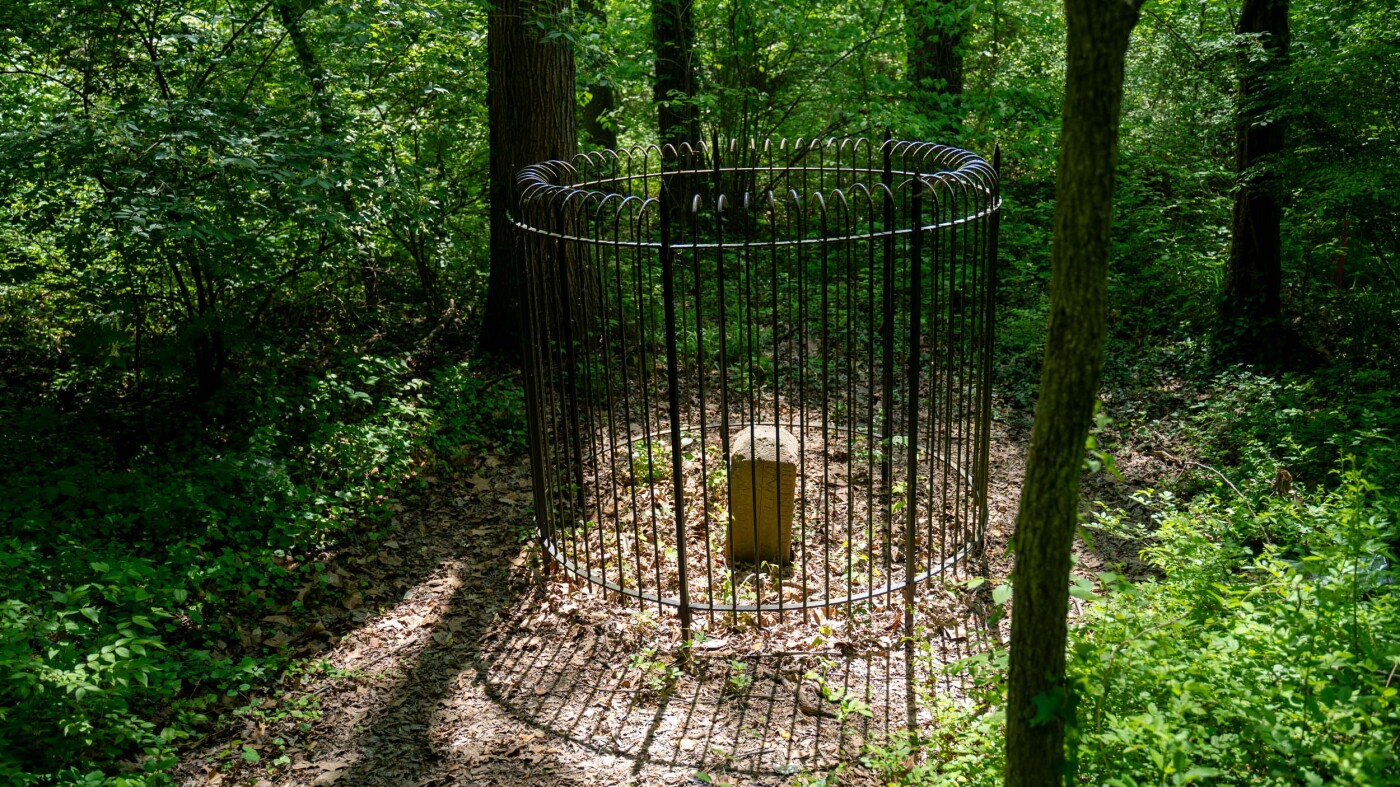
D.C.’s east cornerstone, located at the city’s easternmost point, is hidden in a small patch of woods in a residential neighborhood.
Jacob Fenston/For NPR
hide caption
toggle caption
Jacob Fenston/For NPR
If you’ve been to Washington, D.C., chances are you paid a visit to some of the city’s many monuments.
You probably didn’t see D.C.’s oldest monuments — even though they are thought to be the first federal monuments anywhere in the country, dating back to the 1790s. But they aren’t on any tourist map, and many are at risk of being destroyed.
The monuments in question are D.C.’s boundary stones. Placed by surveyors more than 200 years ago, they delineated the borders of what would become the young nation’s new capital city. Today, 36 of the original 40 sandstone markers remain, but they’re far outside the downtown areas most visitors see.
One face of each stone is carved with the year it was set in the ground, either 1791 or 1792.
Jacob Fenston for NPR
hide caption
toggle caption
Jacob Fenston for NPR
I recently toured all of D.C.’s boundary stones in one day. It took more than 9 hours, crammed in the back of a minivan traversing the wilds of Washington, from the tony mansions along the Potomac River, to a mucky swamp behind the city’s car impound lot.
“It is a long day, and you’ve really got to be into it,” says Stephen Powers, who leads the small tour.
Powers may be the foremost expert on D.C.’s boundary stones and he’s largely responsible for a resurgence of interest in them in recent years. He’s been making these treks each year since 2005. He checks on each stone, and he brings along as many people as he can fit in his vehicle.
A capitol carved out of field and forest
The U.S. Constitution itself authorized the creation of the new nation’s capital — a 10-mile by 10-mile square — and President George Washington selected the exact location. Before any construction could start, surveyors set out through old-growth forests and farmland, manually measuring and marking the official borders. Every mile along the way, they set a boundary stone.
Now, more than 200 years later, many are unmarked and tough to get to. For example, one is hidden in a bit of overgrown woods wedged between the eight-lane I-295 freeway and the Potomac River.
I’m riding next to Sharon Pitts, a local who lives nearby in Alexandria, Va. She’s having fun on this unusual tour, but it’s a little outside her comfort zone. She says she doesn’t usually spend her Sundays wearing khaki cargo pants and muddy boots.
“Oh, no, no! Church,” she says, laughing. “I’m all dressed up and all that.”
Sharon Pitts on the hunt for the southeast #9 boundary stone, located in a small forest between the Potomac River and I-295.
Jacob Fenston for NPR
hide caption
toggle caption
Jacob Fenston for NPR
Powers pulls his minivan over on the shoulder of I-295 , then guides the group over the guardrail as cars whiz by.
A short way into the vine-draped trees, we clamber over a broken section of chain-link fence, and then bushwhack through brambles.
Then, we find it: a little, pyramid-shaped stone, about 2 feet tall. It’s pitted, and dotted with lichen, but you can clearly make out the carved numbers: 1792.
The stone is engraved with the word “Maryland” on one side, and “Jurisdiction of the United States” on the other.
“This is one of the earliest representations of the words ‘United States’ carved into stone,” Powers says.
He waves his arms to show where the border runs, dividing Maryland and the District of Columbia.
For Powers, the boundary stones are a hobby. By day he’s a civil engineer at Metro, D.C.’s public transit agency. In 2005, he got interested in the stones when his second-grade daughter did a school project on them. At the time, before ubiquitous smartphones and GPS-powered maps, he had to spend countless hours tracking down the people who knew how to find each stone. Now, he runs a website with an interactive map and directions to each stone.
Over the centuries, Washington’s boundary stones have been threatened by the elements, in particular water, erosion, and falling trees. A few may have been damaged or gone missing during the Civil War. But in more recent years, there’s been an even bigger threat: the automobile.
On the tour, we pull into a gas station parking lot, and dash across a major intersection. At the spot where a boundary stone should be, there is instead wreckage from a car crash — twisted pieces of metal and yellow caution tape fluttering in the breeze.
Powers was one of the first people on the scene after the crash happened a few days earlier. He found the boundary stone intact, but covered with smashed car parts, including the Maryland license plate from the vehicle involved — a detail that may help police track down the culprit.
District officials later retrieved the stone. They’re still figuring out how to reinstall it to prevent further damage.
Powers heard about the crash from Janet McFarland with the D.C. chapter of the Daughters of the American Revolution. The group has been helping look after the boundary stones for more than a century, and McFarland was on her way to a cleanup of one of the boundary stones when she spotted the one that had been hit and alerted Powers.
“Cars right now are our biggest enemy,” says McFarland.
The boundary stones used to be in the middle of nowhere. In the 1700s, Washington, D.C. was just an idea — an imagined street grid of grand avenues and squares to be built over what was then a rural landscape at the confluence of two rivers.
As Washington’s population grew, the stones were swallowed up by the city. Now, one is on the unnaturally verdant lawn of a self-storage business, one is next to a strip mall parking lot, one is in a cemetery. Many are along busy roads.
On the tour, we see at least three that have been hit by cars over the years.
A bit of history in a suburban yard
Many boundary stones are in people’s yards. Rosa García has one in front of her bungalow. Her house is in Mt. Rainier, Md., but the sidewalk and street are in D.C.
When I call out to her, she’s not surprised to have a stranger at her front gate.
“Plenty of people come by,” she tells me in Spanish. They stop, takes pictures.
She doesn’t mind all the attention to the unusual lawn ornament. “Pues, es historia,” she says. It’s history.
Over the years there have been surges of interest in the boundary stones. They were almost completely forgotten for the first century of their existence, before being surveyed again in 1894.
Powers says there have been many people before him who’ve been fascinated by, even obsessed with, the boundary stones.
“I like to call them stoners,” Powers says. “I walk in their footprints.”
There have been efforts to elevate the status of the stones, and better preserve them. In the 1980s there was an unsuccessful push to turn all of them into National Historic Landmarks, a move that would open the door to federal funding.
There has been some government investment: in 2015, D.C. led a project to restore the stones, digging up, repairing, and resetting them. For the four stones that were missing, concrete replicas were made.
A few of the stones have informational signs, but most don’t. Powers says that’s not necessarily a bad thing.
“I have mixed emotions about that. There are some that I really feel should be more accessible,” he says.
Others, he says, are probably better off hidden — protected by their obscurity, and more fun to visit.
We finally come to the end of the tour, at the western corner stone. We’ve gone 57.8 miles, circumnavigating the city and getting a 360-degree view of life in modern-day Washington. We drove through neighborhoods that are home to Supreme Court justices and cabinet secretaries; we stopped for coffee in a vibrant community of Ethiopian immigrants; we wolfed down a packed lunch behind a dusty concrete plant.
“You get the diversity of it all,” Powers says.
As the minivan pulls to a stop, Sharon Pitts records the time — it’s 9 hours, 33 minutes after we started.
“This has been such a wonderful day,” Pitts says.

News
Louisiana Sen. Bill Cassidy loses in Republican primary, does not advance to runoff
One observer of the current Senate race in Louisiana noted that Sen. Bill Cassidy could lose his reelection bid.
Annie Flanagan for NPR
hide caption
toggle caption
Annie Flanagan for NPR
Sen. Bill Cassidy lost Saturday’s Louisiana Republican primary according to a race call by the Associated Press.
Cassidy, who served two terms in the Senate, was one of seven Republican senators who voted to convict President Trump after the January 6th insurrection at the Capitol. That vote put him at odds with Trump and his MAGA coalition, ultimately leading Trump to push Rep. Julia Letlow to run against Cassidy.
Cassidy’s bid for a third term was viewed as a test of Trump’s grip on the party–and of what voters want from their representatives in Washington. The primary pitted Cassidy, a veteran lawmaker, former physician and chair of the powerful Senate health committee, against Letlow, a political newcomer and a millennial MAGA loyalist.
A detailed view of a hat that reads, Run Julia Run, is seen at a campaign event for Rep. Julia Letlow (R-LA) on May 6, 2026 in Franklinton, Louisiana.
Tyler Kaufman/Getty Images
hide caption
toggle caption
Tyler Kaufman/Getty Images
A former college administrator, Letlow won a special election in 2021 for the House seat her late husband, Luke, was set to assume before he died from COVID in 2020.
In Congress, Letlow sponsored a bill to collect oral histories from the pandemic and has focused on education and children. She introduced the “Parents Bill of Rights Act,” which would allow parents to review classroom materials like library books and require schools to notify parents if their child requests different pronouns, locker rooms or sports teams.
She also serves on the powerful appropriations committee and has embraced Trump’s agenda.
Letlow, who came first in Saturday’s primary, will face Louisiana state Treasurer John Fleming in the runoff on June 27. Cassidy came in third.
The election result is a victory for President Trump who has put Republican loyalty to the test on the ballot so far this year in Indiana state senate primaries and in Cassidy’s race.
Another major test of Trump’s influence comes in Kentucky’s primary on Tuesday when Republican Rep. Thomas Massie, who has found himself at odds with the president, faces a challenger endorsed by Trump.
News
Brass bands in Beijing make way for sticker shock at home as Trump returns to escalating inflation
WASHINGTON (AP) — President Donald Trump returned from the spectacle of a Chinese state visit to a less than welcoming U.S. economy — with the military band and garden tour in Beijing giving way to pressure over how to fix America’s escalating inflation rate.
Consumer inflation in the United States increased to 3.8% annually in April, higher than what he inherited as the Iran war and the Republican president’s own tariffs have pushed up prices. Inflation is now outpacing wage gains and effectively making workers poorer. The Cleveland Federal Reserve estimates that annual inflation could reach 4.2% in May as the war has kept oil and gasoline prices high.
Trump’s time with Chinese leader Xi Jinping appears unlikely to help the U.S. economy much, despite Trump’s claims of coming trade deals. The trip occurred as many people are voting in primaries leading into the November general election while having to absorb the rising costs of gasoline, groceries, utility bills, jewelry, women’s clothing, airplane tickets and delivery services. Democrats see the moment as a political opportunity.
“He’s returning to a dumpster fire,” said Lindsay Owens, executive director of Groundwork Collaborative, a liberal think tank focused on economic issues. “The president will not have the faith and confidence of the American people — the economy is their top issue and the president is saying, ‘You’re on your own.’”
The president’s trip to Beijing and his recent comments that indicated a tone-deafness to voters’ concerns about rising prices have suggested his focus is not on the American public and have undermined Republicans who had intended to campaign on last year’s tax cuts as helping families.
Trump described the trip as a victory, saying on social media that Xi “congratulated me on so many tremendous successes,” as the U.S. president has praised their relationship.
Trump told reporters that Boeing would be selling 200 aircraft — and maybe even 750 “if they do a good job” — to the Chinese. He said American farmers would be “very happy” because China would be “buying billions of dollars of soybeans.”
“We had an amazing time,” Trump said as he flew home on Air Force One, and told Fox News’ Bret Baier in an interview that gasoline prices were just some “short-term pain” and would “drop like a rock” once the war ends.
Inflationary pain is not a factor in how Trump handles Iran
Trump departed from the White House for China by saying the negotiations over the Iran war depended on stopping Tehran from developing nuclear weapons. “I don’t think about Americans’ financial situation. I don’t think about anybody. I think about one thing: We cannot let Iran have a nuclear weapon,” Trump said.
That remark prompted blowback because it suggested to some that Trump cared more about challenging Iran than fighting inflation at home. Trump defended his words, telling Fox News: “That’s a perfect statement. I’d make it again.”
The White House has since stressed that Trump is focused on inflation.
Asked later about the president’s words, Vice President JD Vance said there had been a “misrepresentation” of the remarks. White House spokesman Kush Desai said the “administration remains laser-focused on delivering growth and affordability on the homefront” while indicating actions would be taken on grocery prices.
But as Trump appeared alongside Xi, new reports back home showed inflation rising for businesses and interest rates climbing on U.S. government debt.
His comments that Boeing would sell 200 jets to China caused the company’s stock price to fall because investors had expected a larger number. There was little concrete information offered about any trade agreements reached during the summit, including Chinese purchases of U.S. exports such as liquefied natural gas and beef.
“Foreign policy wins can matter politically, but only if voters feel stability and affordability in their daily lives,” said Brittany Martinez, a former Republican congressional aide who is the executive director of Principles First, a center-right advocacy group focused on democracy issues.
“Midterms are almost always a referendum on cost of living and public frustration, and Republicans are not immune from the same inflation and affordability pressures that hurt Democrats in recent cycles,” she added.
Democrats see Trump as vulnerable
Democratic lawmakers are seizing on Trump’s comments before his trip as proof of his indifference to lowering costs. There is potential staying power of his remarks as Americans head into Memorial Day weekend facing rising prices for the hamburgers and hot dogs to be grilled.
“What Americans do not see is any sympathy, any support, or any plan from Trump and congressional Republicans to lower costs – in fact, they see the opposite,” Senate Democratic leader Chuck Schumer of New York said Thursday.
Vance faulted the Biden administration for the inflation problem even though the inflation rate is now higher than it was when Trump returned to the White House in January 2025 with a specific mandate to fix it.
“The inflation number last month was not great,” Vance said Wednesday, but he then stressed, “We’re not seeing anything like what we saw under the Biden administration.”
Inflation peaked at 9.1% in June 2022 under Biden, a Democrat. By the time Trump took the oath of office, it was a far more modest 3%.
Trump’s inflation challenge could get harder
The data tells a different story as higher inflation is spreading into the cost of servicing the national debt.
Over the past week, the interest rate charged on 10-year U.S. government debt jumped from 4.36% to 4.6%, an increase that implies higher costs for auto loans and mortgages.
“My fear is that the layers of supply shocks that are affecting the U.S. economy will only further feed into inflationary pressures,” said Gregory Daco, chief economist at EY-Parthenon.
Daco noted that last year’s tariff increases were now translating into higher clothing prices. With the Supreme Court ruling against Trump’s ability to impose tariffs by declaring an economic emergency, his administration is preparing a new set of import taxes for this summer.
Daco stressed that there have been a series of supply shocks. First, tariffs cut into the supply of imports. In addition, Trump’s immigration crackdown cut into the supply of foreign-born workers. Now, the effective closure of the Strait of Hormuz has cut off the vital waterway used to ship 20% of global oil supplies.
“We’re seeing an erosion of growth,” Daco said.
News
Top Drug Regulator Is Fired From the F.D.A.
Dr. Tracy Beth Hoeg, the Food and Drug Administration’s top drug regulator, said she was fired from the agency Friday after she declined to resign.
She said she did not know who had ordered her firing or why, nor whether Health Secretary Robert F. Kennedy Jr. knew of her fate. The Department of Health and Human Services did not immediately respond to a request for comment.
The departure reflected the upheaval at the F.D.A., days after the resignation of Dr. Marty Makary, the agency commissioner. Dr. Makary had become a lightning rod for critics of the agency’s decisions to reject applications for rare disease drugs and to delay a report meant to supply damaging evidence about the abortion drug mifepristone. He also spent months before his departure pushing back on the White House’s requests for him to approve more flavored vapes, the reason he ultimately cited for leaving.
Dr. Hoeg’s hiring had startled public health leaders who were familiar with her track record as a vaccine skeptic, and she played a leading role in some of the agency’s most divisive efforts during her tenure. She worked on a report that purportedly linked the deaths of children and young adults to Covid vaccines, a dossier the agency has not released publicly. She was also the co-author of a document describing Mr. Kennedy’s decision to pare the recommendations for 17 childhood vaccines down to 11.
But in an interview on Friday, Dr. Hoeg said she “stuck with the science.”
“I am incredibly proud of the work we were doing,” Dr. Hoeg said, adding, “I’m glad that we didn’t give in to any pressures to approve drugs when it wasn’t appropriate.”
As the director of the agency’s Center for Drug Evaluation and Research, she was a political appointee in a role that had been previously occupied by career officials. An epidemiologist who was trained in the United States and Denmark, she worked on efforts to analyze drug safety and on a panel to discuss the use of serotonin reuptake inhibitors, the most widely prescribed class of antidepressants, during pregnancy. She also worked on efforts to reduce animal testing and was the agency’s liaison to an influential vaccine committee.
She made sure that her teams approved drugs only when the risk-benefit balance was favorable, she said.
The firing worsens the leadership vacuum at the F.D.A. and other agencies, with temporary leaders filling the role of commissioner, food chief and the head of the biologics center, which oversees vaccines and gene therapies. The roles of surgeon general and director of the Centers for Disease Control and Prevention are also unfilled.
-
Arkansas50 seconds agoSuburban sprawl has reached a dead end in Northwest Arkansas, planners say | Arkansas Democrat Gazette
-
California7 minutes ago3 people killed, several others injured after driver crashes into crowd in Oakland, California
-
Colorado13 minutes agoThese Colorado school districts want their students back. So they’re adding online classes
-
Connecticut19 minutes agoAt least 50 people charged with animal cruelty in ‘significant’ police operation in Tolland Saturday
-
Delaware25 minutes agoMassive fire destroys historic church in Wilmington, Delaware
-
Florida31 minutes ago
A Newly Built Oceanfront Compound in the Florida Keys With Its Own Sandy Beach Lists for $40 Million
-
Georgia37 minutes agoHonolulu Police Chief Candidate Under Investigation In Georgia
-
Hawaii43 minutes agoOdds of El Nino forming this summer increase – West Hawaii Today