Politics
Mayoral hopeful Spencer Pratt heads to the Valley, wooing voters in his rival’s district


Lake Balboa resident Jose Meraz is looking for a mayor who will turn L.A. around, cleaning up streets that he says are “filled with garbage.”
Schoolteacher Tracey Schroeder, a Republican candidate for state Assembly, is unhappy about crime, open-air drug use and the slow rebuilding effort in the wake of the Palisades fire, which destroyed thousands of homes.
Greg Whitley, a resident of Reseda, said he’s frustrated with homelessness and the influx of what he called “criminal illegal aliens.”
“I live with the Spanish community. Great people,” he said. “But these illegals that come here for criminal reasons, they’re making them look bad, and they don’t like it.”
All three showed up outside a five-bedroom home in Sherman Oaks on Saturday, looking to speak with reality TV personality Spencer Pratt, now waging an insurgent campaign for Los Angeles mayor in the June 2 election.
Mayoral candidate Spencer Pratt, left, poses with a supporter during a community meet-and-greet event Saturday at a home on Longridge Avenue in a residential neighborhood of Sherman Oaks.
(Etienne Laurent/For The Times)
Standing in the entry to the home’s two-car garage, the onetime star of “The Hills” spent more than two hours shaking hands, giving hugs and posing for photos with his admirers, who waited in line under punishing San Fernando Valley sunshine.
Pratt used social media to invite the public to the campaign event, which took place in the district represented by one of his mayoral opponents, City Councilmember Nithya Raman.
He did not deliver any speeches outside the property, which is listed for rent on Zillow for $15,950 per month. He and a member of his security personnel said he was not taking interviews.
Pratt has been running in voter surveys behind Mayor Karen Bass, who is running for reelection, sometimes swapping places with Raman for second and third. He turned in a strong debate performance this month and has been outpacing his rivals in fundraising, according to the most recent disclosure reports.
While running for office, Pratt has blamed Bass for the 2025 wildfire that destroyed much of Pacific Palisades, including his home. He has railed against the city’s handling of homelessness, saying he would pursue a “treatment first” approach toward people with drug addiction who are living on the street.
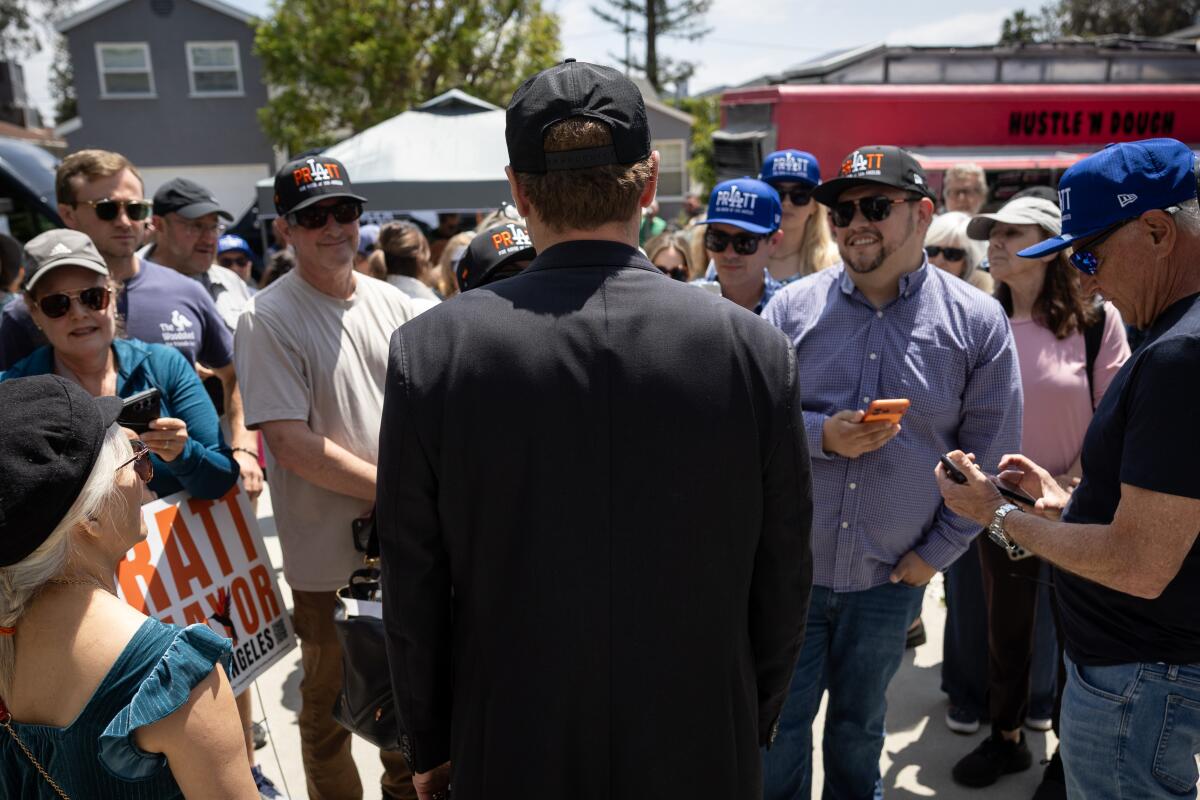
Mayoral candidate Spencer Pratt, back to the camera, speaks with supporters Saturday during a community meet-and-greet event.
(Etienne Laurent/For The Times)
Pratt said recently that he wants to increase Los Angeles Police Department staffing to 12,500 officers over the next decade, up from about 8,600. Speaking with one supporter on Saturday, he said the city needs to “make sure all the laws are being enforced.”
“Plenty of functioning cities enforce their laws,” he said.
That message resonated with many of the people in line.
“He is advocating for the safety and security of our families — specifically, for mothers to be able to walk their kids to school,” said Saba Lahar, a resident of Sherman Oaks, moments after talking to the candidate.
Pratt fans dropped off ballots, picked up lawn signs and stopped to pick up coffee drinks from the Hustle N Dough doughnut truck parked out front.
Some showed up even though they cannot cast ballots in L.A.
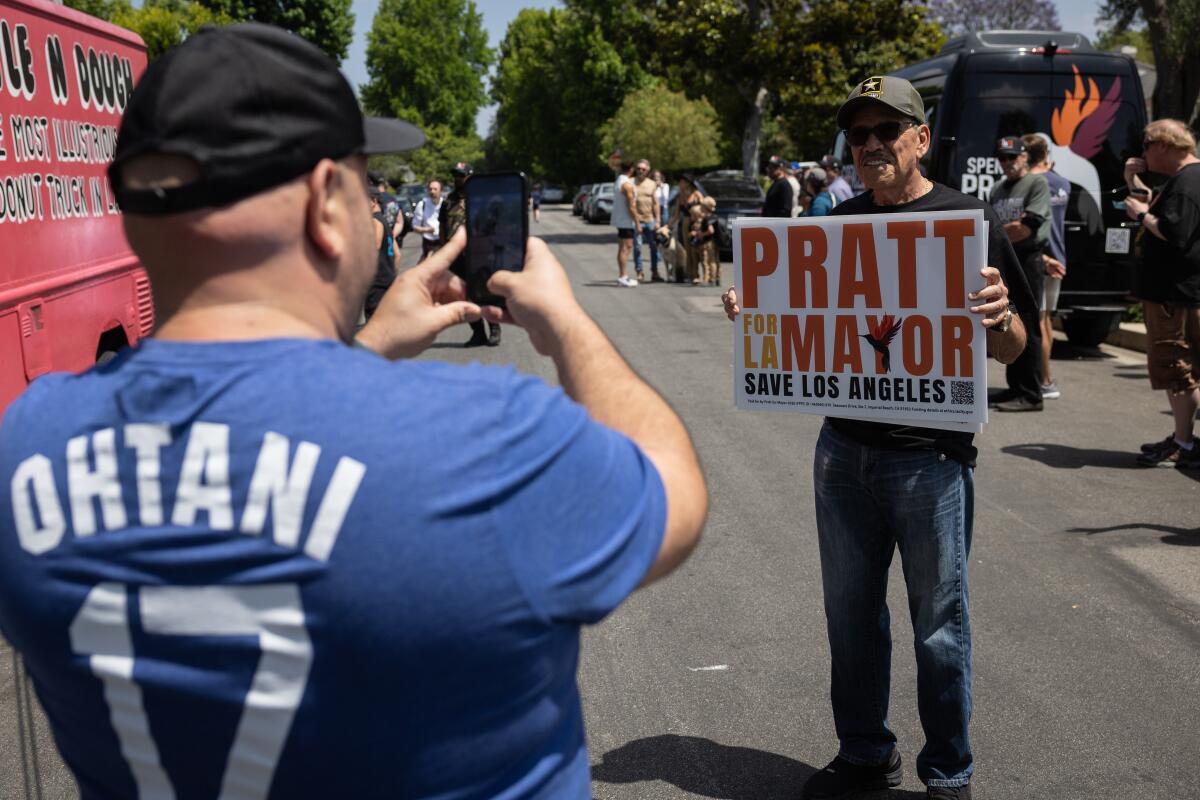
Ruben Jr., no last name given takes a picture of his father during mayoral candidate Spencer Pratt’s community meet-and-greet Saturday in Sherman Oaks.
(Etienne Laurent/For The Times)
Brian Rodda, who runs a walking food tour company, described himself as “an unsatisfied Angeleno” even though he lives in West Hollywood, which is not part of the city of L.A.
“Sadly, because I do live in West Hollywood, I cannot vote for him,” he said. “But I certainly think we need a change.”

Politics
Fetterman unleashes on ‘dirtbag’ wing of Dems after far-left victories: ‘Orgy of socialism’

NEWYou can now listen to Fox News articles!
Sen. John Fetterman, D-Pa., unloaded on his own party on Sunday evening, blasting a series of victories for progressives he called “anti-America.”
“Big night for the dirtbag left,” Fetterman said, referring to New York’s recent primaries, where two members of the Democratic Socialists of America (DSA) won primaries.
“I’ve said the party is becoming an orgy of socialism. Clearly anti-America, anti-Western Civilization,” Fetterman said.
Fetterman’s striking calls give a rare look at how some moderates may view the developments on their far-left flank that have dominated the party’s momentum in recent months, sparking concern that their high visibility is dragging the party further and further left.
FETTERMAN WARNS DEMOCRATS ‘DRIFTING FIRMLY INTO COMMUNISM’ AFTER SOCIALIST PRIMARY WINS
Sen. John Fetterman, D-Pa., speaks to reporters outside the Senate Chamber during votes on Nov. 10, 2025, on Capitol Hill in Washington, D.C. (Andrew Harnik/Getty Images)
His comments come on the heels of a handful of key progressive victories.
In Maine, Graham Platner, a controversial Democratic candidate for U.S. Senate, has attracted controversy for denying knowledge of the meaning behind a Nazi-linked tattoo, for off-color comments about race and calling himself a “communist” in a deleted Reddit post.
In New York, one DSA member, Claire Valdez, won a primary on a platform of abolishing ICE and a Green New Deal-style approach to climate change. Similarly, Darializa Avila-Chevalier, another DSA candidate, beat out incumbent Rep. Adriano Espillat, D-N.Y., a high-ranking Democrat and the chair of the Congressional Hispanic Caucus.
WINNERS AND LOSERS EMERGE AFTER SOCIALIST EARTHQUAKE ROCKS NYC PRIMARIES
Graham Platner, Democratic Senate candidate for Maine, speaks at a primary election night event at the Blue Hill YMCA in Blue Hill, Maine, on June 9, 2026. Platner won the party’s Senate primary after a campaign marked by accusations of past misbehavior and voter concerns. (Graeme Sloan/Bloomberg via Getty Images)
Both Chevalier and Valdez had the backing of New York Mayor Zohran Mamdani, himself a socialist.
The wins have captured national attention and drawn criticisms from Republicans who have pointed to their success as emblematic of the direction of the Democratic Party.
Fetterman, who has not shied away from confrontations, has been one of the few Democrats to express alarm about the kind of candidates carrying the party’s banner.
“I mean, you look at some of the things that people have said. Abolish prison, abolish the border, abolish ICE, I mean these crazy people — I have colleagues in my caucus that refuse to even call this out,” Fetterman said.
FETTERMAN REACTS TO MAMDANI’S REFUSAL TO ACCEPT SUPREME COURT’S IMMIGRATION RULING
U.S. Sen. John Fetterman, D-Pa., walks through the Senate Subway during the Senate War Powers vote on April 22, 2026, in Washington, D.C. (Heather Diehl/Getty Images)
CLICK HERE TO DOWNLOAD THE FOX NEWS APP
“Between P-hustle in Maine and some of the other winners in New York, they should form their own party and run on all the things that they’ve had to delete on social media,” Fetterman said, referring to Platner.
“That’s where our party has moved,” he added.
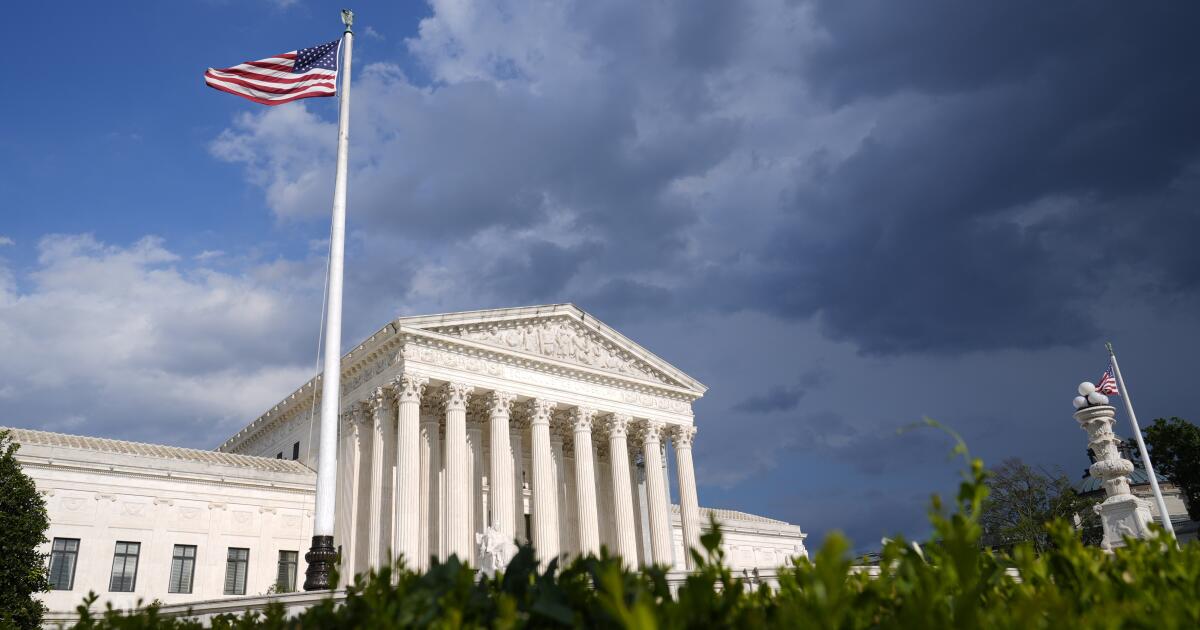
WASHINGTON — The Supreme Court cast doubt Monday on whether police may obtain cellphone data to find crime suspects.
In a 6-3 decision, the justices said this location information showing where a cellphone user has traveled is personal and private and subject to the protection of the 4th Amendment’s ban on unreasonable searches.
Justice Elena Kagan said these “records serve as a personal journal of a user’s movements.”
She said the information “resembles other private materials — think of emails, documents, photographs, or calendars—that even if stored on Google’s servers, a user reasonably views as his own…and reasonably expects to be shielded from the inquisitive eyes of the government.”
Because an “individual has a legitimate expectation of privacy in his cellphone location data,” she said police investigators need a valid search warrant from a magistrate.
The court stopped short of deciding the proper basis for a search warrant in such cases. Instead, the justices sent the case back to judges in Virginia.
But the outcome casts doubt on “geofence warrants.”
In recent years, police have gone to Google and cellphone companies seeking tracking data on cellphones that were at a crime scene. Sometimes, they have had a warrant from a magistrate.
Civil libertarians say the use of this tracking data raises the specter of mass surveillance on innocent people.
Police and government lawyers say no one has a reasonable right to privacy when they are walking on a sidewalk or driving down the street.
The case before the court arose from the armed robbery conviction of a Virginia man who stole $195,000 from a credit union in a small town near Richmond.
By the time police arrived, the robber had fled. But surveillance cameras showed he was carrying a gun and a cellphone.
Lacking other leads, detective Joshua Hilton asked a judge to issue a special type of warrant seeking information from Google.
Referred to as a “geofence warrant,” it seeks data from phones in a particular area at a particular time.
The detective sought data on phones that were within 150 yards of the credit union within one hour of the late afternoon robbery.
After examining and paring down the data, the detective asked for the phone records of Okello Chatrie. Then, with a search warrant of his home, investigators found two robbery-style demand notes, a semi-automatic pistol and about $100,000 in cash.
A judge refused to suppress the evidence from an allegedly unconstitutional search, and Chatrie entered a conditional guilty plea.
The full 4th Circuit Court of Appeals split evenly on the legality of the geofence warrant, and the Supreme Court agreed to decide the issue in Chatrie vs. U.S.
Usually investigators obtain warrants to search the home or vehicle of a known crime suspect.
The new and disputed geofence warrants seek to find a suspect by examining data on the cellphones that were at the scene of a crime.
The FBI used this cellphone data in 2021 to identify suspects who broke through police barricades on Jan. 6, 2021, and pushed their way into the Capitol to disrupt the official counting of electoral votes.
Chief Justice John G. Roberts Jr. and Justices Sonia Sotomayor, Neil M. Gorsuch, Brett M. Kavanaugh and Ketanji Brown Jackson agreed on the outcome in Chatrie vs. U.S.
In a 21-page dissent, Justice Samuel A. Alito Jr. said the court had “carefully set the stage for its planned performance: striking a pose as a great champion of privacy in the digital age. I cannot support this irresponsible escapade.”
Justice Clarence Thomas agreed.
Justice Amy Coney Barrett agreed in a one-paragraph dissent. “Chatrie had no reasonable expectation of privacy in data about his public movements that he voluntarily disclosed to Google,” she said.
The Supreme Court ruled 6-3 that President Trump could fire independent regulators for any reason. But the justices carved out an exception for the Federal Reserve, preventing the immediate removal of Lisa D. Cook, a Federal Reserve governor.
-

 Texas5 seconds ago
Hot, muggy and breezy conditions continue for North Texas ahead of Fourth of July
-
 Utah5 minutes ago
‘She gave of herself constantly’: Loved ones remember woman killed in Utah-Colorado wildfire
-

 Vermont12 minutes ago
Catch these concerts in Vermont outdoors in July
-

 Virginia15 minutes ago
Virginia has a new two-year budget. Here’s what lawmakers now require of data centers.
-

 Washington20 minutes ago
America 250 could bring major tourism boost to Washington, DC
-
 West Virginia25 minutes ago
Across West Virginia, public schools are closing. Communities are feeling the loss.
-

 Wisconsin27 minutes ago
What did prized Wisconsin commit Baboucarr Ann average in 2025-26?
-

 Wyoming35 minutes ago
‘Not just coloring tipis,’ experts debate quality of Indian education in Wyoming schools – WyoFile

