Politics
The Steyer campaign pays influencers. Their posts don’t always make that clear


WASHINGTON — In recent weeks, several social media influencers have popped up in online feeds touting the California gubernatorial campaign of billionaire Democrat Tom Steyer.
Some complain about the price of gasoline. Others mention environmental concerns. One cites her newfound sobriety as evidence that people can change — a nod to Steyer’s self-proclaimed metamorphosis from hedge fund titan to scourge of big corporations.
“I did not expect the most progressive governor candidate to be a billionaire, but look at the policies you guys,” said one content creator on TikTok with the user name Jaz R. “Hear me out. I know Tom Steyer is a billionaire, but he also is for the people.”
The posts include direct-to-the-camera appeals, with personal details interwoven into messages of support for Steyer. An influencer goes for a stroll as onscreen text touts Steyer’s policies. Some seek to convey authenticity, if occasionally ham-fistedly; one influencer mispronounces Steyer’s last name.
What they do not include is a disclosure that their creators were paid by the Steyer campaign to produce the videos, according to a complaint filed this week with California’s Fair Political Practices Commission and a Times review of the posts.
The complaint alleges that the Steyer campaign failed to notify the influencers it hired of their obligation to inform their audience when their posts have been sponsored by the campaign.
California passed a law in 2023 requiring that influencers disclose if they have been paid to create promotional content for or against a candidate or ballot measure, one of the few jurisdictions in the country with such a requirement. There is no such requirement at the federal level.
“Every time there’s a new technology, you have to create legislation that requires them to disclose,” said state Sen. Tom Umberg (D-Orange), who sponsored the bill.
Violating the law doesn’t carry criminal, civil or administrative penalties, but the FPPC can take influencers who break the law to court and ask a judge to force them to comply.
The complaint was filed by two California women — political influencers themselves — who said they noticed a number of new accounts that suddenly started posting similar-sounding videos promoting Steyer earlier this month.
“They had the exact same language, they had the same talking points,” said Beatrice Gomberg, who worked with Kaitlyn Hennessy in their digital sleuthing efforts.
The FPPC did not comment on the complaint.
Steyer’s campaign appears to have relied on paid influencers more than any candidate for governor, according to the most recent campaign finance filings.
That spending represents only a small fraction of the massive campaign war chest Steyer has seeded with nearly $180 million of his own money. But the complaint highlights the growing degree to which political candidates have come to seek out the authenticity that social media influencers seem to offer.
Steyer campaign spokesperson Kevin Liao said the campaign had properly followed the rules in hiring influencers and that the campaign is “confident” that Gomberg and Hennessy’s complaint is “baseless.”
“Creators make their living generating content. The campaign believes in compensating people for their time and work product and has paid creators to generate content,” Liao said in a statement. “Payments for creator content are disclosed in campaign finance reports, and we notify creators we directly work with of their disclosure requirements.”
While many of the new Steyer influencers have few followers, Steyer’s campaign disclosed in its most recent campaign finance report that it had paid thousands of dollars to numerous social media influencers with massive audiences, the Sacramento Bee reported.
Several of the videos produced by these popular social media personalities also failed to disclose that they had been paid by the campaign, according to the complaint and The Times’ review of the content.
But even accounts with few followers can still have a big impact if they are producing a steady stream of content supporting Steyer, said veteran California political strategist Mike Madrid.
“What they’re trying to do is trip the algorithm,” he said. “It looks like it has a bigger audience than it really does. It’s taking the concept of astroturfing into the digital age.”
Gomberg and Hennessy said they became friends after meeting at an April campaign event for Xavier Becerra, Steyer’s chief Democratic rival in the race, who holds a narrow advantage over Steyer in several recent political polls.
The pair have been prolific social media supporters of Becerra’s campaign ever since, though they insist they are not being paid for their efforts.
They said they discovered that many of the new pro-Steyer accounts seemed to be run by influencers — mostly women — who had previously created different social media accounts to hawk other products.
One of the pro-Steyer influencers had an online portfolio listing numerous clients, including the Steyer campaign and a gummy designed to boost arousal, according to the complaint and the Times review of the publicly accessible website.
The pair said they stumbled on an advertisement placed by a vendor for the campaign on a platform used by creators to find work. The advertisement indicated that creators would be paid $10 for each post, with bonuses for posts that amassed large viewership.
The vendor who posted the ad did not respond to a request for comment.
The advertisement has since been updated to say that it pays $1,000 per month and that creators will have to disclose that it is paid content.
As Gomberg and Hennessy dug deeper, they determined that some of the influencers promoting a candidate for governor weren’t even based in California.
A TikTok account using the handle jess.votes, for example, appears to be connected to a woman registered to vote in Florida. Other accounts were connected to women who indicated elsewhere that they were based in Pennsylvania, Missouri and Michigan.
Several influencers who created seemingly paid content promoting Steyer did not respond to multiple requests for comment from The Times.
The brouhaha over paid social media content is just the latest instance of the growing political impact of online creators.
Eric Swalwell’s campaign for governor — and congressional career — came to an end after multiple women accused him of sexual assault. A pair of influencers had publicly raised concerns about Swalwell’s behavior and helped connect victims with journalists who produced highly detailed reports of the allegations.
The California law requires influencers to disclose in a political post’s audio or text that it was sponsored and who paid for it.
The onus is on the creators to make the disclosure, but campaigns are required to tell them that they must do so. Despite passage of the law, the issue has so far remained largely under the radar.
“I have dozens of candidates and campaigns and I have not heard this issue come up one time,” said a campaign finance lawyer who requested anonymity because they represent numerous candidates with active campaigns.
Gomberg and Hennessy said that they were driven to call attention to potential violations of the disclosure requirements because of their concern about the corrosive influence such paid content could have if left unchecked.
“You have people who have trust in these creators,” Hennessy said. “You have a responsibility to your audience.”

Politics
Fetterman unleashes on ‘dirtbag’ wing of Dems after far-left victories: ‘Orgy of socialism’

NEWYou can now listen to Fox News articles!
Sen. John Fetterman, D-Pa., unloaded on his own party on Sunday evening, blasting a series of victories for progressives he called “anti-America.”
“Big night for the dirtbag left,” Fetterman said, referring to New York’s recent primaries, where two members of the Democratic Socialists of America (DSA) won primaries.
“I’ve said the party is becoming an orgy of socialism. Clearly anti-America, anti-Western Civilization,” Fetterman said.
Fetterman’s striking calls give a rare look at how some moderates may view the developments on their far-left flank that have dominated the party’s momentum in recent months, sparking concern that their high visibility is dragging the party further and further left.
FETTERMAN WARNS DEMOCRATS ‘DRIFTING FIRMLY INTO COMMUNISM’ AFTER SOCIALIST PRIMARY WINS
Sen. John Fetterman, D-Pa., speaks to reporters outside the Senate Chamber during votes on Nov. 10, 2025, on Capitol Hill in Washington, D.C. (Andrew Harnik/Getty Images)
His comments come on the heels of a handful of key progressive victories.
In Maine, Graham Platner, a controversial Democratic candidate for U.S. Senate, has attracted controversy for denying knowledge of the meaning behind a Nazi-linked tattoo, for off-color comments about race and calling himself a “communist” in a deleted Reddit post.
In New York, one DSA member, Claire Valdez, won a primary on a platform of abolishing ICE and a Green New Deal-style approach to climate change. Similarly, Darializa Avila-Chevalier, another DSA candidate, beat out incumbent Rep. Adriano Espillat, D-N.Y., a high-ranking Democrat and the chair of the Congressional Hispanic Caucus.
WINNERS AND LOSERS EMERGE AFTER SOCIALIST EARTHQUAKE ROCKS NYC PRIMARIES
Graham Platner, Democratic Senate candidate for Maine, speaks at a primary election night event at the Blue Hill YMCA in Blue Hill, Maine, on June 9, 2026. Platner won the party’s Senate primary after a campaign marked by accusations of past misbehavior and voter concerns. (Graeme Sloan/Bloomberg via Getty Images)
Both Chevalier and Valdez had the backing of New York Mayor Zohran Mamdani, himself a socialist.
The wins have captured national attention and drawn criticisms from Republicans who have pointed to their success as emblematic of the direction of the Democratic Party.
Fetterman, who has not shied away from confrontations, has been one of the few Democrats to express alarm about the kind of candidates carrying the party’s banner.
“I mean, you look at some of the things that people have said. Abolish prison, abolish the border, abolish ICE, I mean these crazy people — I have colleagues in my caucus that refuse to even call this out,” Fetterman said.
FETTERMAN REACTS TO MAMDANI’S REFUSAL TO ACCEPT SUPREME COURT’S IMMIGRATION RULING
U.S. Sen. John Fetterman, D-Pa., walks through the Senate Subway during the Senate War Powers vote on April 22, 2026, in Washington, D.C. (Heather Diehl/Getty Images)
CLICK HERE TO DOWNLOAD THE FOX NEWS APP
“Between P-hustle in Maine and some of the other winners in New York, they should form their own party and run on all the things that they’ve had to delete on social media,” Fetterman said, referring to Platner.
“That’s where our party has moved,” he added.
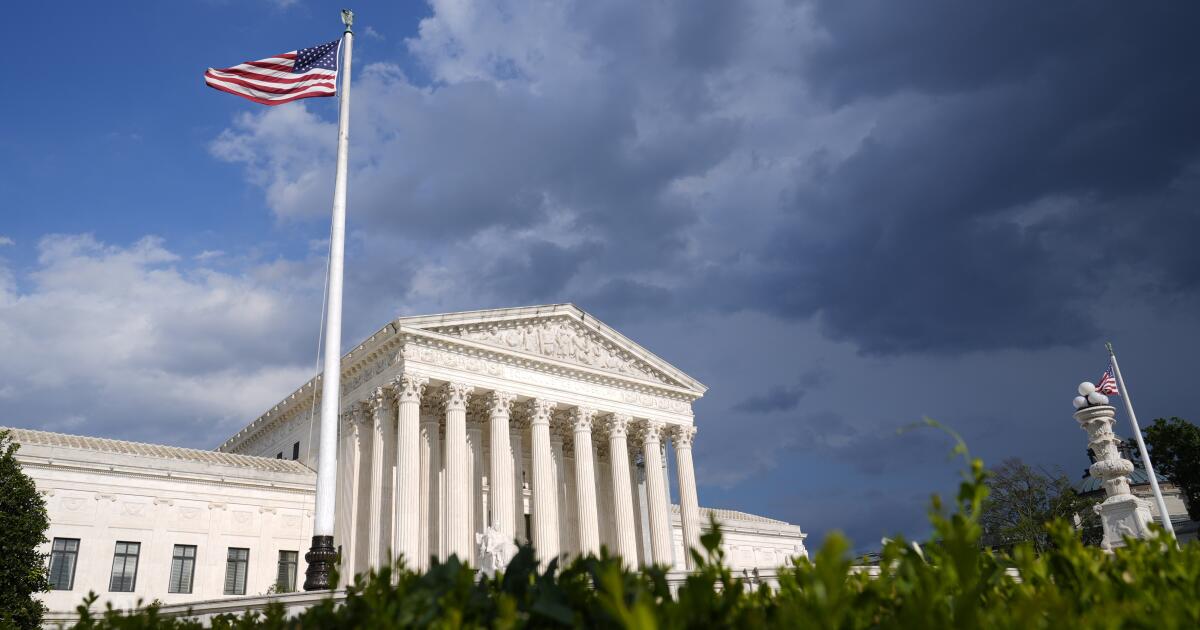
WASHINGTON — The Supreme Court cast doubt Monday on whether police may obtain cellphone data to find crime suspects.
In a 6-3 decision, the justices said this location information showing where a cellphone user has traveled is personal and private and subject to the protection of the 4th Amendment’s ban on unreasonable searches.
Justice Elena Kagan said these “records serve as a personal journal of a user’s movements.”
She said the information “resembles other private materials — think of emails, documents, photographs, or calendars—that even if stored on Google’s servers, a user reasonably views as his own…and reasonably expects to be shielded from the inquisitive eyes of the government.”
Because an “individual has a legitimate expectation of privacy in his cellphone location data,” she said police investigators need a valid search warrant from a magistrate.
The court stopped short of deciding the proper basis for a search warrant in such cases. Instead, the justices sent the case back to judges in Virginia.
But the outcome casts doubt on “geofence warrants.”
In recent years, police have gone to Google and cellphone companies seeking tracking data on cellphones that were at a crime scene. Sometimes, they have had a warrant from a magistrate.
Civil libertarians say the use of this tracking data raises the specter of mass surveillance on innocent people.
Police and government lawyers say no one has a reasonable right to privacy when they are walking on a sidewalk or driving down the street.
The case before the court arose from the armed robbery conviction of a Virginia man who stole $195,000 from a credit union in a small town near Richmond.
By the time police arrived, the robber had fled. But surveillance cameras showed he was carrying a gun and a cellphone.
Lacking other leads, detective Joshua Hilton asked a judge to issue a special type of warrant seeking information from Google.
Referred to as a “geofence warrant,” it seeks data from phones in a particular area at a particular time.
The detective sought data on phones that were within 150 yards of the credit union within one hour of the late afternoon robbery.
After examining and paring down the data, the detective asked for the phone records of Okello Chatrie. Then, with a search warrant of his home, investigators found two robbery-style demand notes, a semi-automatic pistol and about $100,000 in cash.
A judge refused to suppress the evidence from an allegedly unconstitutional search, and Chatrie entered a conditional guilty plea.
The full 4th Circuit Court of Appeals split evenly on the legality of the geofence warrant, and the Supreme Court agreed to decide the issue in Chatrie vs. U.S.
Usually investigators obtain warrants to search the home or vehicle of a known crime suspect.
The new and disputed geofence warrants seek to find a suspect by examining data on the cellphones that were at the scene of a crime.
The FBI used this cellphone data in 2021 to identify suspects who broke through police barricades on Jan. 6, 2021, and pushed their way into the Capitol to disrupt the official counting of electoral votes.
Chief Justice John G. Roberts Jr. and Justices Sonia Sotomayor, Neil M. Gorsuch, Brett M. Kavanaugh and Ketanji Brown Jackson agreed on the outcome in Chatrie vs. U.S.
In a 21-page dissent, Justice Samuel A. Alito Jr. said the court had “carefully set the stage for its planned performance: striking a pose as a great champion of privacy in the digital age. I cannot support this irresponsible escapade.”
Justice Clarence Thomas agreed.
Justice Amy Coney Barrett agreed in a one-paragraph dissent. “Chatrie had no reasonable expectation of privacy in data about his public movements that he voluntarily disclosed to Google,” she said.
The Supreme Court ruled 6-3 that President Trump could fire independent regulators for any reason. But the justices carved out an exception for the Federal Reserve, preventing the immediate removal of Lisa D. Cook, a Federal Reserve governor.
-

 Alaska44 seconds ago
As war stalls, Putin concedes he never cut a deal with Trump in Alaska
-

 Arizona7 minutes ago
Flags are at half-staff today in Arizona. Here’s who is being honored
-

 Arkansas11 minutes ago
What Is The Arkansas Razorbacks Toughest Stretch of the 2026 Season?
-

 California16 minutes ago
Southern California residents say HOA made them take down American flags
-

 Colorado23 minutes ago
Colorado’s Most Beautiful State Parks, Ranked By A Colorado Local
-

 Connecticut26 minutes ago
CT poised to invest again in childcare, pay down pension debt
-

 Delaware31 minutes ago
Delaware on Main Street Program Grows as 17 Communities Earn National Designations – State of Delaware News
-

 Florida38 minutes ago
Fast-growing South Florida wildfire consumes over 4,000 acres

