News
FAA audit faults Boeing for 'multiple instances' of quality control shortcomings


Boeing workers at the Renton Municipal Airport in Washington finalize assembly of an Alaska Airlines Boeing 737 Max jet on Feb. 27. An FAA audit faulted Boeing for “multiple instances” of quality control shortcomings.
Jovelle Tamayo for NPR
hide caption
toggle caption
Jovelle Tamayo for NPR

Boeing workers at the Renton Municipal Airport in Washington finalize assembly of an Alaska Airlines Boeing 737 Max jet on Feb. 27. An FAA audit faulted Boeing for “multiple instances” of quality control shortcomings.
Jovelle Tamayo for NPR
WASHINGTON — After a six-week audit of Boeing, federal regulators say they found quality control problems at Boeing and Spirit AeroSystems, one of its top suppliers.
The Federal Aviation Administration says it found “multiple instances” of Boeing and Spirit failing to “comply with manufacturing quality control requirements.”
The FAA launched the audit of Boeing and Spirit AeroSystems, which builds the fuselage for the Boeing 737 Max, after a door plug panel blew out in midair during an Alaska Airlines flight on Jan. 5.
No one was seriously hurt when the plug came off as the new jet climbed through 14,000 feet after departing Portland, Ore. It returned to make an emergency landing as winds whipped through a hole in the fuselage.
A preliminary investigation by the National Transportation Safety Board determined that four key bolts that were supposed to hold the door plug in place were missing when the plane left Boeing’s factory.
The audit found problems in “Boeing’s manufacturing process control, parts handling and storage, and product control,” the FAA said in a statement.
The agency says FAA administrator Mike Whitaker discussed the findings with Boeing CEO Dave Calhoun last week, when the agency gave Boeing 90 days to come up with a plan of action to address its quality control problems.
The FAA says it provided both companies with a summary of the audit findings. But the agency declined to share those details with NPR, citing its ongoing investigation.
Auditors visited Boeing’s factory in Renton, Wash., and Spirit’s plant in Wichita, Kan.
Boeing confirmed Friday that it is in talks to buy Spirit AeroSystems.
“We believe that the reintegration of Boeing and Spirit AeroSystems’ manufacturing operations would further strengthen aviation safety, improve quality and serve the interests of our customers, employees, and shareholders,” said Jessica Kowal, Boeing’s director of media relations, in a statement.
That would be a change of strategy for Boeing, which nearly two decades ago sold off the assets that are now part of Spirit.
But the supplier has had several costly and embarrassing problems with quality control in recent years as it pushed to keep up with Boeing’s ambitious production schedule.
NPR’s Joel Rose reported from Washington, D.C., and Russell Lewis from Birmingham, Ala.




The Labor Department says the vast majority of new jobs created over the last year went to women, most of them in health care.
melitas
hide caption
toggle caption
melitas
In December 2016, as Donald Trump was headed to the White House for the first time, Betsey Stevenson offered the incoming president some economic advice.
Stevenson, a professor of public policy and economics at the University of Michigan, argued in an op-ed that it would be a disservice to encourage men “to cling to work that isn’t coming back.” She cited Trump’s promise to bring an iPhone factory to the U.S.
“If Trump really wants to get more Americans working,” she wrote at the time, “he’ll have to do something out of his comfort zone: make girly jobs appeal to manly men.”

It’s a message she believes is even more relevant today.
For decades, the focus has been on getting more women into male-dominated fields. Some efforts have been more successful than others. But now, with the vast majority of new jobs going to women, it’s clear that men need help, too.
“This is happening at a time where it’s become verboten to talk about diversity, equity and inclusion,” Stevenson says. “And yet the people we need to be talking about right now are men.”
17 times as many jobs filled by women
In the mid-1970s, women held about 40% of jobs in the U.S, not including farm work or self employment. By the early 2000s, women’s share of jobs had grown to just under half. It’s hovered around there since, crossing the 50% threshold just a few times, including during the Great Recession, just before COVID, and now.
That parity masks the significant gains women have recently made in the labor market. Of the 369,000 jobs the Labor Department says were created since the start of Trump’s second term, nearly all — 348,000 of them — went to women, with only 21,000 going to men. That’s nearly 17 times as many jobs filled by women as by men.
The lopsidedness was driven by huge growth in health care, where women hold nearly 80% of jobs. Over the past 12 months, health care alone added 390,000 jobs, more than in the economy overall, making up for job losses elsewhere.
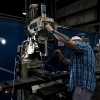
“If we want to see job growth that’s as robust for men as it is for women, we’re going to have to see men embracing those kinds of jobs,” says Stevenson.
So far, that hasn’t happened in any meaningful way. Stevenson believes it’s because men are more likely than women to have an identity tied to a particular occupation, making it harder for them to find work outside that field, much less in one dominated by women.
Meanwhile, in his second term, Trump has not strayed from his message that manufacturing will make the country strong. It’s something he emphasized in his second inaugural address, declaring that “America will be a manufacturing nation once again,” and in his repeated promises that tariffs would “bring factories roaring back.”
When manufacturers added 15,000 jobs in March, the White House called it proof that “the best days for American workers, manufacturers, and families are still ahead,” despite the fact that the sector is still down 82,000 jobs from when Trump took office.
“We have seen a year of a president absolutely fixated [on] growing the manufacturing sector,” Stevenson says. “There’s not enough of those jobs for men as a whole to thrive.”

A push for policies to open doors for men
What’s happening now in the labor market comes as no surprise to Richard Reeves, president of the American Institute for Boys and Men, a nonpartisan think tank.
He says not enough attention has been paid to the scarcity of men in certain professions, and now we’re seeing the consequences.
“There is no cause for panic here,” says Reeves, who’s been studying the decades-long decline in labor force participation among men. “But I do think we should be alert to signs that the labor market might be moving even more quickly in directions that are leaving too many men behind.”
Reeves notes that for years, the country has embraced policies and programs aimed at getting more women into science, technology, engineering and math, and the share of women in STEM jobs has grown.
“But that didn’t happen by itself. It happened as a result of concerted efforts to break down gender stereotypes,” he says.
Still, gaps remain, and some of those efforts have seen their government funding cut under Trump.
Now Reeves says what’s needed are policies and programs to draw male workers into fields such as nursing, teaching and social work.
“Those are occupations that serve people, and they should look like the people that they serve,” he says. “And it’s good for men because it means they won’t lose out on those jobs if that’s where the growth is coming from.”
Framing jobs as more masculine
Stevenson has been thinking about ways to make the fastest-growing sectors of the economy more welcoming to men.
“I think there are ways for us to talk about those jobs as being particularly masculine,” she says.
For instance, many health care jobs could be framed as roles requiring the strength to lift people. Preschools could highlight the need for teachers who serve as positive male role models.
“Kids love to be rough and tumble and build things,” she says.
Stevenson knows some people will be offended by such gender stereotyping.
“But I do want to encourage us to realize that we have to help men understand that they can do caregiving roles and stay masculine,” she says.
Ongoing challenges for women and men
What Stevenson doesn’t want people to conclude is that everything is okay now that women are leading on jobs.
“We know that there is still discrimination that holds people back,” she says.

For women, she says, that discrimination might be preventing them from getting the promotion that they deserve, contributing to the widening gender pay gap. For men, it may mean sitting on the sidelines because they don’t think there’s a role for them in the economy.
“I think we can use this moment to realize that discrimination, occupational segregation… these are things that harm all of us, not just one narrow group,” she says.

new video loaded: How Trump’s Advisers Felt About Going to War With Iran
By Maggie Haberman, Jonathan Swan, Christina Shaman, John Pappas and Ray Whitehouse
April 9, 2026


Home of Sam Altman, CEO of OpenAI, hit with Molotov cocktail

Review: Sicily Comes to Dallas at Caffe Lucca, With Some Kinks to Work Out

A long line awaited the opening of Uniqlo in Downtown Crossing. Take a look inside. – The Boston Globe

Broncos owners buy 40% ownership stake in the Colorado Rockies

New Music You Shouldn’t Miss – The Stranger

Florida High School Football Rankings: Top 25 teams – Oct. 21

How old is Bo Nix? What to know about Oregon quarterback ahead of 2024 NFL Draft

Cleary's 21 help Le Moyne down Central Connecticut State 69-64 in OT

99th annual Pony Swim held in Virginia

Indiana Members Credit Union announced as new anchor tenant at Bottleworks District

Rep Randy Fine joins House Freedom Caucus: ‘Strongest group of conservative patriots in Congress’

Trump issues NATO ultimatum to reopen Strait of Hormuz ‘within days’
Women are getting most of the new jobs. What’s going on with men?

Video: How Trump’s Advisers Felt About Going to War With Iran

Unearthed clip exposes shocking claim by Newsom’s wife about inmates at violent California prison
-

 Atlanta, GA6 days ago
1 teenage girl killed, another injured in shooting at Piedmont Park, police say
-

 Education1 week ago
Video: We Put Dyson’s $600 Vacuum to the Test
-

 Movie Reviews1 week ago
Vaazha 2 first half review: Hashir anchors a lively, chaos-filled teen tale
-

 Education1 week ago
Video: YouTube’s C.E.O. on the Rise of Video and the Decline of Reading
-

 Georgia3 days ago
Georgia House Special Runoff Election 2026 Live Results
-

 Pennsylvania4 days ago
Parents charged after toddler injured by wolf at Pennsylvania zoo
-

 Education1 week ago
Video: Toy Testing with a Discerning Bodega Cat
-
 Milwaukee, WI4 days ago
Potawatomi Casino Hotel evacuated after fire breaks out in rooftop HVAC system