Connect with us

News

Donald Trump to impose 25% tariffs on steel and aluminium imports

Published

on

Donald Trump to impose 25% tariffs on steel and aluminium imports

Unlock the White House Watch newsletter for free

Donald Trump said he would on Monday impose 25 per cent tariffs on all steel and aluminium imports, expanding his trade conflicts to the metals sector in a new burst of protectionism from Washington.

The US president made the announcement during a briefing with reporters as he flew from his Mar-a-Lago estate in Florida to attend the Super Bowl in New Orleans on Sunday evening.

In addition to the measures on steel and aluminium products, Trump said he would later in the week unveil new reciprocal tariffs targeting imports from a wide range of countries that impose levies on US exports.

Advertisement

The promised tariffs on steel and aluminium come as Trump has launched his second term with an aggressive trade policy that has rattled global currency markets, sparked fears of a renewed burst of US inflation and targeted America’s largest trading partners.

Trump last week came within hours of setting 25 per cent tariffs on imports from US neighbours Canada and Mexico, only to offer them a 30-day reprieve. But the administration has pressed ahead with 10 per cent tariffs on Chinese imports, which triggered retaliation from Beijing that took effect on Sunday.

Canada, China and Mexico are the biggest exporters to the US of steel and aluminium products, but Trump’s proposed levies would potentially ensnare countries from Brazil to Germany to South Korea.

Tariffs on metals imports have been championed by some US trade unions as well as domestic producers, but they risk raising input costs for a wide range of US manufacturers. In 2023, the US imported $82.1bn of steel and iron and $27.4bn of aluminium, while exporting $43.3bn of steel and iron and $14.3bn of aluminium.

Responding to Trump’s promise of steel and aluminium tariffs, the European Commission said: “We will react to protect the interests of European businesses, workers and consumers from unjustified measures,” adding that it had not received any official notification of new levies.

Advertisement

Trump took aim at the metals industry during his first term, imposing a 25 per cent tariff on steel and 10 per cent on aluminium, before subsequently granting exemptions to several trading partners, including Canada and Mexico.  

The EU retaliated to Trump’s 2018 metals tariffs by imposing levies on a series of US imports, including bourbon whiskey, Harley-Davidson motorcycles and motor boats. 

Joe Biden later reached an agreement with the EU, replacing the tariffs with a quota system, but that also allowed for the reimposition of duties this year if talks between the sides failed to make progress.

Following Trump’s latest metals tariff plan, the dollar rose 0.1 per cent on Monday against a basket of currencies including the euro, yen and pound. Aluminium traded on the London Metal Exchange was up 0.4 per cent to $2,639 per tonne.

Shares in South Korean steelmakers Hyundai Steel and Posco Holdings fell 2 per cent and 0.8 per cent respectively, underperforming the Kospi benchmark index.

Advertisement

Shares in ArcelorMittal, one of Europe’s largest producers, dropped 2.5 per cent.

Seoul’s Ministry of Industry, Trade and Energy held an emergency meeting with steel industry executives on Monday as they raced to find more details. “We will jointly respond actively to minimise the impact on our companies,” it said.

Australia’s Prime Minister Anthony Albanese said his country’s companies “have significant investments in [the] US steel industry creating thousands of jobs in both the US and in Australia”. 

“We will continue to make the case for Australia’s national interest with the US administration,” Albanese said.

Some content could not load. Check your internet connection or browser settings.

Advertisement

The steel industry has historically been a lightning rod for trade tensions, with several nations last year introducing levies against imports. The US tripled its tariffs on Chinese steel last year, while the EU launched an anti-dumping investigation into Chinese tin-coated steel products. Mexico and Brazil also raised tariffs. 

Trump’s latest pledge comes as the White House has said it will block Nippon Steel’s takeover of US Steel following Joe Biden’s decision to do the same.

But Trump has said he would work on allowing a large investment, though not a majority stake, in the Pennsylvania-based producer by its Japanese rival, and insisted that tariffs would help. “Tariffs are going to make [US Steel] very successful. And I think it has good management,” Trump said.

Shares in Nippon Steel were down 0.4 per cent in Tokyo on Monday.

Trump did not say how exactly he intended to apply the reciprocal tariffs he promised to announce in the coming days.

Advertisement

“Very simply, if they charge us, we charge them,” he said.

Additional reporting by Sam Learner in New York, Arjun Neil Alim in Hong Kong, Nic Fildes in Melbourne, Song Jung-a in Seoul, Sylvia Pfeifer in London and Andy Bounds in Brussels

News

Not a Deal-Breaker: White House Downplays Iranian Action Near the Strait

Published

on

Not a Deal-Breaker: White House Downplays Iranian Action Near the Strait

Just two weeks ago, President Trump threatened to wipe out Iran’s civilization if it did not open the Strait of Hormuz. Days later, he said any Iranian “who fires at us, or at peaceful vessels, will be BLOWN TO HELL!”

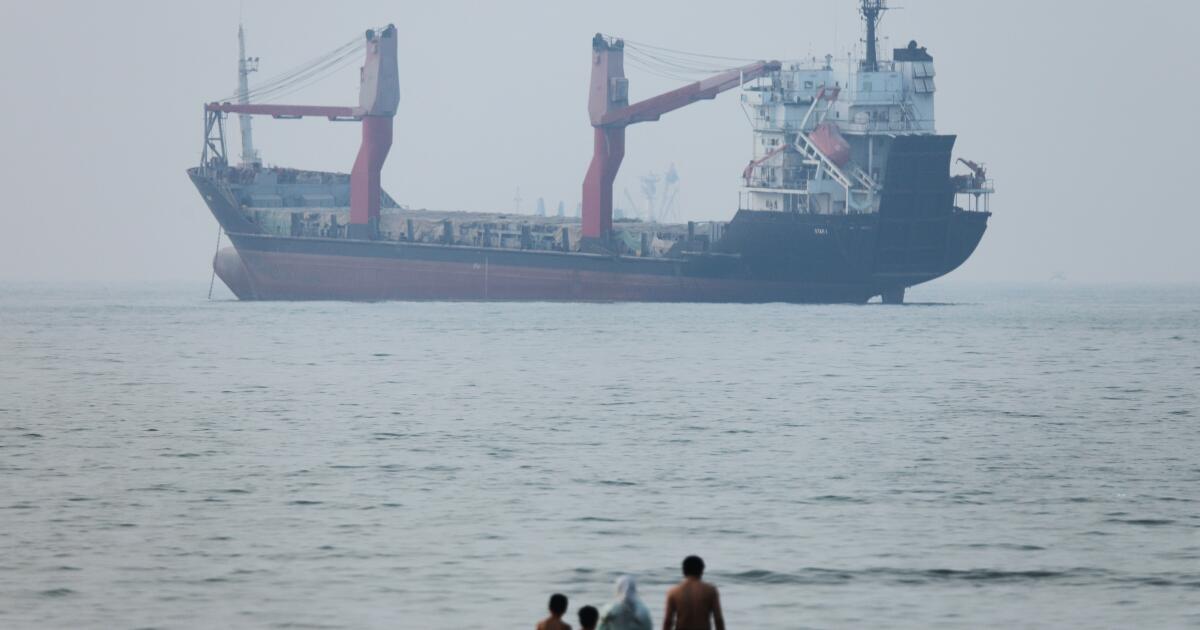
Yet on Wednesday, after Iran seized two ships near the Strait of Hormuz, the White House was quick to argue the action was not a deal breaker for potential peace negotiations.

“These were not U.S. ships,” Karoline Leavitt, the White House press secretary, said on Fox News. “These were not Israeli ships.” Therefore, she explained, the Iranians had not violated a cease-fire with the United States that Mr. Trump has extended indefinitely.

She cautioned the news media against “blowing this out of proportion.”

The surprisingly tolerant tone from the White House suggests Mr. Trump is not eager to reignite a war that he started alongside Israel on Feb. 28 — a war that has proved unpopular with Americans and has gone on longer than he initially estimated.

Advertisement

The president on Tuesday extended a cease-fire between the United States and Iran that had been set to expire within hours, saying he wanted to give Tehran a chance to come up with a new proposal to end the war.

The American military has displayed its overwhelming might during the war, successfully striking thousands of targets. But it remains unclear whether Mr. Trump will accomplish the political objectives of the war.

The Iranian regime, even after its top leaders were killed, is still intact. Iran has not agreed to Mr. Trump’s demands to turn over its nuclear capabilities to the United States or significantly curtail them. And the Strait of Hormuz, a key passageway for world commerce that was open before the war, remains closed.

Nevertheless, the White House has repeatedly highlighted the military successes on the battlefield as evidence it is winning the war.

“We have completely confused and obliterated their regime,” Ms. Leavitt said on Fox Wednesday. “They are in a very weak position thanks to the actions taken by President Trump and our great United States armed forces, and so we will continue this important mission on our own.”

Advertisement

The oscillation between threats and a more conciliatory tone has long been one of Mr. Trump’s signature negotiating strategies.

Potential peace talks between the two countries are on hold. Vice President JD Vance had been poised to fly to Islamabad for negotiations. But the trip was postponed until Iran can “come up with a unified proposal,” Mr. Trump said.

The United States recently transmitted a written proposal to the Iranians intended to establish base-line points of agreement that could frame more detailed negotiations. The document covers a broad range of issues, but the core sticking points are the same ones that have bedeviled Western negotiators for more than a decade: the scope of Iran’s uranium enrichment program and the fate of its stockpile of enriched uranium.

Mr. Trump has not spoken publicly about the cease-fire, other than on social media. On Wednesday, he also posted about topics including “my Apprentice Juggernaut” — a reference to his former television show; the Virginia elections, which he called “rigged”; and a new book about Supreme Court Justice Samuel A. Alito Jr.

Advertisement
Continue Reading

News

Pentagon says Navy secretary is leaving, the latest departure of a top defense leader

Published

on

Pentagon says Navy secretary is leaving, the latest departure of a top defense leader

Secretary of the Navy John Phelan speaks, as President Trump listens, at Trump’s Mar-a-Lago club on Dec. 22 in Palm Beach, Fla.

Alex Brandon/AP


hide caption

toggle caption

Advertisement

Alex Brandon/AP

WASHINGTON — Navy Secretary John Phelan is leaving his job, the Pentagon abruptly announced Wednesday, the first head of a military service to depart during President Trump’s second term but just the latest top defense leader to step down or be ousted.

No reason was given for the unexpected departure of the Navy’s top civilian official, coming as the sea service has imposed a blockade of Iranian ports and is targeting ships linked to Tehran around the world during a tenuous ceasefire in the war. Another Trump loyalist is taking over as acting head of the Navy: Undersecretary Hung Cao, a 25-year Navy combat veteran who ran unsuccessful campaigns for the U.S. Senate and House in Virginia.

Phelan’s departure is the latest in a series of shakeups of top leadership at the Pentagon, coming just weeks after Defense Secretary Pete Hegseth fired the Army’s top uniformed officer, Gen. Randy George. Hegseth also has fired several other top generals, admirals and defense leaders since taking office last year.

Advertisement

The firings began in February 2025, when Hegseth removed military leaders, including Adm. Lisa Franchetti, the Navy’s top uniformed officer, and Gen. Jim Slife, the No. 2 leader at the Air Force. Trump also fired Gen. Charles “CQ” Brown Jr. as chairman of the Joint Chiefs of Staff.

Showing how sudden the latest move was, Phelan had addressed a large crowd of sailors and industry professionals on Tuesday at the Navy’s annual conference in Washington and spoke with reporters about his agenda. He also hosted the leaders of the House Armed Services Committee to discuss the Navy’s budget request and efforts to build more ships, according to a social media post from his office.

Pentagon spokesman Sean Parnell said in a post on X that Phelan was “departing the administration, effective immediately.”

Phelan had been a major Trump donor

Phelan had not served in the military or had a civilian leadership role in the service before Trump nominated him for secretary in late 2024. He was seen as an outsider being brought in to shake up the Navy.

Hung Cao speaks during the Republican National Convention on July 16, 2024, in Milwaukee.

Hung Cao speaks during the Republican National Convention on July 16, 2024, in Milwaukee.

Matt Rourke/AP

Advertisement


hide caption

toggle caption

Matt Rourke/AP

Advertisement

Phelan was a major donor to Trump’s campaign and had founded the private investment firm Rugger Management LLC. According to his biography, Phelan’s primary exposure to the military came from an advisory position he held on the Spirit of America, a nonprofit that supported the defense of Ukraine and the defense of Taiwan.

The Associated Press could not immediately reach Phelan’s office for comment. The White House did not answer questions and instead responded by sending a link to Parnell’s statement.

Phelan is leaving during a busy time for the Navy. It has three aircraft carriers deployed in or heading to the Middle East, while the Trump administration says all the armed forces are poised to resume combat operations against Iran should the ceasefire expire.

The Navy also has maintained a heavy presence in the Caribbean, where it has been part of a campaign of strikes against alleged drug boats. It also played a major role in the capture of Venezuelan leader Nicolás Maduro in January.

New acting Navy secretary ran unsuccessful bids for Congress

Taking over as acting secretary is Cao, who ran a failed U.S. Senate bid in Virginia to try to unseat Democratic Sen. Tim Kaine in 2024. He had Trump’s endorsement in the crowded Republican primary and gave a speech at the 2024 Republican National Convention.

Advertisement

Cao’s biography includes fleeing Vietnam with his family as a child in the 1970s. In a campaign video for his Senate bid, he compared Vietnam’s communist regime during the Cold War to the administration of Democratic President Joe Biden.

During his one debate with Kaine, Cao criticized COVID-19 vaccine mandates for service members as well as the military’s diversity, equity and inclusion efforts.

“When you’re using a drag queen to recruit for the Navy, that’s not the people we want,” Cao said from the debate stage. “What we need is alpha males and alpha females who are going to rip out their own guts, eat them and ask for seconds. Those are the young men and women that are going to win wars.”

Trump and Hegseth have railed against DEI in the military, banning the efforts and firing people accused of supporting such programs.

When he ran for Congress in Virginia in 2022, Cao expressed opposition to aid for Ukraine during a debate against his Democratic opponent.

Advertisement

“My heart goes out to the Ukrainian people. … But right now we’re borrowing $55 billion from China to pay for the war in Ukraine. Not only that, we’re depleting our national strategic reserves,” Cao said.

Cao graduated from the prestigious Thomas Jefferson High School for Science and Technology in Alexandria, Virginia, before attending the U.S. Naval Academy.

He was commissioned as a special operations officer and went on to serve with SEAL teams and special forces in Iraq, Afghanistan and Somalia before retiring at the rank of captain, according to his Senate campaign biography.

Cao also earned a master’s degree in physics and had fellowships at the Massachusetts Institute of Technology and Harvard University.

Since becoming Navy undersecretary, Cao has championed returning to duty service members that refused a Biden-era mandate to take the COVID-19 vaccine.

Advertisement
Continue Reading

News

California Candidates to Appear in First Major Debate After Swalwell

Published

on

California Candidates to Appear in First Major Debate After Swalwell

Candidates in California’s volatile race for governor will meet Wednesday night for the first televised debate since Eric Swalwell dropped out, each looking to seize momentum in the tight contest.

The debate, being held at the television studio of KRON4 in San Francisco, will include four Democrats and two Republicans who are tightly bunched in recent polls, with many voters still undecided less than six weeks before the June 2 primary.

Mr. Swalwell, a Democrat, had just begun to emerge as a Democratic front-runner when his campaign swiftly collapsed after he was accused of sexual assault in news reports on April 10.

Candidates have taken relatively few risks so far in debates around the state, but every candidate is now eyeing a chance to jump to the front of the pack.

“Even though we have seen some movement in the last couple of weeks, it continues to be a fairly crowded, fractured field,” said Sara Sadhwani, an assistant professor of politics at Pomona College. “So candidates need to be able to grab attention in a debate like this.”

Advertisement

The debate comes as Xavier Becerra, a Democrat and former California attorney general, has enjoyed a surge of support in polls since Mr. Swalwell dropped out of the race.

Mr. Becerra and Matt Mahan, the mayor of San Jose, did not originally meet the threshold to participate in Wednesday’s debate when Mr. Swalwell was running. But they both qualified after receiving enough support in a follow-up poll that debate organizers commissioned once Mr. Swalwell had dropped out.

The other Democrats scheduled to participate are Tom Steyer, a former hedge fund manager, and Katie Porter, a former congresswoman, each of whom have been polling near the top of the Democratic field for several weeks. The Republicans in the debate are Steve Hilton, a former Fox News host who has been endorsed by President Trump, and Chad Bianco, the sheriff of Riverside County.

All candidates run on the same ballot in California’s nonpartisan primary, with the two who receive the most votes advancing to the general election, regardless of their party affiliation. The large number of Democratic candidates has created fear among state party leaders that their voters could splinter, potentially allowing two Republicans to sweep the primary in this heavily Democratic state.

The odds of that happening have decreased since Mr. Swalwell dropped out and another Democrat, Betty Yee, withdrew on Monday. But Rusty Hicks, the chairman of the California Democratic Party, still believes there are too many Democrats in the race and has urged those lagging in polls to end their campaigns. (The actual ballot will include 61 candidates for governor, most of whom are completely unknown to voters.)

Advertisement

The messy race to succeed Gov. Gavin Newsom, who cannot run for re-election because of term limits, has played out as the most unpredictable contest California has seen in a generation. It has attracted a sprawling field but no one with the star power of former Gov. Arnold Schwarzenegger or the political might of Mr. Newsom or former Gov. Jerry Brown.

Much of California’s Democratic establishment is still figuring out whom to back in the turbulent race.

Mr. Newsom has not endorsed anyone, saying he trusts voters to elect someone “who reflects the values and direction Californians believe in.” Representative Nancy Pelosi, the influential former House speaker from San Francisco, and Senator Alex Padilla also have not announced their favorites. Senator Adam Schiff endorsed Mr. Swalwell earlier this year but quickly withdrew his support after the accusations against him were published.

On Tuesday, Ms. Yee endorsed Mr. Steyer, praising his work to fight climate change and engage young voters. Mr. Steyer has swamped his competitors with a raft of advertising by pouring $134 million from his personal fortune into his campaign.

Also on Tuesday, Mr. Becerra, whose campaign had appeared to be flailing until Mr. Swalwell dropped out, received the endorsement of Robert Rivas, the Democratic speaker of the California State Assembly. Mr. Rivas said he had encouraged Mr. Becerra to run for governor because he was impressed by his work as California’s attorney general during President Trump’s first term.

Advertisement

“He understands both the policy and the politics,” Mr. Rivas said in an interview. “And he has a track record, in my opinion, of delivering results under pressure.”

The 90-minute debate on Wednesday begins at 7 p.m. PT and will be broadcast and streamed by KRON and other California stations.

Continue Reading
Advertisement

Trending