Connect with us

News

China’s exports miss target in warning signal for Beijing

Published

on

China’s exports miss target in warning signal for Beijing

Stay informed with free updates

China’s export growth missed expectations last month in dollar terms, in what analysts said was a signal to policymakers that their heavy dependence on trade to overcome a weak domestic economy may be facing growing risks.

In contrast to exports, imports rose sharply, reversing previous falls as industry procured machinery and capital goods to sustain rising investment.

Exports rose 7 per cent year on year in dollar terms in July, according to official data released by China’s General Administration of Customs on Wednesday, lower than an 8.6 per cent rise in June. A Reuters poll of analysts had forecast growth of 9.7 per cent.

Advertisement

Imports rose 7.2 per cent, far outpacing the 3.5 per cent growth predicted by the Reuters poll and up from a decline of 2.3 per cent year on year in June.

“[Chinese policymakers] will probably look at this and think the export engine is probably going to slow down sooner than they thought,” said Louise Loo, lead economist at Oxford Economics.

China’s economy has depended on trade and industrial output to offset a prolonged real estate downturn and souring local government finances, which have knocked consumer confidence and household spending.

Investor confidence has also been hit by government crackdowns and Beijing’s insistence on providing only an incremental stimulus, rather than a big bang, to reach its official economic growth target of 5 per cent.

You are seeing a snapshot of an interactive graphic. This is most likely due to being offline or JavaScript being disabled in your browser.

Advertisement

President Xi Jinping has set out a vision of lifting productivity through investment in advanced technology, manufacturing and innovation, with state banks pumping lending into industry rather than stimulating domestic demand.

This has led to disinflationary pressures in the economy, with lower prices supercharging the competitiveness of China’s exports at a time when developed markets are wrestling with higher inflation.

Loo said Chinese industry had probably front-loaded exports in the first part of the year in anticipation of possible tariffs and uncertainty about the US presidential election, as well as weaker external demand as the American economy softens.

“The problem is that the external demand story has never been, in our view, a permanent driver, it was always going to fade,” she said. “It’s just about timing the end of that boom.”

Heron Lim, an economist with Moody’s Analytics, said July’s weaker than expected export figure could be partly down to rising trade protectionism hitting Chinese products, including automobiles.

Advertisement

This was happening not only in developed markets such as the US and the EU, which have increased tariffs on electric vehicles, but also across different products and developing countries.

“We are definitely expecting more to come in terms of stimulus,” he said, pointing to expectations of monetary easing and other measures in the second half of the year.

However, Lynn Song, chief economist for greater China at ING, noted that exports increased in volume terms, particularly in areas such as automobiles, while prices were lower.

“I think the disappointing export data is actually more tied to price competition,” he said, adding that some areas showed stronger activity, such as household electronics and semiconductor exports.

“It’s not a broad-based, big external demand slowdown,” he said, adding “export value has slumped and that’s probably dragging on the numbers a bit.”

Advertisement

Song also pointed out that imports were being driven by demand for auto parts from electric vehicle industries, as well as by China’s drives to upgrade industry and achieve technological self-sufficiency.

“There’s quite a lot of demand for high tech imports, semiconductors as well as automatic data processing equipment,” he said.

“I think one mistake would be to attribute [the import rebound] to a really strong recovery of household demand, because you can see that overall other imports are still quite weak.”

News

Supreme Court blocks redrawing of New York congressional map, dealing a win for GOP

Published

on

Supreme Court blocks redrawing of New York congressional map, dealing a win for GOP

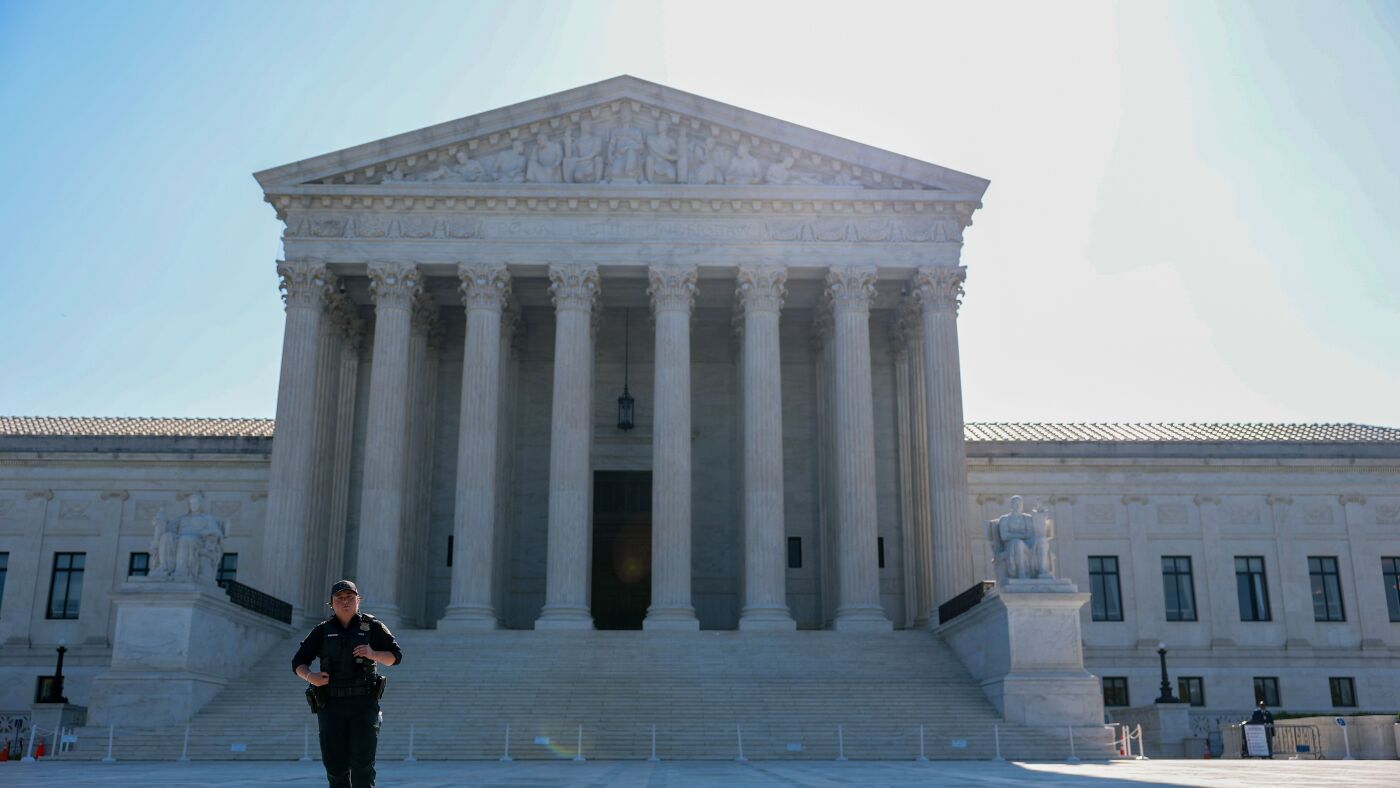
The Supreme Court

Win McNamee/Getty Images


hide caption

toggle caption

Advertisement

Win McNamee/Getty Images

The Supreme Court on Monday intervened in New York’s redistricting process, blocking a lower court decision that would likely have flipped a Republican congressional district into a Democratic district.    
  
At issue is the midterm redrawing of New York’s 11th congressional district, including Staten Island and a small part of Brooklyn. The district is currently held by a Republican, but on Jan. 21, a state Supreme Court judge ruled that the current district dilutes the power of Black and Latino voters in violation of the state constitution.  
  
GOP Rep. Nicole Malliotakis, who represents the district, and the Republican co-chair of the state Board of Elections promptly appealed to the U.S. Supreme Court, asking the justices to block the redrawing as an unconstitutional “racial gerrymander.” New York’s congressional election cycle was set to officially begin Feb. 24, the opening day for candidates to seek placement on the ballot.  
  
As in this year’s prior mid-decade redistricting fights — in Texas and California — the Trump administration backed the Republicans.   
 
Voters and the State of New York contended it’s too soon for the Supreme Court to wade into this dispute. New York’s highest state court has not issued a final judgment, so the voters asserted that if the Supreme Court grants relief now “future stay applicants will see little purpose in waiting for state court rulings before coming to this Court” and “be rewarded for such gamesmanship.” The state argues this is an issue for “New York courts, not federal courts” to resolve, and there is sufficient time for the dispute to be resolved on the merits. 
  
The court majority explained the decision to intervene in 101 words, which the three dissenting liberal justices  summarized as “Rules for thee, but not for me.” 
 
The unsigned majority order does not explain the Court’s rationale. It says only how long the stay will last, until the case moves through the New York State appeals courts. If, however, the losing party petitions and the court agrees to hear the challenge, the stay extends until the final opinion is announced. 
 
Dissenting from the decision were Justices Sonia Sotomayor, Elena Kagan, and Ketanji Brown Jackson. Writing for the three, Sotomayor  said that  if nonfinal decisions of a state trial court can be brought to highest court, “then every decision from any court is now fair game.” More immediately, she noted, “By granting these applications, the Court thrusts itself into the middle of every election-law dispute around the country, even as many States redraw their congressional maps ahead of the 2026 election.” 

Monday’s Supreme Court action deviates from the court’s hands-off pattern in these mid-term redistricting fights this year. In two previous cases — from Texas and California — the court refused to intervene, allowing newly drawn maps to stay in effect.  
  
Requests for Supreme Court intervention on redistricting issues has been a recurring theme this term, a trend that is likely to grow.  Earlier last month  the high court allowed California to use a voter-approved, Democratic-friendly map.  California’s redistricting came in response to a GOP-friendly redistricting plan in Texas that the Supreme Court also permitted to move forward. These redistricting efforts are expected to offset one another.     
   
But the high court itself has yet to rule on a challenge to Louisiana’s voting map, which was drawn by the state legislature after the decennial census in order to create a second majority-Black district.  Since the drawing of that second majority-black district, the state has backed away from that map, hoping to return to a plan that provides for only one majority-minority district.    
     
The Supreme Court’s consideration of the Louisiana case has stretched across two terms. The justices failed to resolve the case last term and chose to order a second round of arguments this term adding a new question: Does the state’s intentional creation of a second majority-minority district violate the constitution’s Fourteenth and Fifteenth Amendments’ guarantee of the right to vote and the authority of Congress to enforce that mandate?    
Following the addition of the new question, the state of Louisiana flipped positions to oppose the map it had just drawn and defended in court. Whether the Supreme Court follows suit remains to be seen. But the tone of the October argument suggested that the court’s conservative supermajority is likely to continue undercutting the 1965 Voting Rights Act.   

Advertisement
Continue Reading

News

Map: Earthquake Shakes Central California

Published

on

Map: Earthquake Shakes Central California

Note: Map shows the area with a shake intensity of 3 or greater, which U.S.G.S. defines as “weak,” though the earthquake may be felt outside the areas shown.  All times on the map are Pacific time. The New York Times

A minor earthquake with a preliminary magnitude of 3.5 struck in Central California on Monday, according to the United States Geological Survey.

The temblor happened at 7:17 a.m. Pacific time about 6 miles northwest of Pinnacles, Calif., data from the agency shows.

As seismologists review available data, they may revise the earthquake’s reported magnitude. Additional information collected about the earthquake may also prompt U.S.G.S. scientists to update the shake-severity map.

Source: United States Geological Survey | Notes: Shaking categories are based on the Modified Mercalli Intensity scale. When aftershock data is available, the corresponding maps and charts include earthquakes within 100 miles and seven days of the initial quake. All times above are Pacific time. Shake data is as of Monday, March 2 at 10:20 a.m. Eastern. Aftershocks data is as of Monday, March 2 at 11:18 a.m. Eastern.

Advertisement
Continue Reading

News

US says Kuwait accidentally shot down 3 American jets

Published

on

US says Kuwait accidentally shot down 3 American jets

The U.S. and Israel have been conducting strikes against targets in Iran since Saturday morning, with the aim of toppling Tehran’s clerical regime. Iran has fired back, with retaliatory assaults featuring missiles and drones targeting several Gulf countries and American bases in the Middle East.

“All six aircrew ejected safely, have been safely recovered, and are in stable condition. Kuwait has acknowledged this incident, and we are grateful for the efforts of the Kuwaiti defense forces and their support in this ongoing operation,” Central Command said.

“The cause of the incident is under investigation. Additional information will be released as it becomes available,” it added.

In a separate statement later Monday, Central Command said that American forces had been killed during combat since the strikes began.

“As of 7:30 am ET, March 2, four U.S. service members have been killed in action. The fourth service member, who was seriously wounded during Iran’s initial attacks, eventually succumbed to their injuries,” it said.

Advertisement

Major combat operations continue and our response effort is ongoing. The identities of the fallen are being withheld until 24 hours after next of kin notification,” Central Command added.

This story has been updated.

Continue Reading

Trending