Midwest
Who is Elissa Slotkin, and why did Dems choose her for the party's rebuttal to Trump speech?

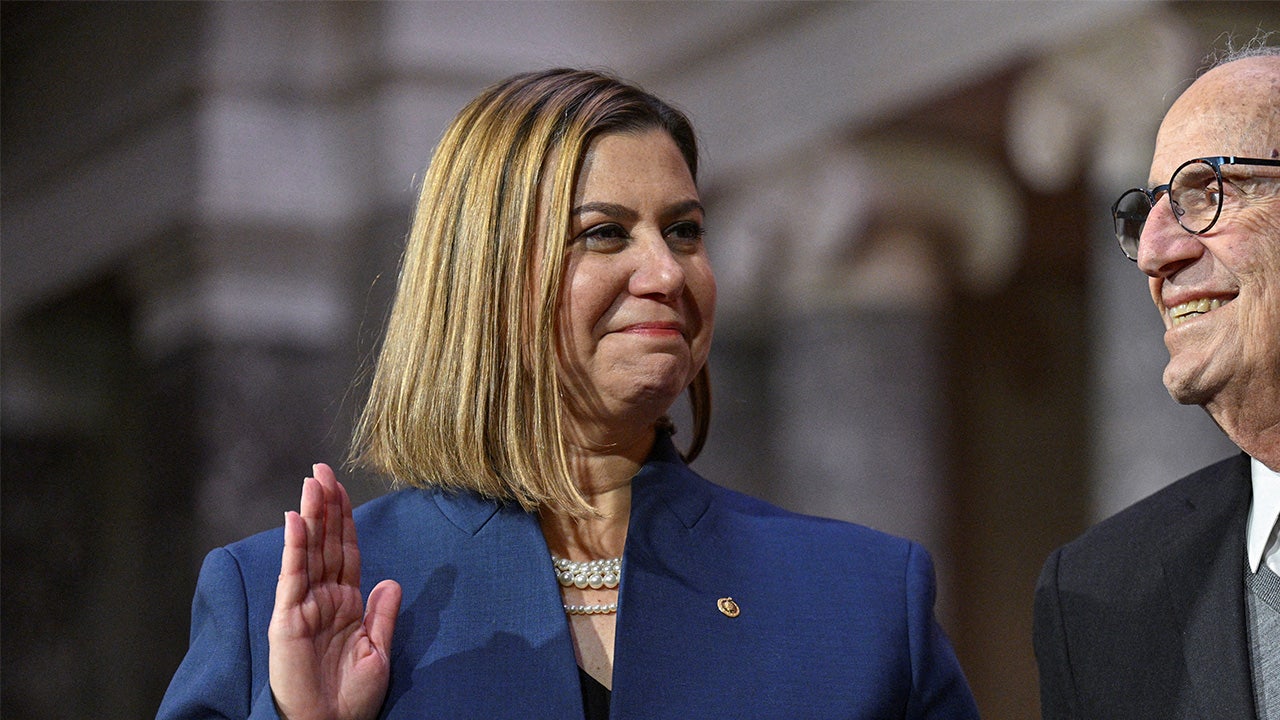
Democrats picked freshman Sen. Elissa Slotkin, D-Mich., who represents a swing state, to give the party’s official response to President Donald Trump’s address to a joint session of Congress Tuesday night.
“BIG: I’m announcing @SenatorSlotkin will deliver our Democratic response to Trump’s Joint Address. Nothing short of a rising star in our party – she’s dedicated her life to our country. She will layout the fight to tackle the deep challenges we face and chart a path forward,” Senate Minority Leader Chuck Schumer, D-N.Y., revealed on X recently.
Slotkin was elected to an open Senate seat in Michigan, which was also won by Trump in the same election. She wrote on X, “I’m looking forward to speaking directly to the American people next week. The public expects leaders to level with them on what’s actually happening in our country.”
‘UTTER DISASTER’: LINDSEY GRAHAM CALLS FOR ZELENSKYY RESIGNATION AFTER WHITE HOUSE THROWDOWN
New Sen. Elissa Slotkin, will be giving the Democratic response to Trump’s speech to Congress on Tuesday evening. (Reuters)
“From our economic security to our national security, we’ve got to chart a way forward that improves people’s lives in the country we all love, I look forward to laying that out. Tune in,” she previewed.
The senator received a bachelor’s degree at Cornell University and a master’s degree from Columbia University.
Slotkin spent much of her career in the national security space, serving three tours in Iraq as a CIA analyst alongside the U.S. military. After that, she worked in multiple roles in the Pentagon and White House under two different presidents, George W. Bush and Barack Obama. In 2014, Obama nominated Slotkin to serve at the Pentagon as assistant secretary of defense for international security affairs.
SEE THE STAR-STUDDED LIST OF TRUMP ALLIES DESCENDING ON DC TO CHART FURTHER 100-DAY WINS
She then chose to run for Congress in 2018 in Michigan, where she grew up.
Slotkin managed to defeat a Republican incumbent in a key Michigan swing district. She served several terms as a member of the House of Representatives before choosing to run for Senate to replace former Sen. Debbie Stabenow, D-Mich.
Despite Trump winning the battleground state in 2024, Slotkin pulled out her own win for Democrats, beating the GOP contender Mike Rogers by less than a percentage point.
Since coming to the Senate, she’s offered some stark criticism of her party, urging Democrats to get away from identity politics.
FURIOUS DEMS ATTACK TRUMP, VANCE AFTER EXPLOSIVE OVAL OFFICE MEETING WITH ZELENSKYY: ‘SIDING WITH DICTATORS’
Schumer announced that Slotkin would give the party’s response to Trump’s address. (Kevin Dietsch/Getty Images)
“As a moderate Democrat, I think she was an excellent choice,” Jim Manley, former senior communications advisor and spokesman for former Democratic Senate Majority Leader Harry Reid and the Senate Democratic Caucus, told Fox News Digital.
He said the choice of Slotkin would be “especially” good if “Trump just throws red meat to the base while using the kind of unhinged rhetoric that will turn off swing voters.”
However, “based on years of experience dealing with these when [I was] working for Sen. Reid, they are usually much more of a hassle than they are ever worth,” he added.
Jim Kessler, former senior aide to Schumer, told Fox News Digital he was a fan of Slotkin for the response. “She’s tough, smart and unafraid to ruffle feathers,” he said.
GABBARD SAYS BIDEN ADMIN IGNORED ‘HIGHLY INAPPROPRIATE’ CHATS HAPPENING AT NATIONAL SECURITY AGENCIES
Rep. Elissa Slotkin speaks on stage during the Democratic National Convention on Aug. 22, 2024, in Chicago. (Chip Somodevilla/Getty Images)
“She also comes from the centrist wing of the Democratic Party and that’s important as a signal to voters. I expect she’ll focus on bread and butter issues, because right now the middle class is starting to lose confidence in Trump’s handling of the economy,” he continued.
According to Michigan Republican strategist Jason Cabel Roe, Slotkin is “one of the better options Democrats have.”
The more “centrist” senator’s response comes at a time when Democrats are “in absolute disarray,” he said.
“You are seeing, I think, a real tug of war between the more progressive elements of the party and the more traditional elements of the party,” Roe added.
Slotkin’s office declined to comment when reached by Fox News Digital.
Read the full article from Here


North Dakota
In ‘last chapter,’ North Dakota son who made ultimate sacrifice in World War II comes home

DAHLEN, N.D. — A spectacular summer day with blue skies, puffy clouds and a light breeze served as a perfect backdrop for the homecoming for a North Dakota hero of World War II.
Hundreds of people came to pay respects to U.S. Army Air Forces Staff Sgt. Irvin C. Ellingson on Saturday, June 20, in his hometown of Dahlen, North Dakota, 55 miles northwest of Grand Forks.
His funeral and burial were the culmination of three days worth of ceremonies, remembrances and celebrations for the extended Ellingson family, friends and community members.
Chris Flynn / The Forum
Brittany Jallo, a great niece to Ellingson, said the family has never let him be forgotten.
“It’s so surreal, it’s like I’m smiling and crying at the same time,” she said.
Terry Ellingson, one of Irvin’s nephews, said they can finally put him to rest alongside other family members.
“It’s a real gift to us, and it’s something that we don’t have to keep wondering about anymore,” he said.

Contributed / Lon Enerson
This was a day many prayed for
but feared might never come.
Ellingson, then 25, was working as a radar operator aboard a B-29 Superfortress that had completed a combat mission over Tokyo when it was fired upon by a Japanese fighter plane on April 14, 1945.
He and other crewmen parachuted safely, only to be captured by the Japanese military and held as prisoners of war. The American POWs in the Tokyo military prison died tragically six weeks later when a fire, sparked by U.S. bombing runs and high winds, swept through the wooden building.

Contributed
Positive identification of remains seemed almost impossible. But almost exactly one year ago, with the work of
forensic anthropologists using advanced DNA technology
and persistence by family members, it happened.
Lon Enerson, another of Ellingson’s nephews, spearheaded the years-long effort and plans to finally bring Ellingson’s remains back home.

Chris Flynn / The Forum
Enerson, now living in St. Cloud, Minnesota, grew up a few miles from the farmstead where Ellingson was born and raised.
He’s been trying to write a book about his uncle Irvin for four years.
“The book’s on hold, of course. I never knew we’d get this last chapter,” he said.
Ellingson’s remains arrived at Minneapolis-St. Paul International Airport from Joint Base Pearl Harbor-Hickam in Honolulu, Hawaii, early Wednesday, where family members waited on the tarmac.
“It was such an intimate experience for all of us, something that I’ll never forget, really,” Enerson said.
A contingent of law enforcement officers and motorcyclists escorted his remains north.
On Thursday, another convoy brought Ellingson’s remains
from the Fargo Air Museum to Grand Forks
for a ceremony featuring Gov. Kelly Armstrong, Sen. John Hoeven and Rep. Julie Fedorchak.
A family celebration on a rural Nelson County farmstead filled the day Friday leading up to Saturday’s farewell.

Chris Flynn / The Forum
At Dahlen Lutheran Church, one of Ellingson’s dress uniforms was on display in his open casket, with his wrapped remains situated toward the top.
His remains, and those of 61 other U.S. servicemen who perished in the Tokyo military prison fire,
first arrived at a forensic lab in Honolulu
in spring of 2022, where the painstaking work of identification began.
Many Ellingson family members contributed DNA to assist in that process.
Two forensic anthropologists from the Defense POW/MIA Accounting Agency, working in that lab in Hawaii, helped identify Ellingson’s remains.
The family grew so close to Kristen Grow and Melissa Menschel,
they invited them to Ellingson’s farewell. To many family members’ surprise, the two women were able to make the trip.

Chris Flynn / The Forum
“Everybody keeps thanking us, but we thank them for allowing us to be part of this process, for them having that persistence in the beginning, and then trusting us with this profound responsibility,” Grow said.
“We don’t interact very often with families unless they come to our lab, and so this is a rare opportunity for us … so we said we can’t miss it,” Menschel said.
The funeral featured music and scriptural readings from many extended Ellingson family members.
Enerson played the trumpet in several orchestral arrangements, and four other Ellingson nephews sang beautiful harmonies.
In the homily, Pastor Val Teppo spoke of the letters Ellingson wrote home to his family, saying it was time for him to get home.

Chris Flynn / The Forum
“Today isn’t the homecoming I am sure he was envisioning then when he wrote those letters, but more than 80 years later, Irvin is indeed coming home,” Teppo said.
Col. James Schlabach, commander of the 91st Missile Wing at the Minot Air Force Base, spoke of how Ellingson, at age 22, during the deadliest conflict in history, raised his right hand and said he was ready to serve.
“What I’d like to do as a final thank you on behalf of a grateful nation, a grateful U.S. military, is offer Staff Sgt. Irvin Ellingson one final salute,” Schlabach said.

Chris Flynn / The Forum
He left the lectern, approached the casket, and fired off a sharp, solemn salute.
Attendees loaded onto buses for the convoy to Middle Forest River Cemetery, just a few miles away on gravel roads.
First, the silver hearse carrying Ellingson’s casket had an important stop.

Chris Flynn / The Forum
It was driven onto the farmstead where Irvin once lived with his parents, Tommy and Ella Ellingson, and seven siblings — the place where the family spent many waking hours, wondering whether Irvin would ever come home.
The old farmhouse is no longer but the property is still very much in the family, as Ellingson’s great niece Brittany Jallo, her husband and children built a home there.

Chris Flynn / The Forum
The hearse circled the driveway and paused, looking out onto the rolling hills and creeks for one final farewell, as children waved American flags and a family member in Marine Corps blues stood at attention.

Chris Flynn / The Forum
The convoy proceeded to the cemetery for final military honors, which included the flyover of a B-52, a long-range strategic bomber from Minot Air Force Base.
With attendees craning their necks toward the sky, the plane’s wide wings appeared a stark contrast to fluffy clouds as it flew by.
At the conclusion, one attendee who said he wasn’t a family member, thanked Enerson and everyone involved for what he described as “an experience of a lifetime.”

Chris Flynn / The Forum

MIDDLEFIELD, Ohio (WKBN) — The Ohio State Highway Patrol’s Chardon Post is investigating a fatal plane crash that killed three people around 3:30 p.m. Saturday.
According to a press release, about one mile east of the Geauga County Airport, a Piper Comanche 250 crashed into a field.
The plane sustained major damage — killing three Ohioans who were identified as Thomas A. Cunningham, 76, of Rome, John W. Taipale, 71, and Alexander C. Taipale, 40, both from Geneva.
OSHP was assisted by the Geauga County Sheriff’s Office, Geauga County Coroner’s Office, Geauga County Emergency Management Agency, Middlefield Fire Department and Community Care Ambulance.
The Western Reserve Port Authority, Youngstown-Warren Regional Airport’s executive director, Anthony Trevena, reached out to our team with a statement regarding the crash.
“We were heartbroken to learn that members of our extended YNG and Youngstown aviation family, were victims in today’s crash in Geagua County. Our deepest condolences go out the Cunningham and Taipale families. We ask that their privacy please be respected during this difficult time. The FAA and NTSB are leading the investigation to determine the cause and will provide any updates as information becomes available.,” Trevena said.
The Federal Aviation Administration and National Transportation Safety Board were notified of the crash.
The crash remains under investigation.
-
Montana5 minutes ago
Montana Lottery Powerball, Lotto America results for June 20, 2026
-

 Nebraska7 minutes ago
Photos: Nebraska Athletics unveils new Adidas uniforms
-

 Nevada13 minutes ago
NEVADA VIEWS: Choosing a school for your child? Here’s what you need to know
-

 New Hampshire20 minutes ago
1 dead, 5 injured in head-on crash in NH – Boston News, Weather, Sports | WHDH 7News
-

 New Jersey23 minutes ago
Did anyone win Powerball? Winning numbers for June 20, 2026
-

 New Mexico28 minutes ago
Video: Roswell police respond to fatal crash involving teens
-
North Carolina35 minutes ago
Oklahoma a win away from national title after roughing up North Carolina ace in Game 1 of CWS finals
-

 North Dakota38 minutes ago
In ‘last chapter,’ North Dakota son who made ultimate sacrifice in World War II comes home


