Midwest
Two young unidentified Black girls found dead inside buried suitcases in Ohio

NEWYou can now listen to Fox News articles!
Police in Cleveland, Ohio, are asking the public for tips after two young Black girls were found dead inside separate suitcases buried in shallow graves on Monday.
Cleveland Police Chief Dorothy Todd said during a news conference that the girls, believed to be between the ages of 8 and 13 and 10 and 14, were found Monday evening.
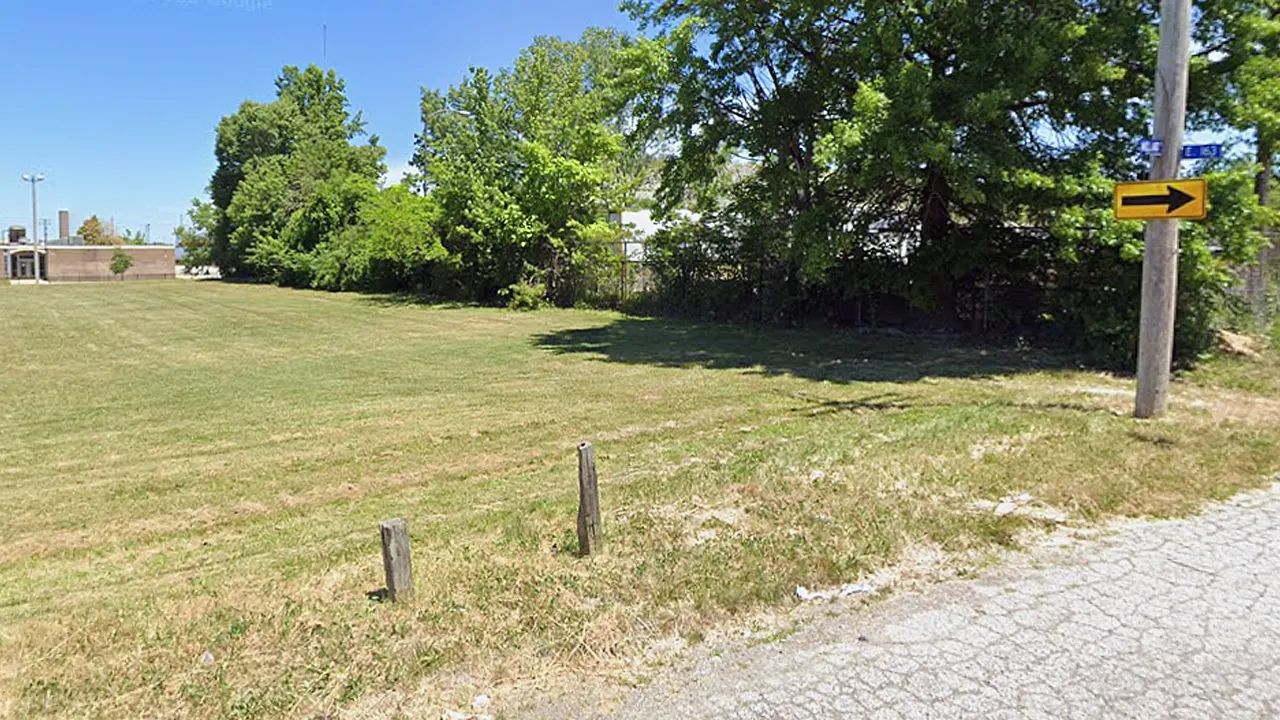
The discovery was made Monday evening after a man walking his dog near East 162nd Street and Midland Avenue, in a field near Ginn Academy, found a partially buried suitcase and called police.
Police responded and located a shallow grave and found a deceased individual in a suitcase. After canvassing the area, police found a second shallow grave and another suitcase containing a second individual.
Police searched the area near East 162nd Street and Midland Avenue following the discovery of two buried suitcases. (Google Maps)
The man who discovered one of the suitcases told Fox 8 that his dog ran toward a fence near a playground where the partially buried suitcase was found. He said he called police after unzipping the suitcase and seeing a head.
The girls have not been identified, and authorities have not determined a cause of death.
There are no active missing persons reports in Cleveland matching the victims, according to police, and it was unclear how long the girls had been inside the suitcases.
DOORBELL VIDEO SHOWS AUSTIN MASS SHOOTING SUSPECT LEAVING APARTMENT BEFORE DEADLY RAMPAGE
Authorities responded to a field in Cleveland where two girls were discovered in buried suitcases. (Tom Szczerbowski/Getty Images)
Todd described the discovery as a “terrible, horrific situation.”
“This is a traumatic event for our officers, for the community. This is just such a tragic incident, but we are trying to develop any leads we can. That’s why we are also asking for the community’s help,” Todd said.
“We know that this didn’t just happen. We still have to develop exactly when this happened. We don’t have any indication this is a clear threat to safety,” Todd said.
WHO IS MELANIE MCGUIRE? WHAT TO KNOW ABOUT THE ‘SUITCASE KILLER’ CONVICTED OF KILLING HER HUSBAND
On March 2, two girls were found dead in suitcases buried in shallow graves, police said. (Cleveland Division of Police)
The Cuyahoga County Medical Examiner’s Office has custody of the bodies.
Todd said the bodies had not been dismembered.
CLICK HERE TO DOWNLOAD THE FOX NEWS APP
The Cleveland Division of Police Homicide Unit launched a 24-hour tip line at 216-623-5464.
Related Article

Read the full article from Here



There was no shortage of things that went wrong for Luke Fickell and the University of Wisconsin football team during its 4–8 season in 2025.
You can point to the countless injuries at quarterback. You can point to an inconsistency at the skill positions. You can point to a lack of offensive identity. All of it is fair. But if you really strip it down from an execution standpoint, most of those problems trace back to one place.
Up front.
“That’s the number one thing offensively is the continuity of those guys up front,” Fickell said when asked about the focus for Wisconsin’s offensive line this spring. “I’m not going to dwell upon the past, but if there’s something that has probably not gone in the direction, individually or unit-wise, it has been the O-line. With the history here and what the expectations are here — that’s one of the big things.”
That’s not a throwaway line. That’s an acknowledgment.
Because for as much as the quarterback carousel defined last season, the offensive line never gave the offense a chance to stabilize or improve. There was constant shuffling. Players were asked to play out of position. Others were forced into roles they probably weren’t ready for yet.
And the result showed up in the numbers.
Wisconsin fielded the least productive offense in the Power Four last season, finishing No. 134 nationally in scoring (12.8 points per game) and No. 135 in total offense (253.1 yards per game). The run game — a foundational piece of the program’s identity — never found traction.
Then, after the season, more experience walked out the door.
Starting left guard Joe Brunner transferred to Indiana. Center Jake Renfro left for Illinois. Offensive tackle Riley Mahlman exhausted his eligibility.
Whatever continuity existed up front didn’t last.
So the response was predictable. Wisconsin moved on from A.J. Blazek and hired Eric Mateos as the new offensive line coach, leaning on his prior working relationship with offensive coordinator Jeff Grimes in hopes that familiarity can help this new group get up to speed quickly.
The next step was to go out and add bodies. A lot of them.
Most notably, Austin Kawecki arrives from Oklahoma State as a veteran presence expected to take over the starting center job. Kevin Heywood returns from an ACL injury and is expected to factor in at tackle. And then there’s P.J. Wilkins, an Ole Miss transfer who has primarily played guard in college but is now working at tackle since arriving in Madison.
That last part matters.
Because Mateos didn’t just inherit this group — he’s reshaping it.
“That’s what I really love about it, to be honest with you,” Fickell said about the offensive line. “I love being in that room right now because there are all new guys. There are some guys who played a little bit in [Colin] Cubberly and Emerson Mandell. But the nature of it is it’s a new group.”
It looks like one, too.
Colin Cubberly brings experience after being thrown into the fire last season. Emerson Mandell, who opened last year as the starting right guard, has shown positional flexibility after sliding out to tackle last season, but is now back working on the interior. Arkansas transfer Blake Cherry is competing on the interior, while younger or depth options like Lucas Simmons and Stylz Blackmon add competition behind them.
Even someone like Barrett Nelson, currently working back from another injury, is viewed as a candidate for the two-deep at tackle when healthy. There are more options. The challenge is turning that into answers.
“Look, we’ve got to get back to that group being a group,” said Fickell. “It’s not individuals. There are a lot of things we’ve got to be able to do… Yes, they understand the history. Yes, they understand the past. But it’s time to kind of say, ‘Look.’ This is a group that’s got to kind of reestablish the things that we believe in, and we are.”
And that’s where everything ties together. Because this isn’t just about fixing the offensive line in isolation, this is about supporting a completely reworked offense.
Nobody’s expecting this group to snap back to the gold standard of offensive line play that Wisconsin built its identity on overnight. But this is still a program that wants to run the ball, play with physicality up front, and lean into a system that now includes mobile quarterbacks.
Even if returning to an elite level immediately isn’t realistic, they do have to become a Big Ten-caliber unit — one capable of holding its own, creating movement, and giving the offense a chance to dictate terms instead of constantly reacting. Wisconsin has a new quarterback room led by Old Dominion transfer Colton Joseph. A reshaped running back group featuring Abu Sama and Darrion Dupree. A completely different mix at wide receiver. Changes at tight end. All of it depends on what happens up front.
If the line comes together, the Badgers’ offense has a path toward meaningful improvement after what was one of the least productive units Wisconsin has fielded in decades. If it doesn’t, it’s hard to see much changing, regardless of who’s under center or carrying the ball.
Fickell knows it. The staff knows it. The returning players know it.
Now it’s about proving it.
“I think that’s where a lot of the youth and the newer guys have been really refreshing — a little bit of a changeover,” Fickell said.
Refreshing is one way to put it. Necessary might be a better one. Because for Wisconsin to take a step forward and make it back to a bowl game for the first time since 2023, it starts where it always has. Up front.
We appreciate you taking the time to read our work at BadgerNotes.com. Your support means the world to us and has helped us become a leading independent source for Wisconsin Badgers coverage.
You can also follow Site Publisher Dillon Graff at @DillonGraff on X.

A former treatment facility in Detroit is the subject of a newly filed lawsuit, alleging that a teen was sexually abused while there.
The Detroit Behavioral Institute and Acadia Healthcare are listed in a new lawsuit filed in the Wayne County Circuit Court. According to the lawsuit, a 17-year-old was sent to the facility in 2015 and was allegedly sexually abused and groomed by a staff member over the next year.
“When he was restraining her, he’d fondle her and grope her. And it was under this sort of idea that he was calming her down,” said attorney Nicholas Wainwright with Gould, Grieco, and Hensley.
According to the lawsuit, the institute had two locations in Detroit, but the state suspended its license in 2022 after continuous abuse allegations.
Acadia Healthcare currently operates several treatment facilities in Michigan and across the country. CBS News Detroit reached out to the company on Wednesday and is awaiting a response.
“This is a company with a litany of problems at the state and federal level,” Wainwright told CBS News Detroit.
The lawsuit alleges that a staff member went as far as purchasing underwear for the victim.
“He would buy her lacy underwear, have inappropriate conversations about having affairs and cheating on his wife,” Wainwright said.
Last year, several victims filed lawsuits against Detroit Behavioral Institute and Acadia Healthcare, alleging similar accusations. The litigation for that case is still ongoing.
“How are they making sure, when two people restrain a kid, we’re checking to make sure the way they said it went down is the way it went down,” Wainwright said.
Wainwright alleges that the company started putting profits over people, which is when problems began to escalate.
“Then they stop focusing on things like hiring the top tier indivudals to be there, because they cost more money. They start focusing on how we can do this – cheaper and cheaper and cheaper,” Wainwright said.
According to the lawsuit, the victim suffered extreme emotional damage from her time at the facility.

A Milwaukee Common Council committee, this week, supported legislative action aimed at addressing the city’s food desert crisis on the city’s north side.At the April 8 Steering and Rules Committee meeting, leaders discussed at length the growing frustration with sudden closures of grocery stores and the minimal notice they said residents received before the businesses shut down.District 1 Alderwoman Andrea Pratt referenced the sudden January closure by owners of the Aldi near North Sherman Boulevard and West Custer Avenue.”They left me a voicemail on January 9 to tell me they were closing on January 11, which means that all those people in that neighborhood were left without a grocery store in two days. They found out on the news,” she said.The committee approved adopting a city ordinance to require licensed food establishments to provide the city written notice of their intent to close a business at least 60 days before the planned closure.The measure will go up for a vote by the full council.”They are there, not only to conduct business, but are very much a part of our neighborhoods and very much a part of our community; they have a responsibility, and they have to be accountable,” Pratt said of food businesses.The planned opening of a grocery store to replace the now-departed Sentry Foods at 64th and Silver Spring Drive in Ald. Mark Chambers Jr.’s district hit a snag.”The Sentry is going to be re-imaged and repurposed into a grocery called One City Supermarket that will be opening up soon, this month,” he said, “There are still some kinks that are coming out as far as accepting SNAP and things for the federal government, so that’s what’s holding up the grand opening on that one.A sign posted on the door said the grand opening was scheduled for April 26. It is unclear if the issue Chambers revealed would push the date.Chambers supported the 60-day notice ordinance along with the resolution to declare food apartheid a public health emergency in the city. A 2023 article published by Jo Walker for the University of Michigan School for Environment and Sustainability cited Karen Washington, a food justice advocate, for coining the term as drawing attention. Karen Washington, food justice advocate, organizer, and author, first coined the term food apartheid to draw attention to the “root causes of inequity in our food system based on race, class, and geography.” The article went on to say Washington emphasized “healthy, fresh food is accessible in wealthy neighborhoods while unhealthy food abounds in poor neighborhoods.””This is necessary because we, as alders on the Northside are severely impacted compared to our counterparts on the south side,” Chambers, who represents District 1 said.”You shouldn’t wake up in a food desert,” Ald. Pratt added.
A Milwaukee Common Council committee, this week, supported legislative action aimed at addressing the city’s food desert crisis on the city’s north side.
At the April 8 Steering and Rules Committee meeting, leaders discussed at length the growing frustration with sudden closures of grocery stores and the minimal notice they said residents received before the businesses shut down.
District 1 Alderwoman Andrea Pratt referenced the sudden January closure by owners of the Aldi near North Sherman Boulevard and West Custer Avenue.
“They left me a voicemail on January 9 to tell me they were closing on January 11, which means that all those people in that neighborhood were left without a grocery store in two days. They found out on the news,” she said.
The committee approved adopting a city ordinance to require licensed food establishments to provide the city written notice of their intent to close a business at least 60 days before the planned closure.
The measure will go up for a vote by the full council.
“They are there, not only to conduct business, but are very much a part of our neighborhoods and very much a part of our community; they have a responsibility, and they have to be accountable,” Pratt said of food businesses.
The planned opening of a grocery store to replace the now-departed Sentry Foods at 64th and Silver Spring Drive in Ald. Mark Chambers Jr.’s district hit a snag.
“The Sentry is going to be re-imaged and repurposed into a grocery called One City Supermarket that will be opening up soon, this month,” he said, “There are still some kinks that are coming out as far as accepting SNAP and things for the federal government, so that’s what’s holding up the grand opening on that one.
A sign posted on the door said the grand opening was scheduled for April 26. It is unclear if the issue Chambers revealed would push the date.
Chambers supported the 60-day notice ordinance along with the resolution to declare food apartheid a public health emergency in the city.
A 2023 article published by Jo Walker for the University of Michigan School for Environment and Sustainability cited Karen Washington, a food justice advocate, for coining the term as drawing attention.
Karen Washington, food justice advocate, organizer, and author, first coined the term food apartheid to draw attention to the “root causes of inequity in our food system based on race, class, and geography.” The article went on to say Washington emphasized “healthy, fresh food is accessible in wealthy neighborhoods while unhealthy food abounds in poor neighborhoods.”
“This [resolution] is necessary because we, as alders on the Northside [of Milwaukee] are severely impacted compared to our counterparts on the south side,” Chambers, who represents District 1 said.
“You shouldn’t wake up in a food desert,” Ald. Pratt added.

A Utah woman helped bring down a polygamous sect leader. Now her story is on Netflix.

Can filmmakers grow VT’s movie industry?; ‘Leather Clad’ ready to try

Randolph-Macon College offers free stargazing through one of Virginia’s largest telescopes

Meet Malik Hardy ’26

Wisconsin football offensive line rebuild starts with continuity, competition

Florida High School Football Rankings: Top 25 teams – Oct. 21

How old is Bo Nix? What to know about Oregon quarterback ahead of 2024 NFL Draft

Cleary's 21 help Le Moyne down Central Connecticut State 69-64 in OT

99th annual Pony Swim held in Virginia

Indiana Members Credit Union announced as new anchor tenant at Bottleworks District

Video: The Fragile Cease-Fire in Iran

Spanberger ripped after taking credit for billions in investments secured under GOP predecessor: ‘Pathetic’

Newsletter: NATO holds amid fragile Iran ceasefire

Jim Whittaker, the first American to summit Mount Everest, dies at 97

Video: Military Families Bear the Burden of War, Again
-

 Atlanta, GA4 days ago
1 teenage girl killed, another injured in shooting at Piedmont Park, police say
-

 Culture1 week ago
Do You Know Where These Famous Authors Are Buried?
-

 Movie Reviews1 week ago
Vaazha 2 first half review: Hashir anchors a lively, chaos-filled teen tale
-

 Georgia2 days ago
Georgia House Special Runoff Election 2026 Live Results
-

 Education1 week ago
Video: We Put Dyson’s $600 Vacuum to the Test
-

 Pennsylvania2 days ago
Parents charged after toddler injured by wolf at Pennsylvania zoo
-
 Milwaukee, WI3 days ago
Potawatomi Casino Hotel evacuated after fire breaks out in rooftop HVAC system
-
 Entertainment1 week ago
Inside Ye’s first comeback show at SoFi Stadium