
Connect with us

News

U.S. and Iran agree to 2-week ceasefire

Published

on

U.S. and Iran agree to 2-week ceasefire

Iranians react after a ceasefire announcement at the Enqelab square, in Tehran, on April 8 2026.

STR/AFP via Getty Images


hide caption

toggle caption

Advertisement

STR/AFP via Getty Images

The U.S. and Iran reached a ceasefire deal on Tuesday, less than two hours before the deadline President Trump imposed for Iran to meet his demands or else face wide-scale destruction.

As part of the agreement, set to take effect immediately, Trump said the U.S. and Israel would suspend bombing Iran for two weeks, subject to Iran following through on its commitment to reopen the Strait of Hormuz for safe passage during the ceasefire period, a strategic waterway through which about 20% of the world’s oil supplies passes.

Oil prices plunged and stocks surged at the announcement of a pause in fighting, with Brent crude oil dropping to $94.74, or by over 13 %.

Advertisement

In the early hours of the ceasefire, Israel disputed that the deal included a pause of its attacks on Iran-backed Hezbollah in Lebanon.

The negotiations — facilitated by Pakistan — mark a breathtaking comedown from Trump’s pledge made early Tuesday that a “whole civilization will die tonight, never to be brought back again” if a deal could not be reached by 8 p.m. ET to open the strait.

In announcing the deal, Trump wrote on his social media platform: “This will be a double sided CEASEFIRE! The reason for doing so is that we have already met and exceeded all Military objectives, and are very far along with a definitive Agreement concerning Longterm PEACE with Iran, and PEACE in the Middle East.”

Trump added that Iran has proposed a “workable” 10-point peace plan that includes what he described as “points of past contention,” which “have been agreed to between the United States and Iran.” The extra time, he said, will allow the agreement to be finalized.

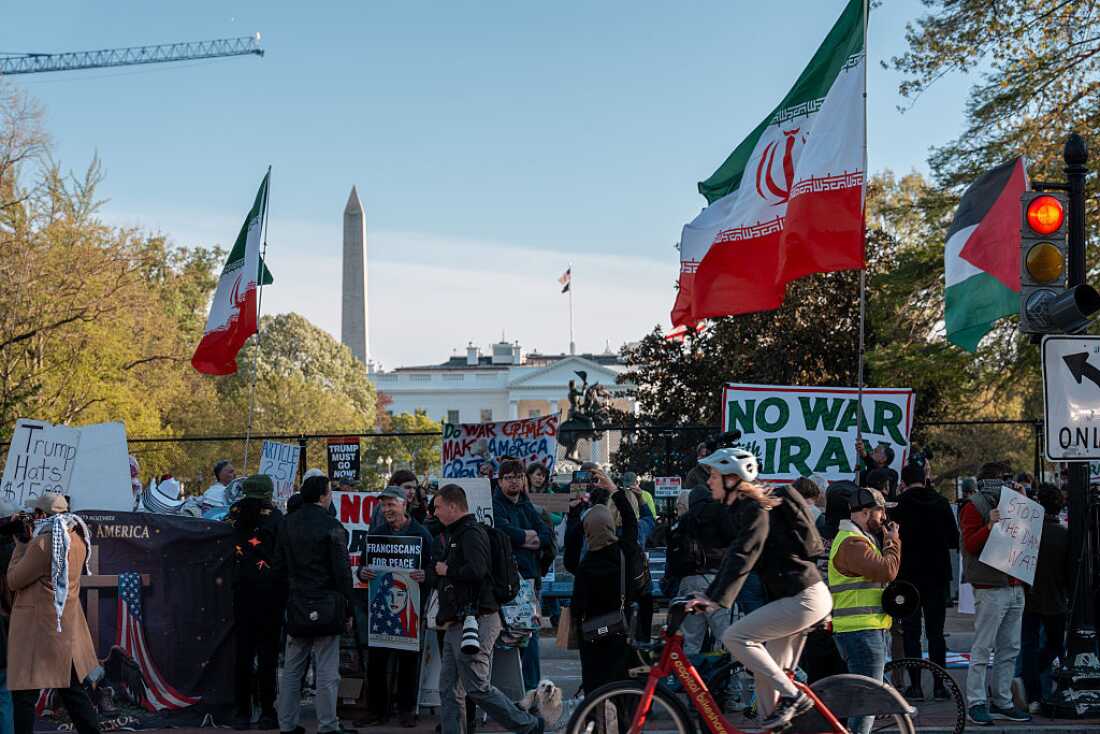
Protesters in opposition to the war with Iran gather outside of Lafayette Park across from the White House on April 7, 2026 in Washington, DC.

Protesters in opposition to the war with Iran gather outside of Lafayette Park across from the White House on April 7, 2026 in Washington, DC.

Andrew Leyden/Getty Images North America

Advertisement


hide caption

toggle caption

Andrew Leyden/Getty Images North America

Advertisement

Iran’s plan, as published by the Iranian Mehr news agency, consists of a set of conditions that Iran claims the U.S. administration has accepted. They include Iran’s control over the Strait of Hormuz, acceptance of its nuclear enrichment, the withdrawal of all U.S. combat forces from the region, the lifting of all sanctions and U.N. resolutions against Iran, compensation of damages to Iran as well as cessation of war in all fronts, including in Lebanon.

NPR is working to independently verify if the plan provided to the U.S. administration is the same as the one published by Iranian state-controlled media.

The Iranian proposal was delivered to the United States via Pakistan.

Pakistan Prime Minister Shehbaz Sharif, who has been acting as an intermediary between Tehran and Washington, said the ceasefire will take effect immediately, and includes “Lebanon and elsewhere.” The prime minister will remain at the forefront of negotiations in the coming week. He has invited delegations from the U.S. and Iran to “settle all disputes” in continued diplomatic talks in Islamabad on Friday.

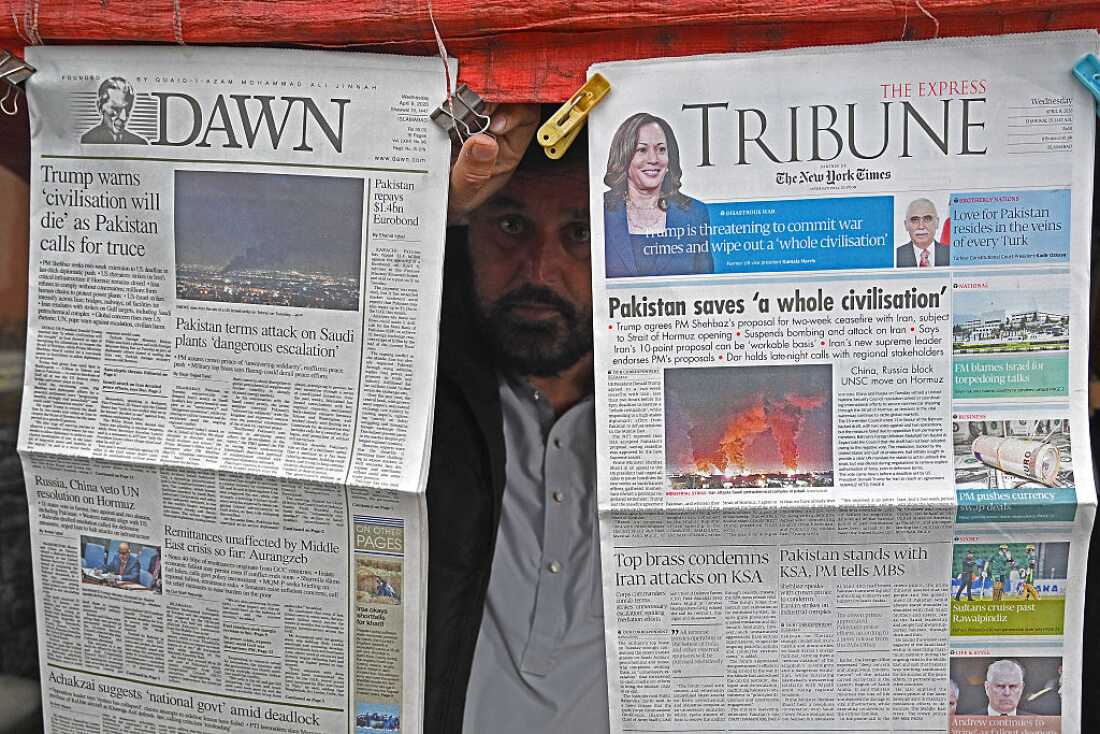
A vendor displays morning newspapers at his roadside stall in Islamabad on April 8, 2026. Pakistan's Prime Minister Shehbaz Sharif said on April 8 that the United States, Iran and their allies had agreed to a ceasefire "everywhere", including Lebanon, following mediation by his government to stop weeks of fighting.

A vendor displays morning newspapers at his roadside stall in Islamabad on April 8, 2026. Pakistan’s Prime Minister Shehbaz Sharif said on April 8 that the United States, Iran and their allies had agreed to a ceasefire “everywhere”, including Lebanon, following mediation by his government to stop weeks of fighting.

Aamir Qureshi/AFP via Getty Images

Advertisement


hide caption

toggle caption

Aamir Qureshi/AFP via Getty Images

Advertisement

Here are more updates from the region today:

Iran reaction | Dispute over Hezbollah | Shelly Kittleson freed

Iranian leaders hail ceasefire as victory

Iranian leaders are also touting the ceasefire as a victory, noting that the “criminal U.S.” has agreed to “the general framework” of Iran’s 10-point proposal.

“Good news to the dear nation of Iran! Nearly all the objectives of the war have been achieved,” the Supreme National Security Council said in a statement.

Iran officials warned that any deviation from the agreement could lead to future violence.

Advertisement

“Our hands are on the trigger, and the moment the enemy makes the slightest mistake, it will be met with full force,” the Supreme National Security Council said.

Iran’s foreign minister, Seyed Abbas Araghchi, thanked Pakistan Prime Minister Sharif for his role in the negotiations.

“If attacks against Iran are halted our Powerful Armed Forces will cease their defensive operations,” Araghchi said in a statement. He added: “For a period of two weeks, safe passage through the Strait of Hormuz will be possible via coordination with Iran’s Armed Forces and with due consideration of technical limitations.”

Israel disputes ceasefire over Hezbollah in Lebanon

Just hours after the pause in violence was announced there appeared to be disagreement over who would be granted a reprieve from the strikes.

Israeli Prime Minister Benjamin Netanyahu’s office said in a statement Wednesday morning that it supports Trump’s decision to suspend strikes against Iran for two weeks, but that the ceasefire doesn’t include Lebanon, despite Pakistan’s prime minister saying otherwise.

Advertisement

It’s unclear where negotiations stand regarding Iran’s position that it can continue its enrichment of uranium. In his statement, Netanyahu said Israel “supports U.S. efforts to ensure Iran no longer poses a nuclear or missile threat.

“Both parties have displayed remarkable wisdom and understanding and have remained constructively engaged in furthering the cause of peace and stability,” Sharif wrote in a post on X, and expressed optimism that the Islamabad talks would result in sustainable peace.

A man flashes the V-sign while driving a vehicle loaded with belongings through the al-Qassimyah area en route to southern Lebanon early on April 8, 2026, after the United States and Iran agreed to a two-week ceasefire. Israel renewed its strikes on southern Lebanon on April 8, state media reported, as the Israeli prime minister insisted the Iran war truce does not include Lebanon.

A man flashes the V-sign while driving a vehicle loaded with belongings through the al-Qassimyah area en route to southern Lebanon early on April 8, 2026, after the United States and Iran agreed to a two-week ceasefire. Israel renewed its strikes on southern Lebanon on April 8, state media reported, as the Israeli prime minister insisted the Iran war truce does not include Lebanon.

Kawnat Haju/AFP via Getty Images


hide caption

Advertisement

toggle caption

Kawnat Haju/AFP via Getty Images

Prior to the ceasefire agreement, Trump had threatened to destroy bridges, power plants and water treatment facilities; moves that would have imperiled the entire population of Iran.

His comments drew a rebuke from Pope Leo XIV, who called Trump’s threat to destroy Iran “truly unacceptable.”

Advertisement

He called on people to contact their political leaders and congressional representatives to press for dialogue.

“We have a worldwide economic crisis, an energy crisis, situation in the Middle East of great instability, which is only provoking more hatred throughout the world,” he said.

“Come back to the table – let’s talk, let’s look for solutions in a peaceful way,” he added.

Wide-scale destruction of infrastructure, without any distinction between civilian and military targets, would be considered a war crime under international and U.S. law, legal experts tell NPR.

American journalist Kittleson is freed

Freelance journalist Shelly Kittleson has been released a week after she was kidnapped by Kataib Hezbollah, the Iranian-backed Iraqi militant group.

Advertisement

“We are relieved that this American is now free and are working to support her safe departure from Iraq,” Secretary of State Marco Rubio wrote in a statement on X on Tuesday evening.

Kittleson, 49, has spent over a decade covering the Middle East, according to Columbia Journalism Review. She was captured by the militia group on March 31, in broad daylight on a Baghdad street corner. Her release was a multi-agency effort, according to Rubio.

U.S. journalist Shelly Kittleson poses for a cellphone photo in a cafe in Baghdad, Iraq, March 30.

U.S. journalist Shelly Kittleson poses for a cellphone photo in a cafe in Baghdad, Iraq, March 30.

AP


hide caption

Advertisement

toggle caption

AP

“The U.S. Department of State extends its appreciation to the Federal Bureau of Investigation, the Department of War, U.S. personnel across multiple agencies, and the Iraqi Supreme Judicial Council and our Iraqi partners, for their assistance in securing her release,” Rubio said.

He added: “Under President Trump, the wrongful detention or kidnapping of U.S. nationals will not be tolerated. We will continue to use every tool to bring Americans home and to hold accountable those responsible.”

Advertisement

Kataib Hezbollah, one of Iraq’s most powerful Shia paramilitaries, announced earlier on Tuesday that it was releasing Kittleson in appreciation of “the patriotic positions” of Iraq’s prime minister, who helped negotiate her release. It said she had to leave the country immediately.

The group in Iraq is not related to the Lebanese militant group Hezbollah. It’s part of a coalition of Iran-backed militias that have been attacking U.S. military and government targets in Iraq. The U.S. and Israel have launched airstrikes in response.

When Kittleson was kidnapped last week, the U.S. State Department said it had warned her of threats against her beforehand, and that it was working with the FBI to secure her release. The U.S. Embassy in Baghdad has said all American citizens should leave Iraq because of attacks.

News

Springfield’s Haitian Workers and Businesses Face Uncertain Future

Published

on

Springfield’s Haitian Workers and Businesses Face Uncertain Future

When Stanley Charles, a Haitian immigrant, arrived in Springfield, Ohio, in 2021, “it was like a desert,” he recently recalled.

The industrial city had been losing population for decades, and some streets were lined with boarded-up, dilapidated homes.

To revive the city, Springfield’s leaders lured auto parts manufacturers, warehouses and other businesses to the area. But once the companies began operating, they struggled to find workers.

Then a wave of Haitian immigrants arrived, helping fill the labor shortage.

Now, many of those Haitians are facing a very uncertain future. The Trump administration wants to end Temporary Protected Status, a humanitarian program that has allowed about 350,000 Haitians, including thousands in Springfield, to live and work in the United States for years because of instability in their home country.

Advertisement

The program’s fate rests with the Supreme Court, which is hearing oral arguments on Wednesday to determine whether the administration has the legal authority to terminate it. A decision is expected by July. If the court rules in the administration’s favor, Haitians would lose their work permits and become subject to deportation.

Springfield, about an hour’s drive west of the Ohio capital, Columbus, could be reshaped by the Supreme Court’s decision.

A few years ago, word spread among Haitians that jobs were plentiful in Springfield. Thousands, some newly arrived to the United States after crossing the border, others relocating from states like Florida and New York, settled there.

“We Haitian people came, we began to work, pay taxes,” Mr. Charles said. “We helped this city develop.”

Between 10,000 and 15,000 Haitians live in the city of 58,000, according to county estimates.

Advertisement

The influx of newcomers initially caused friction. A local health clinic had to hire additional staff; schools had to accommodate new students; and some city services were strained.

Then during the 2024 presidential campaign, Donald J. Trump and his Ohio-born running mate, JD Vance, repeated a baseless claim — that Haitians in Springfield were eating their neighbors’ pets.

White supremacists descended on the city, bomb threats were made against schools and some Haitians moved to other cities. But many remained and carried on with their lives, said Heidi Earlywine, who mentors Haitian families and teaches them English at Central Christian Church.

Now, though, the Trump administration’s push to end T.P.S. has left many Haitians anxious and injected uncertainty into the local economy.

A Haitian exodus could derail Springfield’s momentum just as it rolls out “Springfield 2051,” a road map for the city ahead of its 250th anniversary.

Advertisement

While most employers have not spoken publicly, local and state officials have voiced concern about losing Haitian workers.

“We would have manufacturers and businesses that don’t have employees,” said Charlie Patterson, a commissioner in Clark County, which includes Springfield.

“They will be looking for workers for jobs they couldn’t fill before,” he said in an interview.

The Ohio governor, Mike DeWine, a Republican who has championed the contribution of Haitians, has warned that ending T.P.S. would be a “mistake.”

In early February, a federal judge in Washington paused the government’s termination of T.P.S. for Haiti, finding that the administration’s move had been “arbitrary and capricious” and had failed to consider the perilous conditions in Haiti. On March 6, a three-judge appellate panel affirmed that decision. Five days later, the Trump administration asked the Supreme Court to intervene.

Advertisement

Mr. Charles, 45, who worked at a telecommunications company in Port-au-Prince, fled Haiti after being threatened and imprisoned for his political opposition activities, he said.

After entering the United States in 2021 on a tourist visa, he qualified for T.P.S. under the Biden administration. He also applied for asylum, which, if granted, would allow him to remain in the country even if T.P.S. is revoked.

For now, he operates robots at a manufacturing plant and sends money to his wife and other family members in Haiti.

“They all depend on me,” he said. “We are here because our country is not functioning.”

Advertisement
Continue Reading

News

Read the complete transcript of King Charles III’s speech to Congress

Published

on

Read the complete transcript of King Charles III’s speech to Congress

WASHINGTON (AP) — King Charles III extolled the bonds between Britain and the United States in a speech to Congress. Here is the full text:

“Mr. Vice President, Mr. Speaker, members of Congress, representatives of the American people across all states, territories, cities and communities.

“I would like to take this opportunity to express my particular gratitude to you all for the great honor of addressing this joint meeting of Congress and, on behalf of the queen and myself, to thank the American people for welcoming us to the United States to mark this semi-quincentennial year of the Declaration of Independence.

“And for all of that time, our destinies as nations have been interlinked. As Oscar Wilde said, ‘We have really everything in common with America nowadays except, of course, language.’

“Ladies and gentlemen, we meet in times of great uncertainty; in times of conflict from Europe to the Middle East which pose immense challenges for the international community and whose impact is felt in communities the length and breadth of our own countries.

Advertisement

“We meet, too, in the aftermath of the incident not far from this great building that sought to harm the leadership of your nation and to foment wider fear and discord.

“Let me say with unshakeable resolve: such acts of violence will never succeed. Whatever our differences, whatever disagreements we may have, we stand united in our commitment to uphold democracy, to protect all our people from harm, and to salute the courage of those who daily risk their lives in the service of our countries.

“Standing here today, it is hard not to feel the weight of history on my shoulder — because the modern relationship between our two nations and our own peoples spans not merely 250 years, but over four centuries. It is extraordinary to think that I am the 19th in our line of sovereigns to study, with daily attention, the affairs of America.

“So, I come here today with the highest respect for the United States Congress, this citadel of democracy created to represent the voice of all American people to advance sacred rights and freedoms.

“Speaking in this renowned chamber of debate and deliberation, I cannot help but think of my late mother, Queen Elizabeth, who, in 1991, was also afforded this signal honor and similarly spoke under the watchful eye of the Statue of Freedom above us. Today I am here on this great occasion in the life of our nations to express the highest regard and friendship of the British people to the people of the United States.

Advertisement

“As you may know, when I address my own Parliament at Westminster, we still follow an age-old tradition and take a member of Parliament ‘hostage,’ holding him or her at Buckingham Palace until I am safely returned. These days, we look after our ‘guest’ rather well – to the point that they often do not want to leave. I don’t know, Mr. Speaker, if there were any volunteers for that role here today?

“As I look back across the centuries, Mr. Speaker, there emerge certain patterns, certain self-evident truths from which we can learn and draw mutual strength.

“With the spirit of 1776 in our minds, we can perhaps agree that we do not always agree – at least in the first instance. Indeed, the very principle on which your Congress was founded – no taxation without representation – was at once a fundamental disagreement between us, and at the same time a shared democratic value which you inherited from us.

“Ours is a partnership born out of dispute, but no less strong for it, so perhaps, in this example, we can discern that our nations are in fact instinctively like-minded – a product of the common democratic, legal and social traditions in which our governance is rooted to this day.

“Drawing on these values and traditions, time and again, our two countries have always found ways to come together. And by Jove, Mr. Speaker, when we have found that way to agree, what great change is brought about – not just for the benefit of our peoples, but of all peoples.

Advertisement

“This, I believe, is the special ingredient in our relationship. As President Trump himself observed during his state visit to Britain last autumn, ‘The bond of kinship and identity between America and the United Kingdom is priceless and eternal. It is irreplaceable and unbreakable.’

“This is by no means my first visit to Washington DC – the capital of this great republic. It is in fact my 20th visit to the United States, and my first as King and head of the Commonwealth.

“This is a city which symbolizes a period in our shared history, or what Charles Dickens might have called ‘A Tale of Two Georges’: the first President, George Washington, and my five-times Great Grandfather, King George III. King George never set foot in America and, please rest assured, I am not here as part of some cunning rearguard action.

“The Founding Fathers were bold and imaginative rebels with a cause. Two hundred and fifty years ago, or, as we say in the United Kingdom ‘just the other day,’ they declared Independence. By balancing contending forces and drawing strength in diversity, they united 13 disparate colonies to forge a nation on the revolutionary idea of ‘life, liberty and the pursuit of happiness.’ They carried with them, and carried forward, the great inheritance of the British Enlightenment – as well as the ideals which had an even deeper history in English common law and Magna Carta.

“These roots run deep, and they are still vital. Our Declaration of Rights of 1689 was not only the foundation of our constitutional monarchy, but also provided the source of so many of the principles reiterated, often verbatim, in the American Bill of Rights of 1791.

Advertisement

“And those roots go even further back in our history: the U.S. Supreme Court Historical Society has calculated that Magna Carta is cited in at least 160 Supreme Court cases since 1789, not least as the foundation of the principle that executive power is subject to checks and balances.

“This is the reason why there stands a stone, by the River Thames at Runnymede where Magna Carta was signed in the year 1215. This stone records that an acre of that ancient and historic site was given to the United States of America by the people of the United Kingdom, to symbolize our shared resolve in support of liberty, and in memory of President John F. Kennedy.

“Distinguished members of the 119th Congress, it is here in these very halls that this spirit of liberty and the promise of America’s founders is present in every session and every vote cast.

“Not by the will of one, but by the deliberation of many, representing the living mosaic of the United States. In both of our countries, it is the very fact of our vibrant, diverse and free societies that gives us our collective strength, including to support victims of some of the ills that, so tragically, exist in both our societies today.

“And, Mr. Speaker, for many here – and for myself – the Christian faith is a firm anchor and daily inspiration that guides us not only personally, but together as members of our community. Having devoted a large part of my life to interfaith relationships and greater understanding, it is that faith in the triumph of light over darkness which I have found confirmed countless times.

Advertisement

“Through it I am inspired by the profound respect that develops as people of different faiths grow in their understanding of each other. It is why it is my hope – my prayer – that, in these turbulent times, working together and with our international partners, we can stem the beating of plowshares into swords.

“I am mindful that we are still in the season of Easter, the season that most strengthens my hope. It is why I believe, with all my heart, that the essence of our two nations is a generosity of spirit and a duty to foster compassion, to promote peace, to deepen mutual understanding and to value all people, of all faiths, and of none.

“The alliance that our two nations have built over the centuries, and for which we are profoundly grateful to the American people, is truly unique. And that alliance is part of what Henry Kissinger described as Kennedy’s ‘soaring vision’ of an Atlantic partnership based on twin pillars: Europe and America. That partnership, I believe Mr. Speaker, is more important today than it has ever been.

“The first reigning British sovereign to set foot in America was my grandfather, King George VI. He visited in 1939 with my beloved grandmother, Queen Elizabeth the Queen Mother. The forces of fascism in Europe were on the march, and some time before the United States had joined us in the defense of freedom. Our shared values prevailed.

“Today, we find ourselves in a new era, but those values remain.

Advertisement

“It is an era that is, in many ways, more volatile and more dangerous than the world to which my late mother spoke, in this chamber, in 1991.

“The challenges we face are too great for any one nation to bear alone. But in this unpredictable environment, our alliance cannot rest on past achievements, or assume that foundational principles simply endure. As my Prime Minister said last month: ‘ours is an indispensable partnership. We must not disregard everything that has sustained us for the last eighty years. Instead, we must build on it.’

“Renewal today starts with security. The United Kingdom recognizes that the threats we face demand a transformation in British defense.

“That is why our country, in order to be fit for the future, has committed to the biggest sustained increase in defense spending since the Cold War – during part of which, over 50 years ago, I served with immense pride in the Royal Navy, following in the naval footsteps of my father, Prince Philip, Duke of Edinburgh; my grandfather, King George VI; my great uncle, Lord Mountbatten; and my great grandfather, King George V.

“This year, of course, also marks the 25th anniversary of 9/11. This atrocity was a defining moment for America and your pain and shock were felt around the whole world. During my visit to New York, my wife and I will again pay our respects to the victims, the families, and the bravery shown in the face of terrible loss. We stood with you then. And we stand with you now in solemn remembrance of a day that shall never be forgotten.

Advertisement

“In the immediate aftermath of 9/11, when NATO invoked Article Five for the first time, and the United Nations Security Council was united in the face of terror, we answered the call together – as our people have done so for more than a century, shoulder to shoulder, through two World Wars, the Cold War, Afghanistan and moments that have defined our shared security.

“Today, Mr. Speaker, that same, unyielding resolve is needed for the defense of Ukraine and her most courageous people. It is needed in order to secure a truly just and lasting peace. From the depths of the Atlantic to the disastrously melting icecaps of the Arctic, the commitment and expertise of the United States Armed Forces and its allies lie at the heart of NATO, pledged to each other’s defense, protecting our citizens and interests, keeping North Americans and Europeans safe from our common adversaries.

“Our defense, intelligence and security ties are hard-wired together through relationships measured not in years, but in decades.

“Today, thousands of U.S. service personnel, defense officials and their families are stationed in the United Kingdom, as British personnel serve with equal pride across 30 American states. We are building F-35s together. And we have agreed the most ambitious submarine program in history, AUKUS, in partnership with Australia, a country of which I am also immensely proud to serve as sovereign.

“We do not embark on these remarkable endeavors together out of sentiment. We do so because they build greater shared resilience for the future, so making our citizens safer for generations to come.

Advertisement

“Our common ideals were not only crucial for liberty and equality, they are also the foundation of our shared prosperity. The rule of law: the certainty of stable and accessible rules, an independent judiciary resolving disputes and delivering impartial justice. These features created the conditions for centuries of unmatched economic growth in our two countries. This is why our governments are concluding new economic and technology agreements – to write the next chapter of our joint prosperity and ensure that British and American ingenuity continues to lead the world.

“Our nations are combining talent and resources in the technologies of tomorrow: our new partnerships in nuclear fusion and quantum computing, and in AI and drug discovery, holding the promise of saving countless lives.

“More broadly, we celebrate the 430 billion dollars in annual trade that continues to grow, the 1.7 trillion dollars in mutual investment that fuels that innovation, and the millions of jobs on both sides of the Atlantic supported across both economies. These are strong foundations on which to continue to build, for generations yet unborn.

“Our ties in education, research, and cultural exchange empower citizens and future leaders of both countries.

“The Marshall Scholarship, named after the great General George Marshall, and the Association of which I am so proud to be patron, are emblematic of the connection between our two countries.

Advertisement

“Since its founding, more than 2,300 scholarships have been awarded, opening doors for Americans from all walks of life to study at the United Kingdom’s leading universities.

“So as we look toward the next 250 years, we must also reflect on our shared responsibility to safeguard nature, our most precious and irreplaceable asset.

“Millennia before our nations existed, before any border drawn, the mountains of Scotland and Appalachia were one, a single, continuous range, forged in the ancient collision of continents.

“The natural wonders of the United States of America are indeed a unique asset, and generations of Americans have risen to this calling: indigenous, political and civic leaders, people in rural communities and cities alike, have all helped to protect and nurture what President Theodore Roosevelt called ‘the glorious heritage’ of this land’s extraordinary natural splendor, on which so much of its prosperity has always depended.

“Yet even as we celebrate the beauty that surrounds us, our generation must decide how to address the collapse of critical natural systems which threatens far more than the harmony and essential diversity of nature. We ignore at our peril the fact that these natural systems, in other words, nature’s own economy, provide the foundation for our prosperity and our national security.

Advertisement

“The story of the United Kingdom and the United States is, at its heart, a story of reconciliation, renewal and remarkable partnership.

“From the bitter divisions of 250 years ago, we forged a friendship that has grown into one of the most consequential alliances in human history.

“I pray with all my heart that our alliance will continue to defend our shared values, with our partners in Europe and the Commonwealth, and across the world, and that we ignore the clarion calls to become ever more inward-looking.

“Mr. Speaker, Mr. Vice-President, distinguished ladies and gentlemen, America’s words carry weight and meaning, as they have since Independence.

“The actions of this great nation matter even more.

Advertisement

“President Lincoln understood this so well, with his reflection in the magisterial Gettysburg Address that the world may little note what we say, but will never forget what we do.

“And so, to the United States of America, on your 250th birthday, let our two countries rededicate ourselves to each other in the selfless service of our peoples and of all the peoples of the world.

“God bless the United States and God bless the United Kingdom.”

Advertisement
Continue Reading

News

Beneath King Charles’s Jokes and Decorum, Some Subtle Rebuttals to Trump

Published

on

Beneath King Charles’s Jokes and Decorum, Some Subtle Rebuttals to Trump

King Charles III quoted Oscar Wilde, joking that the British have everything in common with America “except, of course, language.” President Trump said the morning’s gloomy rain reminded him of a “beautiful British day” and noted that his mother thought young Prince Charles was “so cute.” Both men waxed poetic about the bonds between their countries.

And yet, on the first full day of a state visit focused on the shared history between the United States and Britain, the king sprinkled in some ever-so-subtle rebuttals to Mr. Trump. Charles spoke on Tuesday of the value of the trans-Atlantic alliance, the importance of checks and balances and his passion for the environment. He even spoke of his time in the Royal Navy, after Mr. Trump belittled British naval capabilities in recent weeks.

The king tucked his rejoinders into a mostly lighthearted speech to Congress on Tuesday afternoon and during evening remarks at a formal banquet at the White House.

“Please rest assured I am not here as part of some cunning rear-guard action!” the king told lawmakers in the afternoon, only the second time a British monarch had addressed Congress.

The mostly disciplined and careful public appearances by both Charles and Mr. Trump came at a dire moment in American-British relations, arguably at their lowest point in decades over the war in Iran and Mr. Trump’s scathing attacks on NATO.

Advertisement

But for a day (and maybe just a day), the special relationship that has developed over the past 250 years seemed — on the surface at least — special.

In a rarity for the Trump era, the president stuck mostly to his script during the day’s ceremonial events. He did not invite a horde of reporters into the Oval Office just before their meeting to field questions on Iran, the ballroom or Greenland in the presence of his visiting foreign dignitary. He did not lash out at another global ally.

In one apparently unscripted remark during the state dinner, Mr. Trump referred to the war in Iran and insisted that “Charles agrees with me.” It was an awkward moment because Charles studiously stays out of such matters of war and politics.

For the most part, though, Mr. Trump lavished the king with praise throughout the day.

“Before we ever proclaimed our independence, Americans carried within us the rarest of gifts — moral courage — and it came from a small but mighty kingdom from across the sea,” Mr. Trump said on Tuesday morning as he welcomed Charles to the White House.

Advertisement

There is little evidence in more recent history that an era of good feeling will last much beyond the departure of the royal couple’s jet from American shores on Thursday, particularly as Mr. Trump’s well-known affection for the royals does not extend to the British government.

Mr. Trump is furious at Britain for its refusal to join the fight against Iran, and his administration continues to accuse the British government of denying free speech to conservative voices. In London, Prime Minister Keir Starmer vows not to be dragged into another war of America’s choosing, and bristles at the president’s description of Britain’s aircraft carriers as nothing more than “toys.”

Those differences were never likely to be erased by the king’s first visit to the United States as the British monarch. By law and tradition, the king is supposed to rise above the disputes that often bedevil the leaders of both governments.

Mr. Trump was a guest of the royal family for a state dinner at Windsor Castle in September, an experience he described as “one of the highest honors of my life.” Months later, he belittled Mr. Starmer as a coward for not entering the U.S.-Israeli war with Iran.

“That was not very long ago and look where we are in terms of the bilateral relationship,” said Philippe Dickinson, deputy director at the Atlantic Council’s Transatlantic Security Initiative. “It can be cited as evidence by those who are going to make the case that it’s nice words one day and then forgotten the next day.”

Advertisement

Charles chose his words carefully during his public remarks.

During his speech to Congress, he appeared to address — obliquely — the Jeffrey Epstein scandal, which has caused political headaches for the Trump administration and led to a rupture in the royal family.

“In both of our countries, it is the very fact of our vibrant, diverse and free societies that gives us our collective strength, including to support victims of some of the ills that, so tragically, exist in both our societies today,” Charles said.

He also drew a standing ovation during his speech to Congress when he spoke about how the concept of checks and balances in American government has its roots in English history. Mr. Trump has worked to significantly expand executive power.

Charles said the U.S. Supreme Court Historical Society found that Magna Carta was cited in at least 160 Supreme Court cases since 1789, “not least as the foundation of the principle that executive power is subject to checks and balances.”

Advertisement

He spoke of “the natural wonders” of the United States and “our shared responsibility to safeguard nature, our most precious and irreplaceable asset.” Charles is an avid environmentalist; Mr. Trump, by contrast, pulled out of the Paris agreement on climate change, making the United States the only country in the world to abandon the international commitment to slow global warming.

The king spoke of his own service in the Royal Navy more than a half-century ago, and repeated Mr. Starmer’s assertion that Britain had “committed to the biggest sustained increase in defense spending since the Cold War.”

He also pushed back, gently, against Mr. Trump’s attacks on Britain and on the NATO alliance for not joining in the Iran war. After the Sept. 11, 2001, attacks, the king told lawmakers, “We answered the call together — as our people have done so for more than a century.”

And at the start of the evening’s state dinner, Charles recalled how the two nations have had “moments of difficulty” in the past, including in 1957 when Queen Elizabeth II visited the United States after the Suez Canal crisis.

“It is hard to imagine anything like that happening today,” Charles said, as some dinner guests laughed, causing Trump to turn and smile. “But it is not hard to see how important the relationship remains in matters both seen and unseen.”

Advertisement

While it was unclear whether the king’s appeal would be enough to mend the wounds in the trans-Atlantic relationship, Mr. Dickinson said the British were probably hoping the visit created a pathway to recovery.

“That’s why the government values the royal family as a diplomatic ace in the hand,” he said. “It’s not a magic wand, but it helps.”

Continue Reading
Advertisement

Trending
