Midwest
People with disabilities sue in Wisconsin over lack of electronic absentee ballots

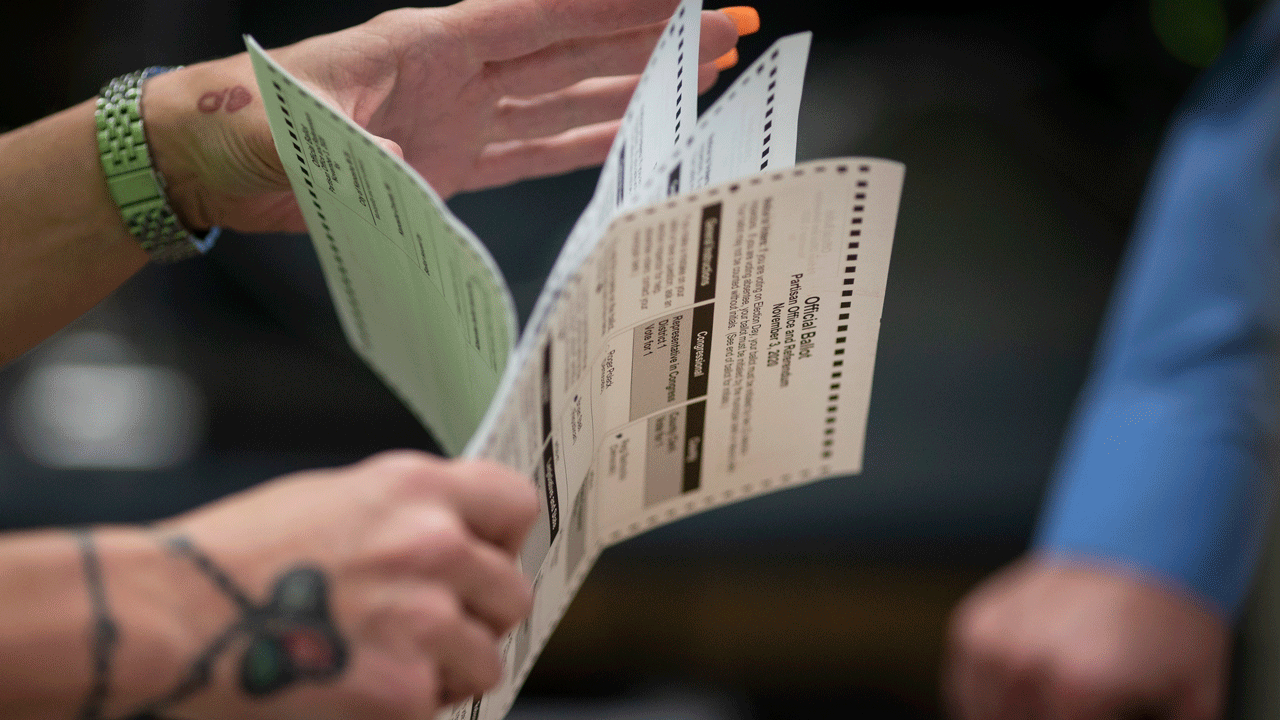
MADISON, Wis. (AP) — Wisconsin voters with disabilities should be able to cast their ballots electronically and failure to provide that option for the upcoming Aug. 13 primary and November presidential election is discriminatory and unconstitutional, a lawsuit filed Tuesday in the battleground state alleges.
The lawsuit seeks to require that electronic absentee voting be an option for people with disabilities, just as it is for military and overseas voters. Under current Wisconsin law, people with disabilities are “treated unequally and face real and considerable hurdles to participating in absentee voting,” the lawsuit argues.
WI ELECTIONS COMMISSION APPROVES GUIDANCE, VOTERS WITH DISABILITIES CAN RECEIVE HELP WITH ABSENTEE BALLOTS
Absentee ballots, including who can return them and where, have been a political flashpoint in swing state Wisconsin, where four of the past six presidential elections have been decided by less than a percentage point. The Wisconsin Supreme Court is scheduled to hear arguments next month in a case seeking to overturn a previous ruling banning absentee ballot drop boxes.
Poll workers sort out ballots at the Kenosha Municipal building on Election Day, Nov. 3, 2020, in Kenosha, Wis. A lawsuit in Wisconsin argues that voters with disabilities should be able to cast their ballots electronically and that failing to provide that option for the upcoming Tuesday, Aug. 13, primary and November 2024 presidential election is discriminatory and unconstitutional. The lawsuit filed Tuesday, April 16, seeks to require that electronic absentee voting be an option for people with disabilities in Wisconsin, just as it is for military and overseas voters. (Wong Maye-E/AP Photo)
A federal court sided with disability rights activists in 2022 and said the Voting Rights Act applies to Wisconsin voters who require assistance with mailing or delivering their absentee ballot because of a disability. The ruling overturned a Wisconsin Supreme Court ruling that said only the voter can return their ballot in person or place it in the mail.
The new case was filed against the Wisconsin Elections Commission in Dane County Circuit Court by four voters, Disability Rights Wisconsin and the League of Women Voters. Riley Vetterkind, a spokesperson for the elections commission, declined to comment on the lawsuit.
Voters with disabilities must have the ability to vote electronically in order for Wisconsin to comply with a variety of state and federal laws related to accommodation and equal-access, the lawsuit argues. Electronic voting will also ensure that people with disabilities are treated the same as other voters, the lawsuit contends.
The lawsuit states that because absentee voting for most in Wisconsin is by paper ballot, many people with disabilities are unable to cast their votes without assistance. They could vote in private if electronic voting were an option, the lawsuit argues.
“This unconstitutional defect in Wisconsin’s absentee ballot system is well-known yet remains unaddressed,” the lawsuit alleges.
The individuals who brought the lawsuit are Donald Natzke, of Shorewood, and Michael Christopher, of Madison, both of whom are blind; Stacy Ellingen, of Oshkosh, who has cerebral palsy; and Tyler Engel, of Madison, who has spinal muscular atrophy. All four of them are unable to vote absentee privately and independently, the lawsuit argues.
The lawsuit alleges that not providing electronic absentee voting for people with disabilities violates the state and federal constitutions, the Americans with Disabilities Act and the federal Rehabilitation Act, which prohibits all organizations that receive federal financial assistance from discriminating on the basis of disability.
People with disabilities make up about one-fourth of the U.S. adult population, according to the Centers for Disease Control and Prevention. They have been ensnared in battles over access to the polls as many Republican-led states have passed restrictive voting laws in recent years, including over limits on what assistance a voter can receive and whether someone else can return a voter’s mailed ballot.
Read the full article from Here


Cincinnati Reds (39-43, fifth in the NL Central) vs. Milwaukee Brewers (50-31, first in the NL Central)
Milwaukee; Monday, 7:40 p.m. EDT
PITCHING PROBABLES: Reds: Nick Lodolo (2-2, 5.59 ERA, 1.52 WHIP, 38 strikeouts); Brewers: Robert Gasser (1-3, 4.50 ERA, 1.27 WHIP, 31 strikeouts)
LINE: Brewers -156, Reds +126; over/under is 8 1/2 runs
BOTTOM LINE: The Milwaukee Brewers begin a four-game series at home against the Cincinnati Reds on Monday.
Milwaukee is 50-31 overall and 26-17 at home. The Brewers have gone 35-13 in games when they record at least eight hits.
Cincinnati has gone 20-21 in road games and 39-43 overall. The Reds have a 27-6 record in games when they scored at least five runs.
The matchup Monday is the fourth time these teams match up this season.
TOP PERFORMERS: William Contreras has nine home runs, 31 walks and 50 RBIs while hitting .301 for the Brewers. Brice Turang is 10 for 44 with a double, a triple and three RBIs over the past 10 games.
Elly De La Cruz has 13 doubles, two triples, 12 home runs and 38 RBIs for the Reds. Spencer Steer is 7 for 39 with three home runs over the last 10 games.
LAST 10 GAMES: Brewers: 5-5, .239 batting average, 3.30 ERA, outscored opponents by two runs
Reds: 4-6, .215 batting average, 4.45 ERA, outscored by seven runs
INJURIES: Brewers: Coleman Crow: 15-Day IL (forearm), Brandon Lockridge: 10-Day IL (knee), Brian Fitzpatrick: 60-Day IL (elbow), D.L. Hall: 15-Day IL (pectoral), Quinn Priester: 60-Day IL (wrist), Carlos Rodriguez: 15-Day IL (shoulder), Logan Henderson: 15-Day IL (back), Rob Zastryzny: 15-Day IL (shoulder), Angel Zerpa: 60-Day IL (forearm)
Reds: Eugenio Suarez: day-to-day (hand), Blake Dunn: 10-Day IL (elbow), Tony Santillan: 15-Day IL (oblique), Ke’Bryan Hayes: 10-Day IL (back), Emilio Pagan: 15-Day IL (hamstring), Nick Lodolo: day-to-day (wrist), Graham Ashcraft: 60-Day IL (forearm), Brandon Williamson: 60-Day IL (shoulder), Hunter Greene: 60-Day IL (elbow)
___
The Associated Press created this story using technology provided by Data Skrive and data from Sportradar.

Extreme Heat Warning
from MON 9:00 AM CDT until TUE 12:00 AM CDT, Stearns County, Waseca County, Goodhue County, Isanti County, Mille Lacs County, Hennepin County, Sherburne County, Meeker County, Dakota County, Le Sueur County, Renville County, Ramsey County, McLeod County, Washington County, Brown County, Rice County, Redwood County, Chisago County, Morrison County, Watonwan County, Nicollet County, Kanabec County, Benton County, Anoka County, Sibley County, Blue Earth County, Martin County, Faribault County, Scott County, Freeborn County, Kandiyohi County, Steele County, Wright County, Pine County, Pepin County, Dunn County, Polk County, Barron County, Chippewa County, Pierce County, Eau Claire County, Burnett County, Washburn County

INDIANAPOLIS — Indiana is under a heat advisory with temperatures in the 90s throughout the week.
Many cooling centers will open throughout the state for those that need to find relief from the heat. Hoosiers looking to find cooling centers in their area can contact Indiana 211. To learn more, call 211 or (866) 211-9966.
Avaliable cooling centers can also be found by clicking here.
Marion County
For those living in Indianapolis, Indy Parks has several cooling centers across the city.
Those Cooling Centers are:
- Broad Ripple Park Family Center
- Brookside Park Family Center
- Christian Park Family Center
- Frederick Douglass Park Family Center
- Garfield Park Burrello Family Center
- Krannert Park Family Center
- Grassy Creek Environmental Education Center
- Pride Park Family Center
- Rhodius Park Family Center
- Riverside Park Family Center
- Stanley Strader Park Family Center
- Washington Park Family Center
- Windsor Park Family Center
- Watkins Park Family Center
- Thatcher Park Family Center
For addresses and hours of operations of these cooling centers, click here.
Beech Grove will also have two cooling Centers for residents starting Monday, June 29. Those hours and locations are:
- Beech Grove Senior Center, 602 Main St
- 8 a.m. – 4 p.m., Monday through Friday
- Hornet Park Community Center, 5245 Hornet Ave
- 8 a.m. – 6 p.m., Monday through Friday
Other Central Indiana Cooling Centers
For addresses and hour of operations of cooling centers below, click here.
Marion
- St. Martin Community Center
- Grant County Family YMCA
- Grant County Rescue Mission
Kokomo
- The Kokomo Rescue Mission
- The Excel Center in Kokomo
Peru
- Community Resource Center
- Miami County Courthouse
- Miami County Health Department
- Miami County YMCA
- Peru City Hall
- Peru Public Library
- Peru Schools Administration Building
-

 Seattle, WA4 minutes ago
Seattle Mariners acquire INF Buddy Kennedy from San Francisco
-

 San Diego, CA11 minutes ago
Feds Will Finally Help Oceanside 73 Years After Admitting Fault for Its Disappearing Beaches
-

 Milwaukee, WI14 minutes ago
Brewers open 4-game series with the Reds
-

 Atlanta, GA19 minutes ago
Atlanta Braves Manager Makes Honest Statement After Giants Game
-

 Minneapolis, MN26 minutes ago
MN weather: Extreme Heat Warning issued for Minnesota Monday
-

 Indianapolis, IN29 minutes ago
Where to find cooling stations in central Indiana
-

 Pittsburg, PA34 minutes ago
Pittsburgh horror film history honored with new award
-

 Augusta, GA41 minutes ago
Augusta Fire Department holds hurricane season preparedness event

