Ohio
NIL makes college athletes 'no different' than pros, say Ohio lawmakers urging repeal of prop bet ban

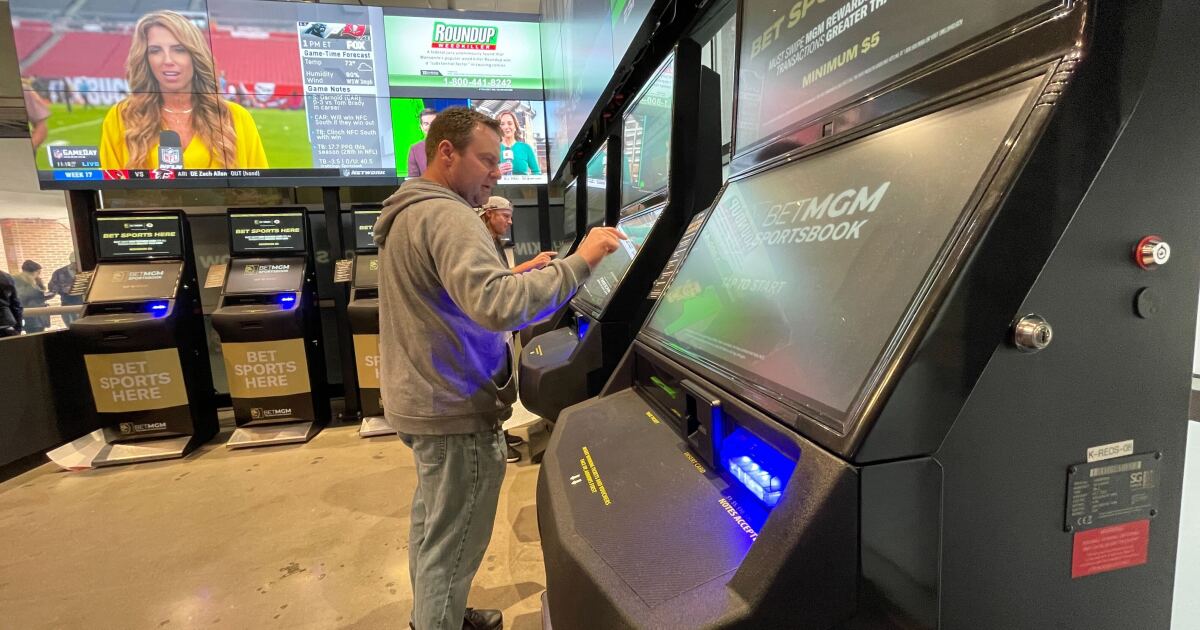
CINCINNATI — Five months after Ohio banned bets on the individual performance of college athletes, some state legislators are calling for a replay review.
Three House Republicans who served on the Study Commission on the Future of Gaming in Ohio argued the rule should be rescinded because college athletes can be compensated for their name, image and likeness.
“Players are now being paid to play (and to perform) in certain sports,” the lawmakers wrote in a letter that accompanied the commission’s July 12 final report. “That is no different than any other professional sport.”
The letter was signed by Reps. Cindy Abrams of Harrison, Jeff LaRe of Violet Township and Jay Edwards of Nelsonville. Edwards, who chairs the House Finance Committee and co-chaired the commission, said supporters of the ban made “ridiculous” arguments that prop bets lead to harassment of college athletes on social media.
“I don’t care if you have a bet on it or not,” Edwards said. “If a quarterback goes out and lays an egg, they’re going get beat up on Twitter, simply for losing the game.”
Provided by Edwards
The Ohio Casino Control Commission said it has no plans to reconsider the rule and Edwards said he is not aware of any legislative proposal to force the change.
And that sounds like good news to Ricardo Hill, boys basketball coach at Indian Hill High School.
“I don’t believe that anyone should be able to bet on collegiate sports because it’s still considered amateur,” Hill said. “I’m not a bettor, but I know what the point spreads are if I just go to a UC game or Xavier game.”
The proposal to rescind Ohio’s ban on prop bets is one of several new ideas to emerge and fail to gain consensus from the “Future of Gaming” panel. It heard more than six hours of testimony on Ohio’s gaming industry and issued a 354-page report in July.
Ohio dramatically expanded legalized gambling with the launch of sports betting in 2023. The 11-member legislative group was established to explore possible next steps for the industry. It invited comments from gaming companies and their trade groups, the Ohio Lottery, the Ohio Casino Control Commission and experts on gambling addiction.
Among the new ideas:
- An expansion of iGaming in Ohio could generate up to $410 million in new tax revenue for the state, according to testimony from the Sports Betting Alliance, a trade group for sportsbooks. It says eight states have legalized online apps for poker, slots and other casino games. Ohio neighbors Michigan and Pennsylvania have two of the biggest markets for iGaming, each claiming more than $1.7 billion in bets last year. Casino operators and lottery officials are worried that iGaming would harm their existing operations in Ohio. Lottery officials said its Keno sales are already down 7% due to sports betting. It wants the ability to offer iLottery games online.
- Brick-and-mortar sportsbooks are having a tough time competing against betting apps like FanDuel and DraftKings, prompting State Senator Nathan Manning to propose a tax cut for operators like the BetMGM Sportsbook at The Banks. Manning said he would try to cut Ohio’s 20% tax rate to 10% for retail sportsbooks by offering amendments to the state budget process. “These brick-and-mortar locations provide jobs for many Ohioans, and it would be beneficial for everyone to work alongside them to find commonsense solutions,” Manning wrote in a letter to the study commission.
- The Ohio Casino Control Commission is spending $400,000 on a behavioral science consultant to help it develop new responsible gaming tools that Ohioans will actually use. In a March 20 hearing, Executive Director Matt Schuler said all sportsbooks are required to offer tools that let gamblers limit the time and money they spend on betting apps. “The problem is, I think we got 2% of those that use the app utilizing any of those tools,” Schuler told the panel. “And so, we’re convinced we’re going about it wrong.” The U.K.-based Behavioural Insights Team is helping state officials test new approaches that can be deployed to all sportsbooks next year.
Of all the new ideas discussed in Ohio’s Future of Gaming report, the behavioral science research appears to be furthest along. The Casino Control Commission expects an initial report on the effort by this fall.
Behavioural Insights has spent several months analyzing the effectiveness of existing tools for responsible gaming, typically identified with an “RG” button on sportsbook apps. The company’s Chief Behavioral Scientist, Michal Hallsworth, said the key to increased use might be incorporating bet limits into ordinary play — as opposed to telling bettors it’s a way to avoid problems.
“These are not tools for people who have a problem. They’re tools for anyone,” Hallsworth said. “When you’re in that moment, you get so absorbed, you kind of forget the context, where you’re coming from, why you’re doing this and how much you wanted to spend. Those kinds of things, you might think about when you stop.”
The panel’s co-chairs, Rep. Jay Edwards and Sen. Nathan Manning, said it might be a few years before there is legislative support for another major expansion of gambling.
“iGaming is popular one to discuss because it is happening in other states,” Manning said. “But I know that Gov. DeWine has expressed some concern and senate members certainly have expressed concern. Expanding into sports betting was a big step. Maybe we should pump the brakes a little bit and see how that’s going.”
Provided by Manning

That seems to be the approach on college prop bets as well, much to Edwards’ chagrin.
The former Ohio University football player, now serving his fourth and final term in the House, thinks the Casino Control Commission made a mistake by banning prop bets on college athletes. He argues the ban won’t keep athletes from being harassed by fans. And he claims Ohio will be less able to catch corruption, like it did in 2023 when it blocked an Indiana man from using inside information to be on a University of Alabama baseball game.
“Before we legalized sports gaming, we would have never caught this,” Edwards said. “This bet could have been put on Bovada or one of these off-shore accounts. They would have never been caught. It’s the fact that we have a regulated market, we’ve driven out the black market, that we’re able catch these types of things.”
In his March 20 testimony to the Future of Gaming panel, Schuler said Ohio law allows for any sports governing body to propose rule changes on bets allowed.
The NCAA argued players were being harassed on social media and it was concerned about bettors influencing the outcome of games. Schuler told Edwards he talked to athletic directors around the state and grew convinced Ohio’s college athletes were at risk without a rule change.
“When a particular bet that you know is going to be offered is solely dependent on you, there may be a temptation to alter your behavior,” Schuler said. “They feel the pressure. They have harassment. They don’t want to say anything. They don’t want to be the poster child for the problem.”
Hill attends about a dozen college games each year because it helps him stay in touch with former players, including MaCio Teague, who helped Baylor University win a national title.
“I’ve had guys tell me that they can hear fans screaming, ‘I need you to get this amount of points tonight.’ They’re calling me and they’re kind of laughing it off but if that person was in some sort of financial difficulty, I mean, it’s just too risky to me,” Teague said.



How to Open the eNewspaper
Tap the eNewspaper icon at the bottom right of the app screen.
USA TODAY
These real estate transactions were recorded in Marion County between June 12 and June 17.
City of Marion
336 Silver St., Marion; Jeffery A. Hallie to Cassidy Manley and Jamal Tyre Manley; $100,000.
597 E. George St., Marion; Robert E. Edens Jr. and Kristin Edens to Clifford D. Hall and Judith K. Hall; $100,000.
395 Park St., Marion; Robin Hirsch to Christian Jaimes Mejia; $165,500.
1007 Fariwood Avenue, Marion; Sherry D. Smith, Jerry L. Winget and Vickie L. Pinyerd to Tami S. McCarty; $149,900.
302 Silver St., Marion; Heaven M. Daniel to US Bank National Association; $44,100.
358 Nye St., Marion; Trever Rinehart to Daniel Murfield and Athena Murfield; $199,000.
538 Cherry St., Marion; Marry On LLC to Tylere Shuster; $150,000.
618 Irey Avenue, Marion; Keith A. Radebaugh to Brittany Marie Crampton; $125,000.
1138 Independence Avenue, Marion; Marion County General Surgery LLC to Independence Avenue Medical LLC; $215,000.
1950 Linda St., Marion; Ralph W. Smith Jr. and Betty J. Smith to Dawn Comer; $116,000.
555 Avondale Avenue, Marion; Angela R. Rivers to Prospect Endeavors LLC; $75,000.
523 Mary St., Marion; Frank Hoffman and Robin Hoffman to Crystal A. Bonsel and John H. Thacker; $175,000.
436 Thompson St., Marion; Shovel City Investment LLC to Duel Patrick Davidson; $47,500.
661 Adams St., Marion; Hideaway Properties 4 LLC to Crystal Lynn Hall; $85,200.
288 Chicago Avenue, Marion; Jeffrey L. Young and Kimberly M. Young to OpenDoor Property Trust; $179,900.
691 Bennett St., Marion; Steven Higgins, Larry Higgins Jr. and Shawn Patrick Higgins to Kyle R. White; $200,000.
Richland Township
5544 Tittlebaugh Road, Marion; John E. Morgan, Rebecca Sue Morgan, Bridget Corcoran and Patrick Corcoran to John E. Morgan and Rebecca Sue Morgan; $87,340.
Pleasant Township
2.345 acres on Gooding Road, Marion; 533 Farm Holdings LLC to Thomas Savage and Lissa Savage; $250,000.
4714 Larue Prospect Road S., Prospect; Vanderbilt Mortgage and Finance to Allyson Fitch and Brandon Fitch; $260,000.
1552 Marion County Club Drive, Marion; WY Corp II to ABI Development LLC; $40,000.
Prospect Township
8323 Hughes Road, Prospect; Cole A. Hess and Cheyenne Hess to Kamryn Miah Jean Sutherland and John Daniel Yersavich; $415,000.
608 Water St., Prospect; EyE Homes Inc. to Mary Elizabeth Machingo and Jeffrey Paul Machingo; $305,000.
Tully Township
2946 Martel Road, Caledonia; Vincent L. Cleveland and Jo D. Cleveland to Carly Rene Bailey-Stultz and Dennis Stultz; $375,000.
Ohio
Ohio lawsuit alleges new NCAA rule unfairly denies high school Class of ’22 athletes a 5th season


Why artists are dropping out of the Great American State Fair
Musicians cancel appearances at the Great American State Fair after questions over Freedom 250 and claims the July Fourth event is nonpartisan.
As several states pull out of the Great American State Fair in Washington, D.C., questions are coming up closer to home — Is Ohio still participating?
Massachusetts and North Carolina won’t participate in the fair, according to USA TODAY. Reports also indicate that Connecticut, Illinois, Maine and Oregon are also expected to skip the event, with some states citing a combination of financial and political concerns as reasons for opting out.
Here’s what we know about Ohio’s role in the event so far.
Is Ohio skipping the 2026 Great American State Fair?
Ohio has confirmed its participation with a booth titled “Ohio: The Heart of it All,” which showcases state parks and childhood development. The governor’s office began the planning process for the booth in February, shortly after the Great American State Fair was announced, said Lisa Peterson director of communications in the governor’s office.
The Great American State Fair, organized by Freedom 250, is a 16-day exposition that will be displayed on the National Mall from June 25 to July 10.
Additionally, Ohio will host a stop from the “Freedom Truck,” a traveling exhibit tied to Freedom 250. The exhibit will appear at the Ohio State Fair in Columbus. Organizers describe the Freedom Truck as a mobile museum that visits existing fairs and community events, not a version of the Great American State Fair itself.
When does the ‘Freedom Truck’ stop in Ohio?
The Freedom Truck is scheduled to be at the Ohio State Fair from July 27 through Aug. 10, 2026 at the Ohio Expo Center in Columbus.
The exhibit includes interactive and historical exhibits about the founding of the United States, according to organizers.
The mobile museum will be open from 10 a.m. to 9 p.m. Monday through Friday, and from 9 a.m. to 9 p.m. on weekends, with the final day closing at 6 p.m.
What is the Great American State Fair?
The Great American State Fair is a 16-day event planned for June 25 through July 10 on the National Mall in Washington, D.C. Organized by Freedom 250, the fair is part of a broader effort to mark the nation’s 250th anniversary with state exhibits, food, entertainment and cultural programming, according to USA TODAY.
President Donald Trump announced he will headline the Freedom 250‑organized Great American State Fair and hold an “America Is Back” rally, the publication reports.
America250 vs. Freedom 250: What’s the difference?
The Great American State Fair is part of Freedom 250, a Trump-backed initiative to celebrate the country’s 250th anniversary.
That effort is different from America250, the official, congressionally-authorized program coordinating nationwide commemorations. Meanwhile, America 250‑Ohio, the Ohio Commission for the U.S. Semiquincentennial, is the official state-level partner to the national America250 effort.
-

 Colorado3 minutes ago
Colorado Springs officials provide details of recent closure, repair work on Uintah Street
-

 Connecticut8 minutes ago
Connecticut man charged with murdering Duxbury woman is an
-

 Delaware15 minutes ago
Officer shoots, kills 19-year-old in Wilmington, Delaware, during foot chase, police say
-

 Florida18 minutes ago
Gators among top-20 rated teams in EA Sports College Football 27
-

 Idaho28 minutes ago
Dorothy Moon reelected to third term as Idaho GOP chair
-

 Georgia30 minutes ago
The Farmer’s Dog Partners with the University of Georgia College of Veterinary Medicine to Advance Veterinary Nutrition Training
-

 Hawaii33 minutes ago
Sewer rate hikes proposed – West Hawaii Today
-

 Illinois45 minutes ago
Man buys winning $1.3 million jackpot ticket at suburban gas station

