Midwest
Bureaucrats hide true price of Obama Presidential Center as taxpayers hit with infrastructure bill

NEWYou can now listen to Fox News articles!
FIRST ON FOX: Former President Barack Obama once declared that his presidential center would be a “gift” to Chicago, but taxpayers are on the hook for hundreds of millions of dollars in hidden costs related to the beleaguered project.
A Fox News Digital investigation shows taxpayers are now stuck footing the bill for surging public infrastructure costs required to support the project — and no government agency can provide an accounting of the total public cost, despite months of queries and FOIA requests.
“Illinois Republicans saw this coming a mile away. Now, right on cue, Illinois Democrats are leaving taxpayers high and dry and putting them on the hook for hundreds of millions of dollars to support the ugliest building in Chicago,” Illinois GOP Chair Kathy Salvi told Fox News Digital. “Illinois’ culture of corruption is humming along with pay-to-play deals to their allies and friends while lying to Illinois voters.”
When the project was approved in 2018, Obama pledged to privately fund construction of the expansive 19.3-acre campus in historic Jackson Park through donations to the Obama Foundation – a commitment that remains in place as the center’s construction continues to be privately financed.
But the extensive infrastructure required to make the campus operationally viable — including redesigned roads, stormwater systems, and relocated utilities — is publicly financed, and without those changes, the center could not function.
At the time, projections placed public infrastructure costs at roughly $350 million, split between the state of Illinois and the city of Chicago.
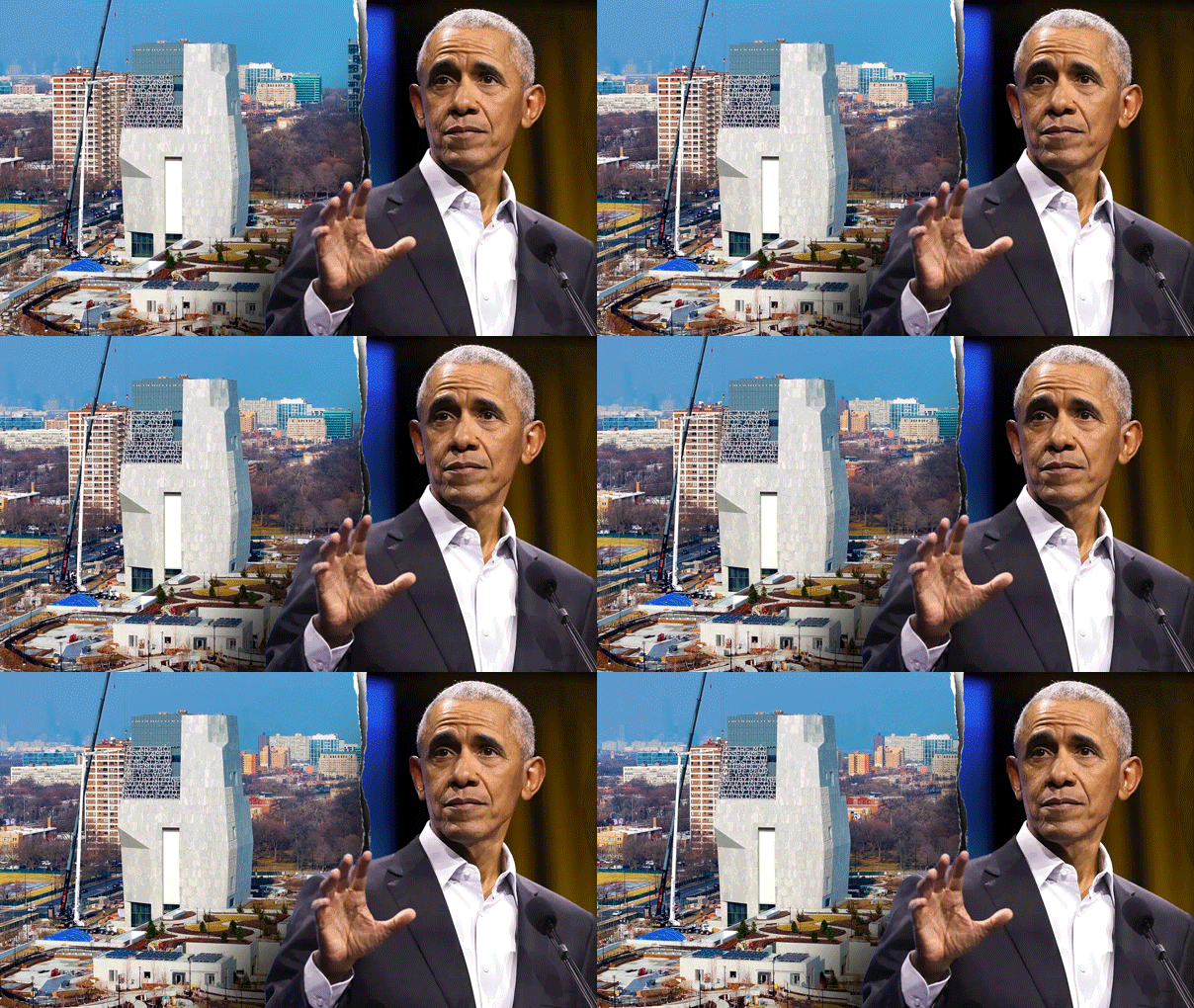
Former President Barack Obama once professed that his presidential center would be a “gift” to Chicago. Animated GIF showing the Obama Presidential Center under construction alongside a static image of former President Barack Obama. (Fox Flight Team; Getty)
Eight years later, the Illinois Department of Transportation (IDOT) told Fox News Digital that approximately $229 million in infrastructure spending was tied to the site, up from its earlier estimate of roughly $174 million.
The $229 million figure reflects state-managed spending, which may include federal transportation funds routed through IDOT.
Meanwhile, Chicago officials have failed to produce a reconciled total showing how much city taxpayers have committed or how current spending compares to the roughly $175 million discussed when the project was approved.
A paper trail without a total
Fox News Digital submitted records requests and press inquiries to every agency involved in the infrastructure work, including the Illinois Department of Transportation (IDOT), Chicago’s Department of Transportation (CDOT), the Office of Budget and Management (OBM), the Mayor’s Office and Gov. J.B. Pritzker’s administration.
Not a single office provided a unified, up-to-date accounting of total public infrastructure spending tied to the project. The investigation involved months of FOIA requests, partial disclosures and repeated follow-ups.
No single agency appears to oversee the full scope of the infrastructure work, and neither the state nor the city has assembled a reconciled accounting — a fragmentation that has made the overall public cost difficult to determine.
Instead, agencies provided partial figures, declined to clarify whether city and state totals overlap or insisted that no consolidated total exists.
The Illinois Attorney General’s Public Access Counselor (PAC) is reviewing whether multiple agencies complied with state transparency laws following Fox News Digital FOIA requests.
Exterior view of the Obama Presidential Center tower under construction in Chicago. (Fox 32 Chicago)
Construction costs soar
The center sits on 19 acres of historic public parkland carved out in a controversial transfer for just $10 under a 99-year agreement, making the question of public infrastructure spending particularly sensitive. Legal challenges to the land transfer, including lawsuits arguing the arrangement was not in the public interest, were ultimately dismissed, although the merits of the arguments were not adjudicated on.
The center — though commonly referred to as a presidential “library” — will not function as a traditional facility operated by the National Archives and Records Administration (NARA), and former President Obama’s official records will be maintained by NARA at a federal site in Maryland.
While the Obama Presidential Center in Chicago is expected to provide digital access to archival materials, it will not serve as a federally operated records repository.
Instead, the Chicago complex will be operated privately, without rent payments, by the Obama Foundation, the former president’s nonprofit organization, which oversees leadership programs and civic initiatives aligned with his values and policy priorities.
Construction costs for the facility itself have ballooned from early estimates of roughly $330 million to at least $850 million, according to the foundation’s 2024 tax filings, although these expenses are being borne by private donors.
Meanwhile, a $470 million reserve fund — known as an endowment — that the foundation promised to fill to protect taxpayers should the project go belly-up, has received only $1 million in deposits, Fox News Digital previously reported.
OBAMA LIBRARY, BEGUN WITH LOFTY DEI GOALS, NOW PLAGUED BY $40M RACIALLY CHARGED SUIT, BALLOONING COSTS
A before-and-after aerial graphic shows the footprint of the Obama Presidential Center in Jackson Park, including the removal of Cornell Drive and construction along Stony Island Avenue. (Fox News)
Roads removed, routes rebuilt
Taxpayers often fund routine improvements near major civic projects — such as turn lanes, utility hookups or upgraded traffic signals — but the scale of the work surrounding the Obama Presidential Center is far more extensive.
By comparison, other modern presidential libraries required only limited public infrastructure upgrades and did not involve the removal of a major roadway or the wholesale redesign of a historic park’s traffic pattern.
Much of the publicly financed work reshaped the roads and utilities that once ran through Jackson Park.
Cornell Drive — a four-lane roadway that bordered the center’s east side by the park’s lagoon — was permanently removed under the center’s site plan and enveloped by the campus. Traffic that once ran alongside the lagoon has been rerouted farther west, reducing the number of public roads directly adjacent to the complex and creating a more unified campus footprint around the center.
Crews also tore down trees, relocated water mains, sewer lines, and electrical infrastructure and installed new drainage systems tied to the facility’s structural needs as part of the public infrastructure project.
City and state officials say the changes were necessary to manage traffic and visitor demand. Critics argued the redesign altered long-standing park infrastructure to accommodate the foundation’s preferred layout.
What’s clear is that without those road closures, reroutes and utility relocations, the project would not function as designed.
The Obama Foundation, which is funding the center’s construction, defended the project in a statement to Fox News Digital.
“The Obama Foundation is investing $850 million in private funding to build the Obama Presidential Center and give back to the community that made the Obamas’ story possible,” said Emily Bittner, a spokesperson for the foundation.
“After decades of underinvestment on the South Side of Chicago, the OPC is catalyzing investment, from both public and private sources, to build economic opportunity for residents through jobs, housing, and public spaces and amenities.”
A map graphic shows the footprint of the Obama Presidential Center inside Jackson Park on Chicago’s South Side along Lake Michigan. (Fox News)
The number no one will state
IDOT, which controls the state’s funding for the corridor and signs off on major transportation contracts tied to the project, acknowledged approximately $229 million in state-managed infrastructure spending but did not produce a consolidated accounting reconciling that total across all project phases.
“With all the main parts of this aspect of the overall project awarded, to date the state via IDOT has contributed approximately $229 million,” an IDOT spokesperson told Fox News Digital in July in its latest release. “Approximate breakdown of these funds: $19 million in preliminary engineering; $24 million for construction engineering and $186 million for construction activities.”
The spokesperson said that the initial $174 million figure was from a “2017 was a preliminary cost estimate.”
CDOT, which carried out the roadway closures, traffic rerouting and utility relocation work inside Jackson Park, acknowledged Fox News Digital’s Oct. 7, 2025, FOIA request and took a statutory extension but never issued a final determination or produced the requested records. The department also did not provide a unified city total or clarify how Chicago’s capital allocations overlap with the state’s spending.
OBM, which oversees the city’s capital allocations, did not say whether the city’s $175 million estimate remains current and directed Fox News Digital to the Capital Improvement Plan. Chicago’s most recent 2024–2028 Capital Improvement Plan — the city’s multi-year infrastructure budget — lists more than $206 million allocated to roadway and utility work surrounding the project. However, much of that funding is labeled “state,” and neither state nor city officials could clarify how those allocations overlap with IDOT’s reported total.
In a FOIA response, OBM said it “does not have responsive records” showing any cost overruns, reallocations or a breakdown of spending across major components of the Obama Center infrastructure work.
The agency also could not explain how Chicago’s $206 million budget line relates to IDOT’s $229 million figure or how much of the city’s amount is actually paid by Chicago rather than the state.
Chicago’s 2024–2028 Capital Improvement Program lists $206,078,058 for “Obama Presidential Center & Jackson Park – Infrastructure Improvements,” with most funding labeled as state sources. (City of Chicago Capital Improvement Program)
Pritzker’s office gave conflicting responses and ultimately produced no records showing the state’s total infrastructure spending.
Meanwhile, Mayor Brandon Johnson’s office did not respond to repeated requests for the city’s total infrastructure spending tied to the project or for how much more Chicago expects to commit.
Without updated reconciliations from both levels of government, taxpayers still have no clear accounting of the financial obligations associated with the center.
What is clear is that Obama’s “gift” to Chicago comes with a hefty public price tag that has grown more complex — and without updated cost projections, the true total cost remains unknown.
Related Article

Read the full article from Here



Beth Kelley spent most of her life working at Sturgis Hospital. For 32 years, the nurse said it was “unusual to walk down the hall and not recognize somebody.” The independently owned hospital had served its community in rural St. Joseph County for more than a century.
“I like the small hospital atmosphere,” Kelley, 56, told Bridge Michigan. “I know this is maybe a little cliché, but it’s like family.”
When administrators held a town hall last month to tell staff the hospital would close about 70 hours later, Kelley said the room filled with “shock” and “devastation.” The decision left many long-serving employees like herself “scrambled trying to find a job” while they worked their remaining shift hours.
Sturgis Hospital shuttered its doors June 19, citing “years of ongoing financial challenges” facing rural health care providers. The facility had 84 licensed beds and about 300 associates working, according to the hospital.
There were warning signs. The facility had been winding down services in recent years, even as it obtained a city-issued pandemic relief loan, a state lifeline and new federal status — Sturgis Hospital became Michigan’s first designated rural emergency hospital in 2023, which allows for increased support from the US Centers for Medicare & Medicaid Services.
It’s not the only rural hospital in Michigan to be impacted by a shifting health care landscape. These health care facilities, sometimes the only medical care providers available for miles, have been navigating several problems, including declining payer reimbursements, rising operating costs, and a federal reworking of Medicaid and Medicare — programs used by the bulk of patients in rural hospital settings.
For Kelley and others, the Sturgis Hospital closure is part of a bigger trend and serves as a wake-up call for her and others in the field.
“As a nurse, we took care of patients, and that’s all we did. It’s all we cared about. We didn’t care about the financial end of it,” Kelley said. “Those days are gone.”
Service cuts
Rural hospital closures, reductions, restructuring and consolidation dominate the contemporary health care landscape in Michigan, according to researchers, physicians and policy advocates working in the field.
For one thing, Michigan’s population is aging, which puts strain on the state’s health care system. In addition, many point to problematic payment models that don’t offset costs for service, and federal program reductions outlined in HR 1 — the “One Big Beautiful Bill.”
Five rural hospitals have closed in Michigan since 2005, according to the Cecil G. Sheps Center for Health Services Research at the University of North Carolina at Chapel Hill.
As Congress debated the One Big Beautiful Bill last year, the Sheps Center estimated four of 63 rural hospitals in Michigan could be at risk for closure, highlighting facilities that had run a three-year deficit or existed as one of the top Medicaid revenue earners in the country. Sturgis Hospital was not included.
Even if a hospital does manage to remain open, many have to drop major parts of their operation to survive. Last year, the labor and delivery unit at Aspirus Ironwood Hospital and the obstetrics unit at MyMichigan Medical Center in Tawas City closed.
Rural birthing hospitals are costly and difficult to staff, according to Michael Shepherd, an assistant professor at the University of Michigan School of Public Health focused on rural health disparities and health policy in the US.
“Half of births in rural communities are being paid for by Medicaid at the moment,” Shepherd told Bridge following passage of President Donald Trump’s One Big Beautiful Bill, which calls for slashing Medicaid. “So what you’re talking about is a not very profitable service line — it’s very expensive and one that’s about to face massive financial shortfalls.”
Sturgis Hospital had closed its birthing center in 2018. Last month, it ended the remaining services nearby residents relied on — surgery, laboratory, medical imaging, physical therapy, endoscopy and cardiac rehabilitation services.
From 2 miles to 25
While other clinics exist to fill the gap, the absence of an emergency department in Sturgis has left facilities in Three Rivers, Coldwater and LaGrange, Indiana as the closest alternatives to patients.
That reality has a “substantial operational effect” on the city’s emergency medical services, according to Sturgis Director of Public Safety Ryan Banaszak. When ambulances leave their service areas, he said longer distances and travel times affect their ability to respond.
“What was once approximately a 2-mile transport for patients has now become closer to 25 miles, which takes ambulance personnel and equipment out of service for a much longer period of time,” Banaszak said in an email.
It’s more than distance for some patients — while Parkview LaGrange Hospital may be the closest drive from Sturgis at less than 20 minutes, low-income patients may still face obstacles finding medical coverage.
“If you are a Michigan Medicaid patient, you can’t simply go across the border to another hospital,” said Joe Gavan, CEO of Cass Family Clinic, a federally qualified health center operating in rural southwest Michigan. The loss of the Sturgis Hospital, he said, is “a huge burden on the folks that are impacted the most.”
Rebecca Burns, health officer of the Branch-Hillsdale-St. Joseph Community Health Agency, said she is “saddened by the loss” of the hospital. The public health agency continues to operate a site in Sturgis.
“We stand ready to continue to provide public health preventative services to residents as they need them,” Burns said.
Another perspective
Dr. Andrea Wendling sees a pattern play across rural systems which lands patients in emergency rooms and causes hospitals to operate on tight margins.
“People aren’t doing the primary care and they’re not doing the preventative care in between,” said Wendling, a family doctor who practices at a clinic in Boyne City and serves as senior associate dean for academic affairs for the Michigan State University College of Human Medicine.
“When they’re not able to pay that bill and there’s not insurance for them to pay, that’s a loss for those hospitals, and they need to have a certain percentage of paying customers in order to be able to fund the service that they provide.”
Wendling, who has spent much of her life living and working in rural hospital settings and ensuring its continued workforce, worries the Sturgis Hospital closure is “the first of more closings that we’re going to see over the next few years” in the state.
She said independent hospitals are pressured to join bigger systems for economic benefit: Acquisition allows for smoother negotiations with big insurance payers, stronger purchasing power and reduced administrative costs.
But acquisition is no guarantee of survival. Sturgis Hospital had been acquired by a health care company in 2023, but city officials reported last August the deal was slow to close “by all indications.” A representative from the company declined to comment.
“Despite extensive efforts by hospital leadership and the Board of Directors to secure the hospital’s future, including pursuing potential acquisition opportunities and partnerships, a sustainable path forward could not be achieved,” Sturgis Hospital noted in its announcement.
The closure underscores the need for rural hospitals to use every tool for financial sustainability, including dollars from the 340B drug cost program and “ swing beds,” according to Lauren LaPine-Ray, vice president of policy and rural health for the Michigan Health & Hospital Association. Under swing bed arrangements, hospitals can shift the use of their beds to provide either acute or post-acute care on an as-needed basis.
“Rural hospitals need sustainable policies that account for the unique challenges associated with providing care in communities with lower patient volumes, workforce shortages and populations that are older, sicker and more likely to rely on Medicare and Medicaid,” LaPine-Ray said in an email.
Michigan has received a $173 million grant from the Rural Health Transformation Program, but the federal initiative has been scrutinized by hospital leaders operating in the targeted areas.
The Michigan Department of Health and Human Services has been criticized because under its grant funding criteria, some populous counties, including Wayne, Washtenaw and Oakland, would qualify as “partially rural” while St. Clair, Monroe, Jackson and Ottawa counties would not.
Looking forward
For Kelley, the change the hospital’s closure forces is out of her hands.
“I was pretty comfortable, so to start over is a little rough,” the nurse said.
The hospital is behind on paying out certain paid time off and retirement benefits, Kelley said, and she’s “doubtful” she’ll get back her vacation and sick time.
Representatives for the Michigan Nurses Association say union members lost health insurance coverage on the day of closure, with some employees reporting issues getting temporary COBRA coverage.
A call to the hospital by Bridge was not answered in time for publication of this story.
Kelley, who lives in Centreville, about 17 miles away from Sturgis, has found new work at Three Rivers Health Hospital as an as-needed nurse working part-time.
It’s an adjustment from her guaranteed, full-time pay position at Sturgis Hospital. “I’m hoping for 40 hours a week, but that’s probably not realistic.”
While the commute will be slightly closer for Kelley, she said the closure of the Sturgis Hospital will mean longer drives for some patients to reach a health care facility.
“For some of those people, it could be a matter of life and death.”
___
This story was originally published by Bridge Michigan and distributed through a partnership with The Associated Press.

A Liberian immigrant who came to the United States in 2018 quickly found work as a Twin Cities caregiver for seniors and the disabled. In 2025, she applied for her U.S. citizenship while seeking a full or partial waiver of the $760 application fee. A citizenship test was scheduled for her, and then abruptly canceled.
Instead, on a Saturday morning last fall, two federal agents with U.S. Citizenship and Immigration Services — a man and a woman — knocked on her door.
“They said they had a few questions for me before my citizenship appointment could be set up,” said the woman, who asked that her name not be shared given her circumstances. “I was a little bit shaken because it was so confusing. They wanted to know how good I was in my neighborhood and in my job.”
She then saw the agents go door-to-door on her street asking if she had ever “caused trouble,” as a neighbor who vouched for her later informed her. Her boss later called her from work and said USCIS agents, a man and a woman, had stopped by with similar questions.
The woman, who had shortened her work hours to care for her 6-year-old daughter, spent the next few weeks defending her decision to ask for financial assistance with the citizenship application.
“They kept on asking why I had applied for a fee waiver,” she recalled. “I explained and they still weren’t satisfied. They kept calling me and asking for more documentation to show that it was actually true that I can’t afford the fees. They were looking for pay stubs, proof of health insurance, year-end tax income.”
She went on to pass her citizenship test last March, months later than expected, and is preparing to be sworn in as a U.S. citizen, but the federal curb on fee waivers has since intensified.
On June 22, the U.S. Department of Homeland Security published a new proposal that would raise naturalization fees by 75% or more and eliminate fee waivers entirely.
For immigration advocates in the Twin Cities, the fee waiver issue is just the latest hurdle in the multi-faceted crackdown on immigration that has unfolded under the second Trump administration — a crackdown that has at times placed Minnesota at its epicenter.
While publicly purporting to go after “the worst of the worst” criminal offenders, Washington has found myriad ways to deter refugees and other immigrants from arriving in the U.S. or to force them to leave, including blocking or delaying efforts by law-abiding refugees to obtain their permanent residency green cards or American citizenship.
Among refugees, “green cards for most people have stopped,” said Jane Graupman, executive director of the International Institute of Minnesota, which is based in St. Paul, in early June. “So have citizenship applications. They want everyone to be in legal status, but then they’re preventing that from happening. It’s not happening, that we’ve seen.”
13 new U.S. citizens, down from 400
A federal judge’s recent ruling in Dorcas International Institute of Rhode Island v. USCIS appears to have reopened the door, at least a crack, and more applications are flowing. Still, in the first six months of the year, the International Institute saw only 13 of its clients receive U.S. citizenship. In the same time period last year, the number was closer to 400.
As for green cards, which confer proof of permanent residency status, 800 of the institute’s refugee and asylee applicants are still awaiting a decision on their applications, with an average wait time of more than a year.
“Verifying identities and personal histories of all aliens seeking immigration benefits requires a rigorous process — one that prioritizes the safety of the American people by more thoroughly screening and vetting all aliens,” said a spokesperson for USCIS in an email response to a reporter’s inquiry. “The goal is not to approve more or deny more applications, but to reach the correct decision in each case to the maximum degree possible.”
This past winter, Operation Metro Surge and Operation PARRIS (Post-Admission Refugee Reverification and Integrity Strengthening) brought thousands of armed federal agents from the Department of Homeland Security to the Twin Cities for door-to-door sweeps and warrantless arrests that detained an estimated 3,700 refugees.
In several high-profile cases, U.S. citizens with no criminal history were removed from their homes by Immigration and Customs Enforcement, and some green card holders who had committed crimes decades ago, as teens or young adults, have been deported.
“The polls show most Americans are against the government arresting people who have not committed a crime — and are doing a job, and showing up — and arresting them for no reason,” Graupman said.
Operation PARRIS, in particular, targeted lawful refugees who were still in the pipeline to receive their green cards, which provide evidence of permanent residency. Many refugees were taken out of state to detention centers as far away as Texas, under the premise of needing to be re-interviewed by federal authorities, until federal judges based in Minnesota and Massachusetts issued preliminary injunctions putting the detentions of refugees who had not yet received their green cards on pause.
“Our federal judges really stepped up,” said E. Michelle Drake, an attorney with the Minneapolis firm of Berger Montague, who served as the lead attorney representing refugees in a class-action lawsuit against the Department of Homeland Security and ICE over Operation PARRIS. “The courts were overwhelmed. … We had human beings being snatched off the street in broad daylight.”

Among Drake’s clients was a 17-year-old girl who had been detained overnight in a hotel room by federal agents on the way to school. Drake had never before met her in person, but on the day she was released, the teen requested Chick-fil-A and asked if it would be safe to join her classmates for a mock trial debate she had been practicing for that weekend.
‘Removing murderers’
Federal officials continue to maintain that the majority of the immigrants they’ve detained have documented criminal histories. The Transactional Records Access Clearinghouse, which tracks federal data, reports just the opposite — that 42,722 out of 60,311 detainees, or 71% held in ICE detention, have no criminal conviction according to data current as of April 4. Many of those convicted committed only minor offenses, including traffic violations.
“What makes someone a target of ICE is if they are in the U.S. illegally,” said a U.S. Department of Homeland Security spokesperson in an email. “America’s brave men and women are removing murderers, MS-13 gang members, pedophiles, rapists — truly the worst of the worst from America’s communities.”
“Nearly 70% of ICE arrests are of criminal illegal aliens who have been convicted or have pending charges,” the DHS spokesperson wrote. “This statistic doesn’t account for those wanted for violent crimes in their home country or another country, INTERPOL notices, human rights abusers, gang members, terrorists, etc. The list goes on.”
Despite the Minnesota and Massachusetts rulings, issued in February and March respectively, federal efforts to remove immigrants through legal means — such as by attempting to invalidate birthright citizenship, as well as removing temporary protected status for Venezuelans, Haitians and Syrians — have continued unabated.
“The new head of immigration services, Tom Homan, is saying they are following rules now, but also (White House Deputy Chief of Staff for Policy) Stephen Miller is finding other ways,” Graupman said. “He’s looking for any way he can to discourage people from coming here and to deport people who are here, and that takes a lot of government resources to do that.”
Immigration advocates say there’s good reason for law-abiding immigrants to be nervous, though they’re still encouraging permanent residents to seek U.S. citizenship, which offers a number of benefits, from U.S.-issued passports and protection from deportation to automatic citizenship for their offspring under the age of 18.
“The reason it was important to me is because I feel it was the right thing to do,” said the Liberian woman who passed her citizenship test in March. “If I want to go to Africa, and visit a friend — ever since I’ve been here, I’ve never gone to Africa, just to be on the safe side. Everybody is not feeling safe.”
During Operation Metro Surge, the Twin Cities became ground zero in a national debate around not just illegal immigration, but immigration in general, including the rights of refugees, asylum seekers, guest workers and permanent residents, or green card holders. At least three legal efforts based in Minnesota and Massachusetts have played pivotal roles in slowing, though not necessarily stopping, widespread detentions and warrantless arrests.
Habeas corpus petitions
During Operation Metro Surge, a wide network of attorneys contributed their time — often, but not always, pro bono, or free of charge — to get immigrants who had been detained without criminal charges out of detention centers. Immigration judges were generally skeptical of federal arguments that refugees could be held indefinitely until their green cards were issued, though some judges allowed detentions through the conclusion of eligibility interviews.
Berger Montague filed over 40 habeas corpus petitions and won most of them. Attorneys with the Minnesota Habeas Project, a collective of nonprofit legal service providers, law school clinics and pro bono law firms, filed additional cases. DHS continues to maintain that “pending applications do not confer legal status” and the detainment of refugees who are in the pipeline for green cards is lawful.
U.H.A. et al v. Bondi
A Jan. 24 class-action lawsuit filed on behalf of Minnesota-based refugees by the Advocates for Human Rights, the International Refugee Assistance Project and Berger Montague sought to halt the door-to-door detention of refugees under Operation PARRIS.
On Jan. 28, Senior U.S. District Judge John Tunheim, based in Minneapolis, issued a temporary restraining order pausing the house-to-house arrests in Minnesota, and ordered the return of refugees who had been taken out of state. His order only applied to Minnesota refugees.
Tunheim extended his time-limited temporary restraining order on Feb. 9 and expanded it into a preliminary injunction on Feb. 27, where he noted the irony of arresting recent immigrants for failing to obtain a green card they were prohibited by law from applying for until one year after their arrival.
“The Court will not allow federal authorities to use a new and erroneous statutory interpretation to terrorize refugees who immigrated to this country under the promise that they would be welcomed and allowed to live in peace, far from the persecution they fled,” he wrote.
Rather than abandon the operation, the Department of Homeland Security soon changed tactics and began issuing letters alerting refugees in Minnesota that they had anywhere from a day to a week to obtain legal counsel before their re-vetting interviews.
“This is yet another lawless and activist order from the federal judiciary who continues to undermine our immigration laws,” said a USCIS spokesperson by email. “We look forward to being vindicated in court. American citizens and the rule of law come first, always.”
Jean A. v. Noem
On Feb. 27, the International Refugee Assistance Project and the nonprofit Democracy Forward filed another lawsuit against warrantless arrests of refugees in the U.S. District Court of Massachusetts, this one challenging the practice nationally. The court order does not prevent DHS from issuing call-in letters forcing refugees to go through heightened scrutiny and re-interviews around their refugee claim, according to the National Immigration Forum. As a result of the Massachusetts case, which remains open, the Minnesota plaintiffs agreed to dismiss the Minnesota case.
Other cases
Other recent cases have also informed the national debate around immigration. Among them:
DOJ subpoenas quashed: A federal judge ruled last month against a Trump administration effort to access Minnesota officials’ records as part of an investigation into whether they obstructed federal law enforcement during Operation Metro Surge. Chief U.S. District Judge for Minnesota Patrick Schiltz quashed six grand jury subpoenas seeking records from Minnesota officials, including Gov. Tim Walz, St. Paul Mayor Kaohly Her and Minneapolis Mayor Jacob Frey. He said there was little evidence that any of the information was connected to a criminal investigation, and said the subpoenas instead were meant to “harass, coerce, and retaliate.”
Dorcas International Institute of Rhode Island, et al. v. USCIS: On June 5, a federal judge in Rhode Island vacated USCIS orders that paused the processing of asylum applications, work permits and green cards for applicants from 39 countries, most of them in Latin America, Asia and the Middle East, as well as the Palestinian Authority. The judge’s decision in the Dorcas case was finalized June 11. USCIS filed an appeal with the First Circuit Court of Appeals the next day, and the case remains open.
Trump v. Barbara, protecting birthright citizenship: On June 30, the Supreme Court ruled 6-3 to uphold birthright citizenship in the United States, a blow to the Trump administration’s executive order to overturn it. The court majority in Trump v. Barbara held that the Fourteenth Amendment, ratified in 1868, grants the automatic right of citizenship to any child born in the U.S. Three justices dissented, while Justice Brett Kavanaugh acknowledged only that federal legislation enacted in the 1950s grants automatic citizenship for children born in the U.S.
Mullin v. Doe, ending TPS status for Haitians, Syrians: On June 25, the Supreme Court sided with the Trump administration in a case clearing the way for the end of Temporary Protected Status for Haitians and Syrians living and working in the United States. Established in 1990, TPS offers protections from removal for roughly 330,000 Haitians and 3,800 Syrians who face dangerous conditions in their home countries. The court, in a 6-3 opinion, said the status, which currently applies to immigrants from 17 countries, was never intended to be permanent. While focused on immigrants from the two countries, immigration advocates say the decision in Mullin v. Doe could have far-reaching consequences for all 1.3 million TPS holders in the U.S.
Mullin v. Al Otro Lado, upholding metering: On June 25, the Supreme Court sided with the Trump administration in a case concerning “metering,” or turning back asylum seekers before they can reach the U.S.-Mexico border. While federal law protects the rights of immigrants to apply for asylum upon arrival, U.S. Customs and Border Patrol officers routinely stand along the border and turn back noncitizens without travel documents before they can officially “arrive,” or set foot within an airport, land crossing or another port of entry. The court upheld the legality of the policy, which was formalized by executive memorandum in 2018, by a vote of 6-3, after debating the definition of the word “arrival.”
Missouri
Recovery efforts continue after deadly Missouri flash flooding | Latest Weather Clips | FOX Weather

Recovery efforts continue after deadly Missouri flash flooding
FOX Weather Meteorologist Jane Minar continues her coverage live from Ironton, Missouri, following catastrophic flash flooding that tore through the region Friday, leaving one dead and prompting more than 350 water rescues. Latest on recovery efforts:
-

 Kentucky12 seconds ago
Kentucky Wildcats News: MLB Draft Day 2
-

 Louisiana7 minutes ago
Check out the Outdoors calendar for fishing events
-

 Maine10 minutes ago
Maine Democrats seek a Platner-like change agent — ‘without the baggage’
-

 Maryland15 minutes ago
Business Leader Key to Maryland Buying Preakness Rights
-

 Michigan22 minutes ago
Sturgis closure may be ‘first of more’ for Michigan rural hospitals
-

 Massachusetts25 minutes ago
Commentary: Massachusetts needs a journalist shield law
-

 Minnesota30 minutes ago
Minnesota was center of immigration enforcement. Here’s how its playing out legally.
-

 Mississippi37 minutes ago
Mississippi Lottery Mississippi Match 5, Cash 3 results for July 11, 2026

