Midwest
Biden pledges $7.3B in 'clean energy' spending with national debt at $35T

President Biden will pledge $7.3 billion in “clean energy” spending during a visit to the battleground state of Wisconsin on Thursday as the national debt sits at more than $35 trillion.
During a visit to Westby, Wisconsin, on Thursday, Biden and U.S. Department of Agriculture (USDA) Secretary Tom Vilsack will announce more than $7.3 billion in financing for rural electric cooperatives to build clean energy for rural communities across the country through the Empowering Rural America (New ERA) program. The administration championed how the New ERA and other investments in rural clean energy in the president’s Inflation Reduction Act make up the largest investment in rural electrification since President Franklin Delano Roosevelt signed the Rural Electrification Act into law in 1936 as part of the New Deal.
The 16 selections – funded by Biden’s Investing in America agenda – will leverage private investments of more than $29 billion to build more than 10 gigawatts of clean energy for rural communities across the country and will reduce and avoid at least 43.7 million tons of greenhouse gases annually, equivalent to removing more than 10 million cars off the road every year, according to the administration.
“It’s an exciting announcement with a massive impact across 23 states to bring the promise of clean energy and lower costs to approximately 5 million rural households, representing 20% of the nation’s entire rural household, as well as farms and businesses that are located in those 23 states,” Vilsack told reporters on a call Wednesday previewing the announcement.
The rollout comes as the U.S. Treasury Department lists the national debt as more than $35 trillion. Yet, the White House fact sheet billed the announcement as part of the president’s “series designed to demonstrate how the Biden-Harris Administration’s Investing in America agenda is improving the lives of Americans across the country and planting the seeds of a better future for decades to come.”
US NATIONAL DEBT TO SURGE TO RECORD LEVELS WITHOUT REFORM, RAISING PROSPECT OF DEBT CRISIS
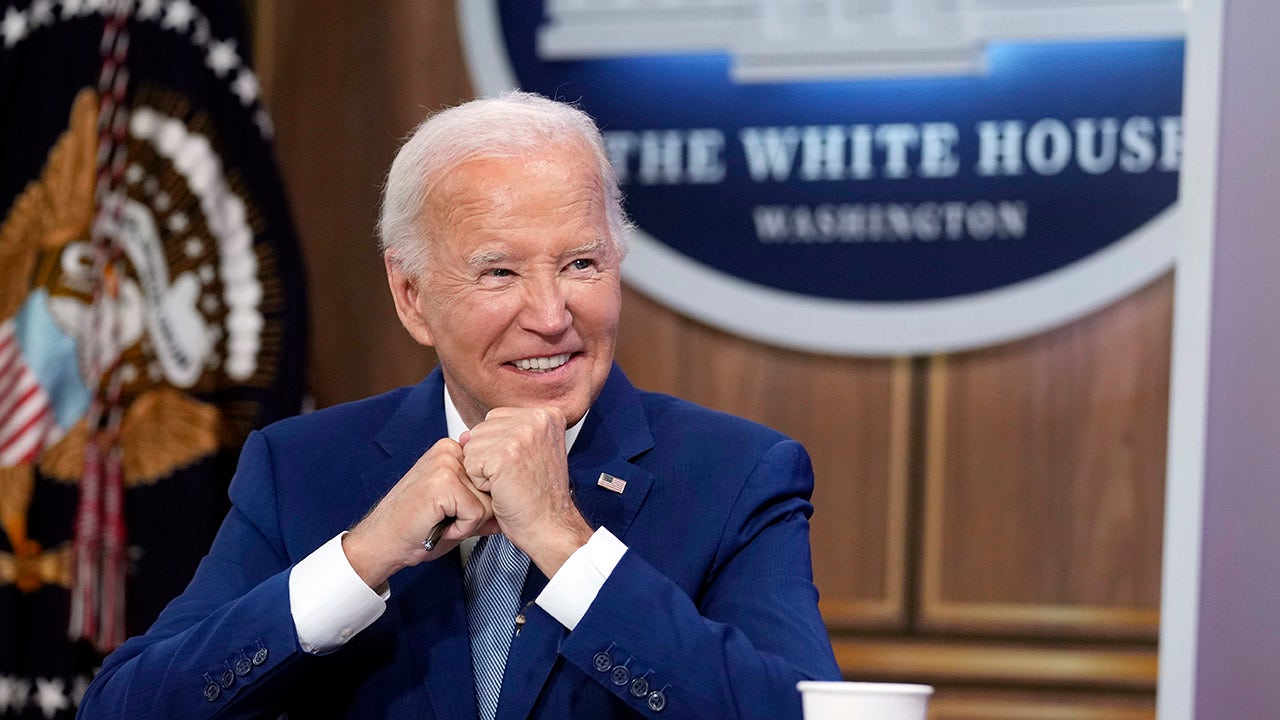
President Biden listens in the South Court Auditorium on the White House complex in Washington, Tuesday, Sept. 3, 2024, as he talks with a virtual participant at the kickoff of the Investing in America event. (AP Photo/Susan Walsh)
White House Deputy Chief of Staff Natalie Quillian told reporters on Wednesday that “manufacturing is making a comeback in communities across the country,” touting Biden’s Investing in America agenda, which includes the American Rescue Plan, the Bipartisan Infrastructure Law, the Chips and Science Act and the Inflation Reduction Act.
“His agenda has spurred over $910 billion in private sector manufacturing and clean energy investments,” Quillian said of Biden. “We’re building a clean energy economy that is lowering costs for millions of families and businesses, and we’re making the most ambitious investments in our infrastructure, including high speed internet, clean water and clean electricity in a generation.”
“Importantly, in 2021, he talked about the need for good paying jobs and opportunities in rural America and the need to address our climate crisis, and tomorrow, he will announce $7.3 billion from his Inflation Reduction Act for clean, affordable, reliable electricity,” the deputy chief of staff added. “It’s the largest investment in rural electrification since FDR administration and will spur economic development and lower costs for millions of Americans. And it will create 4,500 permanent jobs and 16,000 construction jobs.”
Agriculture Secretary Tom Vilsack testifies during a Senate Agriculture, Nutrition and Forestry oversight hearing on Capitol Hill on Wednesday, Feb. 28, 2024. (AP Photo/Mariam Zuhaib, File)
WHITE HOUSE FINALIZES RULES INCREASING CLEAN ENERGY SUBSIDIES FIVEFOLD IN BID TO SUPPORT GREEN JOBS
In Wisconsin, Dairyland Power Cooperative is receiving the first New ERA award of nearly $573 million, which they will leverage for a total project investment of $2.1 billion.
Dairyland plans to procure 1,080 megawatts of renewable energy through eight wind and solar power purchase agreements, four solar installations and four wind power installations across rural portions of Wisconsin, Iowa, Minnesota and Illinois, according to the White House. Dairyland estimates that electric rates for their members will be 42% lower over 10 years than they would have been without New ERA funding.
Contractors install solar panels in Rodeo, California, on July 31, 2024. President Biden is to announce $7.3 billion in new clean energy spending on Thursday. (David Paul Morris/Bloomberg via Getty Images)
“This is a $573 million commitment that the USDA is making, with the Inflation Reduction Act resources, in the form of a grant of nearly $471 million and a loan of nearly $102 million,” Vilsack said Wednesday. “This is going to establish an opportunity for this particular cooperative to purchase, to finance eight power purchase agreements for solar installations, for wind power installations across their service territory in Wisconsin. This is an opportunity, over the next ten years, to lower the cost of electricity for the customers of the Dairyland Cooperative by nearly 42%.”
The White House said the 16 cooperatives are intended to benefit rural communities in Alaska, Arizona, California, Colorado, Florida, Illinois, Indiana, Iowa, Kentucky, Michigan, Minnesota, Montana, Nebraska, New Jersey, New Mexico, Nevada, North Dakota, Ohio, Pennsylvania, South Dakota, Texas, Wisconsin and Wyoming
The secretary said Dairyland Cooperative will also make its own investment into the project and fund community benefit plans. “The total cost of the project will be a little over $2 billion,” Vilsack told reporters. “These benefit plans are designed to provide direct assistance and help to farmers, who will benefit from this clean energy as well as connecting to employment opportunities.”
Read the full article from Here


Taylor police are investigating after a man was found dead with stab wounds outside of a vehicle early Thursday morning.
Police responded to the 11000 block of Elm Street around 4:15 a.m. Thursday for a report of an unresponsive man lying on the ground next to a vehicle. Medics pronounced the man dead at the scene.
Detectives identified a former girlfriend of the victim, and an investigation led police to the area of Telegraph and McNichols roads in Detroit, where authorities say they found her vehicle.
When detectives attempted to make contact with the woman, they say she fled in her car.
The woman’s vehicle was later found abandoned in a field in the 15000 block of Salem Street.
With help from Detroit police and the Michigan State Police K-9 Unit, authorities tracked down the woman hiding behind a bush and took her into custody without incident.
Taylor police have not identified the victim or the suspect.
An investigation is ongoing.

MILWAUKEE — As Venezuela continues to recover from devastating earthquakes, support from Milwaukee’s “United for Venezuela Emergency Relief Campaign” is soon heading to the disaster-stricken country.
The basement of Blessed Sacrament Catholic Church is filled to the brim with donations ticketed for Venezuela, the culmunation of a week of community generosity.
From food to clothing and toys, the outpouring has been remarkable said Father Norberto Sandoval, who is from Venezuela and serves as associate pastor of Blessed Sacrament.
“This [has been] overwhelming,” said Sandoval. “I mean, if you can see [the basement], you were able to get in on Monday. Now we [are not] able to walk.”
(Spectrum News 1/Blake Dietz)
Aura Escobar, who is also from Venezuela, has been doing whatever she can to help her home country, including packing donations. She described the support from friends, coworkers, and strangers as something special to witness.
“In my Venmo, I had three thousand dollars in less than 24 hours,” Escobar said. “And I was able to buy stuff to donate. It’s been amazing. It’s very heartwarming to have so many people that care about Venezuela.”
Due to limited storage capacity and the logistical planning required to transport the supplies to those who need them most, organizers have decided to stop accepting donations after Friday afternoon.
“We have more than a thousand boxes right now. We are expecting two semi-trucks either to move [Friday] in the afternoon or tomorrow,” Sandoval said.

(Spectrum News 1/Blake Dietz)
He acknowledged that corruption in times of trauma is a long-standing concern in Venezuela. For that reason, the trucks will take the local donations to Miami, where a Venezuelan organization he fully trusts will handle the final distribution.
“We have already the person and it’s going to be [done] free. It’s going to be directly to a group of religious groups in Venezuela. So, in that way people will get the donations,” he said.
Sandoval and other organizers are putting out one final plea for volunteers to help load the semi-trucks on Friday and Saturday.

What does it look like to carry your culture with you? When Minneapolis architect and photographer Patricia Mutebi posted a casting call on TikTok in December, she was looking for a way to map how immigrants and diaspora communities in Minnesota keep their heritage close.
She initially planned to photograph Twin Cities residents in their homes, but Operation Metro Surge, the federal immigration enforcement crackdown in Minnesota, forced her to reconsider the safety of her subjects.
“I didn’t think that people would feel comfortable letting a stranger into their home, trying to take pictures of them,” Mutebi said. “From January all through April, I photographed those who were comfortable coming into the downtown [Minneapolis] area.”
The result is “Threads of Us,” a portrait exhibit featuring 20 Hmong, Thai, Indian, African, Pakistani and Indigenous people who have built a life in the Twin Cities.
After seeing the exhibit, spend the rest of the weekend at the annual Taste of Minnesota, revisit soul music of the 1990s at the Dakota or watch Saturday’s World Cup matches at a street fair in Minneapolis.
Finding home in Minnesota
In “Threads of Us,” Mutebi asked each person she photographed the same question: What does home look like after you’ve left it behind?
“Each person I photographed taught me something new about perseverance and resilience,” Mutebi said. “They’ve come into a new place that doesn’t necessarily welcome them openly, but they’re choosing to show up as their authentic self regardless. Nothing could honestly beat that.”
Mutebi understands the feeling. She was born in Uganda, studied architecture in Kenya, and moved to Minnesota in 2019.
“I have friends here who have families that know how to cook Kenyan food, and whenever I go visit them, there’s a smell that just hits me, and I’m taken back to a time when I was an undergrad,” she said. “In the first house that I bought, I have this gallery wall that shows the journey I’ve traveled. It has art from Kenya, from Uganda, and pictures of friends and family. That’s the most treasured thing I have.”
She also draws inspiration from architects like Burkinabé-German designer Diébédo Francis Kéré, whose work centers on Indigenous materials and community-led design across Africa.
He “didn’t try to bring the Western world with him,” Mutebi said. “He was designing for the culture — where it sat, and using the materials they have to help people understand that we have these resources already.”
For “Threads of Us,” participants arrived in traditional clothing — from Hmong vests and Ethiopian habesha dresses to Ghanaian kente cloth and Pakistani shalwar kameez. They brought meaningful objects, including wedding garments, family heirlooms, Oromo beadwork, Somali incense burners and Ethiopian coffee ceremony sets. Each item served as a tangible bridge to their families and homelands.
“I found people who have photographed cultures in the most beautiful way and have captured joy without trying to modernize the culture,” Mutebi said. “I want to photograph people where they’re at and how they move through life without trying to change them one way or another.”
Threads of Us, now on view at The Residency by Modern Day Me in Minneapolis, is Mutebi’s first exhibit — but she’s already thinking about what comes next. She was recently selected for the cohort of the Little Africa residency program, where she will partner with local African-descent business owners to tell their stories through photography.
“Unless you’re Indigenous, you came from somewhere,” Mutebi said. “I want people to take the time to think about what it means to them and how they can show up in the places they are now.”
Date: Friday, July 3 through Friday, July 17.
Time: 10 a.m. to 5 p.m. Monday through Friday
Location: The Residency by Modern Day Me, 401 N. 1st Ave., Minneapolis
Cost: Free
For more information: Visit patriciamutebi.studio/portfolio/threadsofus

Taste of Minnesota
Spend your Fourth of July weekend at the Taste of Minnesota, where 18 local musicians and more than 100 food vendors will take over downtown Minneapolis for the annual two-day festival.
The main stage will feature grunge-pop band Gully Boys, hip-hop artist Nur-D, singer-songwriter Dessa, and DJ Sophia Eris. The North Star Stage will spotlight emerging acts, including Frankie Torres, Adam David Bohanan, and Solana and the Sunsets.
Date: Friday, July 3 and Saturday, July 4
Time: 4 to 10 p.m. on Friday. Noon to 10 p.m. on Saturday
Location: At the intersection of Nicollet Mall and Washington Avenue
Cost: Free. RSVP here.
For more information: Visit tasteofmn.com
A night of ’90s soul
If music from the 1995 film “Waiting to Exhale” still has a place on your playlist, head to the Dakota this Friday for the Ladies of Soul tribute show.
Local singers Solorah, Ashley Commodore and Monique Blakey will perform the soundtrack from start to finish, revisiting songs by Whitney Houston, Toni Braxton, Mary J. Blige, Brandy and Aretha Franklin.

World Cup watch party
Catch the knockout rounds between Canada and Morocco and Paraguay and France at the World Cup Street Fair in Minneapolis this Saturday.
Utepils Brewing will show both games on large indoor and outdoor screens, while the street fair will feature food trucks, art vendors, mini soccer games and DJ sets between kickoffs.
-
Fitness1 minute ago
Huge 30-Year Study Finds Exercise Variety Can Help You Live Longer – Here’s the Ideal Mix
-

 Movie Reviews11 minutes ago
The Kernel: Freshly popped film reviews — Batch #6 – Excalibur
-

 World23 minutes ago
AI ‘Organisms’ Come Alive in Kuala Lumpur as Dutch Artist Unveils Immersive Show
-

 Health46 minutes ago
Is Skipping Breakfast Bad? The Weight-Loss Truth May Surprise You
-
 Lifestyle1 hour ago
Nearly half of Americans surveyed don’t know what America 250 commemorates
-

 Technology1 hour ago
Amazon updated 2023’s Fire HD 10 tablet with 4GB of RAM
-

 World1 hour ago
Interpol issues red notice for Ukrainian woman wanted for Monaco apartment bombing targeting oligarch
-

 Politics1 hour ago
Mamdani blasts ICE agents, Elon Musk and ‘supremacy’ in America 250 speech ahead of July 4 weekend


