Lifestyle
What does luxury even mean today? Four fashion insiders weigh in

This story is part of Image’s October Luxury issue, exploring what luxury really means to artists, designers, aestheticians, architects and more.
In the 2005 Chanel miniseries “Signé Chanel,” French filmmaker Loïc Prigent offers an unprecedented inside look at the storied luxury fashion house. In one scene, the film ventures to a farm in rural Paris, home to an elderly woman who, utilizing a handmade loom, was the only one capable of weaving the trim on Chanel jackets at the time. According to the documentary, Chanel sent interns and seamstresses to the farm in many failed attempts to master the woman’s technique — but only her hands were capable of such finesse. This scene comes to mind for Steff Yotka, newly appointed Global Editorial Director for I-D magazine and former head of content at luxury e-commerce platform Ssense (and also my former colleague), when I asked her about the evolution of luxury fashion. “It’s luxurious because every jacket is a piece of art,” says Yotka.
In the nearly 20 years since Prigent’s Chanel documentary, we’ve entered a totally new luxury landscape. Luxury e-commerce retailers are battling it out — when news broke in March of this year of London retailer Matches closing, its offloaded merchandise from brands like Dries Van Noten and Rick Owens found its way to Walmart marketplace to the surprise (and outrage) of some. Economic uncertainty and inflation have forced luxury’s behemoth parent companies like LVMH and Kering into a juggling act of new creative directors, international expansion, price hikes and excess inventory, while resale sites make maintaining product exclusivity and legitimacy a tough task.
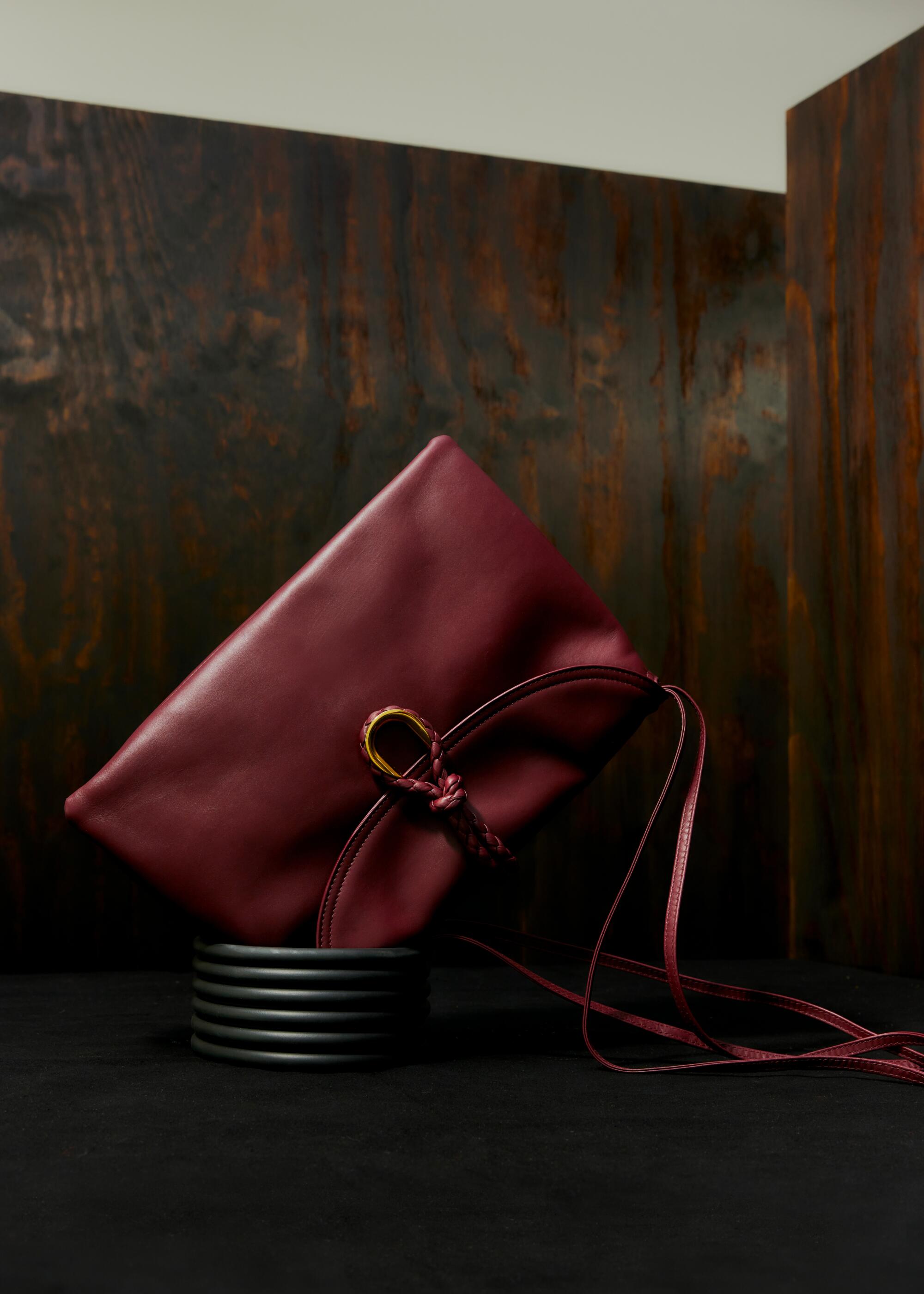
Bottega Veneta Liberta bag in burgundy.
In a saturated market, it’s easy to feel like the days of bespoke craftsmanship and artistry as depicted in Prigent’s film are behind us, replaced with expensive graphic tees, sneakers and more products than we can consume. Once strictly reserved for high-fashion houses and the uber-rich, luxury fashion is more culturally ubiquitous and accessible than ever via social media and resale platforms like the RealReal, Poshmark, eBay, Grailed and Depop. The term “luxury” is actually just as subjective as it is sentimental, and despite economic instability, luxury fashion is simply everywhere today.
Fall/winter 2024 finds us (yes, still) firmly in the “quiet luxury” era, as defined by brands like Khaite, Bottega Veneta and the Row. It got me thinking: What does the word “luxury” even mean? This may seem like a silly question, but at a time of skyrocketing prices, market saturation, widening class disparity, climate change and international tumult, it left me wondering how those within the fashion industry relate to the concept of luxury on a personal level. Does it still sparkle and shine? How does it fit into their daily lives? What does it represent? How do they metabolize the luxury trend cycle?
Beneath the surface, luxury’s long-standing appeal is often about a sense of belonging. Yotka recalls her first luxury fashion purchase: a Spring 2004 Marc by Marc Jacobs T-shirt that she got at the opening of the Bloomingdales in SoHo. “It felt so luxurious because at that time in fashion it was really Marc Jacobs’ world,” she says. “To me, that T-shirt symbolized a whole universe that I wanted to be a part of. Whether it cost $5 or $500, it still would have felt like a luxury.”
For Guillermo Andrade, founder and designer of cult L.A.-based menswear label 424, a professional player’s edition of soccer cleats was the first item that shaped his personal definition of luxury. “They looked the same as everyone else’s cleats, but they smelled different and when you put them on you felt different,” says Andrade. “They were the first thing I considered to be a luxury, because I didn’t actually need that model of cleat to play soccer, but they were the ones I desired and wanted,” he continues. “To me, that’s the difference between mainstream consumer goods versus luxury goods. The cleats signified something that I wanted to be a part of.”
On an aesthetic level, while logos used to reign, the luxury labels that best capture the zeitgeist today are mastering a more subdued — but, importantly, not boring — design POV informed by personal style. “I think the period that we’re in now is about finding the beauty in everyday things,” says Yotka. “You see it at the Row with the most beautiful trench coat, cashmere sweater or ballet flat. You don’t want to change your whole life or become a different person every day, you want to be a slightly more put-together and fabulous version of who you already are.”
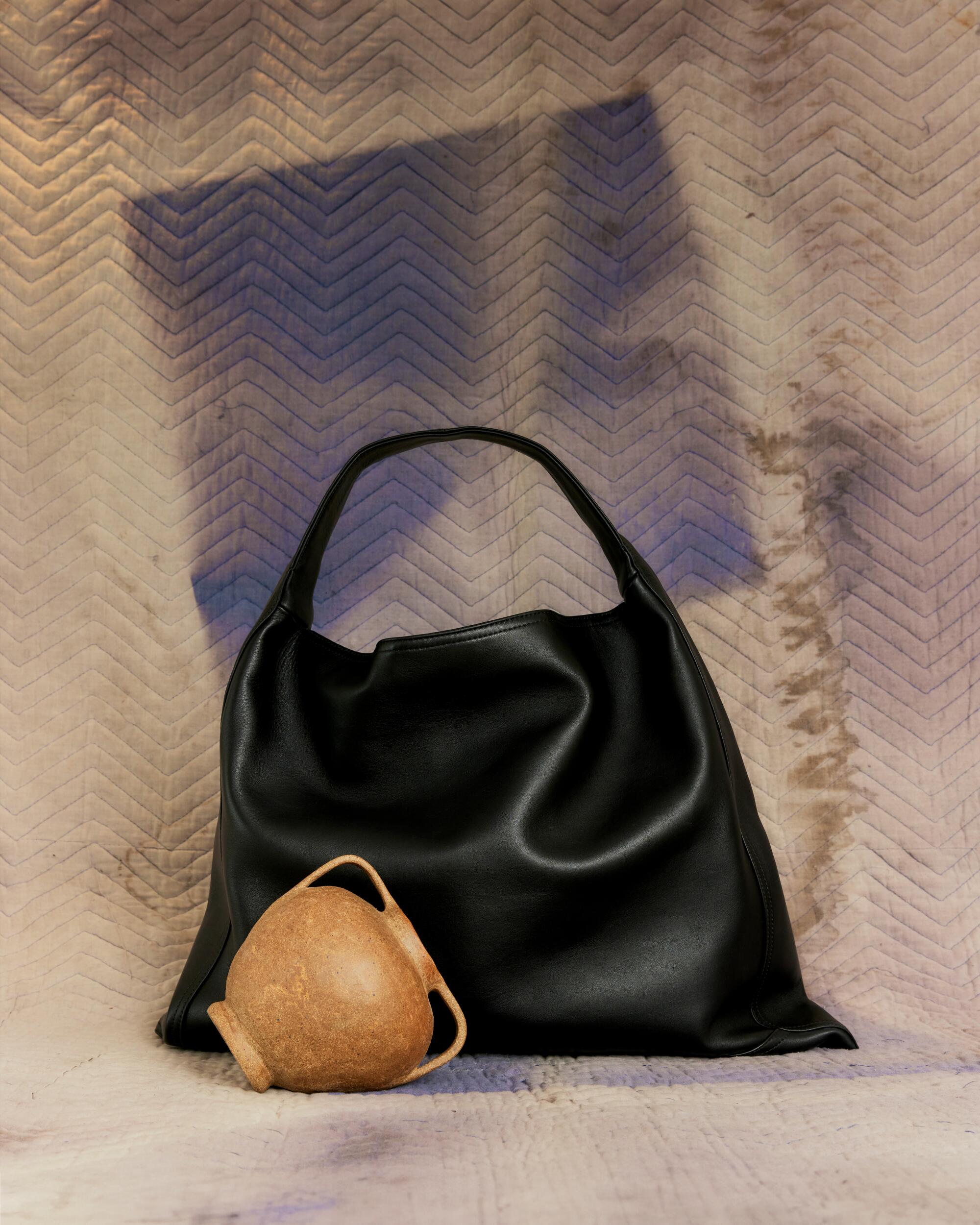
Bottega Veneta Hop bag in black.
This fine-tuned, everyday uniform approach appeals to Daniel Pacitti, curator with vintage shop 194 Los Angeles and co-founder of the made-in-USA clothing label Cease. “I don’t buy things very often anymore, I think we all buy too much,” says Pacitti. “But I made a new friend in Tokyo recently who has a brand called A.PRESSE, and I bought a hoodie from him. The fit and wash technique is great, and that to me is more luxurious than a Louis Vuitton hoodie.”
Quality still makes a luxury purchase worth it for many, but with so much shopping taking place online, it takes more vigilance to discern a well-made garment. “Nothing is worse than a kid saving up their money to buy something like I did when I was 15, and then getting home and looking in the mirror and it’s a massive letdown,” says Andrade. “I respect people’s money so much, the last thing I want is that ‘Why did I buy this’ feeling.”
Mina Alyeshmerni, founder of L.A. shop Maimoun — a store that supports emerging designers like SC103, J.Kim and Super Yaya — agrees. “I think luxury is meant to make your life easier, less stressful,” says Alyeshmerni. “I don’t typically associate [luxury] with material things, since I feel strongly that something that is well made and will last you years should be within reach.”
Working in fashion can be especially illuminating, even sobering. “I’ve learned that a lot of luxury isn’t actually luxury,” says Pacitti. “When you learn about manufacturing, you realize that most of it is made at the same place, at the same factory and with the same fabrics, but luxury doesn’t have to be something that’s expensive. I’ve been to places like India where you’ll find someone on the side of the road hand-stitching something. It’s the same level of work as someone in the Dior atelier except their work is on a runway. Some people’s labor is worth more than others.”
“Maybe it’s because of how I grew up, but I f— hate the word ‘luxury,’” says Andrade. “It feels like another tool to keep you down, to remind you what you lack as a person. The ‘You’re not good enough until you buy this thing’ idea. But the thing that keeps me loving what I do for a living is that every now and then you go to a shop and you pick up a product and you’re like, ‘Wow, this is awesome.’ I love how someone’s dream can manifest into a physical product that you can take home. That’s when you truly get to enjoy the craftsmanship, innovation and attention to detail of fashion. All the little quirks that really move you.”
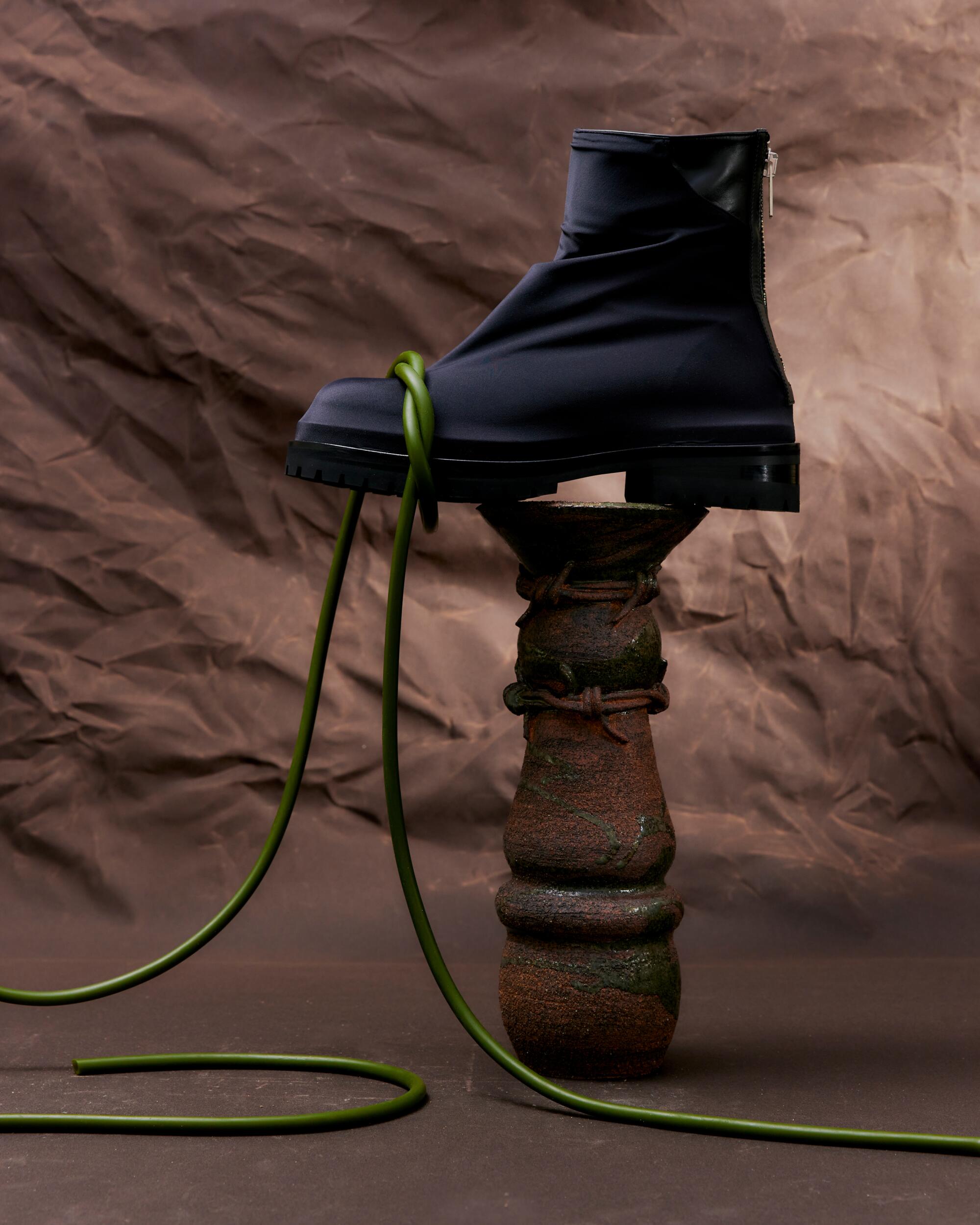
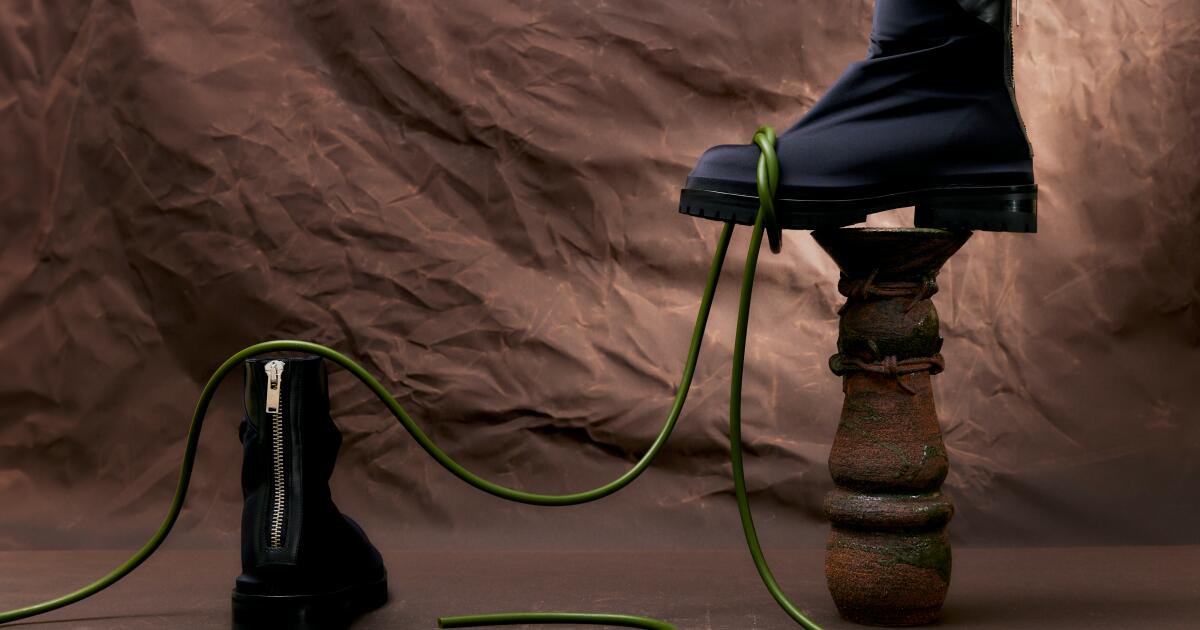
424 Marathon boots, Jess Sasso ceramic.
It’s precisely those quirks that make luxury a deeply personal topic. In many ways, it’s about reciprocity. How much can your clothing give back to you? How does it carry you through the formative and mundane moments of your life? Defining luxury on your own terms offers the chance to reclaim an often esoteric and cost-prohibitive universe. “True luxury is something that stands the test of your emotional time,” says Yotka, who still wears the Marc by Marc Jacobs T-shirt she bought with her friend because it’s as timeless as it is a holder of memory. “I want your little brother or cousin to try to steal your 424 hoodie,” says Andrade. “Those are the pieces of clothing that I always treasured. The intimate relationship that you have with your clothes is the part I care about.” Alyeshmerni’s first luxury purchase was a pair of tinted Dior sunglasses with rhinestone logos on the arms, but wearing her new Baserange sweater makes her feel like she’s embarking on a relationship with a piece she’ll have in her closet for possibly the rest of her life.
While often individualistic in its gaze — used to craft one’s own identity — fashion, in all its ubiquity, also represents shared experience, from the initial design inspiration, to the hands that made it, to the dreams and fantasies we project onto our wardrobes, and their ultimate lived experience. In a rhizomatic network of energy exchanges and cues, our clothing is imbued with life from the start. The chance to add to a garment’s story with our own lineage and that of the people we love, regardless of the item’s price or brand, is perhaps the most luxurious of all.
Production assistant: Carmen Madera
Romany Williams is a writer, editor and stylist based on Vancouver Island, Canada. Her collaborators include SSENSE, Atmos, L.A. Times Image and more.

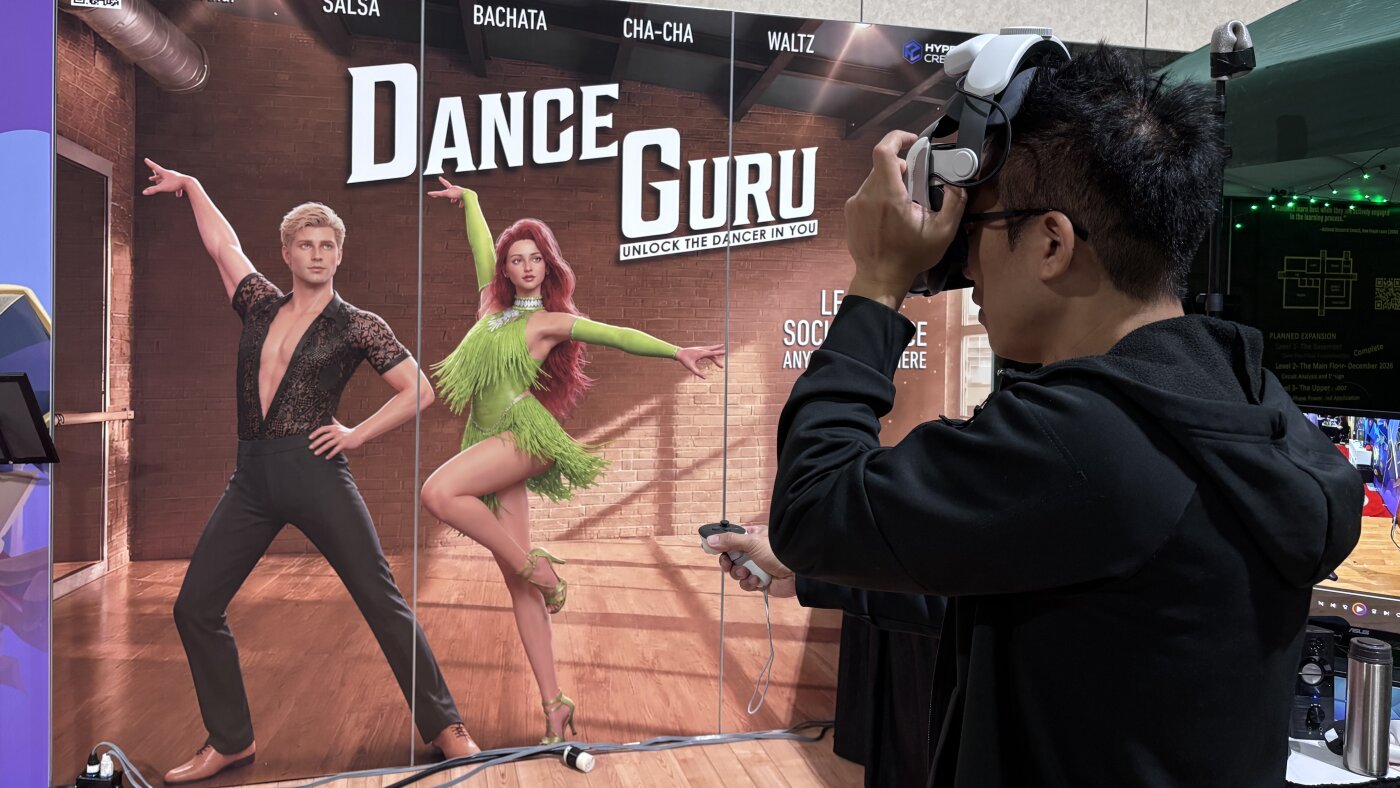
Entrepreneur David Huang tests out a VR headset while conducting demonstrations of the social dance lesson app Dance Guru at the Augmented World Expo in Long Beach, Calif., June 17, 2026.
Chloe Veltman/NPR
hide caption
toggle caption
Chloe Veltman/NPR
Wedding season is in full swing, bringing with it a familiar sense of dread for anyone who fears the dance floor.
But relief may finally be at hand with the help of a new app, Dance Guru, and a virtual reality (VR) headset.
The social dance instruction app transports users to a spacious, digital dance studio. Waiting inside is a computer-generated coach: a handsome, male avatar wearing a shirt open to his navel. He speaks with a slightly gravelly English accent.
“Watch me now,” he instructs at the start of a waltz lesson — which NPR tried out at the Augmented World Expo in Long Beach, Calif., an annual conference showcasing the latest developments in virtual and augmented reality.
The avatar then demonstrates a basic box step.

From there, the lesson becomes interactive. The coach tells the user to hold his hand while an electric pinging sound tracks the student’s foot placement.
“One, two, three, four, five, six,” the virtual teacher counts down.
When the user stumbles, he remains remarkably patient. “Do not worry, foundations take time. Let’s try that again. Work on grounding your steps more intentionally.”
Solving the beginner’s dilemma
Dance Guru creator David Huang said he came up with the idea for the app a couple of years ago out of frustration.
“I always wanted to learn to dance and I was always terrible at it,” Huang said. “And I always ended up stopping midway through the lessons.”
He soon realized that many beginners hit the exact same roadblocks.

“Private lessons are too expensive, and you feel like you’re always forgetting the dance steps,” Huang said. “You cannot find a partner to dance with. So I figured maybe I can create something like this.”
The Dance Guru platform currently offers tutorials in salsa, bachata, waltz, and cha-cha, in both lead and follow modes. To make the digital instruction feel authentic, Huang used motion-capture technology to record the movements of real-life dance teachers — with their permission.
Building on the legacy of online tutorials and video games
Dance Guru belongs to a small but growing wave of apps using VR to demystify social dance. At a nearby booth, conference attendee Victor Chen is testing out a competing app called Trip the Light. It currently offers salsa lessons, as well as freestyle options, where a user can dance with a partner without having to learn specific steps.

Trip the Light’s booth at the Augmented World Expo included posters of the app’s virtual instructors. Real-life performers, who gave Trip the Light permission to motion capture their movements, were used as a basis for these avatars.
Chloe Veltman/NPR
hide caption
toggle caption
Chloe Veltman/NPR
“A lot of times when you’re trying to learn a choreography, it’s watching a YouTube video and you have to pause it, rewind, and play it,” Chen said. “If you were to have a virtual avatar dancing in front of you and correcting for any parts that you missed, it might be a lot easier.”
Interactive video games like Dance Dance Revolution and Just Dance, and YouTube tutorials have been helping people improve their skills in private for years. But those games are mostly aimed at solo players. Unlike the new generation of immersive VR apps, they cannot simulate the mechanics or confidence required for partner dancing on a live dance floor.
The reality check
But this kind of app won’t work for every dancer.
“Everyone learns a little bit differently. And so unless you have a game that has lots of different ways of teaching, you’re going to have things that work for some people and don’t work for others,” said Ariana Katana, a trained contemporary dancer and dance content creator who’s active on YouTube, Twitch and other platforms. “Also, it’s hard to dance with a headset on.”
And then there’s the issue of not being able to physically feel a virtual partner’s hand or shoulder while dancing with them. Patrick Ascolese, the creator of Trip the Light, said the experience could become more tactile in the future. “Haptic suits and wearables will be coming, but I think we’re a little away from that,” he said.
Ascolese said even with their limitations, immersive tools like Trip the Light have immense potential as judgment-free training grounds — giving reluctant dancers the baseline confidence they need to eventually step onto the dance floor with real partners in the real world, including at weddings.
“Just like anything else, practice makes perfect,” said Ascolese. “So the more time you spend in VR with a virtual partner, it works towards helping you get over that social hurdle. We are teaching you the moves that you have to do in order to go out and have fun.”
Jennifer Vanasco edited the broadcast and digital versions of this story. Chloee Weiner mixed the audio.




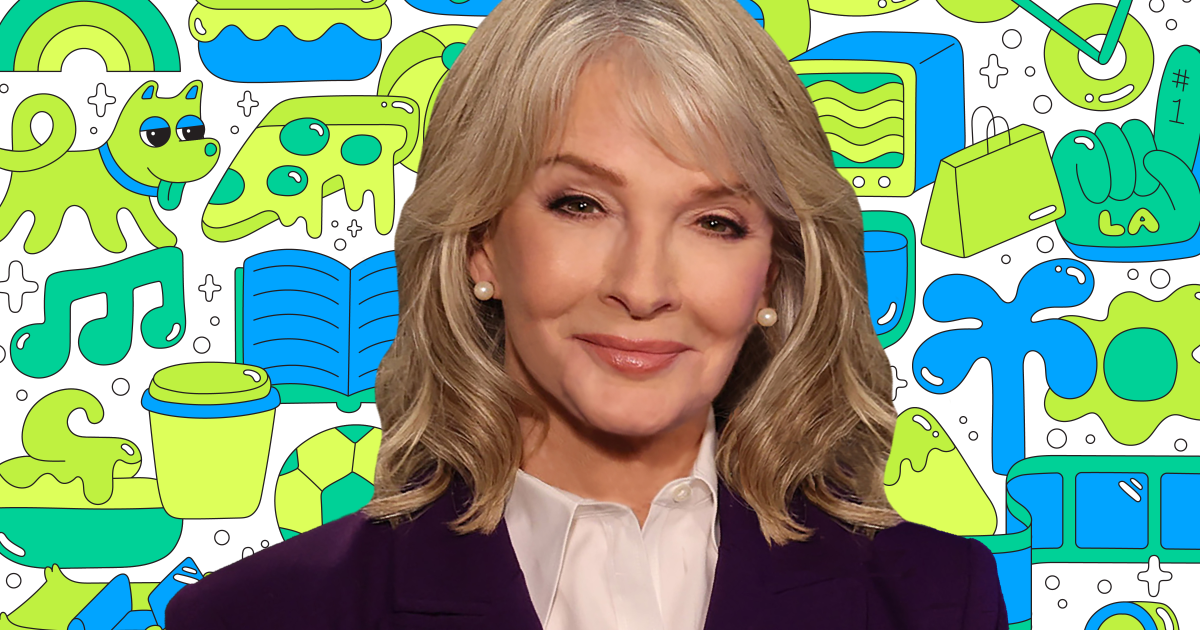
For half a century, Deidre Hall has taken on every kind of disaster in the drama-packed town of Salem, Ill., as a star of “Days of Our Lives.”
There was the time — actually, it happened twice — when her character, Dr. Marlena Evans, was famously possessed by the devil and even levitated.

In Sunday Funday, L.A. people give us a play-by-play of their ideal Sunday around town. Find ideas and inspiration on where to go, what to eat and how to enjoy life on the weekends.
Or the time a serial killer, who was actually Marlena under hypnosis, seemed to kill several beloved characters. The long-running show’s storylines have become legendary, and in March, while promoting “Hail Mary,” actor Ryan Gosling even gave Hall a shout-out, admitting he was a fan, praising the hard work of soap opera actors and calling her an “OG acting inspiration.”
But Hall’s real life in Santa Monica is much quieter than her character’s, and she likes it that way.
“When I bought my house in Santa Monica, I didn’t realize how great it would be to live near Montana Avenue,” says Hall, 78, about the popular shopping spot. Every day, she walks to the main street with her golden retriever, Riley, and enjoys Pilates, art and good food along the way. “The owners of the Farms Market even keep dog biscuits, so guess where the dog wants to go every time we walk — the Farms, of course,” she says, laughing.
When she isn’t filming the daily soap opera, which airs on Peacock, Hall enjoys raising monarch butterflies, exploring the shops and restaurants on Montana, and hosting movie nights at home with her two sons.
Here’s what a perfect day in L.A. looks like for her.
This interview has been lightly edited and condensed for length and clarity.

7 a.m.: Breakfast and dog walk
I usually kick off my day with a protein shake, feed our golden retriever and take her out for a walk. She’s a phenomenal girl. When we adopted her, her name was Riley, but I did think about naming her after Mrs. Hughes from “Downton Abbey.”

10 a.m.: Church and garden time
After I walk the dog and go to church, I like to spend some time in my yard. I’m not a natural gardener, but I really enjoy it. I started raising monarch butterflies because my identical twin sister, who played my twin on the show, planted a butterfly garden. Monarchs are amazing because they are transitional. Every year, they travel from Mexico to southern New England, but it’s getting harder for them. Their numbers have dropped by about 80%. To help, I plant milkweed, which is what they need to survive. I buy my milkweed from the Staghorn Garden on Wilshire Boulevard in Santa Monica. Julie, who owns the nursery, is delightful and has a wide variety of milkweed. The monarchs always seem to find my garden. Julie was raising some caterpillars too, and she cared a lot about them. We talked about how important it is to help the butterflies. That’s why I do this. Sometimes I get milkweed with eggs already on it, and Julie knows her butterflies are going to a good home.

1 p.m.: Walk to Montana Avenue for some lunch
I live near Montana and love taking long walks, going to Pilates and trying out the great restaurants nearby, like R+D Kitchen and La La Land. I’m a big fan of the waffles at the Courtyard Kitchen. Just a few days ago, I had a chicken salad on raisin bread with an Arnold Palmer, and it was delicious. It is right on Montana and has a nice outdoor seating area. It’s one of my favorite spots. La La Land always has a long line in the morning, which is perfect if you want coffee. They serve coffee, doughnuts, croissants and avocado toast. There’s plenty of outdoor seating, and you can even bring your dog.

2 p.m.: Peek inside a clock shop
There’s a small clock shop on Montana Avenue that’s closed on Sundays, but if you walk by, you’ll see all kinds of clocks — standing, table and wall clocks. The owner is great at fixing them. Once, I bought a wall clock from MacKenzie-Childs, but it didn’t work. And I was really upset because it matched everything else on my countertop. I brought it to the owner and said, “I love this, but I can’t make it work.” He fixed it right away. His name is John, but I call him Geppetto. And we all know why. He really does have a magic touch.

2:30 p.m.: Visit a neighborhood art gallery
Ten Women Gallery is run by 10 artists, all of whom show their work there. I was drawn to some watercolors there, bought a few cards and spoke with one of the artists. She told me, “You seem to love watercolors,” and mentioned that the artist who painted them, Pamela Harnois, lives in Los Angeles and teaches nearby. I got Pamela’s name and found out she taught at the Brentwood Art School. I was so inspired by her gift that I started taking private lessons with her on Saturdays. That gallery is where I discovered my love for watercolor painting.

3 p.m.: Grab some ice cream at Rori’s
The other day, my longtime girlfriend wanted to get ice cream and told me, “We are walking to Rori’s Artisanal Creamery.” It’s a small shop on Montana near Lincoln. They make everything themselves, using local ingredients from grass-fed cows with no added hormones. The place is family-owned and probably has the healthiest ice cream you’ll find. They switch up their flavors often, but my favorite is the salted caramel.

6 p.m.: Family dinner and movie night at home
R+D Kitchen is always packed, so my sons, who are 31 and 33, do the cooking. They come over, and together we make salads and cook dinner. There’s a neighborhood grocery store called the Farms, off Montana, a small family-run place that has everything we need. Everyone knows each other there, and people bring their dogs. We try to have movie night every Sunday. Sometimes the day changes, but we always make sure to have one night a week where we cook a meal and sit down as a family. Keeping that tradition has become really important to us. My sons are great cooks, which is funny because they definitely didn’t get that from me. [Laughs]
9 p.m.: Take Riley for one last walk and visit neighbors
After dinner, I take my dog for a walk. It’s a great way to meet neighbors. We always go around the same block. We’ve met so many people, and since she’s a golden retriever, she loves meeting everyone.

10 p.m.: News, knitting and bedtime
I am a news junkie, so I usually watch whatever is on the news before I go to bed. I have a long-standing passion for knitting. Lately, though, the news would make me drop a stitch.
For Iris van Herpen, couture is a laboratory as much as a runway. Our chief fashion critic, Vanessa Friedman, takes us inside this Dutch designer’s latest Paris show — from sci-fi-inspired gowns to an audacious attempt at a dress made of charged plasma.
-
Lifestyle16 minutes ago
Shy on the dance floor? Virtual reality ‘partners’ aim to help you find your groove
-

 Technology29 minutes ago
Are you filthy enough for a $700 portable shower?
-

 World30 minutes ago
Former British MP and reality TV star Ann Widdecombe found dead; man arrested for murder
-

 Politics36 minutes ago
Trump takes unusual step, lets bipartisan housing bill become law unsigned amid SAVE pressure campaign
-

 Health44 minutes ago
Eating common dairy food every day may slow biological aging, study suggests
-

 Sports46 minutes ago
CM Punk to defend Undisputed WWE Championship against Cody Rhodes at SummerSlam
-

 Technology51 minutes ago
Would you pay $8,000 for a robot to fold laundry?
-
 Business59 minutes ago
Legendary Television City may be be sold in further blow to Hollywood

