Lifestyle
The reuse revolution: Your guide to upcycled and sustainable fashion brands


This story is part of Image’s November Lost & Found issue, exploring the many lives our clothes and objects have, the many stories that are still waiting to be unearthed.
When Swedish brand Hodakova won the LVMH prize this year, it felt extra significant. The finalists for the most sought-after prize in fashion — awarded annually — are meant to foreshadow the future of the industry, and not since Paris-based label Marine Serre won in 2017 has a brand centering reuse and upcycling taken the title. Shortly after the LVMH awards, lauded Japanese designer Junya Watanabe presented looks that repurposed techwear, tires and foam blocks in his Summer/Spring ’25 womenswear show at Paris Fashion Week. It all feels different this time, like we’re finally entering the upcycling era.
While the establishment is just starting to adapt, there’s a whole wave of young designers for whom this ethos has been baked into the business from the very beginning, rather than clumsily implemented later on due to (in many cases) increasing pressure for transparency and responsible production. The truth is, reuse has been the foundation for emerging designers for decades (see: cult ’90s and early-2000s New York labels like Susan Cianciolo and Imitation of Christ), offering a chance to participate in an otherwise exclusive industry. Last year a Vogue India article’s headline read, pointedly: “Owning a one-of-a-kind upcycled garment is the new wardrobe flex.” But maybe it’s always been?

Jester wears Compost vest and bottoms, Eytys shoes.

Sky wears Sami Miro dress, Hugo Kreit earrings, Blumarine shoes, VidaKush anklet, model’s own necklaces.
“It’s a fascinating challenge to see how designers incorporate their own codes into the technique of upcycling,” says Faith Robinson, head of content at Global Fashion Agenda, a Copenhagen-based nonprofit dedicated to creating a net-positive fashion industry through research publications, events and policy engagement. “When it comes to garment production, the storytelling side of upcycling is unmatched. Take the spoon dress from Hodakova. Where did those spoons come from? How were they collected? Why? Or Buzigahill, the Uganda-based upcycling label that makes amazing pieces but also tells the story of textile waste.”
When it comes to reuse, scaling up and sourcing are issues yet to be solved, but emerging designers are willing and excited to get creative to reimagine the current system — they just need more support. “We don’t see the process of our clothes being made, so a lot of people don’t realize that the design choices completely define the sustainability credentials of our clothes,” Robinson tells me.
Young retailers like APOC store, Japan’s Season, NYC’s Tangerine and L.A.’s Maimoun focus on independent and emerging designers, with a growing selection of exciting brands from around the world that prove the appeal and potential of upcycling and reuse. In New York, there are brands like Giovanna Flores, Everyone’s Mother, SC103, Collina Strada and La Réunion Studio. In Europe, there’s Conner Ives, Rave Review, Ponte, (Di)vision and Marine Serre. New Delhi has Rkive City and L.A. has Suay Shop, Bobby Cabbagestalk and Rio Sport. Rather than remaining segmented from fashion at large, relegated to novelty or niche, the following brands (and many more) show why upcycling and reuse can, and should, be the new normal.

April wears Sentimiento top, Object From Nothing bottoms, Tecovas boots, Maria Tash earrings, jewelry by Spinelli Kilcollin, Emma Walton, Other People’s Property.
Hodakova
2024 is the year of Hodakova. Motivated by sustainability, Ellen Hodakova Larsson, 32, grew up on a farm an hour outside of Stockholm, and credits her parents’ ingenuity and resourcefulness as a major inspiration for her designs. This is clear in her use of unconventional materials like spoons, rosette prize ribbons, belts and silver plates — everyday items that she recontextualizes to stunning effect in dresses, skirts, and tops. Here’s hoping that under Larsson’s eye, her converted-goods philosophy will take hold of the industry at large.
Ellen Poppy Hill
“I’m kind of a scavenger,” U.K.-based designer Ellen Poppy Hill says of her approach to secondhand fabric sourcing. “I never know what I like but I really know what I don’t like. My fingertips squeal when they don’t like the fabric. It’s a bit of a magpie process.” Hill grew up in Southeast London in an eclectic and playful household with a set designer mother and an actor father. Her first collection, “Constant State of Repair,” debuted this year and was born from her patternless, freehand design method. An Ellen Poppy Hill garment tells a story, like the long black dress covered in lifelike mice figures; the cap with sewing ephemera, buttons and toggles attached by pins; the upcycled dress that appears to be taped together at the seams; or the recycled wool blankets turned into bomber jackets with exaggerated zipper-shaped cutouts. Collections come from time, Hill tells me, to research, draw, think and read. “A lot of the time it’s about listening to the fabrics first,” she says. “I’m focused on finding fabrics that tell a story about why I’m attached to them, why they make me feel a certain way.”

Jester wears Sentimiento top, FreddieFrances bottoms, Rock Town Hollywood belt, Eytys shoes, Zucca bracelet.
Hood Baby
Hood Baby founder Anny Saray Martinez grew up at the swap meets of L.A. “My mom was a vendor at swap meets and I would go to work with her,” Martinez tells me. “When I got older I started to frequent the other fabric vendors and purchase their leftovers from them.” Motivated by sustainability, a love for ’90s and early-2000s fashion and Latina pop stars like Selena, it’s no surprise that Martinez has been embraced by prominent young pop stars like Tinashe and Tyla. Her body-conscious designs range from feminine upcycled miniskirts to sporty football jersey reworks. “I’ve loved fashion my whole life and have definitely done the homework,” says Martinez.

Sky wears Hood Baby top, Sami Miro bottoms, Ancuta Sarca shoes.
All-In
All-In is the life of the party. Founding duo Benjamin Barron and Bror August Vestbø initially bonded over their love of reuse, enamored with the idea that with the right technique, you could create something covetable from nothing. Since presenting their first collection in 2019, their fashion shows have become a must-see, where models like Colin Jones bring the downtown-meets-uptown attitude of the brand to life in redesigned dresses of denim and polka dot chiffon. Charli XCX and Rihanna are also All-In girls.
Nicklas Skovgaard
Copenhagen’s Nicklas Skovgaard found his way to fashion design through weaving. He taught himself on a small loom, creating intricate swatches of fabric, before expanding into ready-to-wear and formally launching his brand in 2020. Often credited as sparking an ’80s revival in fashion, his voluminous, one-of-a-kind party dresses come to life through a combination of contrasting thrifted fabrics like denim, taffeta, chiffon, leather and lace. Sequins and florals also feature heavily. The potential of upcycling absolutely shines with Skovgaard’s tough yet elegant touch.

Jester wears Hood Baby top, Object From Nothing bottoms, Vaquera hat, Kiko Kostadinov shoes, Zucca bracelet.

April wears Sentimiento dress, Givenchy shoes, Maria Tash earrings, jewelry by Spinelli Kilcollin, Emma Walton, Other People’s Property.
Object From Nothing
Partners and founders of Object From Nothing, Meridith Shook and Jacob Schlater met at the University of Cincinnati while studying architectural engineering and product design, respectively. OFN came to life after their move to a studio space in L.A. last year.
“The No. 1 driver for us is dispelling the myth that reuse is just DIY or lower quality than ‘new’ fashion,” says Schlater from his studio. “When fashion content is shared on Instagram, there’s very little focus on the quality, construction and longevity of pieces. Instead, the focus is on the value of the image that you can get with a piece. It doesn’t matter how the garment actually feels to wear, it matters how it looks like it feels to wear.” Adding value to forgotten materials and reimagining them into exceptional everyday pieces, Shook and Schlater embrace extreme resourcefulness, incorporating everything from metal washers they find on the street to deer antler buttons sourced by Schlater’s mom at a garage sale in his hometown of Hillsborough, Ohio. Inspired by designers like John Alexander Skelton and Paul Harnden, OFN treats even the most unassuming blue striped button-up — made from an upcycled vintage cot cover, no less — with the utmost consideration, transformed by their hands into a wearable artifact.
Compost
Tomo Givhan started exploring fashion design in 2021 after a formative trip to Japan, where he discovered traditional Japanese hand-stitching methods like boro and sashiko. Inspired by Japanese brand Kapital as well as antiques and indigo dyeing and distressing techniques, he set out to put his own spin on these traditional methods, resulting in soulful and layered patchwork creations made from carefully sourced vintage materials. “It’s kind of like painting for me,” Givhan says. “I’ve always gravitated toward vintage. I think the quality is better, the silhouettes are timeless and it’s accessible. There’s so much waste [in fashion] and I don’t want to be a part of that.” Based in L.A., Givhan plans to continue to grow the brand as organically as possible, recontextualizing the history of old garments and funneling them through the Compost lens.


Sky wears Nicklas Skovgaard dress, Hugo Kreit earrings, Margiela Tabi shoes.
Buzigahill
In 2018, designer Bobby Kolade, armed with a masters in fashion design from the Academy of Arts Berlin Weissensee and experience at both Margiela and Balenciaga, returned to his native Uganda with the goal to invest in the local fashion economy. After some trial and error, Kolade began sourcing and redesigning clothing from the secondhand market in Uganda, a system that is sustained (and burdened) by excess clothing outsourced from the Global North. Handwoven baskets are adorned with fringe made from strips cut from multicolor T-shirts, and patchwork hoodies feature the brand’s signature triangle motif. “We’re sending the clothes back to where they came from,” Kolade told Vogue Business in 2022, “but we’ve imbued a Ugandan identity onto these pieces.”
Duran Lantink
One of Business of Fashion’s top 10 shows of the Spring/Summer 2025 season, and the recipient of the 2024 Karl Lagerfeld prize issued by LVMH, Duran Lantink had a phenomenal year. The Amsterdam- and Paris-based label offers surreal and seductive fashion that merges three-dimensional sculpting techniques with traditional handiwork, all made from a mix of recycled textiles, deadstock and new sustainable materials. Lantink’s inflated silhouettes — think Pokémon-esque, puffy cropped bomber jackets and button-ups, and spherical skirts that look like an inner-tube pool float — are a favorite of stylists and celebrities, appearing on the covers of magazines like POP, Interview, HommeGirls and Re-Edition.

Sky wears Sami Miro dress, Hugo Kreit earrings, Blumarine shoes, VidaKush anklet, model’s own necklaces.
Les Fleurs Studio
Paris-based Les Fleurs Studio is a self-described upcycling project by creative director and stylist Maria Bernad. Steeped in Gothic and Renaissance-era references, Bernad’s romantic designs feature almost exclusively antique lace and crochet in shades of cream and ivory, and sometimes black or the softest pink. Her intricate designs are very bridal-ready, and both Beyoncé and Jared Leto are fans.
Prototypes
In June of this year, the show on everyone’s radar — including Kanye West, who reportedly went out of his way to attend — was Prototypes. An upcycling and repurposing project by designers Laura Beham and Callum Pidgeon, Prototypes has a dark, direct energy in its balaclavas and black and red color scheme, conjuring Balenciaga, but upcycled. “Out with the new, in with the old” is part of their motto, and according to their website, they want to pave the way toward individual expression and sustainability-focused design, with their customers by their side.

Sami Miro Vintage
When Image staff writer Julissa James spoke to Sami Miró back in 2021, Miró was clear about her commitment to sourcing eco-friendly fabrics. “There’s really no other way,” she told James. “I don’t care if I could find the exact same fabric that’s a fourth of the price; I would still choose this.” Since then, Miró has stayed true to her values while making it to the CFDA/Vogue Fashion Fund finals, and showing her first upcycled runway collection at New York Fashion Week in 2023. Her self-taught and intuitive design method remains sought after beyond her home base of L.A., and we’ll be watching to see where her scissors take her next.

Production: Mere Studios
Models: Jester Bulnes, April Kosky, Sky Michelle
Makeup: Valerie Vonprisk
Hair: Jocelyn Vega
Photo assistant: Saul Barrera
Styling assistant: Ron Ben
Photo intern: Khalil Bowens
Location: Projkt LA
Romany Williams is a writer, editor and stylist based on Vancouver Island, Canada. Her collaborators include SSENSE, Atmos, L.A. Times Image and more.

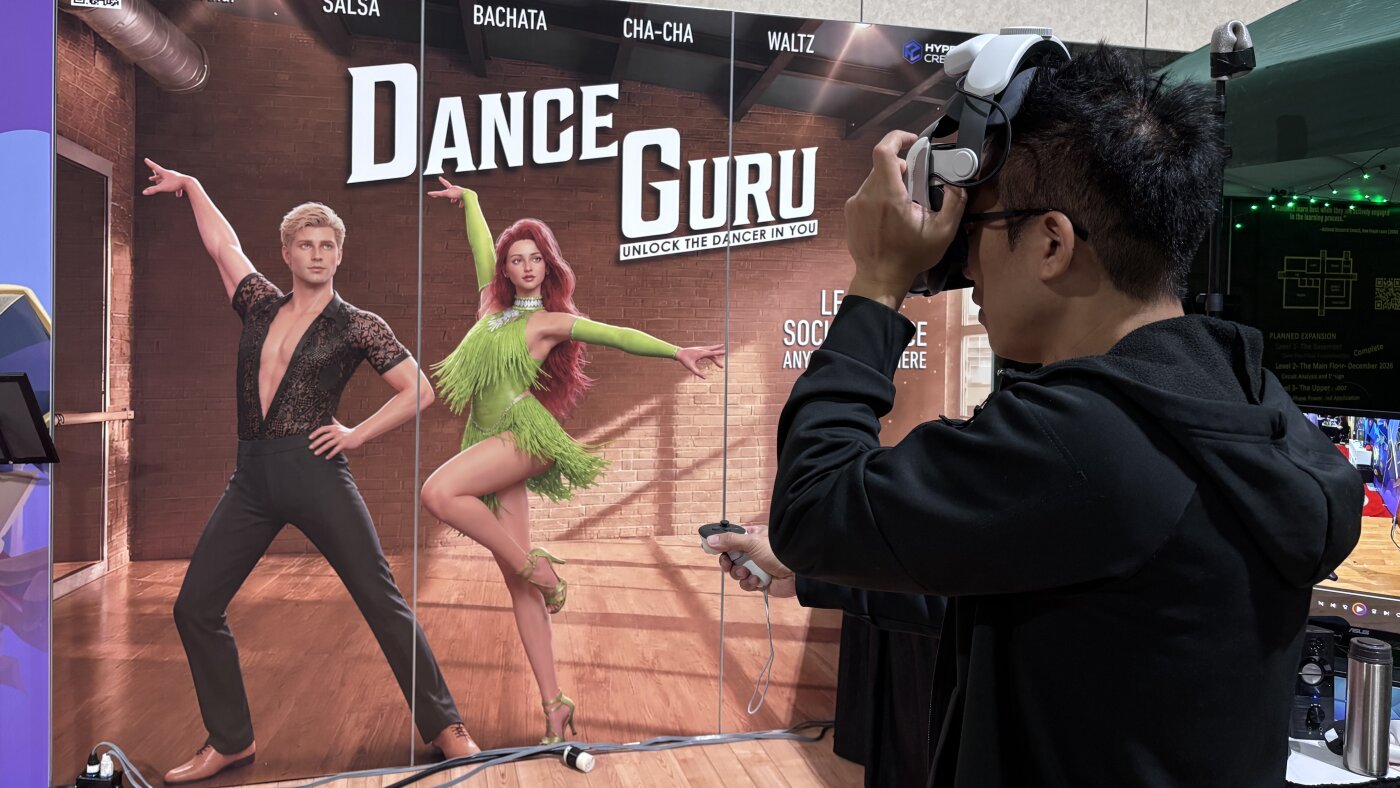
Entrepreneur David Huang tests out a VR headset while conducting demonstrations of the social dance lesson app Dance Guru at the Augmented World Expo in Long Beach, Calif., June 17, 2026.
Chloe Veltman/NPR
hide caption
toggle caption
Chloe Veltman/NPR
Wedding season is in full swing, bringing with it a familiar sense of dread for anyone who fears the dance floor.
But relief may finally be at hand with the help of a new app, Dance Guru, and a virtual reality (VR) headset.
The social dance instruction app transports users to a spacious, digital dance studio. Waiting inside is a computer-generated coach: a handsome, male avatar wearing a shirt open to his navel. He speaks with a slightly gravelly English accent.
“Watch me now,” he instructs at the start of a waltz lesson — which NPR tried out at the Augmented World Expo in Long Beach, Calif., an annual conference showcasing the latest developments in virtual and augmented reality.
The avatar then demonstrates a basic box step.

From there, the lesson becomes interactive. The coach tells the user to hold his hand while an electric pinging sound tracks the student’s foot placement.
“One, two, three, four, five, six,” the virtual teacher counts down.
When the user stumbles, he remains remarkably patient. “Do not worry, foundations take time. Let’s try that again. Work on grounding your steps more intentionally.”
Solving the beginner’s dilemma
Dance Guru creator David Huang said he came up with the idea for the app a couple of years ago out of frustration.
“I always wanted to learn to dance and I was always terrible at it,” Huang said. “And I always ended up stopping midway through the lessons.”
He soon realized that many beginners hit the exact same roadblocks.

“Private lessons are too expensive, and you feel like you’re always forgetting the dance steps,” Huang said. “You cannot find a partner to dance with. So I figured maybe I can create something like this.”
The Dance Guru platform currently offers tutorials in salsa, bachata, waltz, and cha-cha, in both lead and follow modes. To make the digital instruction feel authentic, Huang used motion-capture technology to record the movements of real-life dance teachers — with their permission.
Building on the legacy of online tutorials and video games
Dance Guru belongs to a small but growing wave of apps using VR to demystify social dance. At a nearby booth, conference attendee Victor Chen is testing out a competing app called Trip the Light. It currently offers salsa lessons, as well as freestyle options, where a user can dance with a partner without having to learn specific steps.

Trip the Light’s booth at the Augmented World Expo included posters of the app’s virtual instructors. Real-life performers, who gave Trip the Light permission to motion capture their movements, were used as a basis for these avatars.
Chloe Veltman/NPR
hide caption
toggle caption
Chloe Veltman/NPR
“A lot of times when you’re trying to learn a choreography, it’s watching a YouTube video and you have to pause it, rewind, and play it,” Chen said. “If you were to have a virtual avatar dancing in front of you and correcting for any parts that you missed, it might be a lot easier.”
Interactive video games like Dance Dance Revolution and Just Dance, and YouTube tutorials have been helping people improve their skills in private for years. But those games are mostly aimed at solo players. Unlike the new generation of immersive VR apps, they cannot simulate the mechanics or confidence required for partner dancing on a live dance floor.
The reality check
But this kind of app won’t work for every dancer.
“Everyone learns a little bit differently. And so unless you have a game that has lots of different ways of teaching, you’re going to have things that work for some people and don’t work for others,” said Ariana Katana, a trained contemporary dancer and dance content creator who’s active on YouTube, Twitch and other platforms. “Also, it’s hard to dance with a headset on.”
And then there’s the issue of not being able to physically feel a virtual partner’s hand or shoulder while dancing with them. Patrick Ascolese, the creator of Trip the Light, said the experience could become more tactile in the future. “Haptic suits and wearables will be coming, but I think we’re a little away from that,” he said.
Ascolese said even with their limitations, immersive tools like Trip the Light have immense potential as judgment-free training grounds — giving reluctant dancers the baseline confidence they need to eventually step onto the dance floor with real partners in the real world, including at weddings.
“Just like anything else, practice makes perfect,” said Ascolese. “So the more time you spend in VR with a virtual partner, it works towards helping you get over that social hurdle. We are teaching you the moves that you have to do in order to go out and have fun.”
Jennifer Vanasco edited the broadcast and digital versions of this story. Chloee Weiner mixed the audio.





For half a century, Deidre Hall has taken on every kind of disaster in the drama-packed town of Salem, Ill., as a star of “Days of Our Lives.”
There was the time — actually, it happened twice — when her character, Dr. Marlena Evans, was famously possessed by the devil and even levitated.

In Sunday Funday, L.A. people give us a play-by-play of their ideal Sunday around town. Find ideas and inspiration on where to go, what to eat and how to enjoy life on the weekends.
Or the time a serial killer, who was actually Marlena under hypnosis, seemed to kill several beloved characters. The long-running show’s storylines have become legendary, and in March, while promoting “Hail Mary,” actor Ryan Gosling even gave Hall a shout-out, admitting he was a fan, praising the hard work of soap opera actors and calling her an “OG acting inspiration.”
But Hall’s real life in Santa Monica is much quieter than her character’s, and she likes it that way.
“When I bought my house in Santa Monica, I didn’t realize how great it would be to live near Montana Avenue,” says Hall, 78, about the popular shopping spot. Every day, she walks to the main street with her golden retriever, Riley, and enjoys Pilates, art and good food along the way. “The owners of the Farms Market even keep dog biscuits, so guess where the dog wants to go every time we walk — the Farms, of course,” she says, laughing.
When she isn’t filming the daily soap opera, which airs on Peacock, Hall enjoys raising monarch butterflies, exploring the shops and restaurants on Montana, and hosting movie nights at home with her two sons.
Here’s what a perfect day in L.A. looks like for her.
This interview has been lightly edited and condensed for length and clarity.

7 a.m.: Breakfast and dog walk
I usually kick off my day with a protein shake, feed our golden retriever and take her out for a walk. She’s a phenomenal girl. When we adopted her, her name was Riley, but I did think about naming her after Mrs. Hughes from “Downton Abbey.”

10 a.m.: Church and garden time
After I walk the dog and go to church, I like to spend some time in my yard. I’m not a natural gardener, but I really enjoy it. I started raising monarch butterflies because my identical twin sister, who played my twin on the show, planted a butterfly garden. Monarchs are amazing because they are transitional. Every year, they travel from Mexico to southern New England, but it’s getting harder for them. Their numbers have dropped by about 80%. To help, I plant milkweed, which is what they need to survive. I buy my milkweed from the Staghorn Garden on Wilshire Boulevard in Santa Monica. Julie, who owns the nursery, is delightful and has a wide variety of milkweed. The monarchs always seem to find my garden. Julie was raising some caterpillars too, and she cared a lot about them. We talked about how important it is to help the butterflies. That’s why I do this. Sometimes I get milkweed with eggs already on it, and Julie knows her butterflies are going to a good home.

1 p.m.: Walk to Montana Avenue for some lunch
I live near Montana and love taking long walks, going to Pilates and trying out the great restaurants nearby, like R+D Kitchen and La La Land. I’m a big fan of the waffles at the Courtyard Kitchen. Just a few days ago, I had a chicken salad on raisin bread with an Arnold Palmer, and it was delicious. It is right on Montana and has a nice outdoor seating area. It’s one of my favorite spots. La La Land always has a long line in the morning, which is perfect if you want coffee. They serve coffee, doughnuts, croissants and avocado toast. There’s plenty of outdoor seating, and you can even bring your dog.

2 p.m.: Peek inside a clock shop
There’s a small clock shop on Montana Avenue that’s closed on Sundays, but if you walk by, you’ll see all kinds of clocks — standing, table and wall clocks. The owner is great at fixing them. Once, I bought a wall clock from MacKenzie-Childs, but it didn’t work. And I was really upset because it matched everything else on my countertop. I brought it to the owner and said, “I love this, but I can’t make it work.” He fixed it right away. His name is John, but I call him Geppetto. And we all know why. He really does have a magic touch.

2:30 p.m.: Visit a neighborhood art gallery
Ten Women Gallery is run by 10 artists, all of whom show their work there. I was drawn to some watercolors there, bought a few cards and spoke with one of the artists. She told me, “You seem to love watercolors,” and mentioned that the artist who painted them, Pamela Harnois, lives in Los Angeles and teaches nearby. I got Pamela’s name and found out she taught at the Brentwood Art School. I was so inspired by her gift that I started taking private lessons with her on Saturdays. That gallery is where I discovered my love for watercolor painting.

3 p.m.: Grab some ice cream at Rori’s
The other day, my longtime girlfriend wanted to get ice cream and told me, “We are walking to Rori’s Artisanal Creamery.” It’s a small shop on Montana near Lincoln. They make everything themselves, using local ingredients from grass-fed cows with no added hormones. The place is family-owned and probably has the healthiest ice cream you’ll find. They switch up their flavors often, but my favorite is the salted caramel.

6 p.m.: Family dinner and movie night at home
R+D Kitchen is always packed, so my sons, who are 31 and 33, do the cooking. They come over, and together we make salads and cook dinner. There’s a neighborhood grocery store called the Farms, off Montana, a small family-run place that has everything we need. Everyone knows each other there, and people bring their dogs. We try to have movie night every Sunday. Sometimes the day changes, but we always make sure to have one night a week where we cook a meal and sit down as a family. Keeping that tradition has become really important to us. My sons are great cooks, which is funny because they definitely didn’t get that from me. [Laughs]
9 p.m.: Take Riley for one last walk and visit neighbors
After dinner, I take my dog for a walk. It’s a great way to meet neighbors. We always go around the same block. We’ve met so many people, and since she’s a golden retriever, she loves meeting everyone.

10 p.m.: News, knitting and bedtime
I am a news junkie, so I usually watch whatever is on the news before I go to bed. I have a long-standing passion for knitting. Lately, though, the news would make me drop a stitch.
For Iris van Herpen, couture is a laboratory as much as a runway. Our chief fashion critic, Vanessa Friedman, takes us inside this Dutch designer’s latest Paris show — from sci-fi-inspired gowns to an audacious attempt at a dress made of charged plasma.
-

 Los Angeles, Ca39 minutes ago
New details emerge in fatal stabbing of boy in El Monte
-

 Detroit, MI1 hour ago
1 dead, 1 injured after two-vehicle crash at Collingwood and Belleterre in Detroit
-

 San Francisco, CA1 hour ago
4 arrested, 3 cited after brawl following Giants vs. Rockies game at Oracle Park
-

 Dallas, TX1 hour ago
Mark Cuban takes legal action against Dallas Mavericks ownership over potential new arena deal
-

 Miami, FL1 hour ago
South Florida Dirt: A timeline of the Vacchi vs. Stern legal battle
-

 Boston, MA1 hour ago
Tall Ships begin historic Boston parade of sails
-

 Denver, CO2 hours ago
Lakers Proposed to Land Peyton Watson in Massive 9-Player Blockbuster Trade
-

 Seattle, WA2 hours ago
Cyclists fill backroads for annual summer Seattle-to-Portland ride

