Lifestyle
Smokey Bear turns 80 this year. Did he help prevent forest fires?

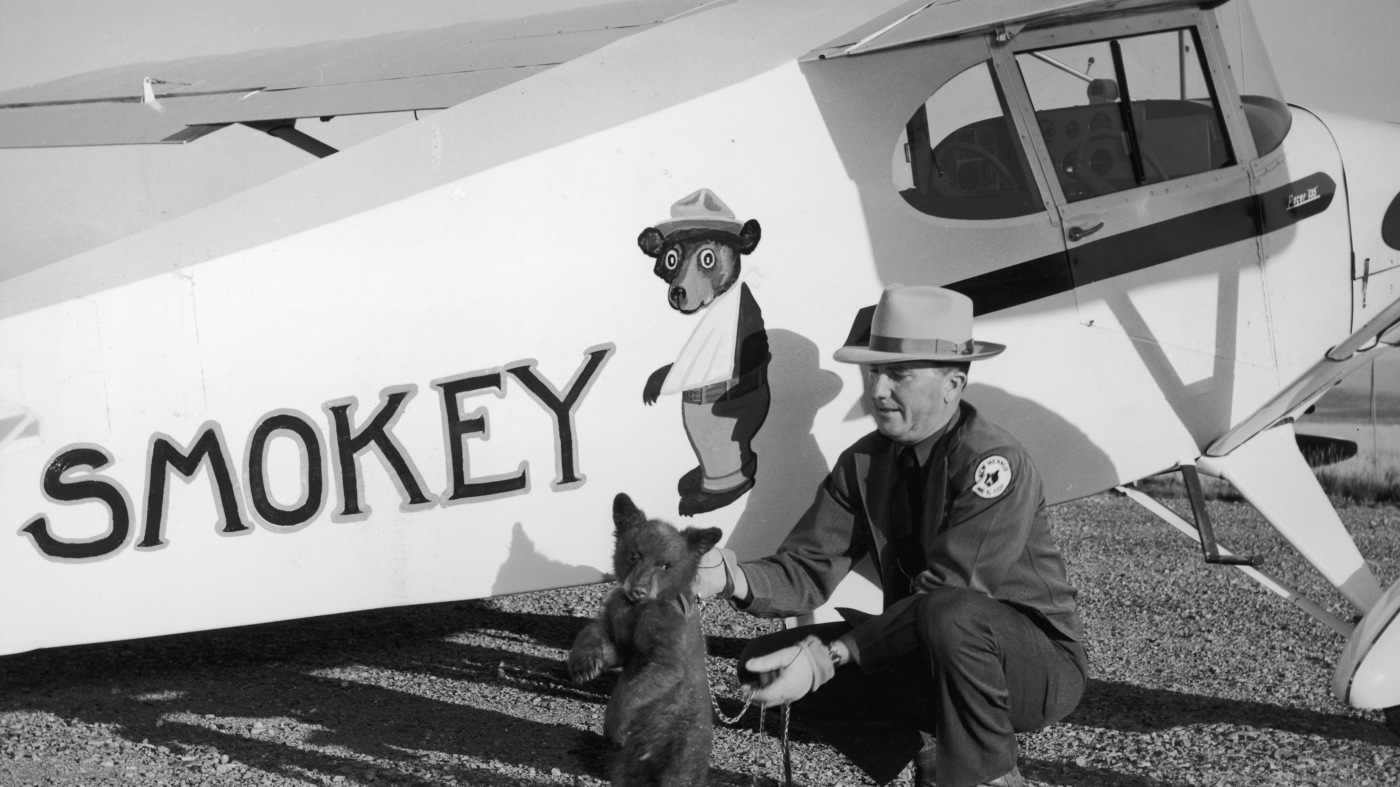
Smokey the bear cub is flown from Santa Fe, N.M., to his new home at the Washington National Zoo in a Piper J-3 Cub by New Mexico Assistant State Game Warden Homer C. Pickens in 1950. The little bear was rescued from a forest fire and named Smokey after the fire prevention symbol of the U.S. Forest Service.
FPG/Hulton Archive/Getty Images
hide caption
toggle caption
FPG/Hulton Archive/Getty Images
The longest-running public service announcement in the U.S. turns 80 years old today.
Its message is simple and one you’ve heard many times before: “Only you can prevent wildfires.” Smokey Bear, the beloved park ranger hat-wearing black bear who utters these famous words has undergone a complicated evolution.
And his birthday comes as fires rage in California, Colorado and other Western states. On average, some 70,000 wildfires have been documented every year in the U.S. since 1983, according to data from the National Interagency Fire Center.
Human-caused climate change has made these fires more intense and dangerous, but it isn’t the only factor: Federal data and various independent studies show that around 80% of all wildfires in the country are caused by humans, making Smokey’s message more relevant than ever.
So we’re taking a look back at how Smokey Bear’s mission came to be and how effective his messaging has been.
How World War II influenced Smokey Bear’s creation

Fire burns near a Smokey the Bear fire warning sign as the Oak Fire burns through the area on July 24, 2022 near Jerseydale, California.
Justin Sullivan/Getty Images/Getty Images North America
hide caption
toggle caption
Justin Sullivan/Getty Images/Getty Images North America
Smokey Bear’s public service ad was created at the height of World War II in 1944. The U.S. Forest Service had been fighting forest fires for years, but the attack on Pearl Harbor brought a greater need for fire safety messaging, as firefighters were deployed overseas.
“When this campaign first launched, it was in the context of our war efforts, and the forests were seen as a resource in that context,” said Tracy Danicich, director of the Smokey Bear campaign at the Ad Council.
A few weeks after the attack on Pearl Harbor in 1941, a Japanese submarine sitting off the coast fired shells at an oil facility in Santa Barbara County, Calif. south of the Los Padres National Forest. The attack raised fears that more attacks like this could cause wildfires in forests along the Pacific coast. The Forest Service hoped that connecting the risk of fires to the war effort would help make the case for fighting forest fires more urgent.
“There was also a rise in wildfires just from general human carelessness, lack of respect for fire, perhaps lack of knowledge of how to contain and properly respect a fire,” said Tad Bennicoff, a reference archivist at the Smithsonian Institution archives. “So the Forest Service came up with the idea of the Smokey Bear character and the message.”
But even after World War II ended, Smokey stuck around. He started showing up on posters, U.S. Postal Service stamps, in radio ads and alongside stars like Bing Crosby and Ward Bond.
You might remember calling the forest fire fighting black bear “Smokey the Bear,” but that isn’t actually his name.
In 1952, singers Steve Nelson and Jack Rollins wrote a jingle for and added a “the” to maintain the song’s rhythm. This inadvertently created confusion about the bear’s name, but the U.S. Forest Service maintains that Smokey’s official name is “Smokey Bear,” not “Smokey the Bear.”
The campaign’s mascot was an actual bear rescued from a wildfire

The Smokey Bear balloon floats in the Macy’s Thanksgiving Day Parade on Thursday, Nov. 25, 2021, in New York. (Photo by Charles Sykes/Invision/AP)
Charles Sykes/Charles Sykes/Invision/AP/Invision
hide caption
toggle caption
Charles Sykes/Charles Sykes/Invision/AP/Invision
In the spring of 1950, a group of Native American firefighters rescued a bear cub who clung to a tree as a fire raged in the Capitan Mountains in New Mexico.
After its rescue, the cub became the symbol of the Smokey Bear campaign and was put on display at the National Zoo in Washington, D.C.
But the physical public service announcements, which for years showed a black bear in a pair of blue pants, a tan wide-brimmed park ranger’s hat and a metal shovel, confused some zoo goers.
Bennicoff said this outfit was so closely associated with Smokey that some young kids were bewildered when they saw a naked bear at the National Zoo.
Visitors were startled to see a real bear, Bennicoff said. “They were expecting to see the Smokey Bear that they saw in print ads and on television. But lo and behold, there’s this actual bear.”
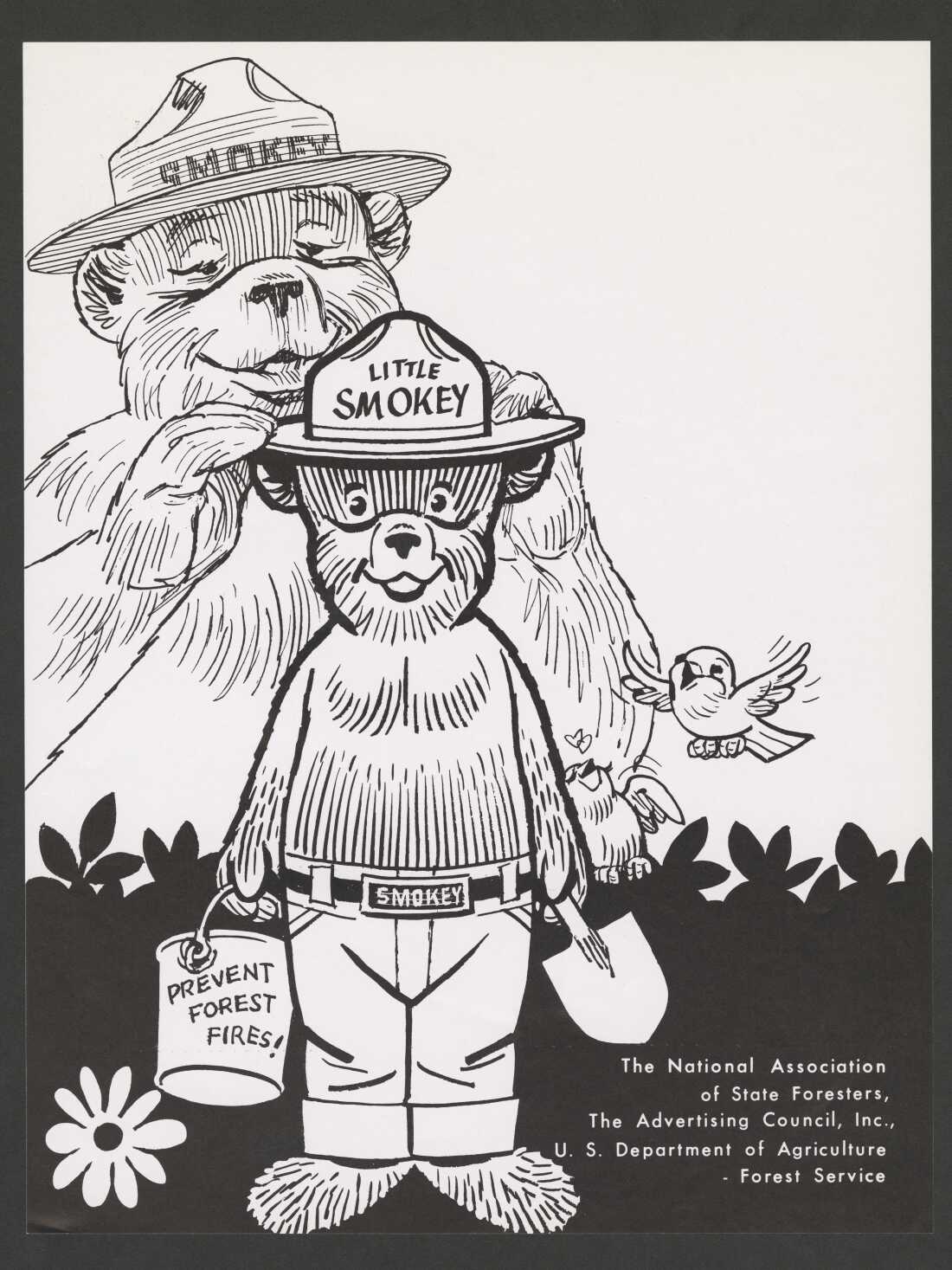
Forest Service cartoon of Smokey Bear welcoming Little Smokey./Smithsonian Institution Archives
To help with the confusion, the zoo added a special exhibit next to Smokey’s enclosure that featured a park ranger’s uniform in Smokey’s size. During this time, Smokey Bear was receiving so much fan mail that the Zoo had to hire three assistants to keep up with the amount of letters he was getting. He even got his own ZIP code — an honor only bestowed to one other figure: the president.
Smokey retired from the zoo at 25. In human years, he would have been roughly 70, the mandatory retirement age for federal employees at the time. In 1971, the zoo introduced “Little Smokey,” another orphan cub rescued by the Forest Service. When Smokey retired, Little Smokey took over the mantle.
The original Smokey died Nov. 9,1976, a year after his retirement. His remains were returned to New Mexico, where he was buried in the Smokey Bear Historical Park in Capitan, N.M., not far from where he was rescued two decades prior.
A small change for Smokey represents a big change for environmentalism
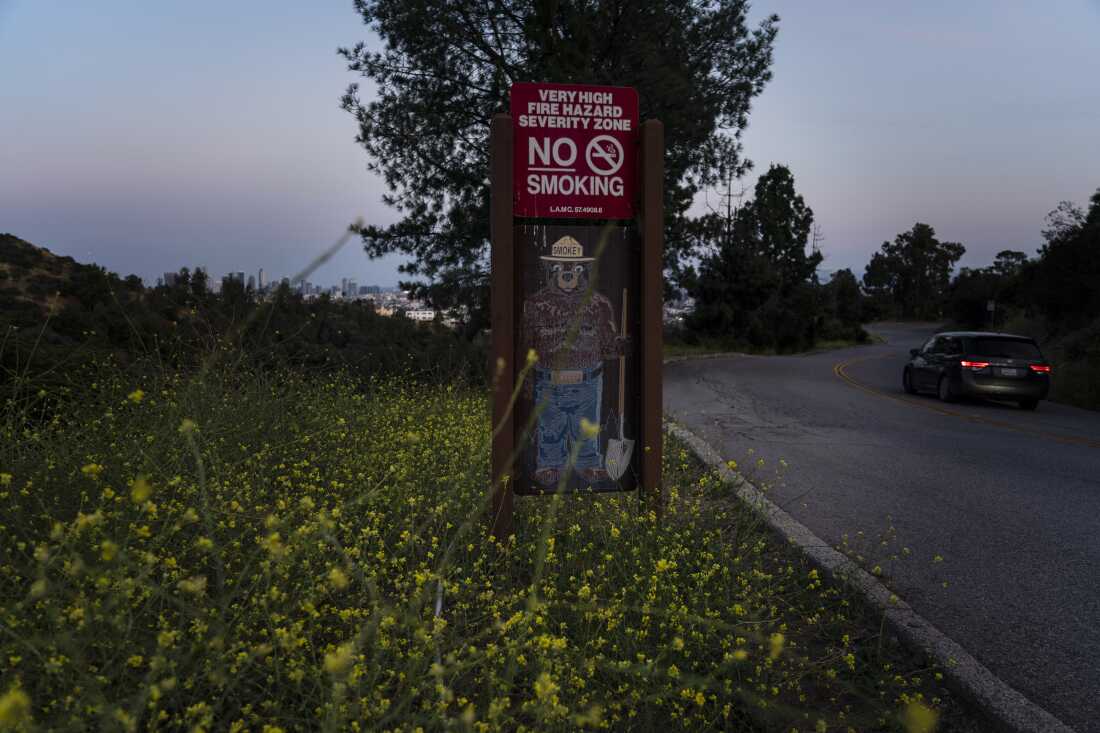
Wild mustard flowers bloom around a Smokey Bear sign in Griffith Park in Los Angeles, Thursday, June 8, 2023.
Jae C. Hong/AP/AP
hide caption
toggle caption
Jae C. Hong/AP/AP
For five decades, Smokey’s slogan remained the same: “Only you can prevent forest fires.” The message suggested that all fires were preventable and bad for the environment and that nature could return to its original state if fires didn’t occur.
In one ad, Smokey said that if people just took his message into their hearts, it could be like “the old times, maybe, when great herds of buffalo roamed.“
Melinda Adams, an Indigenous fire scientist and assistant professor in the Department of Geography and Atmospheric Science at the University of Kansas told Morning Edition that Smokey’s vision of an America without wildfires isn’t accurate.
“When you had colonizers come over and look at land, mosaics or beautiful landscapes, they developed a narrative of [these] being untouched by humans, virgin lands. They arrived and the lands were like that,” Adams said. “But we know through the recent scholarship that that’s not true. We know that Indigenous peoples created these landscapes or maintained them.”
Adams is a proponent of what she calls good fire — or burns to land that help an environment thrive. This practice is also called prescribed burning.
This is one of the reasons that in 2001, Smokey Bear changed his slogan from only you can prevent forest fires to only you can prevent wildfires. This change in messaging also represented a change in how the U.S. Forest Service approached fire treatment.
“Now, the U.S. Forest Service and the U.S Department of Agriculture are redirecting resources to good fire, beneficial fire during the off fire season in order to reduce the overgrowth that, you know, decades of fire suppression of fire deficiency has left, which makes those areas of lands more flammable,” Adams said.
The road ahead for Smokey

A Smokey the Bear forest fire prevention sign stands in front of snow blanketing the Sierra Nevada mountains after recent storms increased the snowpack on February 23, 2024 near Bishop, California. (Photo by Mario Tama/Getty Images)
Mario Tama/Getty Images/Getty Images North America
hide caption
toggle caption
Mario Tama/Getty Images/Getty Images North America
Most wildfires are still caused by human activity, which raises the question: Has Smokey’s messaging actually been effective?
John Miller, the chief of Fire and Emergency Response at the Virginia Department of Forestry, said that there is still a lot of work to be done to educate the public on fire safety.
It’s not enough, Miller said, for officials who work in fire prevention education to stand “with [their] arm around Smokey Bear shouting fire prevention on an occasional TV commercial or at a school near you or at a county fair with a booth. Somehow we need to turn that prevention into more to be more front and center to the public.”

Miller believes that one of the big problems is that people are not aware of smaller fires that occur in areas like Virginia all the time.
“Thankfully, because of quick and efficient suppression those fire hours are suppressed quickly. They don’t become newsworthy,” Miller said. “If it hadn’t impacted a home or damaged the public just never hears about that.”
Miller thinks these smaller fires can be prevented, especially because they are often caused by humans who are not aware of simple ways they can be practicing fire safety.
Which is exactly what Smokey Bear’s evolving message is — the best way to continue to spread awareness about safe fires.
“His tips evolve, and there are other things about Smokey and the campaign that have evolved to stay relevant, but that message and focus has always remained consistent,” Danicich said.
This digital story was edited by Obed Manuel.



Lifestyle
Wagner Moura on ‘The Secret Agent,’ aging and privileging joy : Wild Card with Rachel Martin

A note from Wild Card host Rachel Martin: After watching the Brazilian film “The Secret Agent,” I came away with a deeper appreciation for how much fear, resolve and longing can be communicated through a person’s eyes.
Wagner Moura subtly conveys all those emotions as a man on the run in a military dictatorship. Yes, there are powerful moments of dialogue but so much of Wagner’s talent as a storyteller and an actor comes in what is left unsaid – how he uses the negative space to make us feel and to make us think.

White House To Ilhan Omar
Stop Inciting Violence!!!
Published
President Trump‘s White House is ripping Rep. Ilhan Omar after she seemingly called for him to be executed for allegedly being a pedophile.
White House spokeswoman Abigail Jackson tells TMZ … “It should deeply concern every single American that Congresswoman Omar is spreading such egregious lies and calling for the execution of President Trump, who has already survived two assassination attempts.”
The response comes after the Democratic Congresswoman from Minnesota posted on social media, “The leader of the Pedophile Protection Party is trying to deflect attention from his name being all over the Epstein files. At least in Somalia they execute pedophiles not elect them.”
The Trump White House tells us … “Democrats should immediately condemn this post and urge their colleague to stop lying and inciting political violence against the sitting President.”
POTUS referred to Rep. Omar Tuesday night as a “fake ‘congresswoman’” … though it’s unclear exactly what Trump means by that.
As you know … the prez’s former association with convicted pedophile Jeffrey Epstein has received a ton of attention over the past several months … and Trump is mentioned numerous times in the files.
DT has denied all accusations of wrongdoing … claiming he cut off his relationship with pedo Epstein decades ago.
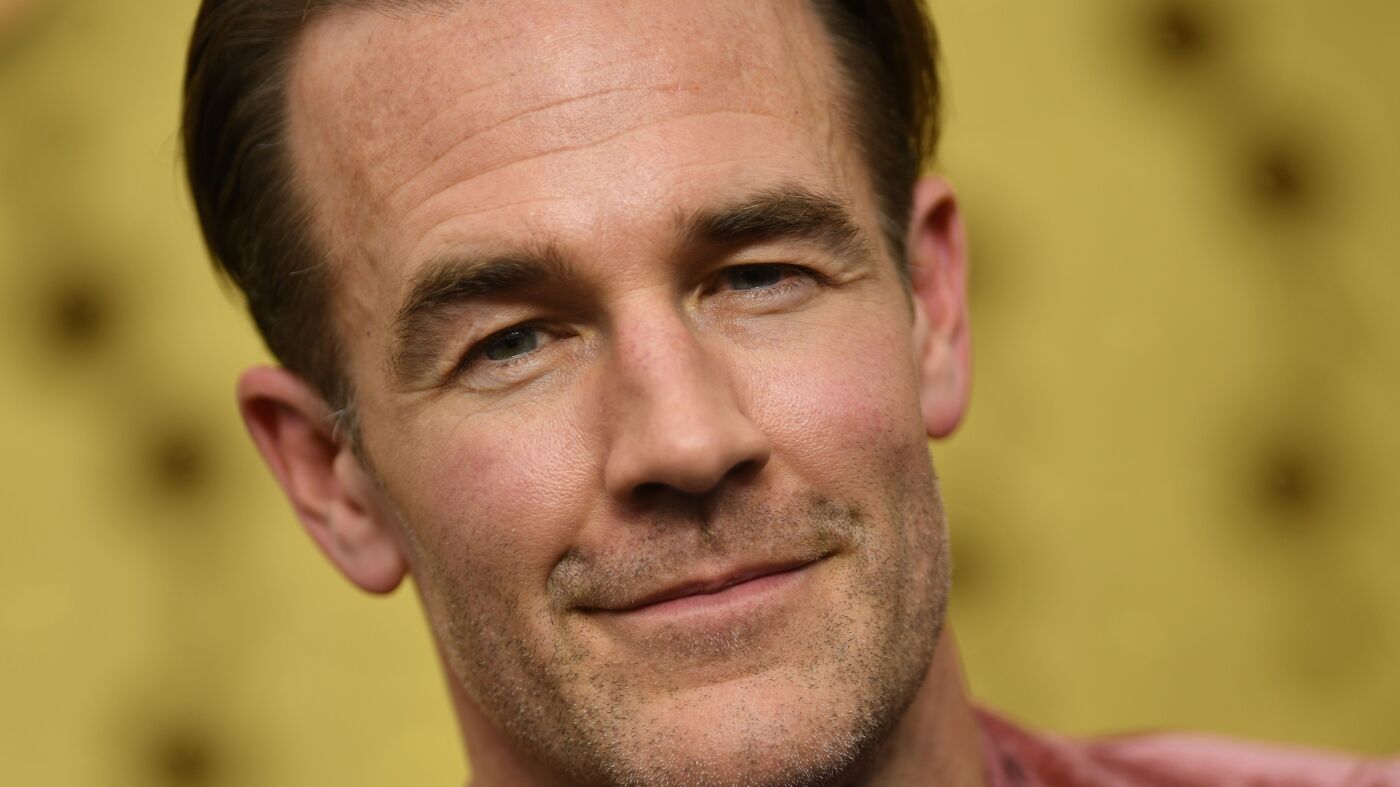
Actor James Van Der Beek arriving at the Emmy Awards in 2019.
Valerie Macon/AFP via Getty Images
hide caption
toggle caption
Valerie Macon/AFP via Getty Images
James Van Der Beek — best known for his role as Dawson Leery in the hit late 1990s and early aughts show Dawson’s Creek — has died. He was 48. Van Der Beek announced his diagnosis of Stage 3 colon cancer in November 2024.
His family wrote on Instagram on Wednesday, “Our beloved James David Van Der Beek passed peacefully this morning. He met his final days with courage, faith, and grace. There is much to share regarding his wishes, love for humanity and the sacredness of time. Those days will come. For now we ask for peaceful privacy as we grieve our loving husband, father, son, brother, and friend.”
Van Der Beek started acting when he was 13 in Cheshire, Conn., after a football injury kept him off the field. He played the lead in a school production of Grease, got involved with local theater, and fell in love with performing. A few years later, he and his mother went to New York City to sign the then-16 year old actor with an agent.
But Van Der Beek didn’t break out as a star until he was 21, when he landed the lead role of 15-year-old Dawson Leery, an aspiring filmmaker, in Dawson’s Creek.
Van Der Beek’s life changed forever with this role. The teen coming-of-age show was a huge hit, with millions of weekly viewers over 6 seasons. It helped both establish the fledgling WB network and the boom of teen-centered dramas, says Lori Bindig Yousman, a media professor at Sacred Heart University and the author of Dawson’s Creek: A Critical Understanding.
“Dawson’s really came on the scene and felt different, looked different,” Bindig Yousman says.
It was different, she points out, from other popular teen shows at the time such as Beverly Hills, 90210. “It wasn’t these rich kids. It was supposed to be normal kids, but they were a little bit more intelligent and aware of the world around them … It was attainable in some way. It was reflective.”
The Dawson’s drama centered around love, hardships, relationships, school and sex — sometimes pushing the boundaries when it came to teens discussing sex. Van Der Beek’s character Dawson was a moody, earnest dreamer, sometimes so earnest he came across as a “sad sack,” says Bindig Yousman. He had a seasons long on-again off-again on-screen relationship with his best friend Joey, played by Katie Holmes. Bindig Yousman says Van Der Beek quickly became seen as a heartthrob.
“I think he was very safe for a lot of tweens, and that’s when we started to get the tween marketing,” she says, referring to the attention paid to him by magazines like Teen People and Teen Celebrity. “And so because he wasn’t a bad guy, he was conventionally attractive … He definitely appealed to the masses.”
Dawson’s Creek launched the careers of not just of James Van Der Beek, but his costars Katie Holmes, Joshua Jackson and Michelle Williams. All went on to have successful careers in the entertainment industry.
Despite his success, Van Der Beek didn’t land many roles that rose to that same level of fame he enjoyed in Dawson’s Creek. Perhaps because audiences associated him so much with Dawson Leery, it was difficult to separate him from that character.
Still, he starred in the 1999 coming of age film Varsity Blues, as a high school football player who wants to be more than just a jock. In 2002’s Rules of Attraction, he played a toxic college drug dealer.
And he actually parodied himself in the sitcom Don’t Trust the B—- in Apartment 23. In it, he’s a self-obsessed actor unsuccessfully trying to get people to see him as someone other than the celebrity from Dawson’s Creek. In an episode where he decides to teach an acting class, the students ignore the lesson and instead pester him to perform a monologue from the show.
In real life as well, the floppy blond-haired Dawson Leery is the one that stole fans’ hearts, but Bindig Yousman says Van Der Beek still enjoyed a strong fanbase that followed him to other shows, even when they were only smaller cameos.
In the 2024 Instagram post about his cancer, Van Der Beek said “Each year, approximately 2 billion people around the world receive this diagnosis … I am one of them.” (There were about 18.5 million new cases of cancer around the world in 2023, a number that researchers say is projected to rise.) Van Der Beek leaves behind six children.
The cast of Dawson’s Creek reunited to raise money for the nonprofit F Cancer, which focuses on prevention, detection and support for people affected by cancer. They read the pilot episode at a Broadway theater in New York City in September 2025. His former co-star Michelle Williams organized the reunion. James Van Der Beek was unable to perform, due to his illness, but contributed an emotional video that was shown onstage. In it, he thanked his crew and castmates, and the Dawson’s Creek fans for being “the best fans in the world.”

Beloved firefighter tearfully reacts to insurance denial of stage 4 cancer drugs

Dallas Animal Services invites North Texans to spend Valentine’s Day with shelter dogs

Dolphins free agency: Who was the best signing in 2025?

Boston Mayor Michelle Wu is heading to Germany this week. Here’s why

Denver Broncos tight ends and wide receivers were among the worst in the league in 2025

Florida High School Football Rankings: Top 25 teams – Oct. 21

Cleary's 21 help Le Moyne down Central Connecticut State 69-64 in OT

How old is Bo Nix? What to know about Oregon quarterback ahead of 2024 NFL Draft

99th annual Pony Swim held in Virginia

Indiana Members Credit Union announced as new anchor tenant at Bottleworks District

House Republican Greg Steube introduces bill to nix controversial H-1B visa program

Photos: Bangladeshis turn out for historic election after Hasina’s downfall

US Colleges received more than $5 billion in foreign gifts, contracts in 2025

Video: F.A.A. Said to Have Closed El Paso Airspace Over Military’s Use of Anti-Drone Technology

Only one House Dem voted in favor of voter ID, proof of citizenship in US elections
-

 Politics7 days ago
White House says murder rate plummeted to lowest level since 1900 under Trump administration
-

 Alabama5 days ago
Geneva’s Kiera Howell, 16, auditions for ‘American Idol’ season 24
-

 Politics1 week ago
Trump unveils new rendering of sprawling White House ballroom project
-

 Culture1 week ago
Try This Quiz on Mysteries Set in American Small Towns
-

 San Francisco, CA1 week ago
Exclusive | Super Bowl 2026: Guide to the hottest events, concerts and parties happening in San Francisco
-

 Ohio1 week ago
Ohio town launching treasure hunt for $10K worth of gold, jewelry
-

 Education1 week ago
Video: We Tested Shark’s Viral Facial Device
-

 Education1 week ago
Video: Is Ikea Cookware As Good As All-Clad?