Lifestyle
Smokey Bear turns 80 this year. Did he help prevent forest fires?

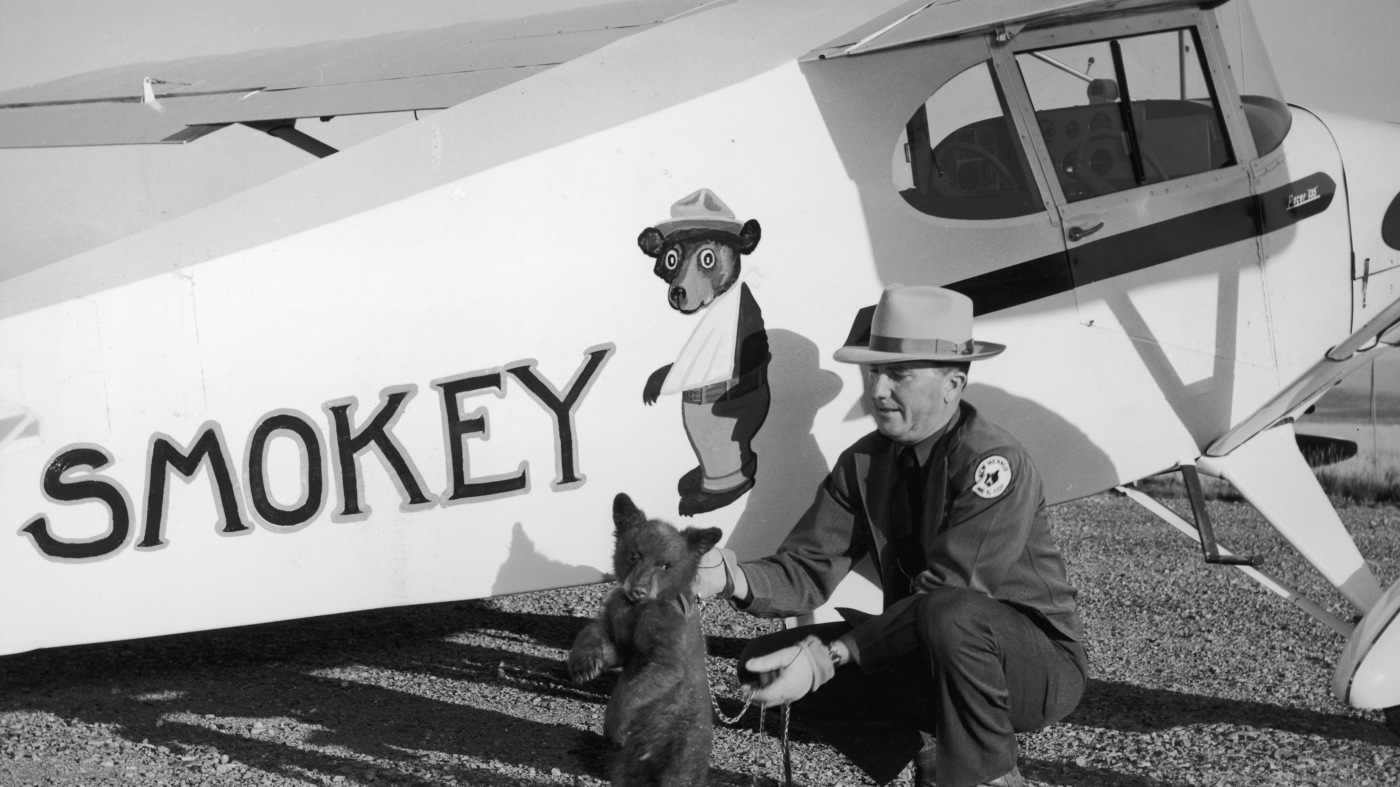
Smokey the bear cub is flown from Santa Fe, N.M., to his new home at the Washington National Zoo in a Piper J-3 Cub by New Mexico Assistant State Game Warden Homer C. Pickens in 1950. The little bear was rescued from a forest fire and named Smokey after the fire prevention symbol of the U.S. Forest Service.
FPG/Hulton Archive/Getty Images
hide caption
toggle caption
FPG/Hulton Archive/Getty Images
The longest-running public service announcement in the U.S. turns 80 years old today.
Its message is simple and one you’ve heard many times before: “Only you can prevent wildfires.” Smokey Bear, the beloved park ranger hat-wearing black bear who utters these famous words has undergone a complicated evolution.
And his birthday comes as fires rage in California, Colorado and other Western states. On average, some 70,000 wildfires have been documented every year in the U.S. since 1983, according to data from the National Interagency Fire Center.
Human-caused climate change has made these fires more intense and dangerous, but it isn’t the only factor: Federal data and various independent studies show that around 80% of all wildfires in the country are caused by humans, making Smokey’s message more relevant than ever.
So we’re taking a look back at how Smokey Bear’s mission came to be and how effective his messaging has been.
How World War II influenced Smokey Bear’s creation

Fire burns near a Smokey the Bear fire warning sign as the Oak Fire burns through the area on July 24, 2022 near Jerseydale, California.
Justin Sullivan/Getty Images/Getty Images North America
hide caption
toggle caption
Justin Sullivan/Getty Images/Getty Images North America
Smokey Bear’s public service ad was created at the height of World War II in 1944. The U.S. Forest Service had been fighting forest fires for years, but the attack on Pearl Harbor brought a greater need for fire safety messaging, as firefighters were deployed overseas.
“When this campaign first launched, it was in the context of our war efforts, and the forests were seen as a resource in that context,” said Tracy Danicich, director of the Smokey Bear campaign at the Ad Council.
A few weeks after the attack on Pearl Harbor in 1941, a Japanese submarine sitting off the coast fired shells at an oil facility in Santa Barbara County, Calif. south of the Los Padres National Forest. The attack raised fears that more attacks like this could cause wildfires in forests along the Pacific coast. The Forest Service hoped that connecting the risk of fires to the war effort would help make the case for fighting forest fires more urgent.
“There was also a rise in wildfires just from general human carelessness, lack of respect for fire, perhaps lack of knowledge of how to contain and properly respect a fire,” said Tad Bennicoff, a reference archivist at the Smithsonian Institution archives. “So the Forest Service came up with the idea of the Smokey Bear character and the message.”
But even after World War II ended, Smokey stuck around. He started showing up on posters, U.S. Postal Service stamps, in radio ads and alongside stars like Bing Crosby and Ward Bond.
You might remember calling the forest fire fighting black bear “Smokey the Bear,” but that isn’t actually his name.
In 1952, singers Steve Nelson and Jack Rollins wrote a jingle for and added a “the” to maintain the song’s rhythm. This inadvertently created confusion about the bear’s name, but the U.S. Forest Service maintains that Smokey’s official name is “Smokey Bear,” not “Smokey the Bear.”
The campaign’s mascot was an actual bear rescued from a wildfire
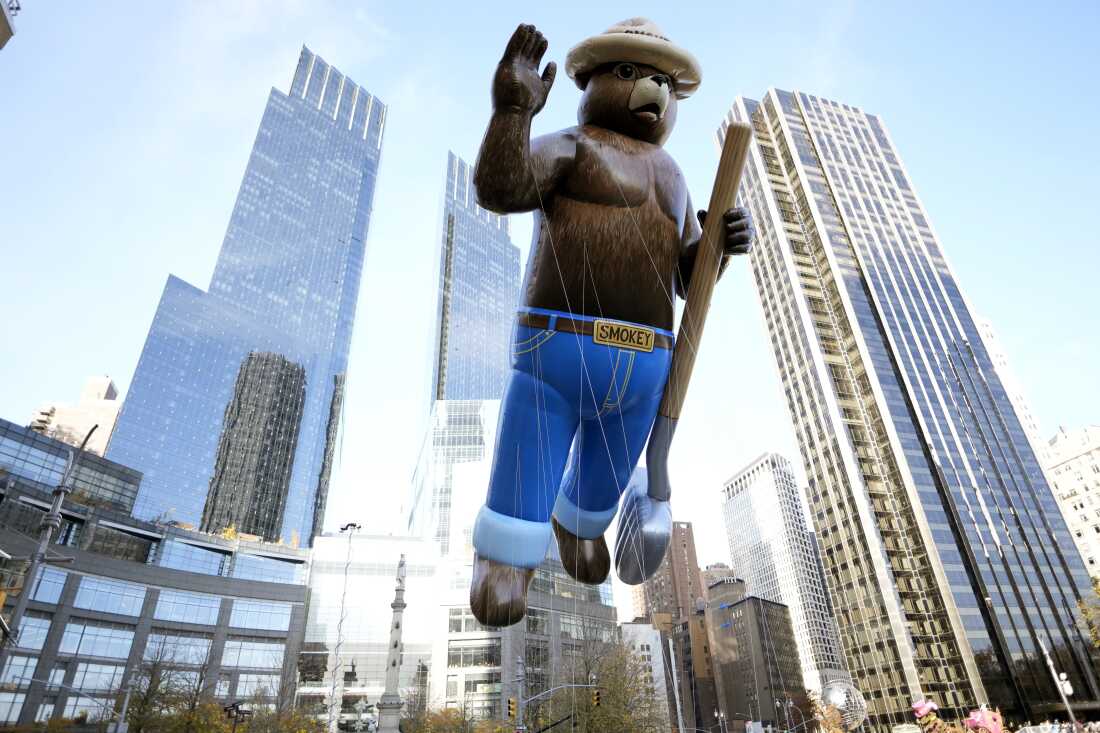
The Smokey Bear balloon floats in the Macy’s Thanksgiving Day Parade on Thursday, Nov. 25, 2021, in New York. (Photo by Charles Sykes/Invision/AP)
Charles Sykes/Charles Sykes/Invision/AP/Invision
hide caption
toggle caption
Charles Sykes/Charles Sykes/Invision/AP/Invision
In the spring of 1950, a group of Native American firefighters rescued a bear cub who clung to a tree as a fire raged in the Capitan Mountains in New Mexico.
After its rescue, the cub became the symbol of the Smokey Bear campaign and was put on display at the National Zoo in Washington, D.C.
But the physical public service announcements, which for years showed a black bear in a pair of blue pants, a tan wide-brimmed park ranger’s hat and a metal shovel, confused some zoo goers.
Bennicoff said this outfit was so closely associated with Smokey that some young kids were bewildered when they saw a naked bear at the National Zoo.
Visitors were startled to see a real bear, Bennicoff said. “They were expecting to see the Smokey Bear that they saw in print ads and on television. But lo and behold, there’s this actual bear.”
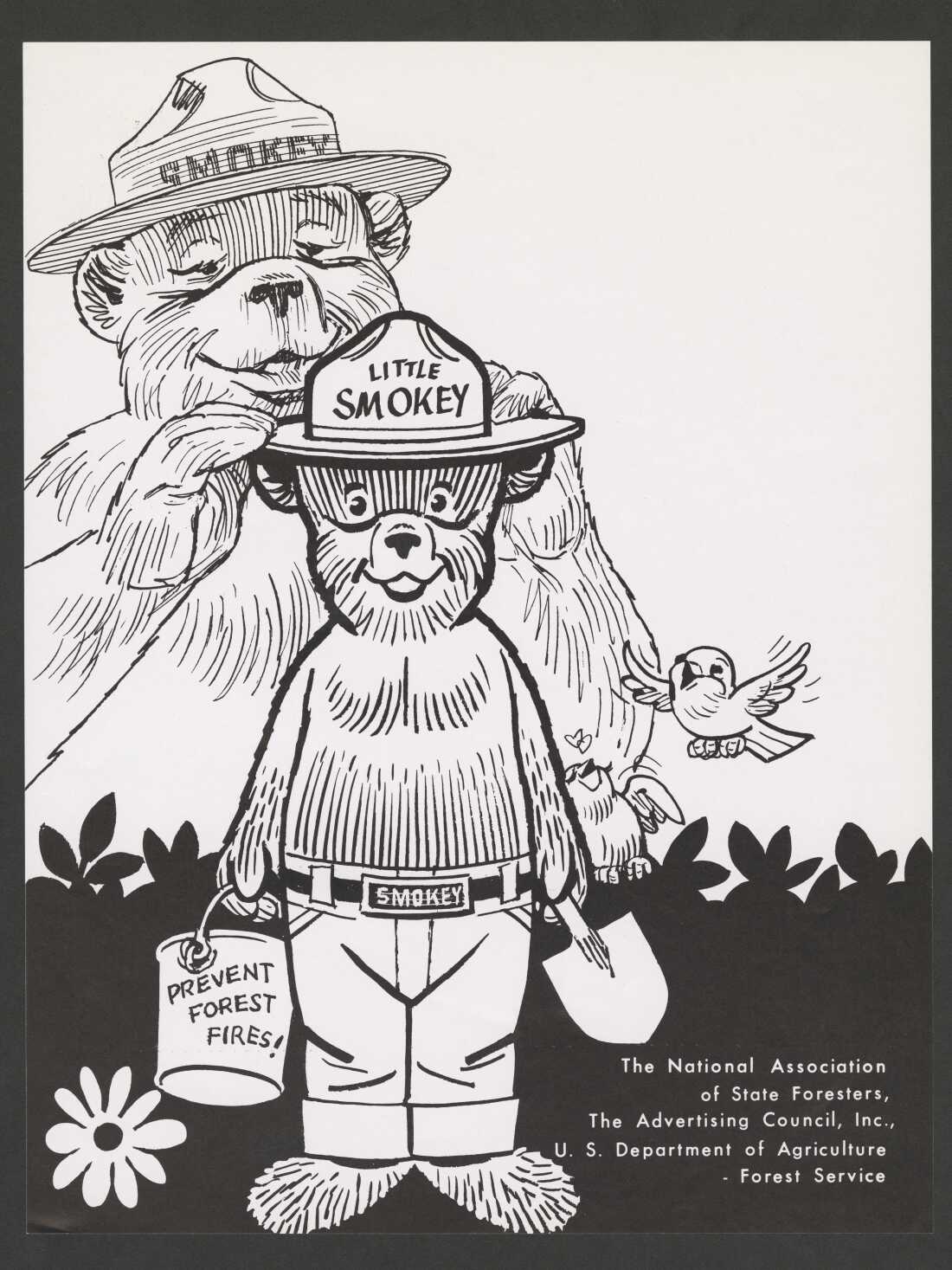
Forest Service cartoon of Smokey Bear welcoming Little Smokey./Smithsonian Institution Archives
To help with the confusion, the zoo added a special exhibit next to Smokey’s enclosure that featured a park ranger’s uniform in Smokey’s size. During this time, Smokey Bear was receiving so much fan mail that the Zoo had to hire three assistants to keep up with the amount of letters he was getting. He even got his own ZIP code — an honor only bestowed to one other figure: the president.
Smokey retired from the zoo at 25. In human years, he would have been roughly 70, the mandatory retirement age for federal employees at the time. In 1971, the zoo introduced “Little Smokey,” another orphan cub rescued by the Forest Service. When Smokey retired, Little Smokey took over the mantle.
The original Smokey died Nov. 9,1976, a year after his retirement. His remains were returned to New Mexico, where he was buried in the Smokey Bear Historical Park in Capitan, N.M., not far from where he was rescued two decades prior.
A small change for Smokey represents a big change for environmentalism
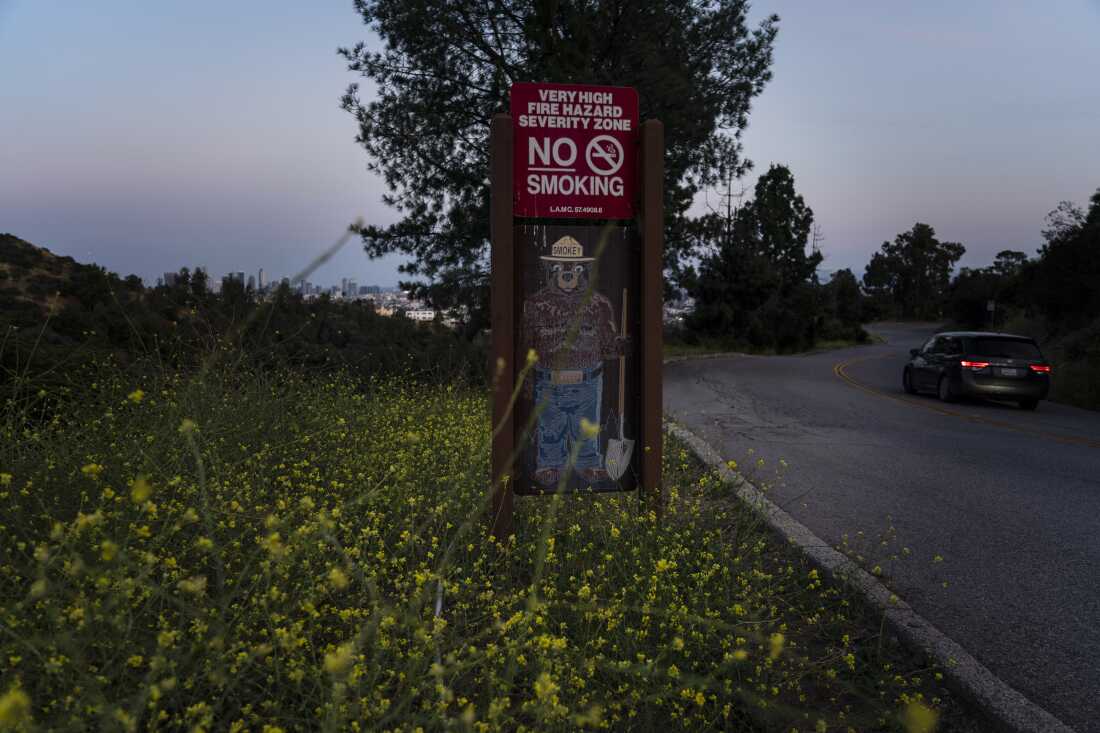
Wild mustard flowers bloom around a Smokey Bear sign in Griffith Park in Los Angeles, Thursday, June 8, 2023.
Jae C. Hong/AP/AP
hide caption
toggle caption
Jae C. Hong/AP/AP
For five decades, Smokey’s slogan remained the same: “Only you can prevent forest fires.” The message suggested that all fires were preventable and bad for the environment and that nature could return to its original state if fires didn’t occur.
In one ad, Smokey said that if people just took his message into their hearts, it could be like “the old times, maybe, when great herds of buffalo roamed.“
Melinda Adams, an Indigenous fire scientist and assistant professor in the Department of Geography and Atmospheric Science at the University of Kansas told Morning Edition that Smokey’s vision of an America without wildfires isn’t accurate.
“When you had colonizers come over and look at land, mosaics or beautiful landscapes, they developed a narrative of [these] being untouched by humans, virgin lands. They arrived and the lands were like that,” Adams said. “But we know through the recent scholarship that that’s not true. We know that Indigenous peoples created these landscapes or maintained them.”
Adams is a proponent of what she calls good fire — or burns to land that help an environment thrive. This practice is also called prescribed burning.
This is one of the reasons that in 2001, Smokey Bear changed his slogan from only you can prevent forest fires to only you can prevent wildfires. This change in messaging also represented a change in how the U.S. Forest Service approached fire treatment.
“Now, the U.S. Forest Service and the U.S Department of Agriculture are redirecting resources to good fire, beneficial fire during the off fire season in order to reduce the overgrowth that, you know, decades of fire suppression of fire deficiency has left, which makes those areas of lands more flammable,” Adams said.
The road ahead for Smokey

A Smokey the Bear forest fire prevention sign stands in front of snow blanketing the Sierra Nevada mountains after recent storms increased the snowpack on February 23, 2024 near Bishop, California. (Photo by Mario Tama/Getty Images)
Mario Tama/Getty Images/Getty Images North America
hide caption
toggle caption
Mario Tama/Getty Images/Getty Images North America
Most wildfires are still caused by human activity, which raises the question: Has Smokey’s messaging actually been effective?
John Miller, the chief of Fire and Emergency Response at the Virginia Department of Forestry, said that there is still a lot of work to be done to educate the public on fire safety.
It’s not enough, Miller said, for officials who work in fire prevention education to stand “with [their] arm around Smokey Bear shouting fire prevention on an occasional TV commercial or at a school near you or at a county fair with a booth. Somehow we need to turn that prevention into more to be more front and center to the public.”

Miller believes that one of the big problems is that people are not aware of smaller fires that occur in areas like Virginia all the time.
“Thankfully, because of quick and efficient suppression those fire hours are suppressed quickly. They don’t become newsworthy,” Miller said. “If it hadn’t impacted a home or damaged the public just never hears about that.”
Miller thinks these smaller fires can be prevented, especially because they are often caused by humans who are not aware of simple ways they can be practicing fire safety.
Which is exactly what Smokey Bear’s evolving message is — the best way to continue to spread awareness about safe fires.
“His tips evolve, and there are other things about Smokey and the campaign that have evolved to stay relevant, but that message and focus has always remained consistent,” Danicich said.
This digital story was edited by Obed Manuel.



Sydney (Ayo Edebiri) and Carmy (Jeremy Allen White).
FX
hide caption
toggle caption
FX
There has always been a metaphorical parallel between The Bear, the television show, and The Bear, the fictional restaurant on the television show. Even as Carmy (Jeremy Allen White) and Sydney (Ayo Edebiri) transformed the Italian beef joint into the fancy restaurant of their dreams and wished for a Michelin star, there were undoubtedly locals who thought, “This is great and all, and I’m sure the food is good, but … I liked the beef sandwiches.” There’s still a window at The Bear to get them, but the focus is certainly elsewhere.
When it started, The Bear was mostly about the work that took place in the kitchen. The stresses of too many orders, territoriality from Richie (Ebon Moss-Bachrach), the arrival of Sydney, and the tightly wound but undeniably talented Carmy, making everybody both extremely stressed and significantly better. Over time, it shifted and grew, putting together beloved departure episodes like “Fishes” in Season 2, which introduced a boatload of guest stars for a flashback story of a disastrous family dinner before Mikey (Jon Bernthal) died. It spent time with Sydney’s family, it explored the way Tina (Liza Colón-Zayas) and Mikey originally met, it followed Marcus (Lionel Boyce) to Copenhagen, and it went with Richie to work for Andrea (Olivia Colman). All these episodes were excellent. And there was still a kitchen. But the focus seemed to be elsewhere.

At times, the show seemed to have disappeared up its own nose, to the point where you weren’t watching the show The Bear as much as you were watching the phenomenon The Bear. There were too many real-life chef cameos, until it seemed like those chefs were checking a box on a list of “things all the cool kids do.” There were too many other cameos, culminating in a rare miss from the reliably charismatic John Cena. The show placed a lot of narrative weight on Carmy’s love interest, Claire (Molly Gordon) — weight that the underwritten character couldn’t support. But even if every experiment and every diversion had worked, viewers couldn’t be blamed for missing the close focus on the kitchen and the camaraderie — for thinking, “This is all really special, but I do miss the beef sandwiches.”
The fifth and final season dispenses with the departure episodes, and it mostly dispenses with cameos. It all takes place on one day, just after Carmy tells Richie and Sydney that he wants to step back from the restaurant and give it to them and Sugar (Abby Elliott) to run, and it mostly takes place right there at The Bear. Now that the clock set by Jimmy (Oliver Platt) has run out, his money has run out as well, and a series of cascading disasters puts Sydney, Carmy and Richie behind the 8-ball from very early in the day, not least because of the tension hanging over all three of them as they prepare to tell the staff about Carmy’s decision to leave.

Tina (Liza Colón-Zayas).
FX
hide caption
toggle caption
FX
We spend this day mostly with the people we know best: our three leads, along with Sugar, Tina, Marcus, and the rest of the staff — including Luca (Will Poulter), who has stayed around to keep working with Marcus. Jimmy is running around with Computer (Brian Koppelman) and a young apprentice of his named Cheese (Elsie Fisher of Eighth Grade), trying to figure out what to do about his finances since it is Jimmy, and not just the restaurant, who’s out of money.
This day takes a while to get cooking, so to speak. The first three episodes of the season are slow, the first two in particular. It’s pouring rain outside, the lighting is dim, and the score maintains the same contemplative melancholy for a long, long time. For about two and a half episodes, it feels like one extended, low-energy scene.
But after that, there’s a shift in tone as the staff looks to get through service, and through seven episodes (FX did not make the finale available in advance for critics), the rest of the season is terrific. What you see is the core story of The Bear, which is people trying to serve food and overcome problems, but through the lens of everything that has happened over the show’s run: Carmy’s retreat from his obsessiveness, Richie’s expansive (and inspiring) discovery of his gift for hospitality; Sydney’s stepping forward from second-in-command to leader; Tina’s complex relationship with the restaurant and her grief over Mikey; Sugar and Carmy’s relationship with Donna (Jamie Lee Curtis); the arrival of Marcus as a high-end pastry chef.
The question the show asks over the last four episodes is: Given all those digressions and flashbacks, given all those visits with families and others, given everything we know about where all these people have been and what they’ve experienced, how does a high-pressure service — of the same kind we used to see in that first season — look now? How do they behave differently, and how does their behavior read differently? How are they the same people we have always known, but at a different juncture, in a different context? How do their wins mean more to them, and to the audience?
On the one hand, making a season this way, there are fewer surprising grace notes, like “Napkins,” the Tina/Mikey flashback episode in Season 3, or “Worms,” the episode in Season 4 where Sydney hung out with her cousin (Danielle Deadwyler) and her cousin’s kid. The Bear feels less daring and more conventional.
But oh, when they have victories under pressure? Victories, large or small? It is immensely, richly satisfying. There’s also more comedy other than just the goofy Faks family than we’ve had in a few seasons; Richie is perhaps the MVP of the season, and that’s partly because of how often he gets to be really funny. Ayo Edebiri continues to be the show’s best reactor, showing Syd eternally a little bit surprised (dismayed?) that she’s chosen to throw in her lot with these people.
There are a couple of questions yet to answer in the finale, both little plot items and broader character resolutions. Over these seven episodes, though, there is much to cheer.


Lifestyle
John Cena wanted to step away from the WWE ring before he became ‘too slow for the show’ : Wild Card with Rachel Martin

A note from Wild Card host Rachel Martin: First a confession: I have never watched a WWE match in its entirety. Don’t get me wrong, I appreciate the athleticism and the performance, it’s just not my thing. But there is something about John Cena I’ve never been able to shake.
Yes, he is a wrestling legend, but he has built a career as an entertainer that transcends the ring. The first time I saw him lead a cast was the 2019 family movie “Playing with Fire” and his rapport with kids in that film didn’t seem like acting at all. The man contains multitudes!
He co-stars with Eric Andre in his newest film, “Little Brother.”

Xie Miao and Yang Enyou in The Furious.
Norachai Kajchapanont/Lionsgate
hide caption
toggle caption
Norachai Kajchapanont/Lionsgate
There have been some fantastic movies released this year, and we know you can’t see them all. So we’re recommending four recent movies we missed that you should add to your watchlist: The Furious, Tuner, She’s The He, and Heresy.
If you need a few more fun film recommendations, check out these episodes:
Fun movies you may have missed
Our favorite movies on Tubi
We debate the best movies to watch on an airplane
Connect with Pop Culture Happy Hour:
Letterboxd / Facebook
Our weekly newsletter
Support Pop Culture Happy Hour+
-

 Los Angeles, Ca49 minutes ago
Woman ambushed, violently attacked by robber in downtown Long Beach
-

 Detroit, MI1 hour ago
Where to watch Houston Astros vs Detroit Tigers: TV channel, start time, streaming for June 26
-
San Francisco, CA1 hour ago
I own a Turkish Restaurant in San Francisco. Turkey’s World Cup match here has changed my business.
-

 Dallas, TX1 hour ago
Australia advances at World Cup, how to buy Australia soccer tickets
-

 Miami, FL1 hour ago
2 detained after police pursuit ends with bailout, neighborhood search in NW Miami-Dade – WSVN 7News | Miami News, Weather, Sports | Fort Lauderdale
-

 Boston, MA2 hours ago
Delta flight returns to Logan after smoke scare in cockpit – Boston News, Weather, Sports | WHDH 7News
-

 Denver, CO2 hours ago
Pat Surtain II Gets More Bad News Amid Broncos’ Uncertainty
-

 Seattle, WA2 hours ago
The World Cup 2026 Pride Match between Egypt and Iran that Seattle hopes can ‘unite football community’

