Lifestyle
L.A. contractors razed a native plant garden for kids. What happens now?

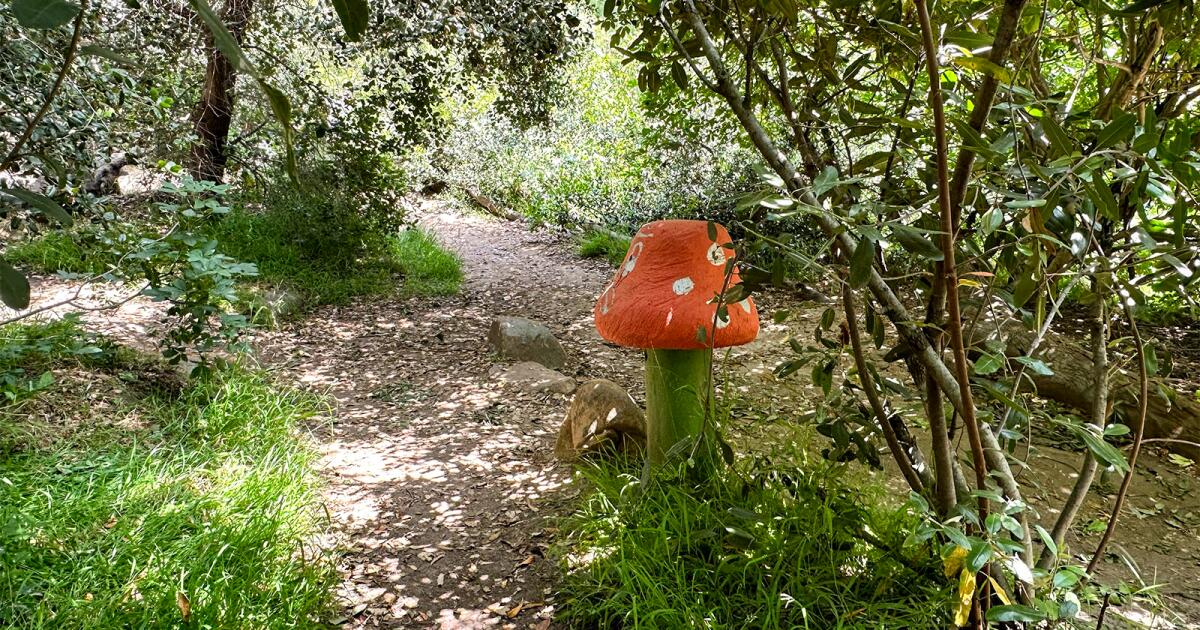
For more than a decade, visitors say the Children’s Garden at Elysian Park was a shady showcase for indigenous plants, with dense stands of mature native trees and shrubs lining the paths of the grounds just west of Grace E. Simon Lodge and creating a cool, restful places to walk, play and learn.
Then, in late June, all that lush undergrowth was leveled by a contractor hired by Los Angeles’ Department of Recreation and Parks to conform with the Los Angeles Fire Department’s brush clearance requirements. Since then, finger pointing and cries of “Ecocide” have reverberated on social media and during city meetings.
Update:
2:00 p.m. Aug. 9, 2024This story has been updated to include additional information provided by a Los Angeles Fire Department spokesperson.
“It was a magical environment,” said Shari Lee, a nearby resident who’s been walking the site for years. “Now it just seems sort of … blank.”
The Children’s Garden in Elysian Park after the brush clearance.
(Shari Lee)
These heated exchanges are all part of an ongoing and often contentious discussion about how a city like Los Angeles should manage urban wild lands with native plants. No one questions the need to remove such fast-growing invasives as black mustard, which becomes kindling for wildfires once it dries out in the summer.
But should green native shrubs like toyons and lemonade berry be treated the same way? Native plant enthusiasts say those plants control erosion, provide shade and habitat for wildlife and pose little fire danger.
Critics say that before the work was done, the city should have notified stakeholders, such as the Northeast LA Forest School, which pays to use the Children’s Garden (also known as the Children’s Arboretum) year round for outdoor instruction. They also believe there should have been an environmental evaluation of the site before Mariposa Landscapes Inc. of Irwindale did the work.
The trees and shrubs had been planted more than a decade earlier by the urban forestry nonprofit North East Trees, a project that included signage to identify the many native species added to the site, such as California buckeye, California black walnut and oaks.
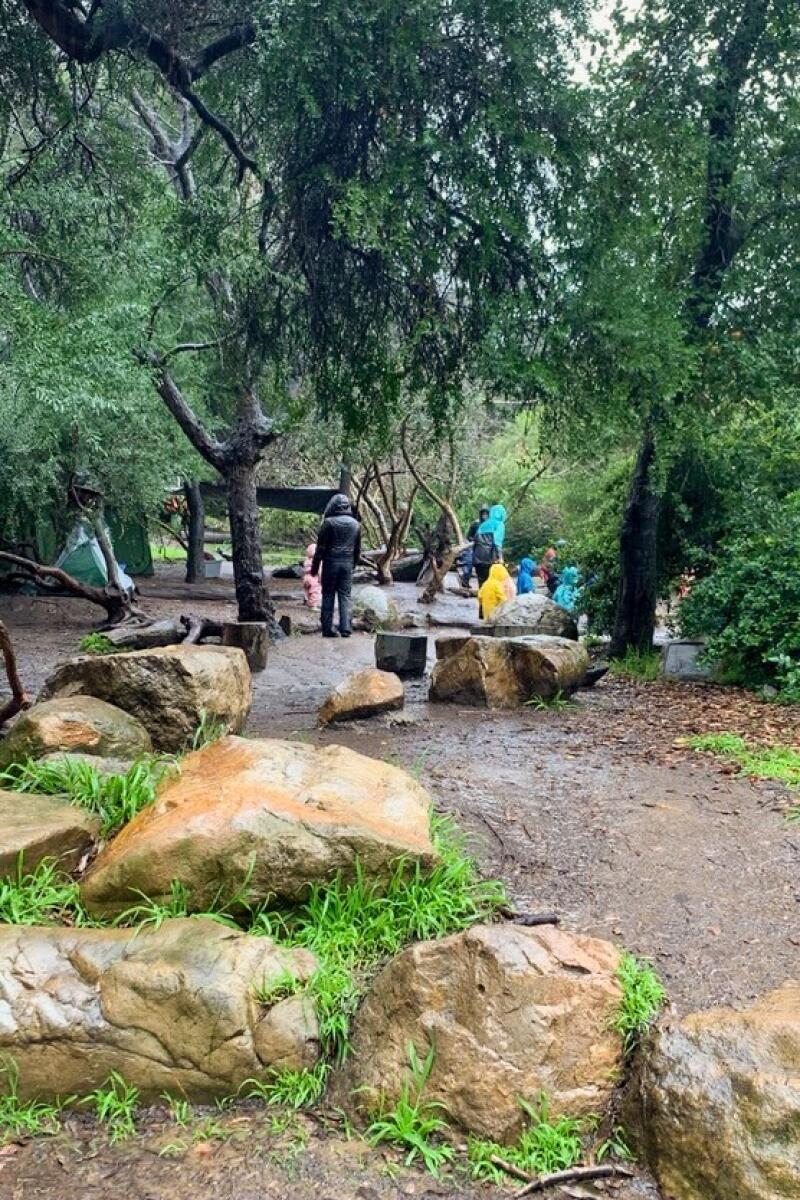
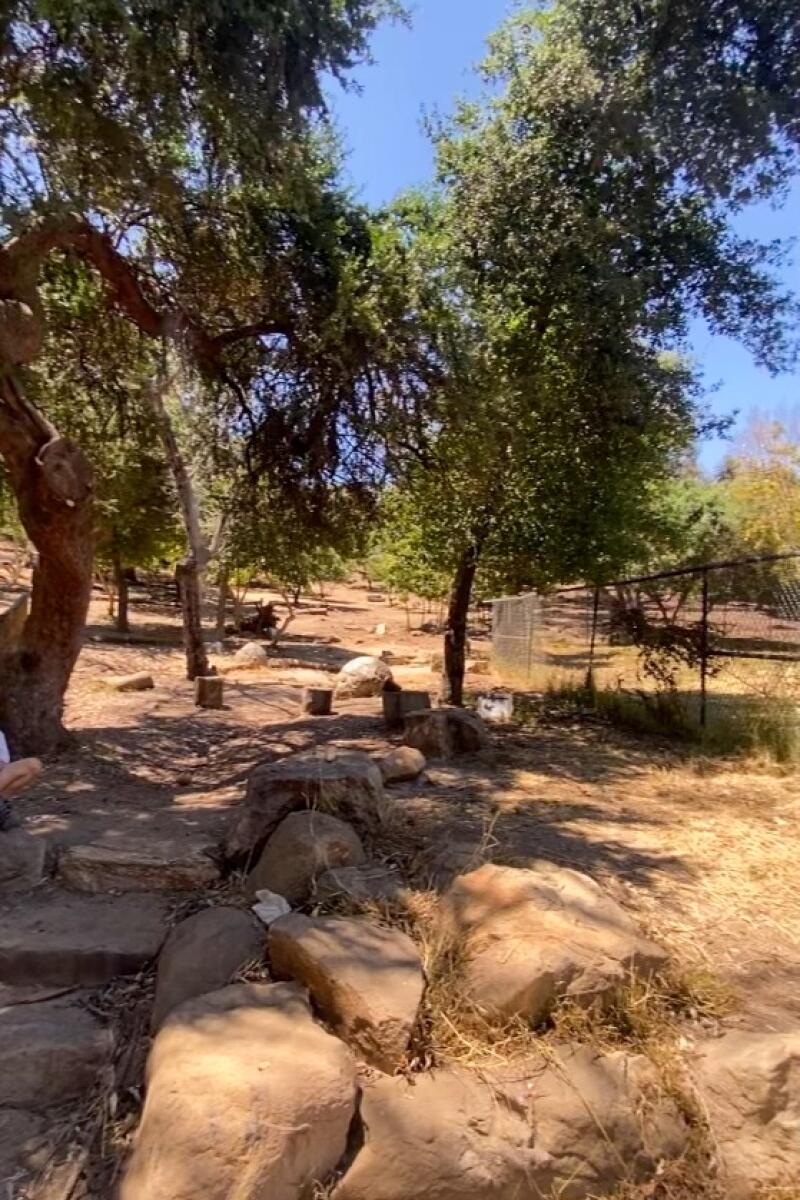
The Children’s Garden in Elysian Park on a rainy day in February, 2024 (top) and after the brush clearance on June 27, 2024. (Becca Hackett-Levy)
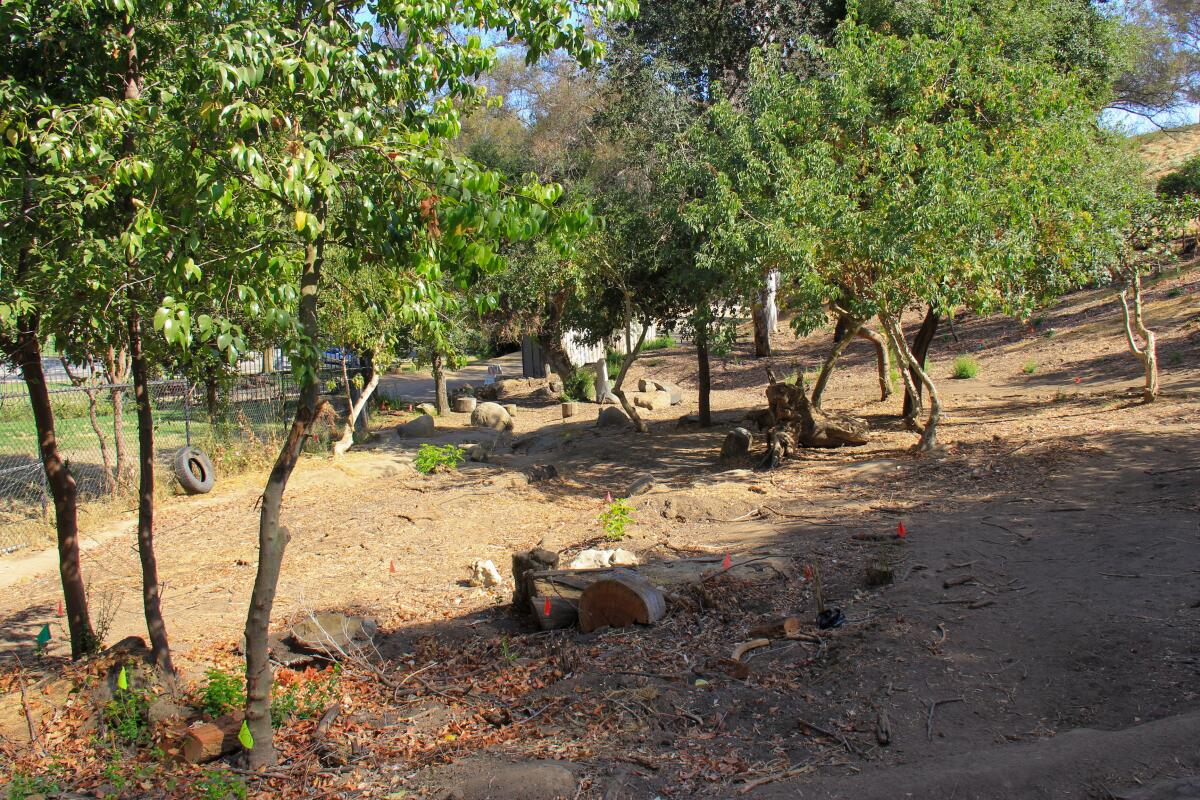
Today, the area looks denuded. The remaining trees have been trimmed so their limbs are at least 6 feet above the ground per fire prevention rules, some of the plant identification markers have been upturned and the dry, loose soil is covered with leaf debris.
Both Mariposa and North East Trees contract with the city on other projects. Neither was willing to be interviewed for this story.
The brush clearing was required by the Los Angeles Fire Department to protect a metal shed where the parks department stores fuel for lawn mowers, said Leon Boroditsky, principal ground maintenance supervisor for the forestry division of Recreation and Parks.
While fire inspectors issued a brush violation around the shed at the Children’s Garden in March, they would not have required those mature native shrubs to have been removed, Los Angeles Fire Department spokesperson Karla Tovar said Friday. Typically Recreation and Parks officials consult with fire inspectors about how the trimming should be conducted, Tovar said, but that didn’t happen this time.
LAFD is “saddened by the approach that was taken with this brush clearance,” Tovar said. “We look forward to collaborating with [Recreation and Parks] in future endeavors to make sure something like this doesn’t occur again.”
Boroditsky didn’t order the clearing; he was away when the project was contracted. He said that he didn’t know how long the shed had been at the site but that this appeared to be the first year the LAFD felt the building needed to be considered a structure under the brush-clearing rules.
The city is also trying to find out how and why North East Trees installed the native plant garden at the park in the first place. It happened about 20 years ago, said Rose Watson, public information director for Recreation and Parks, but the department can’t find any documents outlining the project or what plants were added to the site.
There are lots of unanswered questions, Boroditsky said, and the clearance has created so much uproar that the city plans to bring in an independent third-party “arboreal expert” to do their own evaluation.
“There have been a lot of knee-jerk reactions and inflammatory rhetoric happening,” Boroditsky said. The city doesn’t even have photos of what the area looked like before the clearing, he added, “which is why I’m saying they don’t have evidence to make some of those claims.”
The site is in what the fire department classifies as a “very high fire hazard severity zone,” Boroditsky said, and the rules for clearance in such spots are strict. For instance, in “areas within 200 feet of structures and/or 10 feet of roadside surfaces or combustible fence: Grass shall be cut to 3 inches in height. Native brush shall be reduced in quantity to three inches in height. This does not apply to individual native shrubs spaced a minimum of 18 feet apart, provided such shrubs are trimmed up from the ground to 1/3 of their height with all dead material being removed ….”
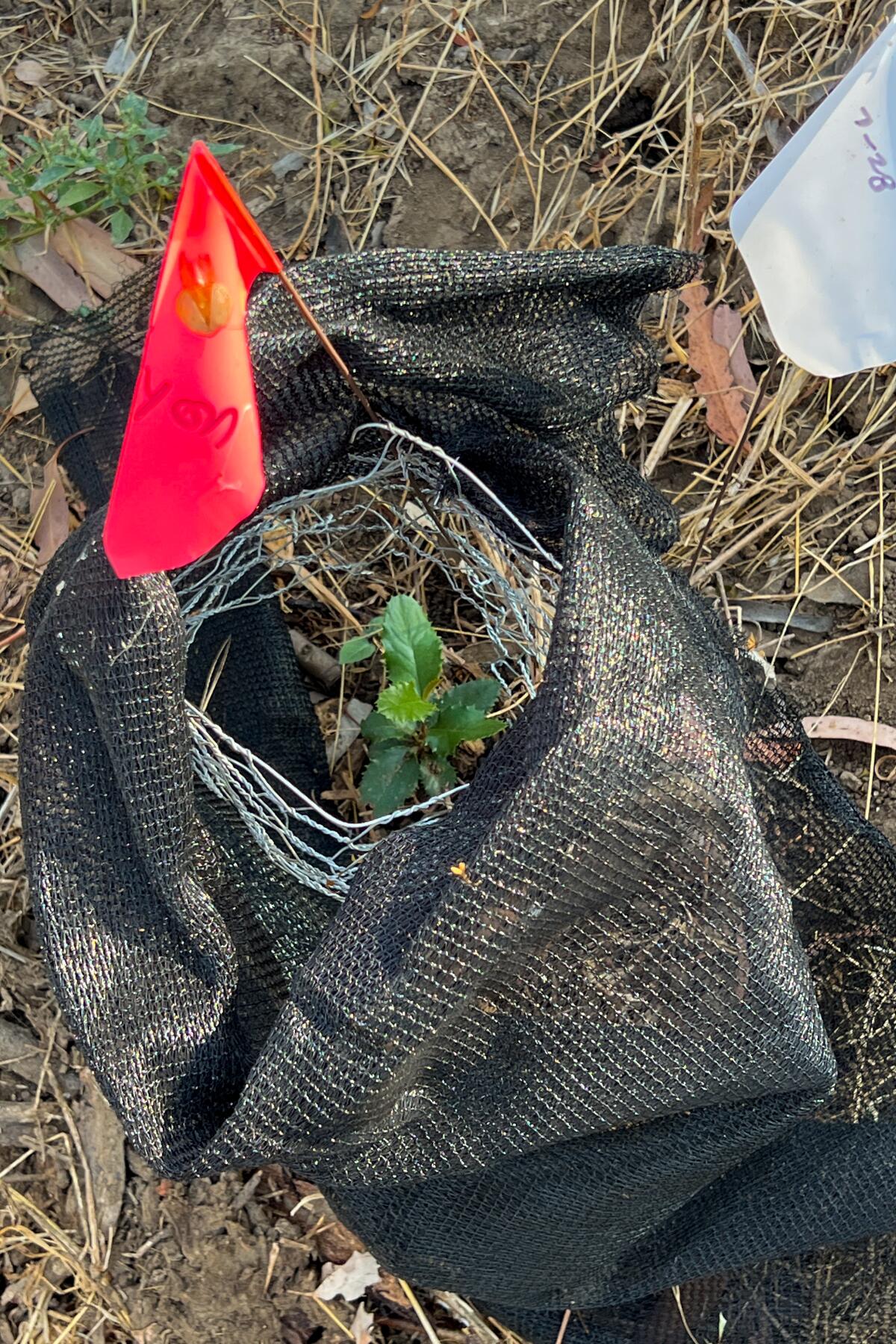
Volunteers located tiny native plants like this toyon that survived the brush clearing, wrapping them in shade cloth to protect them from the scorching sun.
(Jeanette Marantos / Los Angeles Times)
So basically, the city paid $12,500 for brush clearance to protect a metal storage shed. Critics question whether it would have been simpler and cheaper to just move the shed, say to the adjacent Grace E. Simon Lodge enclosure? “That’s really not something I can clarify now,” Boroditsky said. “That’s something we’re evaluating now.”
Becca Hackett-Levy, director of the Northeast LA Forest School, said the shed was at the Children’s Garden before she began using the location nearly eight years ago. She added that she was on maternity leave after the birth of her second child when she got panicked calls from parents saying the space she had paid the city to use for her year-round outdoor classroom had been devastated.
A storage shed at the edge of the Children’s Garden in Elysian Park reportedly triggered the brush clearance around the site. The Grace E. Simon Lodge is behind the fence to the left.
(Jeanette Marantos / Los Angeles Times)
After weeks of uncertainty, Hackett-Levy said she got a call from parks officials Tuesday who told her that they’d found some areas she might be able to use nearby. “They found some good spots in the area, and they’re even changing their mowing schedule to accommodate the school,” she said Wednesday. “I’m just so thankful and shocked, frankly.”
The other concerns won’t be so easily resolved.
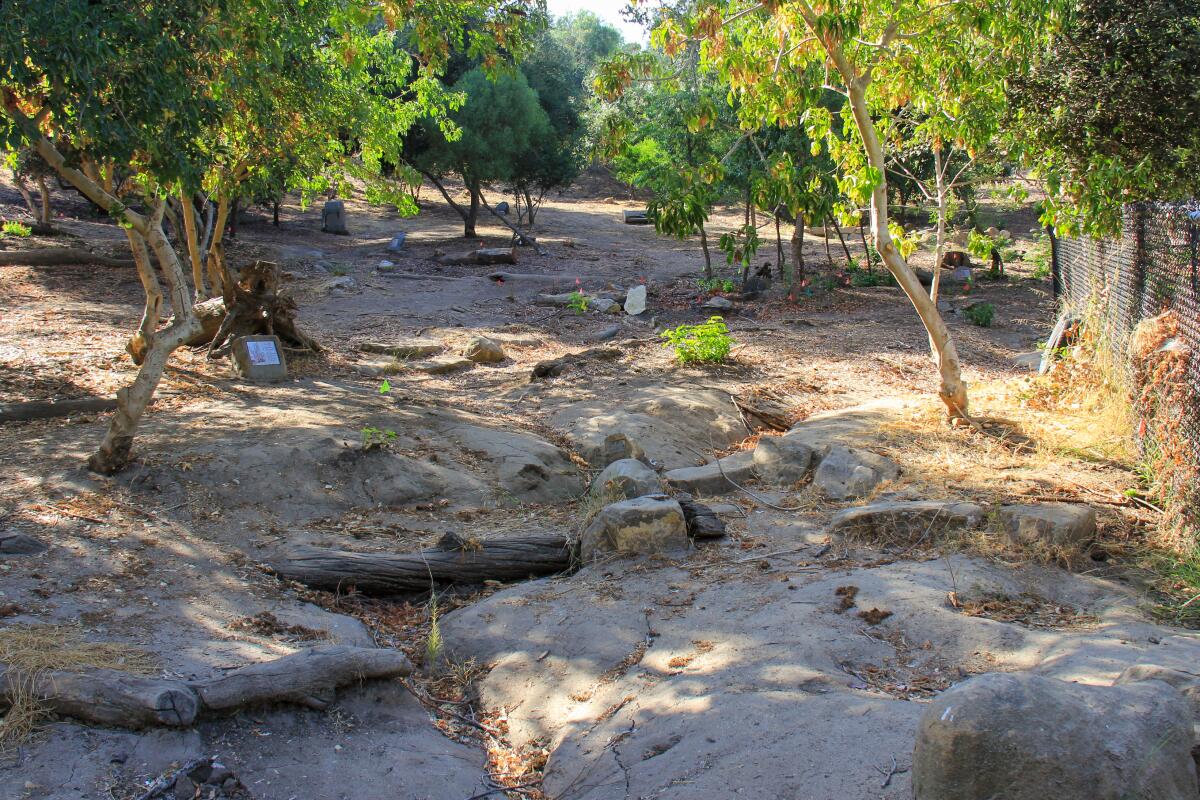
The Elysian Park Children’s Garden on Aug. 1, about a month after the brush clearance.
(Jeanette Marantos / Los Angeles Times)
Native plant supporters mobilized within hours of the clearing to locate and try to protect surviving baby native shrubs, dotting the area with small red and yellow flags to indicate their locations. Without shelter from the larger shrubs, they were vulnerable during the severe heat, said Brenda Contreras, director of the native plant and wildlife support group Coyotl wan Macehualli. So volunteers wrapped many of the plants in chicken wire and shade cloth for protection and carried in water to irrigate the survivors.
Elizabeth Birkenbuel, who lives above the site on Park Drive, was so distressed by volunteers lugging large containers of water on the slippery hill that she encouraged them to hook up hoses to her outdoor faucet so they could more easily fill their buckets.
The city typically does brush clearance in the area to remove invasive and highly flammable black mustard and castor bean plants, Birkenbuel said, “but it was really aggressively cleared this time, in a way I’ve never seen it done before. I was very shocked. I usually end my walks there in the summer because it was very shaded, lush and cool, but it’s vastly different now.”
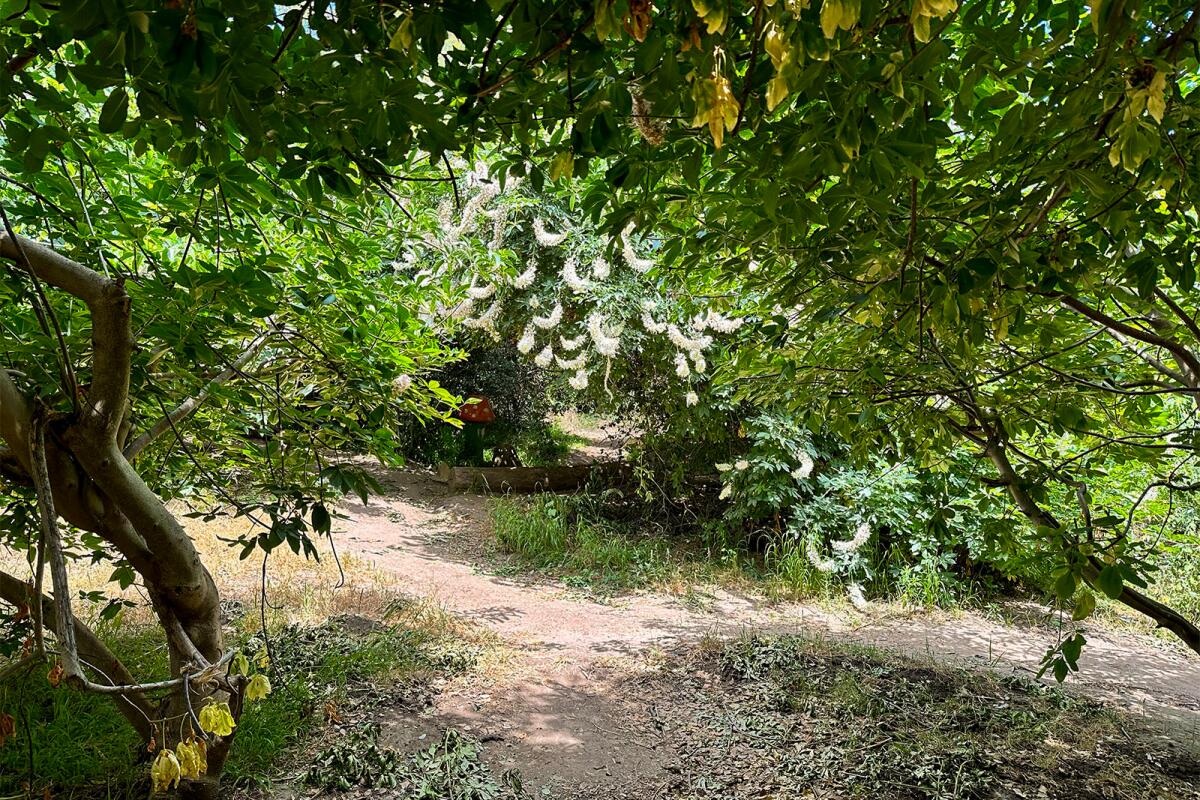
The Children’s Garden in Elysian Park, before the clearance of plants.
(Shari Lee)
Birkenbuel said she can’t afford to keep sharing her water; she’s hoping the city will provide an alternative source. That’s another thing Recreation and Parks is researching right now, Boroditsky said, along with why stakeholders weren’t given advance notice about the work, per usual, and whether the department needs to change its protocols for when it requires environmental review of a site before brush clearance can occur.
However, native plant advocates are still going to city meetings and onto social media to accuse the city of deception and “ecocide” by killing protected plants like California black walnut.
Boroditsky, a certified arborist, said the site still has lots of native trees, like buckeyes, walnut and oaks, that may have been trimmed to conform to clearance rules but that were not removed. “There is no evidence that protected trees were removed,” he said. Although he added that that’s partly because he didn’t have any photographs of the site before the clearance to confirm what plants were no longer there.
He accused community activists of guerrilla gardening in the area by planting more native plants before the city had time to assess what happened and what needed to change. Adding more plants before the city has a plan is a problem, he said, because similar brush clearing might have to be repeated in the future.
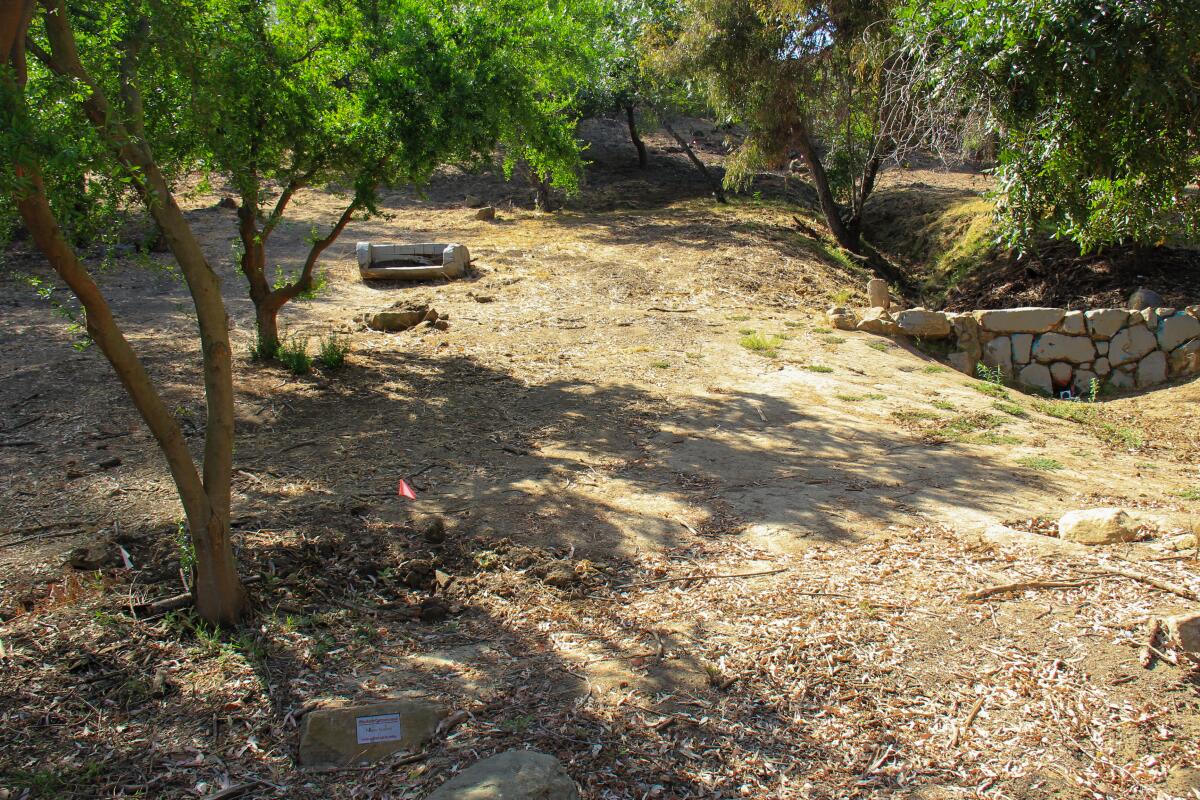
The Children’s Garden in Elysian Park on Aug. 1, about a month after the brush was cleared.
(Jeanette Marantos / Los Angeles Times)
However, Contreras and Flink say no one is putting new plants into the ground, especially in the heat of summer, when they would have little chance of surviving. All they’re doing, Contreras said, is trying to identify the plants that survived the clearance and keep them alive until the rains come this winter, which, they worry, could result in problematic erosion in that stripped area.
Meanwhile, Mason Flink and Max Kanter, co-founders of Garden City LA, are trying to build awareness of land management at the park by leading free, hour-long tours on the West Loop Trail from Aug. 10 through Sept. 1 to demonstrate the ways public lands can be managed and how the public can get involved. The tour includes the cleared Children’s Garden and the thriving native plant Test Plot gardens they help tend near the Marian Harlow Grove.
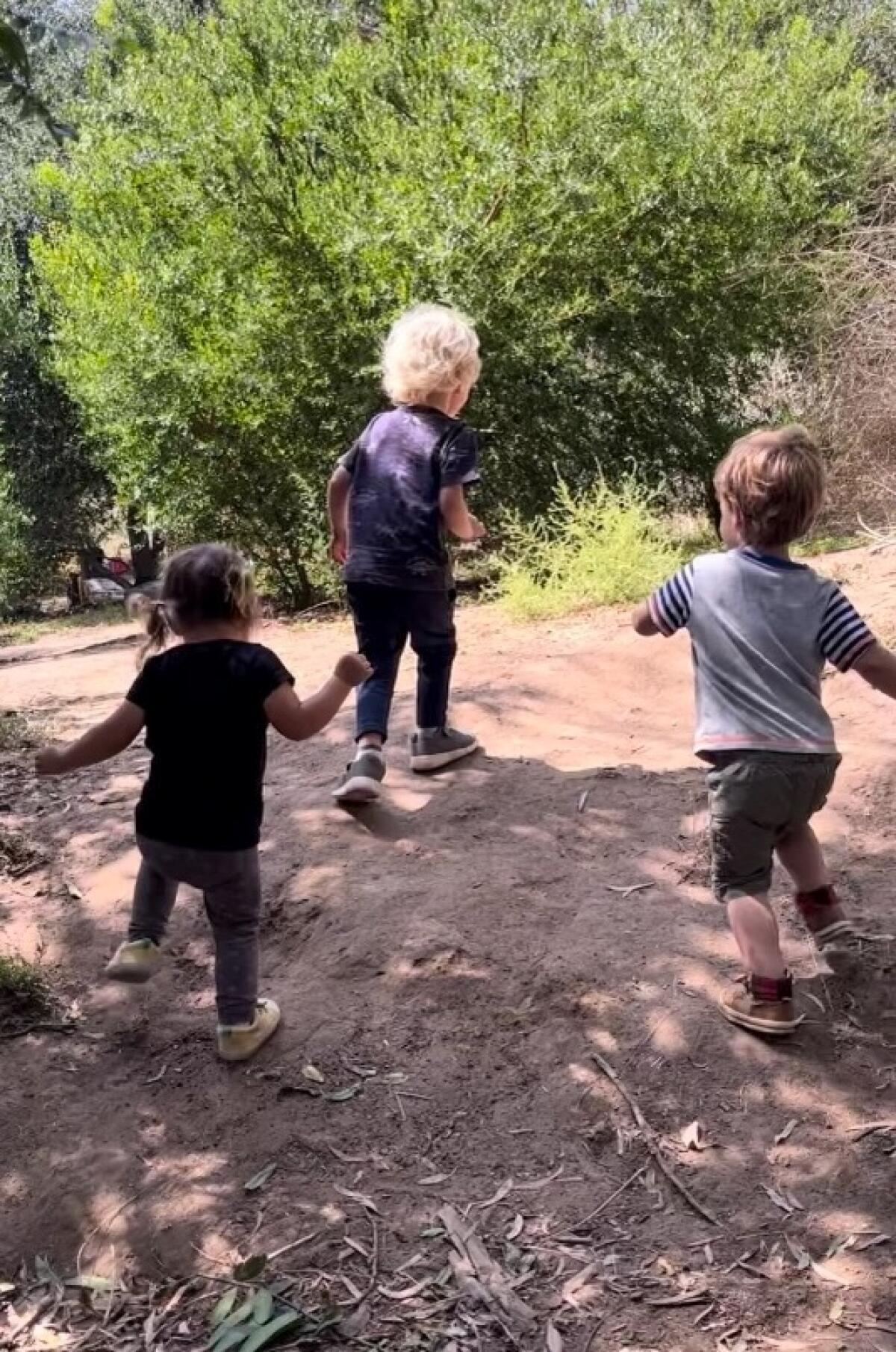
Preschoolers from the Northeast LA Forest School race up a path last fall toward the native shrubs in the Children’s Garden at Elysian Park.
(Becca Hackett-Levy)
“Before they cleared out all the native plants, our point of going through the Children’s Garden was to show how all this life was flourishing,” Flink said. “Now it will offer a stark visual contrast to the Test Plot native plant gardens to spark conversations among the participants.”
Los Angeles City Councilman Hugo Soto-Martinez, whose district includes that part of Elysian Park, has taken the role of mediator and hopes to bring everyone together to discuss what happened and how to avoid problems going forward.
The city “made a big mistake in not communicating with the community groups” who frequent that space, Soto-Martinez said in an interview. But Recreation and Parks “gave the correct instruction for the brush clearance,” he added, “because we don’t want a brush fire in that area with so many homes nearby.”
As for the storage shed that apparently triggered the $12,500 upset: “That’s one of the first things we thought about … couldn’t we have just moved it?” Soto-Martinez said. “I think that’s a very simple question to ask and a fair thing to keep asking.”


Sydney (Ayo Edebiri) and Carmy (Jeremy Allen White).
FX
hide caption
toggle caption
FX
There has always been a metaphorical parallel between The Bear, the television show, and The Bear, the fictional restaurant on the television show. Even as Carmy (Jeremy Allen White) and Sydney (Ayo Edebiri) transformed the Italian beef joint into the fancy restaurant of their dreams and wished for a Michelin star, there were undoubtedly locals who thought, “This is great and all, and I’m sure the food is good, but … I liked the beef sandwiches.” There’s still a window at The Bear to get them, but the focus is certainly elsewhere.
When it started, The Bear was mostly about the work that took place in the kitchen. The stresses of too many orders, territoriality from Richie (Ebon Moss-Bachrach), the arrival of Sydney, and the tightly wound but undeniably talented Carmy, making everybody both extremely stressed and significantly better. Over time, it shifted and grew, putting together beloved departure episodes like “Fishes” in Season 2, which introduced a boatload of guest stars for a flashback story of a disastrous family dinner before Mikey (Jon Bernthal) died. It spent time with Sydney’s family, it explored the way Tina (Liza Colón-Zayas) and Mikey originally met, it followed Marcus (Lionel Boyce) to Copenhagen, and it went with Richie to work for Andrea (Olivia Colman). All these episodes were excellent. And there was still a kitchen. But the focus seemed to be elsewhere.

At times, the show seemed to have disappeared up its own nose, to the point where you weren’t watching the show The Bear as much as you were watching the phenomenon The Bear. There were too many real-life chef cameos, until it seemed like those chefs were checking a box on a list of “things all the cool kids do.” There were too many other cameos, culminating in a rare miss from the reliably charismatic John Cena. The show placed a lot of narrative weight on Carmy’s love interest, Claire (Molly Gordon) — weight that the underwritten character couldn’t support. But even if every experiment and every diversion had worked, viewers couldn’t be blamed for missing the close focus on the kitchen and the camaraderie — for thinking, “This is all really special, but I do miss the beef sandwiches.”
The fifth and final season dispenses with the departure episodes, and it mostly dispenses with cameos. It all takes place on one day, just after Carmy tells Richie and Sydney that he wants to step back from the restaurant and give it to them and Sugar (Abby Elliott) to run, and it mostly takes place right there at The Bear. Now that the clock set by Jimmy (Oliver Platt) has run out, his money has run out as well, and a series of cascading disasters puts Sydney, Carmy and Richie behind the 8-ball from very early in the day, not least because of the tension hanging over all three of them as they prepare to tell the staff about Carmy’s decision to leave.

Tina (Liza Colón-Zayas).
FX
hide caption
toggle caption
FX
We spend this day mostly with the people we know best: our three leads, along with Sugar, Tina, Marcus, and the rest of the staff — including Luca (Will Poulter), who has stayed around to keep working with Marcus. Jimmy is running around with Computer (Brian Koppelman) and a young apprentice of his named Cheese (Elsie Fisher of Eighth Grade), trying to figure out what to do about his finances since it is Jimmy, and not just the restaurant, who’s out of money.
This day takes a while to get cooking, so to speak. The first three episodes of the season are slow, the first two in particular. It’s pouring rain outside, the lighting is dim, and the score maintains the same contemplative melancholy for a long, long time. For about two and a half episodes, it feels like one extended, low-energy scene.
But after that, there’s a shift in tone as the staff looks to get through service, and through seven episodes (FX did not make the finale available in advance for critics), the rest of the season is terrific. What you see is the core story of The Bear, which is people trying to serve food and overcome problems, but through the lens of everything that has happened over the show’s run: Carmy’s retreat from his obsessiveness, Richie’s expansive (and inspiring) discovery of his gift for hospitality; Sydney’s stepping forward from second-in-command to leader; Tina’s complex relationship with the restaurant and her grief over Mikey; Sugar and Carmy’s relationship with Donna (Jamie Lee Curtis); the arrival of Marcus as a high-end pastry chef.
The question the show asks over the last four episodes is: Given all those digressions and flashbacks, given all those visits with families and others, given everything we know about where all these people have been and what they’ve experienced, how does a high-pressure service — of the same kind we used to see in that first season — look now? How do they behave differently, and how does their behavior read differently? How are they the same people we have always known, but at a different juncture, in a different context? How do their wins mean more to them, and to the audience?
On the one hand, making a season this way, there are fewer surprising grace notes, like “Napkins,” the Tina/Mikey flashback episode in Season 3, or “Worms,” the episode in Season 4 where Sydney hung out with her cousin (Danielle Deadwyler) and her cousin’s kid. The Bear feels less daring and more conventional.
But oh, when they have victories under pressure? Victories, large or small? It is immensely, richly satisfying. There’s also more comedy other than just the goofy Faks family than we’ve had in a few seasons; Richie is perhaps the MVP of the season, and that’s partly because of how often he gets to be really funny. Ayo Edebiri continues to be the show’s best reactor, showing Syd eternally a little bit surprised (dismayed?) that she’s chosen to throw in her lot with these people.
There are a couple of questions yet to answer in the finale, both little plot items and broader character resolutions. Over these seven episodes, though, there is much to cheer.


Lifestyle
John Cena wanted to step away from the WWE ring before he became ‘too slow for the show’ : Wild Card with Rachel Martin

A note from Wild Card host Rachel Martin: First a confession: I have never watched a WWE match in its entirety. Don’t get me wrong, I appreciate the athleticism and the performance, it’s just not my thing. But there is something about John Cena I’ve never been able to shake.
Yes, he is a wrestling legend, but he has built a career as an entertainer that transcends the ring. The first time I saw him lead a cast was the 2019 family movie “Playing with Fire” and his rapport with kids in that film didn’t seem like acting at all. The man contains multitudes!
He co-stars with Eric Andre in his newest film, “Little Brother.”

Xie Miao and Yang Enyou in The Furious.
Norachai Kajchapanont/Lionsgate
hide caption
toggle caption
Norachai Kajchapanont/Lionsgate
There have been some fantastic movies released this year, and we know you can’t see them all. So we’re recommending four recent movies we missed that you should add to your watchlist: The Furious, Tuner, She’s The He, and Heresy.
If you need a few more fun film recommendations, check out these episodes:
Fun movies you may have missed
Our favorite movies on Tubi
We debate the best movies to watch on an airplane
Connect with Pop Culture Happy Hour:
Letterboxd / Facebook
Our weekly newsletter
Support Pop Culture Happy Hour+
-

 Montana2 minutes ago
‘Hannah Montana’s Mitchel Musso On Why He Missed 20th Anniversary
-

 Nebraska9 minutes ago
HealthierU opens wellness coaching program to employees
-

 Nevada12 minutes ago
Shaquille O’Neal Foundation donates 260 supply-filled backpacks to Nevada students
-

 New Hampshire17 minutes ago
Police: Man stabbed during domestic dispute in Nashua, NH
-

 New Jersey24 minutes ago
1 injured after vehicle hits tree in West Deptford, NJ
-

 New Mexico27 minutes ago
1 dead following shooting involving Rio Arriba County Sheriff’s Office
-

 North Carolina32 minutes ago
Former Madison County chief deputy in North Carolina custody after Arizona arrest
-

 North Dakota39 minutes ago
North Dakota composer launches statewide virtual choir project

