Lifestyle
'It was sexy, it was fun': Why these waterbed devotees never gave up on the jiggle

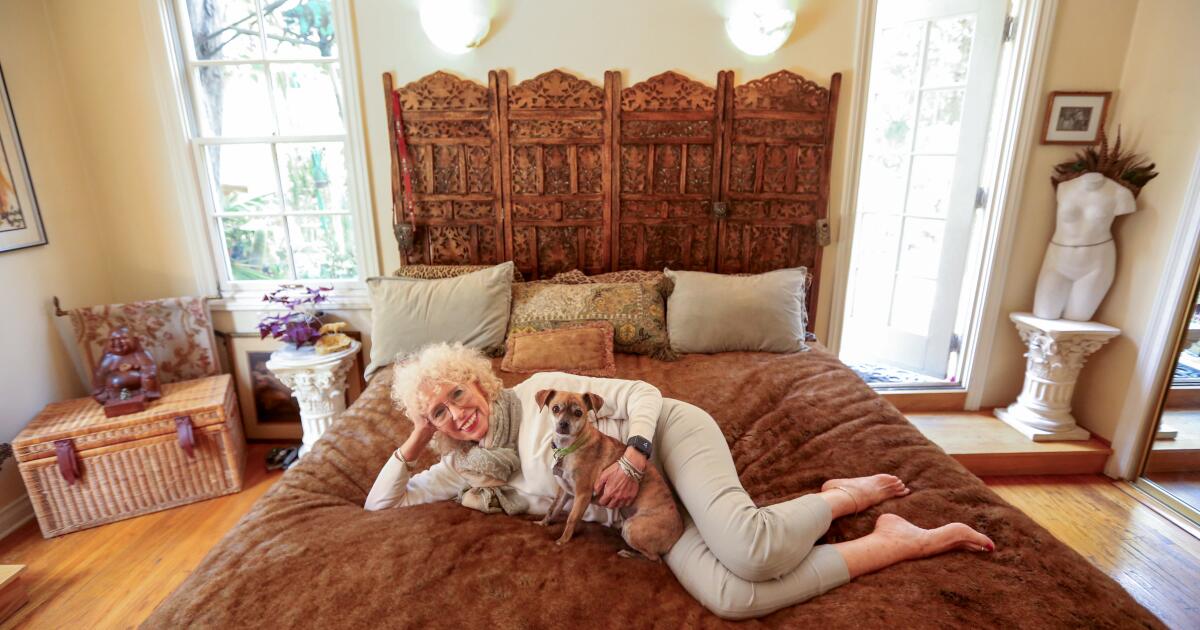
The bed in Nancy Gerrish’s bright Los Feliz home appears perfectly normal — carved wooden headboard, fuzzy brown blanket, cream-colored bed skirt. The sheets are a tasteful leopard print. A few brocade throw pillows lie atop the spread to complete the earth-tone look.
But beneath that plush exterior, Gerrish’s bed hides a jiggling secret.
Sit on the mattress’ edge and it wobbles and undulates. Lie down and it rocks gently, as if you’re floating above a temperate pool of water.
And indeed, you are.

In L.A., water rules everything around us. Drink up, cool off and dive into our stories about hydrating and recreating in the city.
“I tell people I have a waterbed, and everyone laughs,” says Gerrish, 78, a financial planner with white curly hair and manicured lavender nails. “But it’s a very comfortable bed to sleep in, and I personally don’t know why the world doesn’t have this.”
If you thought waterbeds had gone the way of 1970s trends like Troll dolls and polyester pantsuits, you are mostly correct. The wavy vinyl mattresses that became a symbol of the era’s sex, drugs and rock ’n’ roll lifestyle may no longer be part of the collective consciousness except as the butt of a joke in a period film or as a forbidden item on a boilerplate apartment lease. But they can still be found gently rippling in a handful of Southern California bedrooms.
Waterbeds account for less than 2% of all mattress sales today, according to the Specialty Sleep Assn., but the few remaining retailers receive daily calls from stubborn holdouts like Gerrish — mostly older folks who bought a fluid-filled mattress decades ago, fell in love with its wavy motion and won’t sleep on anything else. Now, these waterbed enthusiasts scour the internet for replacement mattresses, heaters and water treatment systems, determined to resist sleeping on standard mattresses — what they call “dead beds” — for as long as they can.
“I worry,” said Donna Martin, 77, of Glendale, who has been sleeping in a waterbed for 50 years. “I think to myself if I ever have to go into a home, they won’t give me no waterbed.”
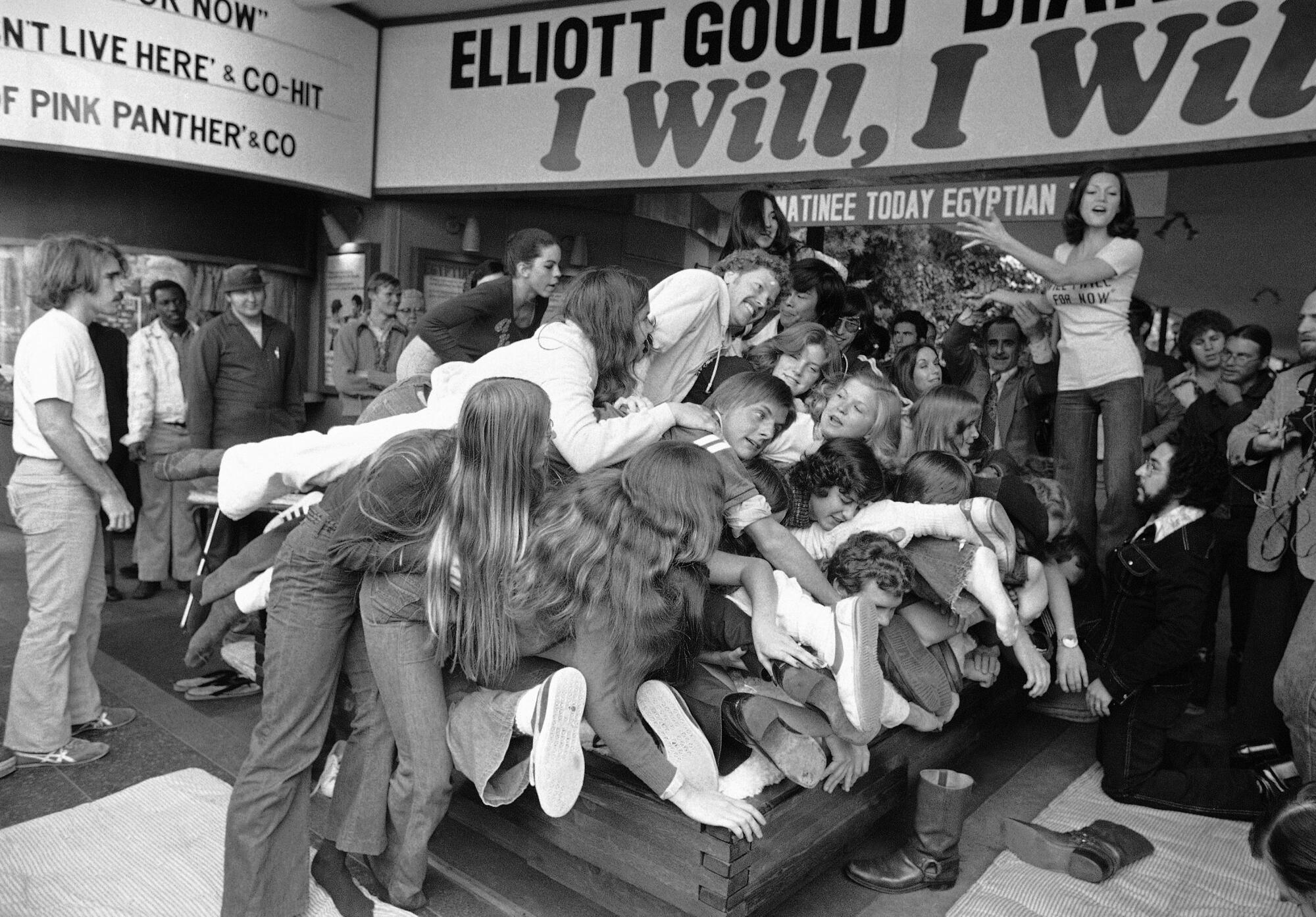
Forty-seven students from UCLA pile on top of a water bed , March 10, 1976, to establish a new record for a human pyramid on a water bed in Los Angeles. They broke the old record of 16, according to the press agent, in a stunt to publicize a then-current Hollywood production.
(Wally Fong / Associated Press)
The ‘Pleasure Pit’ boom
The modern waterbed was invented in 1968 by Charles Hall, a graduate student at San Francisco State, as part of his master’s thesis in design. Hall, then 24, had originally set out to create the world’s most comfortable chair, filling a plastic sack with gelatin and then cornstarch with disappointing results. Eventually, he landed on a winning formula — an 8-foot water-filled square vinyl mattress. He called it the “Pleasure Pit” and imagined it as a bed-chair hybrid — the only piece of furniture one would need.
“It was new, it was exciting, it was different, it was sexy, it was fun. It was our generation’s bed.”
— Denny Boyd, former president of the Waterbed Manufacturers Association.
His prototype was featured in a show called “Happy Happenings” at the San Francisco Cannery art gallery that summer and articles about a new-fangled waterbed soon were appearing in newspapers and magazines across the country. A modern sleep trend was born.
“It was new, it was exciting, it was different, it was sexy, it was fun,” said Denny Boyd, former president of the Waterbed Manufacturers Assn., who once owned 35 waterbed stores throughout Texas, Missouri and Louisiana. “It was our generation’s bed.”
Waterbed sales skyrocketed from an estimated $13 million in 1971 to $1.9 billion in 1986, according to the New York Times. The mattresses were fairly cheap, but sales of the heavy wood frames that kept the mattresses from flopping around, plus water heaters and conditioners, brought in big bucks. By 1991, roughly 1 in every 5 mattresses sold in America was fluid-filled, according to the Washington Post. Hall received a patent for his invention in 1971 but rarely enforced it, and young entrepreneurs quickly turned the waterbed business into a lucrative industry.
“There were a whole lot of people who were millionaires by the time they were 25,” Boyd said.
It was a wild, sex-soaked business. One early ad declared, “Two things are better on a waterbed. One of them is sleeping.” Boyd remembers hosting pajama party sales events at his stores where customers would show up in outrageous sleepwear — see-through nighties and G-strings. The store served wine and cheese and stayed open until 3 or 4 a.m.
“It was more than R-rated,” Boyd said.
Competition among the mostly male sales force was fierce. “People used to throw rocks at each other’s stores and look in dustbins to see client lists,” Boyd said. “At the trade shows, you had to hire a security guard to watch your space so people wouldn’t sneak back in and poke holes in your mattress.”
By the mid-1990s, however, the party was over. After a precipitous rise, the waterbed market dried up. Boyd says the decline was due to a handful of factors, one of which was the advent of the “softside” waterbed mattress, which looked and felt more like a traditional bed and didn’t require pricy bed frames or special sheets — accessories that generated the bulk of the revenue for waterbed stores. At the same time, several new alternative mattress technologies hit the market, including airbeds, the Sleep Number, Tempur-Pedic and memory foam.
“These were more conventional beds, easier to sell and less complicated,” Boyd said. “They also had lots of advertising behind them.”
In 1995, the Waterbed Manufacturers Assn. rebranded itself as the Specialty Sleep Assn.
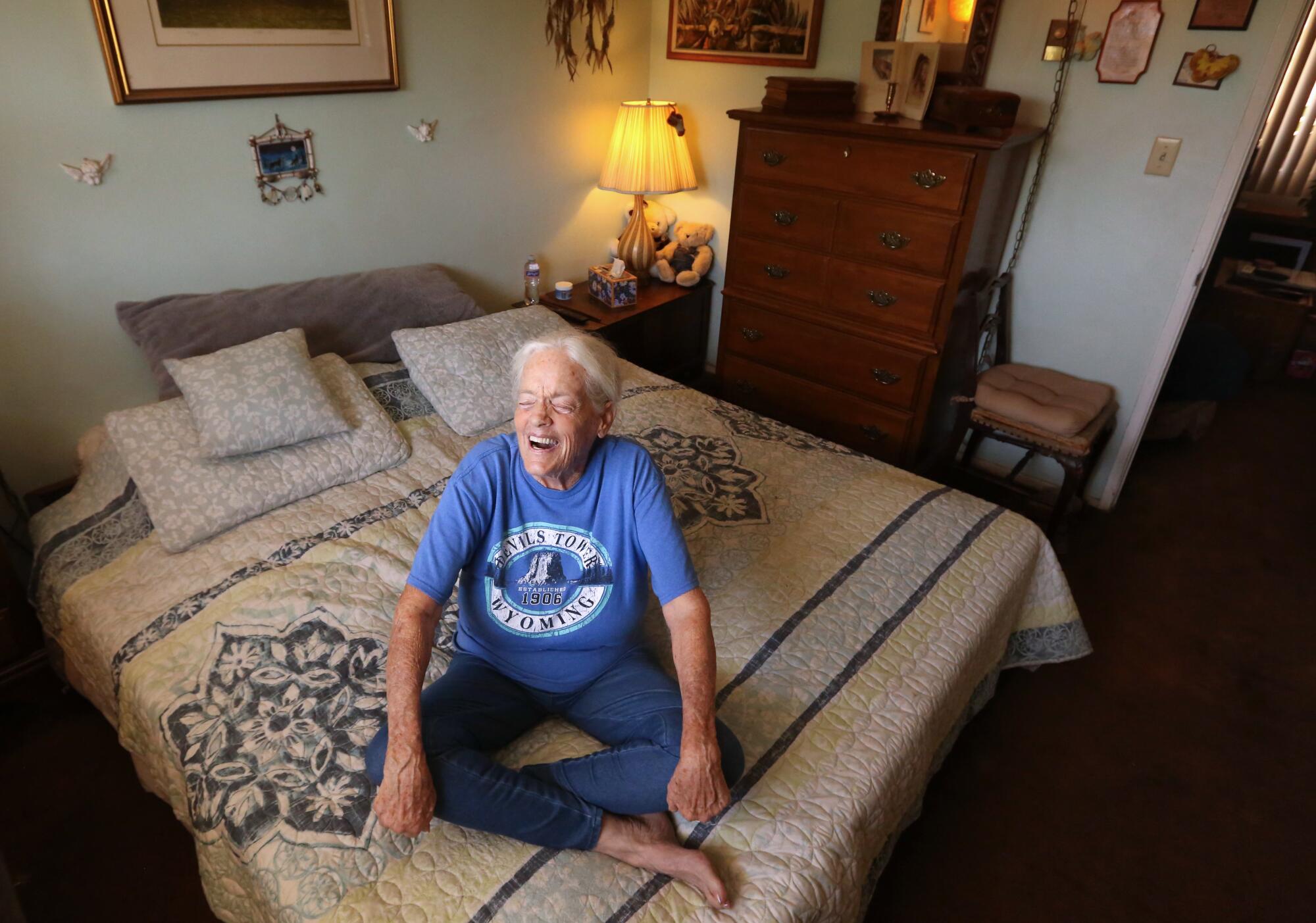
Donna Martin, 77, rests on her waterbed in her apartment in Glendale. Martin has used waterbeds for the past 50 years.
(Genaro Molina / Los Angeles Times)
Dedicated ‘water heads’ remain
For some, the waterbed was never a passing trend. It‘s a lifelong devotion.
Gerrish, the financial planner from Los Feliz, bought her first water-filled mattress in 1996 after sleeping on a friend’s waterbed. “I couldn’t believe how comfortable it was,” she said. “It’s very soft on all your joints, and if you like to cuddle, your arm sinks into the bed so there’s no pressure on it.”
She moved her waterbed to Los Angeles from New York 21 years ago. When she eventually sells her Los Feliz home, she hopes to take it with her wherever she moves next. (She was relieved to learn that it is illegal for landlords to forbid waterbeds in California in rental units built after 1973, though they can require tenants to have insurance for damage caused by the bed.)
“I feel so cozy. It’s hard to get out of it,” she said. “And anyone visiting me loves it. I think the [traditional] mattress companies don’t want this information getting out.”
Gerrish has been sleeping on a water-filled mattress for 28 years, but several L.A. waterbed lovers have had an even longer relationship with Hall’s 1968 invention.
Martin, the 77-year-old in Glendale, has been sleeping on a waterbed since she got her first one as a hand-me-down from a friend.
“I’ve had five mattresses since the first time I set one up. I love it,” she said.
Recently, she slept on her sister’s Swedish memory foam mattress while taking care of her pets for the weekend. The verdict? No, thank you. Martin has a squashed disk in her spine and finds the waterbed is easier on her hips.
“At first it was OK, but then the same thing happened, too much pressure,” she said. “I would rather not sleep in something else.”
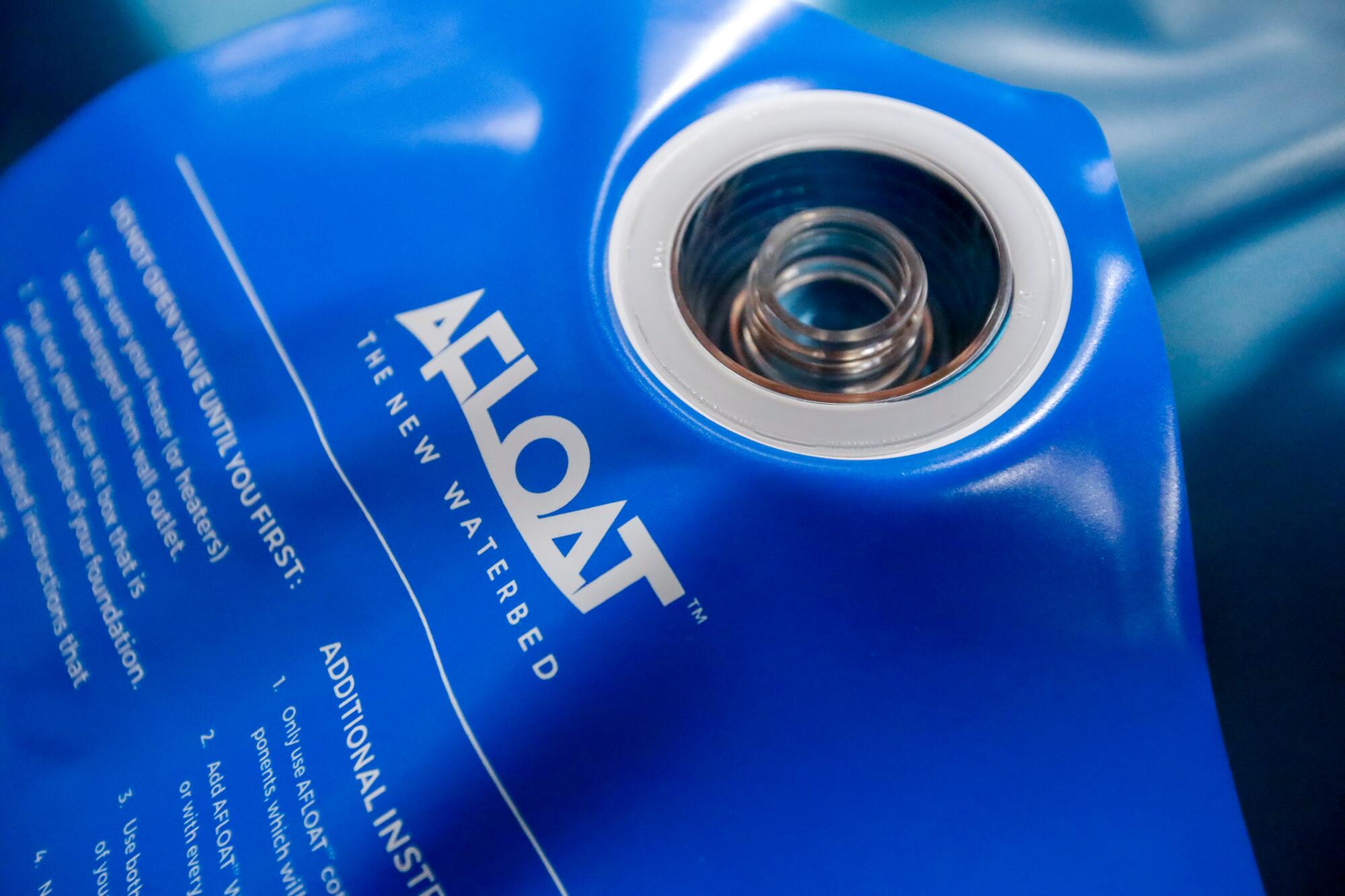
A closeup of a waterbed at the Afloat factory in Corona.
(Chris Carlson / Associated Press)
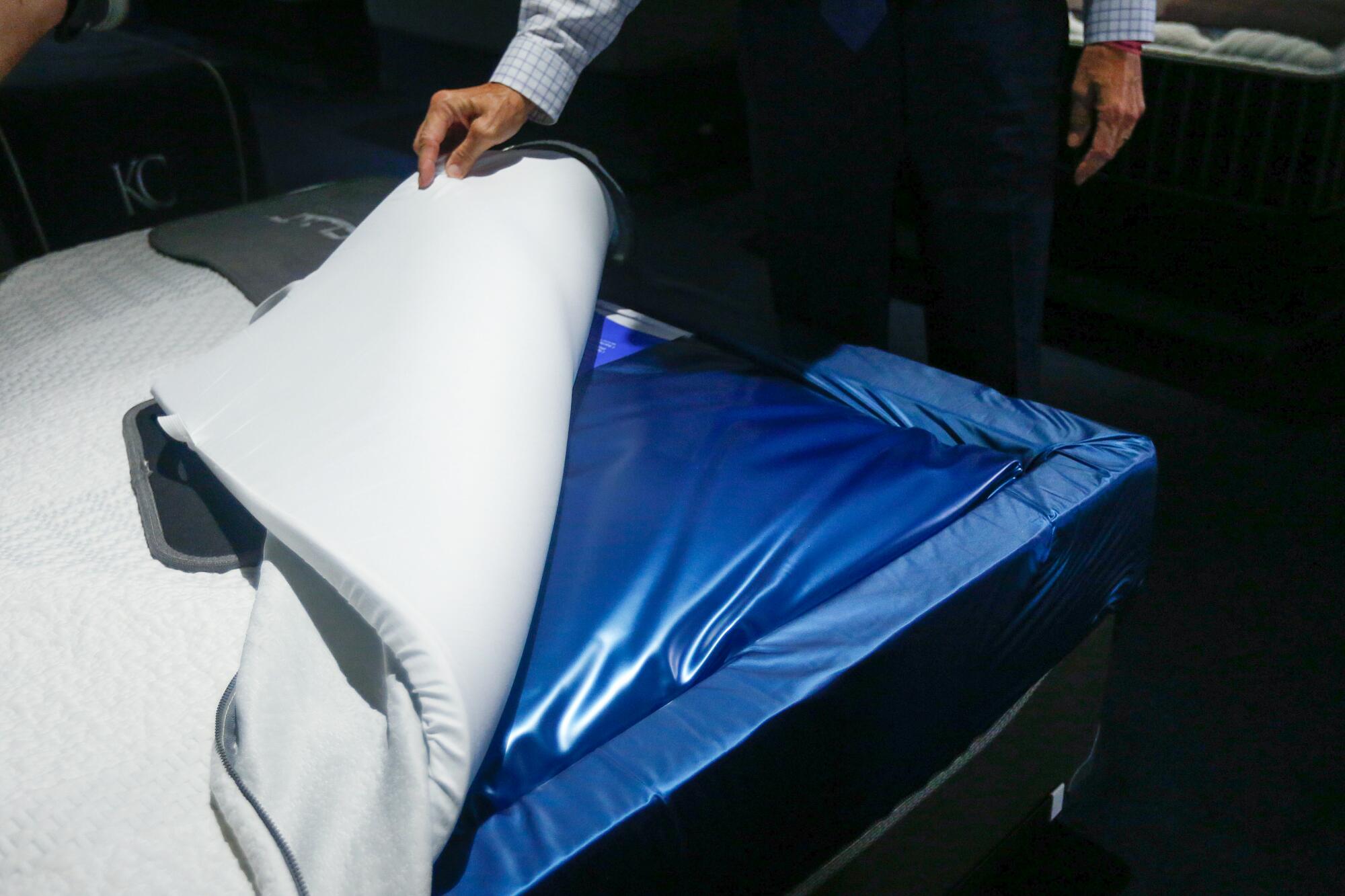
City Furniture CEO Keith Koenig shows the new waterbed on display as he speaks during an interview with the Associated Press in Tamarac, Fla., in 2018. Koenig and inventor Charles Hall, pioneers of the waterbed industry in the United States, are hoping to generate a new wave of popularity for the old furniture concept by using a wholesome new pitch.
(Brynn Anderson / Associated Press)
Steve Hertzmann, 62, of San Pedro, gets it. He’s been a waterbed devotee for 40 years and is surprised that the wavy mattresses have never made a comeback.
“The best part is in the wintertime when you’re freezing cold,” he said. “The waterbed has a heater, and you hop in and you’re all warm.”
Marty Pojar, who has a store called the Waterbed Doctor in Westminster, would love to see a renaissance, but he thinks the technology needs a rebrand.
“The word ‘waterbed’ creates a stigma,” he said. “When people hear it, they are thinking of the big, old wood-frame waterbeds with lots of wave action.”
In fact, waterbeds have evolved over the years. Consumers can now pick among mattresses that offer old-school full-motion waves and others that are semi-waveless or have almost no waves at all. Many beds also have two separate water mattresses, one on each side, so if two people are sleeping together and one person gets out of bed, the other doesn’t experience any rocking.
With enough advertising dollars behind it, Pojar thinks renaming waterbeds “flotation sleep systems with temperature control” could bring in new customers.
“Reeducating the public is a big challenge, but there is a big opportunity there, I believe,” Pojar said.
For now, longtime devotees are keeping his business alive. Change can be difficult for a lifelong waterbed fan, as Larry Johnson of Mar Vista has learned firsthand.
The accountant slept on a waterbed for 50 years, until May, when his wife convinced him that a standard mattress would make it easier to get out of bed as they age.
A few days in, Johnson was on the fence. The “dead bed” was not as soft as his waterbed. He missed the rocking motion.
“It’s going to take some getting used to,” he said.



Milly Alcock in Supergirl.
Warner Bros. Pictures
hide caption
toggle caption
Warner Bros. Pictures
Hollywood’s newest Supergirl is kind of a dirtbag — in the good way. Fearless and grumpy, Supergirl (Milly Alcock) sets out on a quest to support a new pal’s revenge journey and to make a point that should be clear by now: Never mess with a lady’s dog. Also featuring David Corenswet and Jason Momoa, is Supergirl a worthy follow up to Superman?
If you want more DC superhero action, check out these episodes:
‘Superman’ takes off and nails the landing
‘The Batman’ puts the emo in emote
Connect with Pop Culture Happy Hour:
Letterboxd / Facebook
Our weekly newsletter
Support Pop Culture Happy Hour+
Lifestyle
L.A. Affairs: After decades of near-misses, I finally told him: ‘I’m not leaving here without you’

It didn’t take endless quarantining with my spouse during the COVID-19 pandemic to end my marriage of over two decades. By the summer of 2019, menopause — and the extra-added “bonus” of frontal fibrosing alopecia that it awakened — was pummeling me physically and mentally to the extent that I no longer had the capacity to function inside the dysfunction of my life.
The relief that came with the decision to finally let go was completely dwarfed by the immense pain of severing a family in two. I cried as I packed. I cried as I unpacked. I was rolling endlessly in a dark wave that would not stop; my feet could not tell sand from sky. Once I managed to break the surface, I reached out.
I called Tish, Diane and Michelle, three smart, strong, nurturing women who’d been through and survived divorce. I also called my brother, Dan, and my friends Doug and Steve, three kind, creative, funny men who always “got” me.
As for Steve, we met in the spring of 1984 when he auditioned to be the drummer for the Secrets, the band Dan, Doug and I had started the year before. In our small-town high school of fewer than 400 students, he had flown completely under my radar, as he was two years younger, and he joined marching band the year after I’d ditched my baritone horn for a microphone and Pat Benatar tights. Steve aced the audition, and the four of us clicked immediately over our shared love of the Pretenders and all things Monty Python. By mid-June, the Secrets were playing local bars and biker parties in the middle of nowhere, and I was head over heels in love with the drummer.
It wasn’t supposed to happen like that. I wasn’t supposed to fall in love with a boy from my hometown.
I had spent my whole life dying to get out of Middlebourne, W.Va., and had been champing at the bit to leave for college, but by late August, that no longer meant freedom; it meant that I’d have to leave Steve behind. I told myself we’d defy the odds and make it work. He was my soul mate. But we were just kids, and there was no internet, no cellphones with unlimited text and calling. By February 1985, the divide was too great. In a moment of loneliness, I cheated on him. It was over, and I was firmly told to take my place in the friend zone.
I spent the following year flailing and failing in college before making the bold, half-baked decision to drop out of the West Virginia University theater program and move to Los Angeles, a place I’d never been, to pursue a singing career. When Steve found out that I was moving across the country, he softened his friend-zone stance and told me he loved me. On July 13, 1986, he went with my parents to Pittsburgh International Airport to see me off.
For the next 33 years, we would come together and drift apart — sometimes as lovers but mostly as friends. During a visit to my Hollywood apartment in 1988, when he was still in college and the timing was still wrong, I told him, “Who knows. Maybe in 30 years, I’ll come back and get you.”
In November 2019, Steve came to visit me for a long weekend.
I picked him up at Los Angeles International Airport and took him straight to Zuma Beach for a picnic, where we watched dolphins jumping in the waves while the seagulls stole our potato chips. The following day, we cozied up for an afternoon of wine and cheese at Cornell Wine Co. in Old Agoura, then made our way over Topanga Canyon for dinner at Canyon Bistro & Wine Bar.
The night before he flew home, we watched the sun set from our table by the lake at Zin Bistro Americana in Westlake Village. I felt giddy, excited, seen, understood and appreciated in a way I hadn’t felt in a very long time. While it was tempting to jump right in with both feet, we decided to date long distance and take things slowly.
On March 26, 2020, while Steve was still recovering from being profoundly ill with COVID, I arrived at his doorstep at 6 a.m. and proclaimed, “I’m not leaving here without you.”
Two weeks later, after packing most of his belongings into U-Haul shipping crates, we left Parkersburg, W.Va., in Steve’s red Volkswagen Golf with two suitcases, one Treeing Walker Coonhound and one Aussie/Chow mix. I-40 West was practically empty; just us and the occasional car or Amazon truck.
We arrived in California on Easter Sunday and joined the rest of the world in quarantine, not knowing how it would affect our work and financial future. We took a lot of long walks to help deal with the stress of the not knowing, but the magic panacea for me came the day Steve’s Harley-Davidson arrived in one of the crates.
We cruised up and down PCH, and roared our way up and over Mulholland Highway, Stunt Road, Malibu Canyon and Decker Canyon, stopping along the way to stretch our legs, feel the sea spray on our faces and take in views from the valleys to the coastline. We were surrounded by so much beauty; it was almost impossible to let trepidation win.
On one particularly memorable ride on Mulholland Highway between Kanan Road and SR 23 near Saddle Rock, we came around a bend and — bam! — right in front of me was the greenest mountain range I’d ever seen in California, gleaming spectacularly in the sunlight. As I inhaled its gorgeousness and exhaled my stress, I thought, “I can’t believe I get to see this. I can’t believe I get to do this. I can’t believe I get to be with Steve.”
In September 2024, I got to marry Steve.
As my brother, Dan, said at the reception, “What a long, strange trip it’s been.”
The author lives in the suburbs of Los Angeles with her husband, Steve, and their dogs, Coco Puff and Kira.
L.A. Affairs chronicles the search for romantic love in all its glorious expressions in the L.A. area, and we want to hear your true story. We pay $400 for a published essay. Email LAAffairs@latimes.com. You can find submission guidelines here. You can find past columns here.
-

 Lifestyle4 minutes ago
Swatch Seeks Damages From Samsung Over Trademark Infringement, Ft Reports
-
 Politics11 minutes ago
MS NOW anchor Alex Witt to exit as network reduces live weekend programming
-
 Sports18 minutes ago
Parents of ex-NFL player Doug Martin allege excessive force by Oakland police in wrongful death suit
-

 World28 minutes ago
Burkina Faso cuts diplomatic ties with former colonial ruler France
-
 News56 minutes ago
A day after Alito’s testy response to Sotomayor’s dissent, court says it was a ‘misunderstanding’
-

 Los Angeles, Ca2 hours ago
Watch Project Angel Food's 'Lead with Love' telethon on KTLA
-

 Detroit, MI3 hours ago
Metro Detroit weather forecast, June 26, 2026 — 4 p.m. Update
-

 San Francisco, CA3 hours ago
Newlyweds celebrate Pride-themed weddings inside SF City Hall as parade preparations underway

