Lifestyle
Indie gems, a new ‘Predator’ and a boxing biopic are all in theaters


Sydney Sweeney plays boxing star Christy Martin in the film Christy, out this week.
Eddy Chen/Black Bear Pictures
hide caption
toggle caption
Eddy Chen/Black Bear Pictures
Something for nearly everyone at cinemas this weekend: A boxing biopic, an epic set in the Pacific Northwest, a new Predator flick and an anguishing postpartum story. Also quieter titles: a recreation of a 1970s interview with a celebrated New York art scene photographer, and a father-daughter drama from the filmmaker behind the 2022 standout The Worst Person in the World.
Christy
In theaters Friday
YouTube
Christy Martin, whose life story is featured in the new film Christy, grew up a coal miner’s daughter in West Virginia. After playing Little League baseball and basketball with the boys, she got a basketball scholarship to college. Then she began boxing in local amateur tough-man contests. She wore pink trunks, had a mean left hook, and enjoyed trash-talking her opponents. She kept winning fights, and was the first woman signed by promoter and boxing impresario Don King.
In the 1990s, Christy Martin was considered the most exciting and successful female boxer. She won titles, fought at Madison Square Garden and made it onto the cover of Sports Illustrated. She was later inducted into the International Boxing Hall of Fame. Martin says inside the boxing ring, she felt safe. But her private life was a different story. For two decades, she suffered her husband’s emotional and physical brutality. Actress Sydney Sweeney portrays Martin in the film, which is more than a rise-to-fame biopic: Christy depicts how Martin’s then-husband tried to make good on decades of threats, and how Christy survived being stabbed and shot by him in 2010. — Mandalit del Barco
Die My Love
In theaters Friday
YouTube
Director and co-writer Lynne Ramsay adapts Ariana Harwicz’s novel Die, My Love and gives Jennifer Lawrence the challenging role of Grace, a new mother in the throes of severe postpartum depression. Grace feels ignored in the isolated, rural family home she shares with her aloof partner Jackson (Robert Pattinson). Lawrence is a compelling presence and more than game to go through the pangs the part calls for, and she shares some strong scenes with Sissy Spacek, playing Jackson’s empathetic mother Pam. But the storytelling is too abstract and at a remove to fully lock in emotionally, and as Grace’s descent takes unsurprising turns, I was reminded of other, more successful works conveying this delicate subject matter — A Woman Under the Influence, for one. — Aisha Harris
Predator: Badlands
In theaters Friday
YouTube
In sequels and novels, comics and video games, various Predators have faced off against everything from Aliens to Batman to, recently, a very resourceful young Comanche woman, in 2022’s Prey. Predator: Badlands is the latest iteration of the franchise about an alien race that hunts things using all sorts of space-gadgets. In this version, Dek, the runt of his Predator litter, goes to the deadly planet of Genna to hunt down a hideous monster, because he’s determined to prove to his clan that he’s got what it takes to belong to the species of intergalactic badasses that audiences first met back in a 1987 Schwarzenegger movie. This Predator, played by Dimitrius Schuster-Koloamatangi, is aided by the top half of an abandoned robot named Thia, played by Elle Fanning. — Glen Weldon
Peter Hujar’s Day
In limited theaters Friday
YouTube
Writer and director Ira Sachs’ character-portrait two-hander will likely sound stagy and static, but it turns out to be not just resonant, but surprisingly cinematic as played by Ben Whishaw and Rebecca Hall. Sachs is recreating an interview that writer Linda Rosenkrantz recorded with photographer Peter Hujar on Dec. 19, 1974, for a never-published book about the daily lives of artists. The two were friends, and she asked him to relate in detail his activities of the day before. The original audio tape was lost, but a typewritten transcript of the interview lived on, donated by Rosenkrantz to the Morgan Library and Museum in New York City. It was published as a book in 2021.
The film’s recreation finds Hujar, fidgeting and chainsmoking as he namedrops casually about members of the 1970s downtown art scene — Susan Sontag, Lauren Hutton, Bob (Robert) Wilson, Fran Lebowitz, William S. Burroughs — to regale Rosenkrantz, who is comparatively laconic. The most sustained (and most amusing) anecdote begins with Hujar debating whether to wear his red ski jacket or a more bohemian coat to shoot Allen Ginsberg for The New York Times. He decides on the jacket, and regrets it as he heads to Ginsberg’s apartment for the shoot. The beat poet proves a difficult, testy subject, but Hujar gets the shot he needs. Then he buys liverwurst for a sandwich, develops the photos in his darkroom, has a few conversations, lets a friend whose hot water isn’t working take a shower. It’s all minor key, but thoroughly engaging, somewhat in the manner of Louis Malle’s My Dinner with Andre, or perhaps the less formal artists-gabbing films of Andy Warhol. The director lets daylight fade to a candlelit evening meal as the minutia of Peter Hujar’s Day becomes an understated aria for Whishaw, and a spoken-word concert both for Hall’s active listener — and for the movie audience. — Bob Mondello
Sentimental Value
In limited theaters Friday
YouTube
Joachim Trier’s eloquent drama centers on the two long-neglected daughters of a film director (Stellan Skarsgård) overly caught up in his career. Nora (Renate Reinsve, the star of Trier’s The Worst Person in the World) is suffering a case of stage fright when we meet her, possibly because she knows her father won’t show up. Her opening night will end in triumph with her sister Agnes (Inga Ibsdotter Lilleaas), an academic and former child performer in their father’s biggest artistic triumph, present to back her up.
Shortly after, at their mother’s funeral, things are the other way around — Agnes a basket case and Nora the strong one — when dad shows up, not to mourn the wife he left long ago, but to drop off a script he’s written for Nora. She angrily turns him down, and he reluctantly casts a visiting American star (Elle Fanning), having her alter her hair color to match Nora’s. Trier anchors the film in the ornate Victorian home that’s been in the family for generations. If its walls could talk, they’d tell of mom dying by suicide, the girls growing up, and dad’s new movie, which is set at the home, almost incestuously. The dynamics are fraught, the performances as understated as they are heartbreaking. And the plot, which keeps you guessing up to the final moments of the final scene, is riveting. — Bob Mondello
Train Dreams
In limited theaters Friday; streaming on Netflix Nov. 21
YouTube
The grandeur of the Pacific Northwest, and the irrevocability of change, love, memory, cruelty and heartbreak all come together in Clint Bentley’s gorgeous historical drama set in the early 20th century. It’s the age of the steam locomotive and westward expansion, centered on an intimate portrait of Robert Grainier (Joel Edgerton) a taciturn day laborer and logger who meets Gladys (Felicity Jones), the love of his life and the mother of a daughter he seldom sees, since he’s forever off working to support them. Grainier is passive, amazed, and often bewildered in a story crammed with incident — a Chinese coworker tossed off a bridge in a fit of anti-immigrant pique, a felled tree killing three loggers, a comet streaking in the night sky, memories made and lost, stones laid out in a square to mark the future walls of a log cabin, a forest fire laying waste to dreams. It’s breathtaking, with Terrence Malick-esque visuals and wrenching emotions. — Bob Mondello


Dr. John Henry Cook III hadn’t meant to appear bare-chested on Sylvia Rosemarie Auton’s iPhone when he called her for a chat last July. It was 7:45 a.m., and Cook, who was home alone with his dog in Leesburg, Va., was having trouble facing the day.
“I was lying in the bed my wife had died in,” he said. “I was feeling busted by sorrow, and I just wanted to talk to Sylvia.” An accidental push of the FaceTime button sent more than his voice through the ether.
Auton, who was visiting her daughter at the time in Phoenix, Md., was taken aback.
“He said, ‘Good morning, Love,’” she recalled. “I was stunned.” She was equally stunned a day later when, hours after their first kiss, he proposed.
Auton, 85, and Cook, 90, first met in May 2011, when Auton and her late husband, Forrest Hanvey, became patients at Cook’s concierge medical practice in Leesburg. Hanvey, who died in 2024, had known Cook since the 1950s, when both were midshipmen at the U.S. Naval Academy. A friendly relationship between the former classmates soon extended to their wives, Auton and Agnes diZerega Cook, whom friends knew as Di.
Both couples would routinely see each other at U.S.N.A. alumni events, and after Cook retired from medicine in 2017, they met up occasionally for group lunches with Navy friends.
“I got to know Di, who was a wonderful watercolor artist and wonderful person,” Auton said. When Di died in April 2025 of cardiac arrest, the friendship between the two surviving spouses deepened.
Auton is an author and educator. Before she moved to Fairfax, Va., in 1969 with her first husband, a nuclear physicist named David Auton, she lived in Chicago, where she grew up. Her bachelor’s degree in mathematics and master’s in mathematics education are from the University of Chicago. Her doctorate in mathematics education and statistics is from the University of Maryland.
Auton and David, who died of a cerebral hemorrhage in 2003, raised a daughter, Alyson Russo, now an anesthesiologist at the Johns Hopkins Hospital and the mother of Auton’s two grandsons, ages 6 and 2. The Autons also had a son, Timothy Lee, who died in 2014.
Auton taught in Chicago classrooms before she was promoted to her first position in educational leadership in the late 1970s. In 2005, she retired as director of staff development for Fairfax County Public Schools.
Auton now teaches personal finance classes at the Osher Lifelong Learning Institute, part of George Mason University. She also advises women on beginner stock market and investment strategies.
Her advice extends to navigating romance and relationships, too. “The Last Embrace: Caregiving for a Beloved Spouse,” a self-published 2025 book, was written after she spent a protracted period caring for Hanvey, who died after a fall at home in Fairfax Station. “The Wondrous Embrace: Finding Love in the Sunset Years,” also self-published in 2025, is meant to inspire hope among older people who may be souring on the chances of finding love.
Auton met Hanvey when she was well into her 60s and he was 70 in January 2005. They married the same year, in September. “One thing I do not want is for anyone to feel discouraged,” when it comes to love or otherwise, she said.
Before Cook earned his medical degree from Yale, he was a Polaris submarine commander in the U.S. Navy. During the Cold War, he served in nuclear submarines. He married Di in 1957, the day after he graduated from the Naval Academy.
Military service had been a Cook family legacy. His father was a Marine first lieutenant; he was born at Marine Corps Base Quantico in Virginia. With Di, he had a daughter, Elizabeth, and two sons, John and Harrison. His five grandchildren range in age from 24 to 30.
When Hanvey was declining in 2024, Auton wasn’t always certain she understood his needs. In those moments, she would ask Hanvey if he wanted to talk with someone else. “Invariably, it would be, ‘I want to talk with Jack,’” she said. Cook picked up the phone every time.
On May 17, 2025, Cook held a memorial for Di at St. James’ Episcopal Church in Leesburg, where they had married almost 70 years earlier. Soon after she died, Auton sent the family a condolence card and tucked a printout of the 1934 poem “Immortality,” by Clare Harner, inside. “I thought it might comfort Jack,” she said.
At the memorial, he told her how much he liked it. But Auton knew his grief was of a depth poetry could do little to assuage. “I saw the pain he was in,” she said.
Less than two weeks later, she was surprised when he texted her a handwritten poem. “He had taken the original poem I sent him and created a poem as if Di were reading it to him,” she said. “I was so taken with that I sent a poem back to him as though Forrest were writing to me.” Both poems touched on how they shouldn’t feel alone, how their spouses’ spirits wouldn’t leave them.
Auton was planning a June 2025 celebration of life for Hanvey at the time. “Jack had done such a wonderful job with Di’s, I asked him if he would come over and look at my ideas,” she said. Over lunch, the effects of his loss were as apparent as they had been at the memorial for Di.
“He was still zombielike with grief,” she said. Compassion and a sense of hopefulness about helping him through his pain led to a shift toward tender new feelings.
On June 29, as Cook was leaving the celebration of life for Hanvey, he bent down to hug her and whispered “I love you” in her ear. “What was astonishing is that, without a moment of hesitation, I responded ‘I love you, too,’” she said.
The next morning, he sent her a text message: “Bravo Zulu,” a Navy term for “well done.” She asked herself if his declaration of love at the service meant little more than appreciation for the celebration honoring his friend.
They didn’t speak again until July 11, when Auton was preparing to get in the shower at her daughter’s house and Cook was shirtless and in bed. Auton checked that only her face was visible when she answered the early morning call. They hung up with a plan to meet for lunch the next day, at Auton’s house in Fairfax Station.
“At 1 o’clock, there he was, holding a mini orchid plant” as a gift, she said. “He stepped into the foyer, stepped into my arms and gave me a long, deep kiss.” Two hours later, on a deck overlooking a lake on the property, he proposed.
At the memorial for Hanvey, Cook’s feelings for Auton had taken him by surprise. “When you’ve been in a long-term, loving marriage, you always have your feelers out” for your spouse, he said. When the spouse dies, “those feelers that had been intertwined wither away.” For Cook, maintaining hope that they would one day regenerate and intertwine with someone else had been a challenge.
But “the moment I kissed her, it’s almost like I put the key in the lock,” he said. “My life started again.”
On May 9, Cook and Auton married at St. James’ Episcopal Church. Rev. Chad Martin officiated a traditional Christian ceremony for 90 guests.
Auton wore a dusty rose ankle-length dress from her closet — the same dress she had worn to marry Hanvey. “It brought back loving memories,” she said. Cook wore a dark gray suit with a multicolored tie and his trademark red socks. Both had entered the church from a side door, then sat in chairs arranged in front of the altar, standing only to say their vows.
“At our age, stability is an issue,” Auton said. “I wobble well, but I didn’t want to wobble up a long aisle.”
After a kiss to mark the start of their married life and a careful recess to the church parish for a buffet lunch, they reflected on the resilience of the heart.
“Even if the days ahead are few, both of us would like others to have hope for the future,” Auton said. Since he and Auton fell in love, Cook said, “life has been delightful.”
“Beauty and music surround us all,” he added. “If you listen for it, you’ll hear it. If you don’t, you’ll miss it.”
On This Day
When May 9, 2026
Where St. James’ Episcopal Church, Leesburg, Va.
Church Finest The reception in the church parish was catered by Tuscarora Mill, a local restaurant whose owner Cook has known for years. On the menu were prime rib and roast chicken. The lively spring décor, including bright florals, pink napkins and white tablecloths, had been set up by the church sexton and came as a surprise to Auton. “People came up to us to say they had never seen the church look so lovely,” she said.
A Past Worth Preserving Cook will move into Auton’s home in Fairfax Station. He recently sold the 16-acre Leesburg farm he and Di lived on for over 40 years, known as Historic Rock Spring, to the City of Leesburg, to be used as a park. “It was important to Di that the land be preserved,” he said.
Accidental Vintage Auton’s wedding dress was at least 21 years old, she estimated, and Cook’s suit was more than 30. “We were not in today’s fashions by any means,” she said, unapologetically.
Gratitude The day after the wedding, Auton and Cook sent thank-you emails and texts to each of their guests. “At 85 and 90, we wake up each day with a sense of profound thanks-giving: for you, for our health and for the joy of hoping to continue to be of value in this world,” they wrote. They signed their first correspondence as husband and wife with, “Many thanks from two wrinkly, creaky, wobbly but very grateful people.”
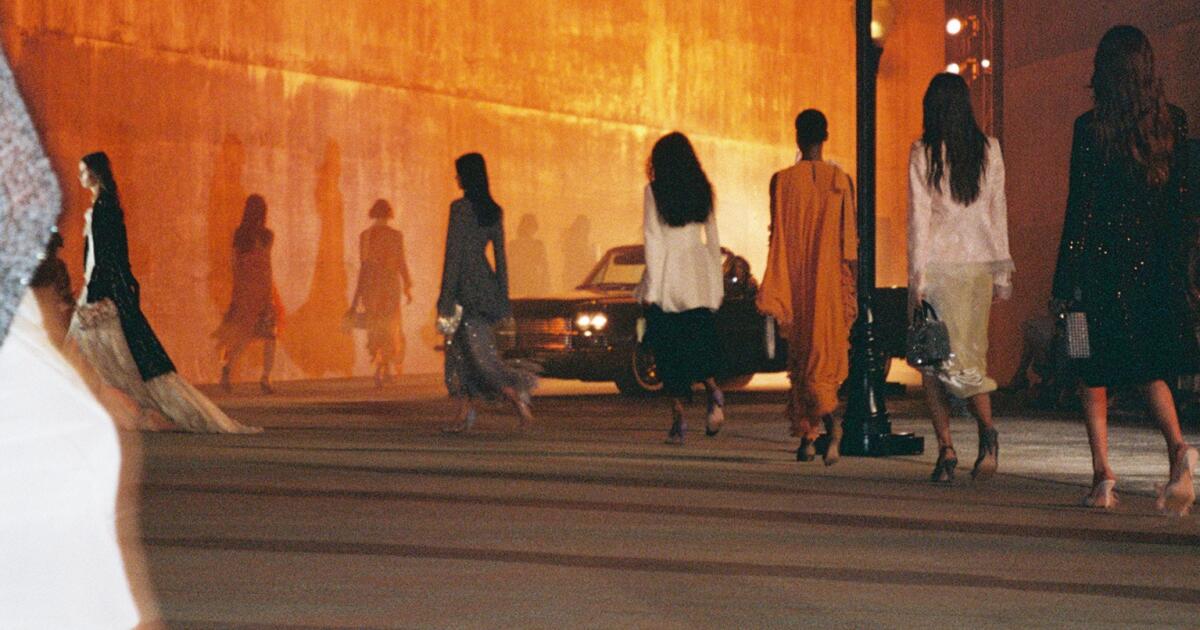

L.A. is proof that sometimes all you need is a car, a streetlamp and that orange light to make something really special happen. Jonathan Anderson presented his first Dior Cruise show in L.A. under the fluttering shadows cast by Peter Zumthor’s new Brutalist building at LACMA, and the whole thing felt like the equivalent of sending a text after hours of getting ready, buzzing with anticipation: “I’m OMW.”
At the base of the David Geffen Galleries, anchored by classic American cars in colors like bubblegum and butter, where models sat inside sucking lollipops and talking close, was “an illusion of L.A., in L.A.,” so say the show notes. The scene mirrored the energy of a film set, all drama and specific lighting and smoke billowing from mysterious corners, honoring the house’s relationship with cinema. The show notes also came in the form of a film script — titled “Wilshire Boulevard” — opening with the “No Dior, No Dietrich!” of it all and followed by Anderson’s thoughts on escapism and dreaming. Today’s Hollywood stars — Taylor Russell, Greta Lee, Anya Taylor-Joy, Alison Oliver, Jisoo, Maude Apatow, Jeff Goldblum, Sabrina Carpenter, to name a few — were in attendance.
The looks that walked down the runway also called upon the dream, soundtracked by a score that included blues icon John Lee Hooker and beloved French band Air. A new iteration of the Dior Saddle bag was car-inspired, sharing DNA with John Galliano’s 2001 Dior Cadillac bags, featuring car paint surfaces and motor key charms. There were the bespoke Philip Treacy hats that revisited a technique the milliner has honed for years, with feathers forming typography in words like “Buzz” and “Flow,” worn with some of the men’s looks. There was Anderson’s take on the bar jacket that Christian Dior made for Marlene Dietrich to wear in Alfred Hitchcock’s “Stage Fright,” white with a geometric black collar. A grey flannel coat was inspired by film noir, featuring a stripe detail that took inspiration from Venetian blinds. A red velvet dress with a rosette was Anderson’s way of playing with Christian Dior’s practice of putting a red dress partway through a show “simply to wake people up.”


As polished-glam and old-Hollywood as the references were, there were moments that also felt sleazy and fun in the way that Hollywood in 2007 did, when getting photographed pouring out of a car on the way into the club was a rite of passage and full of its own twisted promise. Denim was intentionally pilled and embroidered with fine silver chains in the rips, replacing frayed strands of cotton (“the everyday becomes couture,” the show notes say). Leather pants were worn with oversized rhinestone-rimmed sunglasses. A fuzzy coat in almost a wood grain-like pattern was worn slipshod over a shoulder with a black dress. Shirts were made in collaboration with L.A. artist Ed Ruscha, worn by models with messy long hair and hands in their pockets, sporting the kind of attitudinal walk that the skater boy-actor-model working at your local coffee shop has perfected. “When I think of L.A., I think of Ruscha’s work, which has a fascinating sense of the mundane and how it relates to the city’s grandeur,” Anderson wrote in the notes.
A resort collection is all about the destination, and in L.A. a destination can be the most quotidian, normal-ass place. For example, even the rarest piece in your closet is first experienced by your car, or your backyard, or the courtyard of a county museum. L.A. people get that the mundane is the destination because our version of mundane is anything but.


Cut to the afters at the Chateau Marmont. It was a blur of champagne, full sized In-N-Out cheeseburgers, chic ushers wearing Dior uniforms with snug grey sweaters and slacks that pooled perfectly at the leg. Oh, and also, a collective fear that someone would slip and fall into the gleaming turquoise pool (but isn’t that the intrusive thought that hangs over every Chateau party?). Faces like Teyana Taylor, Mikey Madison, Paul W. Downs, Role Model and Dominic Fike, all in Dior, were soaking in the ambiance.
As the night waned and we piled into big black SUVs with an emblematic “CD” on the windows that were there to take us home, one couldn’t help but call to mind a Hollywood trope, where in L.A., the journey was the destination all along.


Dior creative director Jonathan Anderson.

Taylor Russell and Mikey Madison.

Malcolm McRae and Anya Taylor-Joy.


Greta Lee and her parents.


Steven Yeun and Humberto Leon.


That spot did not go over well with many fliers, who voiced their disagreement on social media (it’s unclear that getting gussied up would solve the upset caused by delayed flights, increasingly tiny seats and other flying indignities). But it was merely a warm-up for the longer show, which has its debut next month on YouTube. This one features Duffy in a whole variety of dad outfits straight from the “Father Knows Best” closet of the American mind, with his family as supporting characters, down to their matching PJs.
There he is in the Oval Office, introducing his kids (and the show’s concept) to President Trump as white-collar dad in a Trumpian outfit of blue suit, white shirt and red-and-blue tie. There he is in snowy Montana, leading his gang on snowmobiles in coordinated snowsuits. In Philadelphia, he’s in a polo shirt and jeans, introducing his children to a role-playing Benjamin Franklin. He hangs out in a plaid shirt with Kid Rock, a scene that also features Duffy’s wife, Rachel Campos-Duffy, a Fox anchor, in an American flag sweater and matching American flag cowboy boots. (The two met on the reality show “Road Rules: All Stars.”) He wears a lot of shackets. And that’s just in the show’s four-minute promo.
In other words, this does not seem to be in the mode of the storied road trips of American pop-culture mythology, be they the grungy road trip of Peter Fonda and Jack Nicholson in “Easy Rider” or the existential one of Chloé Zhao’s Oscar winner “Nomadland.” It does not even seem to be modeled on the gaffe-filled comic road trip of the Griswold clan in “National Lampoon’s Vacation.”
It’s more like “Road Trip: The Suburban Nostalgia Version.” (See the cars, which include throwback station wagons redolent of “Leave It to Beaver” and a big, black Toyota SUV with Duffy, of course, in the driver’s seat.) It was conceived, presumably, to evoke the values — “wholesome,” “patriotic,” “joyful” — enumerated by Duffy in his post on X and meant to define the show and, by association, himself.
As such, it effectively brands him as the Everydad of the administration, complete with ur-weekend wardrobe. And when it finally airs next month, it may turn out to be less about actual reality (reality TV rarely is) than about heavily messaged reality. In other words: marketing for history.
-

 Kansas3 minutes ago
SW Kansas wildfires prompt evacuations, school closure, road closures
-

 Kentucky9 minutes ago
Former Kentucky education commissioner to leave California superintendent job
-

 Louisiana15 minutes ago
Oil donors cling to Cassidy in Louisiana primary
-

 Maine21 minutes ago
A Maine couple known for restoring cabins on TV is opening an inn of their own – The Boston Globe
-

 Maryland27 minutes ago
Prominent immigrant rights group endorses Ferguson to remain as Senate president
-

 Michigan33 minutes ago
Michigan State roster reset: All eyes on Jeremy Fears Jr.’s return
-

 Massachusetts39 minutes ago
Hacky sack is suddenly cool again – The Boston Globe
-

 Minnesota45 minutes ago
Support from DC for Michele Tafoya’s Senate run splits Minnesota GOP