Lifestyle
Gothic romance reaches new ‘Heights’ as fan communities collide


Of course now was the moment for a Charli xcx-assisted ‘Wuthering Heights’: Pop fandoms and literary ones have rarely had more in common
Charli xcx’s original soundtrack serves as a kind of secondary narrator for Emerald Fennell’s adaptation of Wuthering Heights. The film arrives in a landscape where the fan cultures of pop music and romance literature have already been intertwining in striking ways.
Paul Kooiker
hide caption
toggle caption
Paul Kooiker
This essay first appeared in the NPR Music newsletter. Sign up for early access to articles like this one, listening recommendations and more.
This past Valentine’s Day weekend, a common sight in the usual places where hand-holding pairs wander on afternoon dates broke the mold for conventional coupling: groups of young women celebrating the holiday in the spirit of both romance and friendship. They entered theaters bearing popcorn and tissues, ready for a group cry to Emerald Fennell’s florid cinematic update of Emily Brontë’s foundational anti-romance, Wuthering Heights. And in the romance-oriented bookstores increasingly popping up across America, they shopped together for spicy novels about hockey players coming to terms with their mutual attraction or dragon riders stealing kisses while saving their kingdoms. Someone running across a phalanx of these self-professed “book nerds” wouldn’t be wrong to sense a connection to 21st century pop music fandoms, the social networks supporting artists like Taylor Swift or Charli xcx. Bookstores with names like Slow Burn or Lovestruck sell bookmarks or other trinkets emblazoned with Swift lyrics alongside those with quotes from leading romantasy author Sarah J. Maas. One I recently visited in Nashville had heartthrob-themed votive candles for sale on the counter, featuring Wuthering Heights star Jacob Elordi, perennial internet’s boyfriend Pedro Pascal — and Bad Bunny. Pop icons can serve as ideal Male Main Characters alongside the usual movie stars.
Fennell understands how this decade’s resurgence of interest in literary love stories is connected to the phenomenon of music fans forming robust communities. Most pop hits are love stories, after all, and in the minds of romance readers, music plays behind each climactic kiss. In Wuthering Heights, with its Harlequin-cover imagery and a contemporary take on Brontë’s twisted, infernal view of erotic desire that turns it into 50 Shades of Victorian Fog, Fennell creates a setting that’s as much about today’s fashions and pop references as it is about the muck and intrigue of Brontë’s time. Doing so connects this Wuthering Heights with the bibliophile demographic that’s inseparably intertwined with the Swifties and Angels and other robust pop affinity groups that have redefined 21st century consumer culture. She even commissioned Charli xcx to write songs for the film, a challenge the inventor of Brat Summer eagerly accepted as a way to step aside from her club and drug era and into something more redolent of history and high art. Having closed the door on pop stardom temporarily with her pseudo-documentary film The Moment, the always experimental diva declared herself inspired by Velvet Underground violist and general art god John Cale’s description of his legendary former band’s music as “elegant and brutal,” a blend she hoped for on this new project. Her collaboration with Cale, the tone poem “House,” emulates Cale’s way of blending classical tropes with Leonard Cohen-like rock balladry. Its use in the grisly-sexy opening scene of Wuthering Heights sets the film’s mood as pure pop — grounded in pastiche and anachronisms, unconcerned with formal or historical accuracy, dedicated to bringing its story into the present moment.
YouTube
The album Wuthering Heights is a circuitous journey, really a series of approaches to the inner world of Catherine Earnshaw, an anti-heroine whom Charli clearly finds sympathetic if sometimes also pathetic. Fitting its role as both part of and companion to the film (all three singles from the album get screen time, though folk songs and a deliberately sentimental score by Fennell’s longtime collaborator Anthony Willis more openly advance the plot), it alternates fully formed singles with short set pieces that sonically answer the lushly creepy imagery Fennell favors. There is one banger, the Eurodisco redux “Dying For You,” which taps the dopamine vein in romantic suffering. The strings-driven pop of “Seeing Things” suggests what Charli’s former friend Taylor Swift might have done with this story, but most of the album is far murkier and more fatalistic than anything that usually makes today’s pop charts. It’s closer to Charli’s own formative hyperpop forays, and to the post-punk experiments that leaked into the mainstream back when Kate Bush, music’s eternally unrivaled Brontë interpreter, wrote her 1978 breakthrough fantasia named after the novel.
While nothing on Charli’s album reaches the great Kate’s apex of enthrallment and abandon, she does connect with the spirit of those days when new wave was new and arty girls and boys were making grand gestures, from Pat Benatar’s rock to the maudlin lyricism of synth-driven bands like Talk Talk. On the impeccable playlist that Charli assembled for Spotify with help from Fennell, dream pop originators Cocteau Twins sit next to David Lynch soundtracker Julee Cruise, original abject rocker Iggy Pop, cloud rapper Yung Lean and costume punks Shakespears Sister. The playlist’s motivation resembles that of Charli’s original music, and Fennell’s film: to yank the gothic out of any one period, be it the 19th century or the 1980s, and follow its dim light through all kinds of sonic passages.
While sticklers for historical accuracy have found much to criticize in Wuthering Heights — despite the stylized scare quotes reinforcing Fennell’s insistence that her Heathcliff and Cathy are constructed from her own reference points alone, debate has raged about everything from Heathcliff’s racial identity to whether this is a love story at all — it is, in fact, tailor-made for the blissfully recombinant world of current romance reading. Enter a bookstore with a spicy focus and you’ll discover myriad variations on what the critic Shawna Lipton called “the bodice-ripper rebrand,” from updates on all-American faves like cowboys and quarterbacks to “dark romance” set in libraries and castles, sci-fi crossovers, and explicit quests to figure out the anatomy of sex with monsters, fairies or werewolves. Music occasionally becomes the subject of these novels, with aspiring songwriters and bad-boy rockstars serving as main characters. But whether it’s a plot point or not, choosing music to read by and to flesh out further dreams about their favorite characters is a major aspect of romance readers’ leisure time.
While I waited for the release of Wuthering Heights, I grew curious about the intersection of reading and listening to music at a time when high romance has taken over far more than Emerald Fennell’s fancy. I cast my net for other playlists and discussions about music to read by. I found much more than I expected — and frankly, I expected a lot. While my own taste in genre fiction runs more to murder than romance or fantasy, I’m fascinated by the burgeoning subcultures keeping bookstores — and, arguably, publishing — alive through their avid pursuit of all things wild, dark and spicy. What I’ve learned in my limited research is that these intersecting communities of readers do much more to celebrate their affinities than drop reviews on Goodreads; for many, reading is the heart of a sparkling creative lifestyle. And music is a big part of the cozy bibliophile’s world.
Besides Charli’s official playlist, for example, dozens of user-generated Wuthering Heights playlists appear across streaming services, most of which predate the existence of Fennell’s film. Dozens more surface in a simple search for “reading” and “romance,” with titles like “Booktok songs that destroy me,” “POV: a vampire is in love with you” and “reading cute romance books at 1 a.m.” A whole subset of playlists is designed to soundtrack specific books or series. Attached to this playlist-making surge is the use of music on #BookTok, where certain songs and artists become deeply linked with the novels and series fans celebrate. Some musicians are learning to take advantage of this connection: the Irish singer-songwriter Dermot Kennedy, for example, is often cited on Reddit as a bibliophile favorite, and maintains an Instagram “book club” where fans can see what he’s got on his own bookshelf. Literary websites also often make playlists devoted to a particular genre or author, some historically accurate (Jane Austen playlists abound, focusing on the music of Regency England) while others are more like fan lists — which, like Charli’s album, range freely throughout genres and periods.
Among lovers of contemporary genre fiction, certain musical styles have gained favor. Progressive metal, for example, syncs up well for readers of stories about fairies and dragons. A Reddit thread tagged “Sleep Token + Romantasy = Perfection” has readers matching songs by that popular if critically unloved band to various MMC’s, or male main characters. Some participants in the thread went so far as to connect specific scenes with passages in Sleep Token songs, and vice versa. “I literally just requested a book rec where the relationship feels like 4:15 to 5:20 of ‘Emergence,’ ” one fan wrote, citing a particularly bombastic, drum-driven climax. Other frequently cited metal and adjacent bands include the Deftones and the symphonic Nightwish.
YouTube
The metalheads I know are uniformly bookish, so this alignment doesn’t surprise me — but if I’m being honest, nods go far more frequently to balladeers who fit the MMC mold, like Kennedy, Alex Warren and the lord of them all, Hozier. Playlists vary by genre according to who’s reading. Adjacent to romance are sci-fi authors like Nnedi Okorafor, whose followers bring an Afrofuturist sensibility to their playlisting, favoriting techno-savvy musicians like Sudan Archives. My NPR Music colleague Nikki Birch is a major fantasy fan, and she polled her friend group of BIPOC romance and fantasy fans for their picks. They listed a lot of classic R&B — Sade, Maxwell, Luther, Janet — alongside some jazz and contemporary classical artists like Tony Ann. There’s definitely a subset of bibliophiles who prefer instrumental music to read by, and a cohort of classical-lite composers and instrumentalists like Ann, Joel Sunny, Kelsey Woods and Taylor Ash have found success connecting with these listeners. Ash even has a lush, synth-driven song called “A Court of Thorns and Roses.”
Most often, readers sharing music through playlists and forums cite women as their musical inspiration. Florence Welch deserves special mention, not only because her Pre-Raphaelite persona predated the romantasy craze and probably helped feed it, but because she has written songs inspired by the works of Shakespeare, Virginia Woolf and Kazuo Ishiguro. (Florence’s fans made a book club in her honor, Between Two Books, focusing on her favorites but eventually expanding to include an array of contributors.) In the past year, a new rival has emerged for Florence’s crown among book lovers: Paris Paloma, whose fans attend her concerts wearing hodgepodge period garb and dance in “fairy rings” after each show. Paloma’s 2023 song “Labour” swept across social platforms as a rallying cry for Gen Z women discovering, and enraged by, the double standard of work in many heterosexual relationships. As Paloma put it, “All day, every day, therapist, mother, maid / Nymph, then a virgin, nurse, then a servant.”
Last year, Paloma released a short film celebrating her fans; as images of shouting, smiling young women turned toward each other fill the screen, the songwriter intones, “At every single show, every night, I’m reminded of the power we have in our community and solidarity with each other.” This feminist pronouncement recalls the way romance readers talk about their bonds. As with many pop worlds, this one does break down into identity clusters — most of Paloma’s fans are white, as is the public face of the cozy bibliophile craze. BIPOC writers and readers of romance and fantasy are claiming space in bookstores and online, however, and, as I noted above, making their own playlists. One interesting subset of musicians who frequently appear on romance readers’ lists consists of Black and brown artists whose music defies easy categorization. FKA twigs, Spellling and Doechii, all artists who entertain the fabulous within their music, show up on many playlists.
The most recent artist to enter this space is Hemlocke Springs — the performing alter ego of Isimeme “Naomi” Udu — whose rococo dance-pop has won a strong fanbase among bibliophiles. Her just-released debut album the apple tree under the sea includes “sever the blight,” a truly gothic account of erotic thrall that, unlike most attempts to glom on to her glory, captures the nervous magic of Kate Bush. With a Game of Thrones-meets-Guy Maddin video that fully locates its story in a non-white universe, recalling Doechii’s fever dreams, and lyrics that infuse the gothic with intersectional awareness (“You see, I’m not Snow White / The fairest of our land,” Udu sings, Heathcliffing it up), “sever the blight” takes pop romantasy in a promising new direction.
As Emerald Fennell certainly understands, romance novels restage women’s fight for independence within environments far more exciting than the offices and apartments where readers might be living through similar power dynamics. The theatrical pop songs of artists like Paris Paloma and Hemlocke Springs do the same, adding a supernatural kick to the often frustrating struggles of women’s daily lives. Emily Brontë showed her genius for confronting the tangle of gender, class and racial hierarchies within a classic ghost story when she wrote Wuthering Heights; no matter how campy or sexy or pastiche-y a contemporary reinterpreter renders her tale, that mess, which we as humans are perennially trying and failing to clean up, lies at the heart of it.
Romance novels both acknowledge this human predicament and allow for some escape from it. Fantasy takes readers to another plane. Wuthering Heights, as an historical text with supernatural elements, addresses real inequities and oppression within a heightened framework. The dislocated music Charli xcx brings to Fennell’s version of the tale further destabilizes a story that has rattled readers for two centuries. But even in a far more comprehensible romance, the sensory immediacy of music can evoke and intensify an emotional shift in ways that up the stakes both within a story and beyond it. Bibliophiles creating needle drops to soundtrack their reading experiences subtly change the meanings of both the books and the songs they bring together.
This can happen in other media, too: Just consider Heated Rivalry, the homoerotic hockey drama that was also pulled from the bookshelf, and which has become streaming culture’s latest major thirst trap. That show’s revival of the 20-year-old Wolf Parade song “I’ll Believe in Anything” is a perfect instance of a needle drop enhancing high romance; playing behind a cathartic embrace that changes its main characters’ lives, the song conveys the queasy interplay of urgency and fear that Charli xcx captures differently in her Wuthering Heights songs. “Give me your eyes, I need sunshine,” sings Wolf Parade’s Spencer Krug, “your blood, your bones, your voice and your ghost.” What was it that Heathcliff said? “Haunt me, then!” Call it love or desperation — desire can feel this way. Like a chorus that doesn’t fade.
YouTube

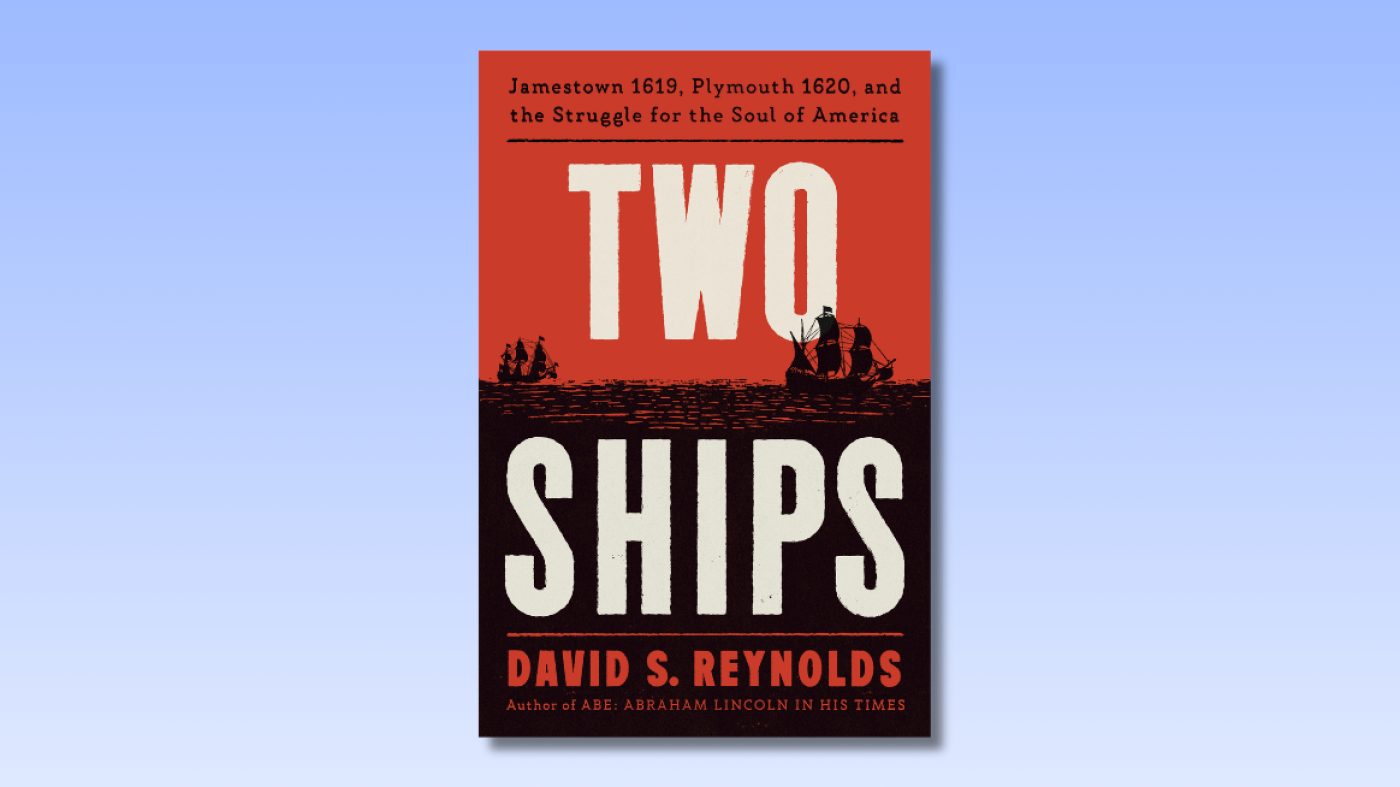
Just in time for a contentious 250th anniversary of the United States of America, historian David S. Reynolds’ latest book, Two Ships, helps us realize that any country that couldn’t agree on its own origin story is destined for divisive times.
Two Ships is about the complicated, conjoined legacy of the landings of the Mayflower, which carried the Pilgrims to Plymouth, Mass., in 1620, and the White Lion, which arrived in Jamestown a year earlier, bringing the first enslaved Africans to Virginia.
As Reynolds demonstrates, it’s not so much the facts of these two voyages, as it is the meanings ascribed to them, that made them such a powerful metaphor for two conflicting visions of American identity.
To simplify, the Mayflower’s passengers were separatist Puritans, dissenters to the reign of the English king, James I. As the United States developed, the Mayflower was credited with carrying the seeds of a radical democracy to the New World, one in which all men (in theory, at least) were equal before God.
In contrast, the European settlers of Jamestown were Royalists, also known as Cavaliers. Loyal to the monarchy, they believed in a strict hierarchy.

But the meaning of the images of the two ships shifted depended on who was invoking them and when. Not surprisingly, the metaphor was deployed most vigorously during the Civil War. In abolitionist speeches and writings, the White Lion or the “Slave-Ship,” as it was commonly called, was condemned for infecting America with the “plague-spot” of slavery.
Reynolds says that Frederick Douglass resorted to the “two ships” metaphor frequently, while Lincoln avoided it, hoping to preserve a unified ship of state. Meanwhile, Southern descendants of Cavaliers invoked the Mayflower to emphasize the intolerance and “cruel, persecuting” character of the Puritans. In a comment that resonates for our own times, Reynolds says:
It didn’t matter to the South that … by the mid-nineteenth century, the North had become a kaleidoscope of religious denominations, …, few of which resembled the faith of the Plymouth colonists. Distortion is intrinsic to cultural memory, especially when amplified by sectional or political bias. For Southerners, the Mayflower had brought Puritanism, which had yielded fanatical movements like abolitionism, now a dire threat to the Union.
In a brief-but-fascinating digression into the unpredictable power of literary fiction, Reynolds observes that the South’s fondness for Nathaniel Hawthorne’s anti-Puritan novel, The Scarlet Letter, and, even more, for the medieval historical romances of Sir Walter Scott, bolstered its nostalgia for a largely-imagined feudal society.

Reynolds quotes the always-quotable Mark Twain, no fan of Scott’s, as saying that Scott “did measureless harm; more real and lasting harm, perhaps, than any other individual that ever wrote …”
Two Ships is a dazzling survey of some three centuries of American history through a close reading of a metaphor. By the 1890s, Reynolds says, the interpretive tide had turned again: “Southern and Northern whites, feeling threatened by people of color and by an array of European immigrants, were retreating to a cocoon of racial solidarity that Mayflower celebrations helped reinforce.”
By the later-20th century, the image of the Mayflower was depoliticized and commercialized into Pilgrim hats and Black Friday sales. The powerful metaphor of the two ships receded into the mist.
Seven years ago, however, the 1619 Project piloted the White Lion — “The Slave-Ship” — back into view and anchored it at the center of debates about slavery’s place in the national story. The 1619 Project has been faulted for its historiography, and it does lie outside of the chronological boundaries of Reynolds’ book; still, it seems too momentous a reappearance of the White Lion not to at least acknowledge in this book.
That criticism noted, I think reading Two Ships would be an excellent way to observe this particular Fourth of July. It’s wise for all of us to have a more informed awareness of how Americans have understood, misunderstood and, often, flattened each other into stereotypes. Or, as Ernest Hemingway, one of the Mayflower Pilgrims’ more cynical descendants, might say in response to that sentiment: “Isn’t it pretty to think so?”



I took a kid’s camera to Paris Fashion Week, because was it ever really that serious? Yes and no. This men’s season happened during one of the hottest weeks in France’s recorded history, which inspired that specific brand of collective hysteria brought on by living through yet another unprecedented moment together — taking over our brains and ruining our plans to wear boots — and a grander reflection on what we were doing there and why. The throngs of teenagers doing back flips into the Canal Saint-Martin and playing soccer in the street set the mood for the week. If the world is ending, you might as well swim in dirty water and have fun doing it, no?
As far as the shows went, there was the coastal stoner energy of Tokyo-based Auralee — brightly colored leathers and furry flip-flops — that reminded me of the low-key elegance of hanging out in Southern California. At the Rick Owens show, Rick-heads made minimal weather-restrictive tweaks to their usual uniforms — platforms, leather, ground-grazing garments — making you appreciate the beauty in that level of ascetic dedication. Louis Vuitton built a literal beach as its runway, complete with sand and a giant wave that felt like a mirage: Is this a heat-induced hallucination or yet another buzzed-about set design under men’s creative director Pharrell Williams? At the Dries Van Noten show, there was an ice-cold beer fridge and popsicles, a chic and inspired detail only rivaled by a collection that was a breath of fresh air during a week where I Googled the symptoms of heat stroke more than once. The Willy Chavarria show was air-conditioned, pumped with Xinú perfume and felt expensive. Sven Marquardt, a Berlin photographer and Berghain’s most famous bouncer, was sitting in front of me, which I took as an incredibly good omen. The painted blue feet and Oakley collab sunglasses at the Kiko Kostadinov show felt auspicious as well.

A look from the Auralee show.
There were conversations floating around about how apocalyptic it felt sitting at a fashion show in over 100-degree Fahrenheit weather, our backs soaked, our minds dizzied, when the industry is responsible for something like 10% of global greenhouse gas emissions. The cognitive dissonance contributed to the thickness in the air that week.
At the Comme des Garçons show, called “If the War Were to End..,” models danced and ran and skipped out onto the runway for the finale, soundtracked by the joyous sound of children singing “You’re So Good to Me” by the Langley Schools Music Project. In that moment, we were happy, we were clapping, we might have even been hopeful. Humans have the capacity to hold a lot — a fan in one hand while attempting not to completely melt in the front row, and a fantasy that there might still be a future where we get to wear those leopard-print Dries shoes we fell in love with on the runway.

The moments before the Comme des Garçons show.

Comme des Garçons show attendees.

Comme des Garçons, head-to-toe.

The Comme des Garçons show.

The Dries Van Noten show.

A chic and inspired detail at the Dries Van Noten show: ice-cold beer.


Scenes from the ERL presentation.


The Kiko Kostadinov show.


Tapping in from Louis Vuitton beach.

Quavo at the Louis Vuitton show.

Scenes from after the Louis Vuitton show.

Scenes from the Louis Vuitton show.

Scenes from the Nahmias x Puma dinner at Gigi Paris.

Scenes from the On X Online Ceramics rave.


At Silencio to see Venezuelan DJ and producer Safety Trance.

The Willy Chavarria show.

Scenes from Willy Chavarria.

The throngs of teenagers doing back flips into the Canal Saint-Martin and playing soccer in the street set the mood for the week.

Taylor Swift and Travis Kelce of the Kansas City Chiefs, pictured at a basketball game in May, announced their engagement in August 2025.
Gregory Shamus/Getty Images
hide caption
toggle caption
Gregory Shamus/Getty Images
NEW YORK — Taylor Swift and Travis Kelce are officially married.
After three years of dating, The pop icon and Super Bowl-winning football player, both 36, tied the knot in New York, according to a statement from Swift’s publicist, Tree Paine.
There were neither bridesmaids nor groomsmen. “Instead, her brother Austin Swift served as Taylor’s Man of Honor and Jason Kelce was Travis’ Best Man. The ceremony joined both families together,” Swift’s publicist said in the statement released Friday evening.
The ceremony was officiated by comedian and a friend of the couple, Adam Sandler, the statement added.
The singer’s rep said that the couple was dressed in Christian Dior Haute Couture.
“The bride and groom’s wedding ceremony looks have been created by Christian Dior Haute Couture. They are designed by Jonathan Anderson, Creative Director of Dior Women’s, Men’s and Haute Couture Collections, in close collaboration with the Bride and Groom,” the statement said. “This is the designer’s first couture wedding dress for a world-renowned celebrity. Their shoes were custom made by Christian Louboutin and the bride wore Cartier jewelry.”
Security around the event was intense, so it remains unclear if the wedding was charming, if a little gauche. But the night before the ceremony the 20,000-person stadium was bathed in a lavender haze.
Details gleaned from a city permit obtained by The Associated Press, showed details of a “special event at MSG” scheduled to begin Friday evening and running overnight Saturday.
As speculation built, fans began gathering in front of the stadium ahead of the expected wedding, despite the couple’s efforts to keep details of the celebration under wraps.
Superfans and sleuths appeared to have their hunches confirmed on Friday, as dozens of black cars dropped off elegantly dressed guests outside of Madison Square Garden in New York City.
Lisa Benham and her daughter, Zara, posed for selfies outside the Garden. They’re visiting from England and both told NPR they’re huge Swifties.
“I just remember always listening to her,” said Zara Benham, age 17. The women said they’ve followed all the ins and outs of Swift’s romance with Travis Kelce, a tight end with the Kansas City chiefs.
“I’m thrilled for her. I love it. I love the whole story,” gushed Lisa Benham, 47, who says she became a fan after her daughter dragged her to a Swift concert. “I’m pleased for them, really pleased for them.”

A woman wearing a white veil stands outside Madison Square Garden in New York City on July 3, 2026. Taylor Swift and Travis Kelce’s official wedding plans are tightly under wraps, but New York is bracing to host the celebrity marriage of the year.
CHARLY TRIBALLEAU/AFP
hide caption
toggle caption
CHARLY TRIBALLEAU/AFP
Swift has a massive global platform, and a tendency to pull back the curtain on her personal life in song lyrics and the occasional documentary. But the shared little about her wedding plans since she and Kelce announced their engagement last August.
“You would think that I had been the type of person who would have obsessed over the idea of a wedding my whole life, but I actually never thought about what I would ever do or what I would want until I met the person,” Swift told the U.K.’s Heart Radio in October, while promoting her last album The Life of a Showgirl.

In the months since, speculation mounted over where and when the wedding would take place. In recent weeks, the theories all pointed in the same direction: New York City’s Madison Square Garden on July Fourth weekend.
Swift loves a good Easter egg, and her fans have been known to crack at least some of them successfully. That appears to have been the case with her wedding, even as some wondered for days whether it was merely a high-profile ruse.

Swift and Kelce celebrate the Kansas City Chiefs’ Super Bowl victory in Feb. 2024.
John Locher/AP
hide caption
toggle caption
John Locher/AP
A recap of their romance
Swift and Kelce began dating in the summer of 2023, during the first year of her record-breaking Eras Tour.
The Kansas City Chiefs tight end admitted on a July 2023 episode of New Heights — the podcast he co-hosts with his brother, retired NFL player Jason Kelce — that he had tried to meet Swift after one of her shows in the area.

“I was a little butt-hurt I didn’t get to hand her one of the [friendship] bracelets I made for her,” Kelce said. “I wanted to give Taylor Swift one with my number on it.”
Swift later told Time she thought that call-out was “metal as hell.”
Within months, she was attending his games — most famously, the 2024 Super Bowl his team went on to win. He was spotted in the crowd — and even onstage — at many of her shows the next year.
Fans got a peek into their chemistry when Swift appeared on New Heights last August to announce her 12th studio album, The Life of a Showgirl (which she said was heavily influenced by their relationship). She said she and Kelce bonded in part over similarities in their careers, in which they both “entertain people for three-plus hours in NFL stadiums.”
Less than two weeks later, Swift announced their engagement on Instagram, with photos of a flower-filled backyard proposal and a massive diamond ring. In an episode of The Graham Norton Show a few months later, Swift deflected questions about her wedding planning but joked about inviting “anyone I’ve ever talked to.”
Sleuths had been eyeing Madison Square Garden
Speculation about a July 3rd wedding at MSG reached new heights this month.
Part of that was through the process of elimination: Swifties descended on Watch Hill, R.I. — where Swift owns a seaside estate — on June 13, but tabloid reports of a ceremony there proved unfounded.
But there also seemed to be a paper trail leading to Manhattan.
New York City Mayor Zohran Mamdani seemed to drop a hint while talking to reporters in June.
“We are used to big events, and we are incredibly excited for this one,” Mamdani said, referring to the World Cup. “We know it coincides with the Knicks Finals run. We know it coincides with July Fourth, America 250, Taylor Swift’s wedding all happening at the same time.”

Forklifts and trucks were spotted outside Madison Square Garden in New York on Tuesday, as speculation about a weekend wedding grew.
Leonardo Munoz/AFP via Getty Images
hide caption
toggle caption
Leonardo Munoz/AFP via Getty Images
Then, The New York Times reported that an event company obtained permits for a gathering of up to 1,000 people at Madison Square Garden on July 3rd (and a smaller event the day before). It also cited unnamed sources with details about plans for street closures in the area, later confirmed by City Hall spokesperson Dora Pekec to Reuters.
CBS News shared video this week of trucks unloading “garden party” themed equipment outside the venue earlier this week. And the venue’s online event calendar is suspiciously empty until July 7.
Mamdani appeared to double down Tuesday, while speaking to reporters about the forthcoming heat wave.
“My recommendation to all New Yorkers is to stay inside and stay cool, and if you happen to be getting married at Madison Square Garden you will be staying inside and staying cool, and I think it’s a good example to set for the city at large,” he said with a smile.
This isn’t the first celebrity wedding celebration to take place at MSG. Sly Stone married actress Kathy Silva there in June 1974. As Stone wrote in his memoir, he was talking to his A&R liaison at Epic Records, Stephen Paley, about wanting to marry Silva, and one of them jokingly suggested he do so before an upcoming show.
“I could do a gig, get paid, and get married at the same time. ‘Go, go, go,’ I told him. He went and went fast,” Stone wrote, adding, “Steve wanted everyone to wear gold to keep the shine high.”
According to a New York Times report at the time, the two married in front of nearly 23,000 people, at a ceremony that turned into a full-fledged Sly and the Family Stone concert.

A closer look at Swift’s engagement ring from the 55th Annual Songwriters Hall of Fame Induction and Awards Gala in New York last month.
Kena Betancur/AFP via Getty Images
hide caption
toggle caption
Kena Betancur/AFP via Getty Images
Why New York, and why now?
Madison Square Garden, which can hold nearly 20,000 people, may seem like a surprising choice for a singer who prizes her privacy.
But Emma Fitzsimmons, one of the New York Times reporters covering the wedding, told NPR last week that it makes sense for privacy and security reasons.
“It’s sort of this locked box where paparazzi can’t get inside,” she said. “There’s not going to be helicopters overhead. She can release photos of the event and her dress, which we’re all very curious to see, on her own terms.”
Swift, who owns a sprawling Tribeca compound, is famously a fan of New York City. She even has a song about it: “Welcome To New York,” on the album 1989, inspired by her relocation to the city.

And she has a well-documented love of Fourth of July. Over the years, many photos have emerged — some on Swift’s own Instagram — of the star celebrating the holiday weekend in Rhode Island with friends and fireworks.
And it’s not lost on Swifties that she met Kelce shortly after the holiday in 2023, which she celebrated with girlfriends and shared photos of on Instagram.
“Happy belated Independence Day from your local neighborhood independent girlies,” she captioned the photo. “See you tonight Kansas Cityyy.”
-

 World6 minutes ago
80 vials of fentanyl stolen from Rome hospital
-

 News36 minutes ago
Crowds ordered to evacuate National Mall area as stormy weather slams DC
-

 Los Angeles, Ca2 hours ago
Motorcyclist struck, killed by driver making U-turn in L.A. neighborhood
-

 Detroit, MI2 hours ago
GameThread: Detroit Tigers vs. Texas Rangers, 4:05 p.m.
-

 San Francisco, CA2 hours ago
Why Vogue World Should Definitely Head to San Francisco Next
-

 Dallas, TX2 hours ago
Mistake avoided? Cowboys FA signing could’ve been drafted… but fate
-

 Miami, FL3 hours ago
No Room For LB Ronnie Harrison In Miami?
-

 Boston, MA3 hours ago
Celtics’ Jaylen Brown trade leaves Boston fans, community feeling bankrupt: ‘A huge void’

