Lifestyle
Expert on dictators warns: Don't lose hope — that's what they want


Russian President Vladimir Putin and Chinese President Xi Jinping shake hands during a meeting in Beijing on Oct. 18, 2023.
Sergei Guneyev/AFP via Getty Images
hide caption
toggle caption
Sergei Guneyev/AFP via Getty Images
When we think of dictators, often the image that comes to mind is of a lone strongman, whose main concern is holding power within his own borders. But Pulitzer Prize-winning journalist Anne Applebaum says today’s dictators are actually working together in a global fight to dismantle democracy.
In her new book, Autocracy, Inc.: The Dictators Who Want to Run the World, Applebaum describes a “network of convenience” that exists among various autocratic states, including Russia, China, North Korea, Turkey, Hungary and Venezuela among others.
“There isn’t a secret room like in a James Bond movie where all the leaders meet; it’s not like that,” she says. “It’s like a big corporation that has different companies, and each company does its own thing, but they have loose ties, and they cooperate when it’s convenient.”
Applebaum says alliances among the global autocracy center on issues of military influence, kleptocracy and defeating democracy — and she sees a link between former President Donald Trump these concerns.

“Simply being someone who’s interested in using foreign policy to make money for oneself. I mean, that already makes Trump similar to a lot of Central Asian leaders or Africans, not to mention Putin,” she says.
Looking forward, Applebaum says she hopes her book helps re-engage people who may have become cynical by the political process. “What the autocrats — whether they’re in American politics or in Russian politics or in Chinese politics — what they want is for you to be disengaged. They want you to drop out,” she says. “I want people to be convinced that ideas matter, that we’re going to have to defend and protect our political system if we want to keep it.”

Autocracy, Inc.
Penguin Random House/Penguin Random House
hide caption
toggle caption
Penguin Random House/Penguin Random House
Interview highlights
On how the Russian war in Ukraine is a war between autocracy and democratic world
In the last few years, [Putin] had begun talking about the end of the democratic world or the end of Democratic dominance. … The war was an attempt to show that he doesn’t care anymore about the world that was created in 1945. He doesn’t care about the UN charter. He doesn’t care about UN documents and organizations that use the language of human rights. He doesn’t care about the so-called unspoken rule or unwritten rule that we don’t change borders in Europe by force. … He’s going to show that NATO is powerless, that it’s a paper tiger, and that none of the international institutions can control him because he stands for a new order and a new future. And he has used that language. And his foreign minister, Sergey Lavrov, specifically said this war is about a new world order.
On how Putin set the example for leaders to use money to gain power
In my view, the rise of these new forms of autocracy were made possible by the nature of modern financial transactions. If you look closely at the rise of Putin … he began essentially by stealing money. He stole money from the city of St. Petersburg. He took it out of the country. He laundered it through Western institutions, brought it back in, and he and others, mostly in the former KGB who were doing this, eventually enrich themselves. And they enrich themselves using Western partners, Western companies, connections to the Frankfurt Stock Exchange.

They were enabled in this process by Western financial institutions — German, European, American. And, first of all, that gave them a certain cynicism about the Western world. So, “OK, you guys talk about democracy and transparency, but you’re perfectly willing to help us steal.” … You can see modern dictators also beginning to learn this, also beginning to understand they can use tax havens or they can filter their money through Western banks so that there are different ways of stealing and hiding money. And it’s become something that people imitate really around the world.
On what she calls “information laundering”
I should start by saying that the autocratic world takes ideas very seriously and takes information seriously, and thinks a lot about how to get their message not just to us, but to Africa, to Latin America, to other countries around the world. They invest in it heavily. The Chinese have invested in a huge network of television and radio and website and newspaper and other forms of broadcasting in Africa, in Latin America, in Asia and elsewhere. They have content-sharing agreements with different newspapers around the world. Their wire service, Xinhua, is very cheap and easy to get hold of, very often cheaper than AP or Reuters. And they also think about how they can get information to people, in a way that they accept.

They have an idea that you want information to seem native, that it will seem local. And so they would rather have an African newspaper write something positive about China or write something negative about America, rather than it coming from a Chinese source. And the Russians in particular, have enthusiastically run with that idea. And they have also begun pretty systematically to create websites, newspapers and other forms of media that look like they are Ecuadorian or Peruvian or they’re in Arabic, or they’re in French. … And they look native. They’re using local languages, but they rely on, as I said, on Russian narratives and especially on these authoritarian narratives about how about the degeneracy and decline of America in the West, about the superiority of autocratic states.
On an autocratic strategy that relies on lies to control the political narrative
Trump began his presidency with a lie about how many people had appeared on the National Mall for his inauguration. … It was a very stupid lie. I mean, who cares how many people were in the National Mall? But he wanted the U.S. Park Service to lie about it, and he wanted his press spokesman to lie about it. And again, that was partly to show who’s in control here? I’m in control, and I get to decide what the truth is. And it’s also to confuse people and alienate them from politics. I mean, during the Trump administration, we spent a lot of time arguing about what was true and what wasn’t. …
Constant lies also create this kind of cynicism and apathy. It’s a way of keeping people out of politics and preventing civic engagement. I mean, a lot of these authoritarian states know that … [the] biggest threat to their power is their own people. And so their goal is to prevent people from ever organizing, from ever being engaged, from ever caring at all. And one of the ways they do that is through this constant stream of lies that make people feel like they’re simply unable to know anymore what’s true and what’s not.
On how political arguments went from policy to culture wars
The way we did politics even 10 years ago, which was we argued about real things. Right? We argued about health care. We argued about infrastructure investment. … So that was the stuff that politics was supposed to be about once. Politics isn’t about that anymore. Once it’s about existential questions and identity, and once it’s only culture wars which are easily exaggerated …. then you’re in the realm where it’s much easier for demagogues and for people who are good at evoking and creating emotion to win arguments. And I think it just took a long time for the opposition forces to understand how this works.
Sam Briger and Joel Wolfram produced and edited this interview for broadcast. Bridget Bentz and Molly Seavy-Nesper adapted it for the web.



Milly Alcock in Supergirl.
Warner Bros. Pictures
hide caption
toggle caption
Warner Bros. Pictures
Hollywood’s newest Supergirl is kind of a dirtbag — in the good way. Fearless and grumpy, Supergirl (Milly Alcock) sets out on a quest to support a new pal’s revenge journey and to make a point that should be clear by now: Never mess with a lady’s dog. Also featuring David Corenswet and Jason Momoa, is Supergirl a worthy follow up to Superman?
If you want more DC superhero action, check out these episodes:
‘Superman’ takes off and nails the landing
‘The Batman’ puts the emo in emote
Connect with Pop Culture Happy Hour:
Letterboxd / Facebook
Our weekly newsletter
Support Pop Culture Happy Hour+
Lifestyle
L.A. Affairs: After decades of near-misses, I finally told him: ‘I’m not leaving here without you’

It didn’t take endless quarantining with my spouse during the COVID-19 pandemic to end my marriage of over two decades. By the summer of 2019, menopause — and the extra-added “bonus” of frontal fibrosing alopecia that it awakened — was pummeling me physically and mentally to the extent that I no longer had the capacity to function inside the dysfunction of my life.
The relief that came with the decision to finally let go was completely dwarfed by the immense pain of severing a family in two. I cried as I packed. I cried as I unpacked. I was rolling endlessly in a dark wave that would not stop; my feet could not tell sand from sky. Once I managed to break the surface, I reached out.
I called Tish, Diane and Michelle, three smart, strong, nurturing women who’d been through and survived divorce. I also called my brother, Dan, and my friends Doug and Steve, three kind, creative, funny men who always “got” me.
As for Steve, we met in the spring of 1984 when he auditioned to be the drummer for the Secrets, the band Dan, Doug and I had started the year before. In our small-town high school of fewer than 400 students, he had flown completely under my radar, as he was two years younger, and he joined marching band the year after I’d ditched my baritone horn for a microphone and Pat Benatar tights. Steve aced the audition, and the four of us clicked immediately over our shared love of the Pretenders and all things Monty Python. By mid-June, the Secrets were playing local bars and biker parties in the middle of nowhere, and I was head over heels in love with the drummer.
It wasn’t supposed to happen like that. I wasn’t supposed to fall in love with a boy from my hometown.
I had spent my whole life dying to get out of Middlebourne, W.Va., and had been champing at the bit to leave for college, but by late August, that no longer meant freedom; it meant that I’d have to leave Steve behind. I told myself we’d defy the odds and make it work. He was my soul mate. But we were just kids, and there was no internet, no cellphones with unlimited text and calling. By February 1985, the divide was too great. In a moment of loneliness, I cheated on him. It was over, and I was firmly told to take my place in the friend zone.
I spent the following year flailing and failing in college before making the bold, half-baked decision to drop out of the West Virginia University theater program and move to Los Angeles, a place I’d never been, to pursue a singing career. When Steve found out that I was moving across the country, he softened his friend-zone stance and told me he loved me. On July 13, 1986, he went with my parents to Pittsburgh International Airport to see me off.
For the next 33 years, we would come together and drift apart — sometimes as lovers but mostly as friends. During a visit to my Hollywood apartment in 1988, when he was still in college and the timing was still wrong, I told him, “Who knows. Maybe in 30 years, I’ll come back and get you.”
In November 2019, Steve came to visit me for a long weekend.
I picked him up at Los Angeles International Airport and took him straight to Zuma Beach for a picnic, where we watched dolphins jumping in the waves while the seagulls stole our potato chips. The following day, we cozied up for an afternoon of wine and cheese at Cornell Wine Co. in Old Agoura, then made our way over Topanga Canyon for dinner at Canyon Bistro & Wine Bar.
The night before he flew home, we watched the sun set from our table by the lake at Zin Bistro Americana in Westlake Village. I felt giddy, excited, seen, understood and appreciated in a way I hadn’t felt in a very long time. While it was tempting to jump right in with both feet, we decided to date long distance and take things slowly.
On March 26, 2020, while Steve was still recovering from being profoundly ill with COVID, I arrived at his doorstep at 6 a.m. and proclaimed, “I’m not leaving here without you.”
Two weeks later, after packing most of his belongings into U-Haul shipping crates, we left Parkersburg, W.Va., in Steve’s red Volkswagen Golf with two suitcases, one Treeing Walker Coonhound and one Aussie/Chow mix. I-40 West was practically empty; just us and the occasional car or Amazon truck.
We arrived in California on Easter Sunday and joined the rest of the world in quarantine, not knowing how it would affect our work and financial future. We took a lot of long walks to help deal with the stress of the not knowing, but the magic panacea for me came the day Steve’s Harley-Davidson arrived in one of the crates.
We cruised up and down PCH, and roared our way up and over Mulholland Highway, Stunt Road, Malibu Canyon and Decker Canyon, stopping along the way to stretch our legs, feel the sea spray on our faces and take in views from the valleys to the coastline. We were surrounded by so much beauty; it was almost impossible to let trepidation win.
On one particularly memorable ride on Mulholland Highway between Kanan Road and SR 23 near Saddle Rock, we came around a bend and — bam! — right in front of me was the greenest mountain range I’d ever seen in California, gleaming spectacularly in the sunlight. As I inhaled its gorgeousness and exhaled my stress, I thought, “I can’t believe I get to see this. I can’t believe I get to do this. I can’t believe I get to be with Steve.”
In September 2024, I got to marry Steve.
As my brother, Dan, said at the reception, “What a long, strange trip it’s been.”
The author lives in the suburbs of Los Angeles with her husband, Steve, and their dogs, Coco Puff and Kira.
L.A. Affairs chronicles the search for romantic love in all its glorious expressions in the L.A. area, and we want to hear your true story. We pay $400 for a published essay. Email LAAffairs@latimes.com. You can find submission guidelines here. You can find past columns here.
-

 Lifestyle3 minutes ago
Swatch Seeks Damages From Samsung Over Trademark Infringement, Ft Reports
-
 Politics10 minutes ago
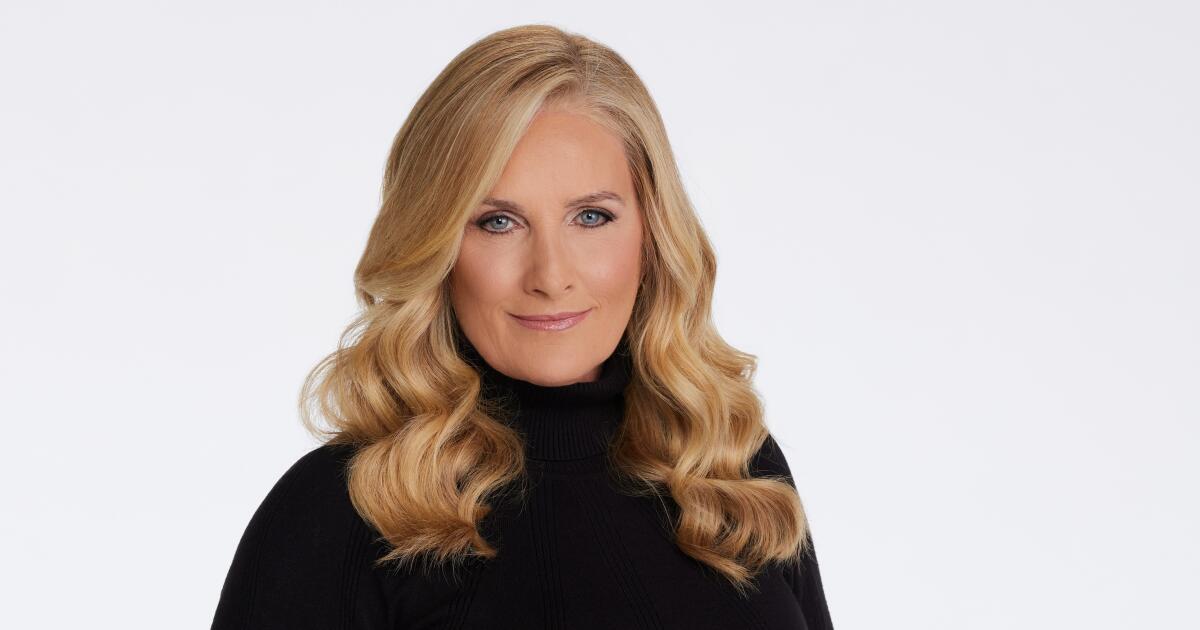
MS NOW anchor Alex Witt to exit as network reduces live weekend programming
-
 Sports18 minutes ago
Parents of ex-NFL player Doug Martin allege excessive force by Oakland police in wrongful death suit
-

 World28 minutes ago
Burkina Faso cuts diplomatic ties with former colonial ruler France
-
 News55 minutes ago
A day after Alito’s testy response to Sotomayor’s dissent, court says it was a ‘misunderstanding’
-

 Los Angeles, Ca2 hours ago
Watch Project Angel Food's 'Lead with Love' telethon on KTLA
-

 Detroit, MI3 hours ago
Metro Detroit weather forecast, June 26, 2026 — 4 p.m. Update
-

 San Francisco, CA3 hours ago
Newlyweds celebrate Pride-themed weddings inside SF City Hall as parade preparations underway

