Lifestyle
DTLA has a new theater — inside a fake electrical box


By day, you’d be forgiven for walking past the newest theater in downtown L.A.
It isn’t hidden in an alley or obscured via a nameless door. No, this performance space is essentially a theater in disguise, as it’s designed to look like an electrical box — a fabrication so real that when artist S.C. Mero was installing it in the Arts District, police stopped her, concerned she was ripping out its copper wire. (There is no copper wire inside this wooden nook.)
Open the door to the theater, and discover a place of urban enchantment, where a red velvet door and crimson wallpaper beckon guests to come closer and sit inside. That is, if they can fit.
With a mirror on its side and a clock in its back, Mero’s creation, about 6 feet tall and 3 feet deep yet smaller on its interior, looks something akin to an intimate, private boudoir — the sort of dressing room that wouldn’t be out of place in one of Broadway’s historic downtown theaters. That’s by design, says Mero, who cites the ornately romanticized vibe and color palette of the Los Angeles Theatre as prime inspiration. Mero, a longtime street artist whose guerrilla art regularly dots the downtown landscape, likes to inject whimsy into her work: a drainage pipe that gives birth, a ball pit for rats or the transformation of a dilapidated building into a “castle.” But there’s just as often some hidden social commentary.
With her Electrical Box Theatre, situated across from the historic American Hotel and sausage restaurant and bar Wurstküche, Mero set out to create an impromptu performance space for the sort of experimental artists who no longer have an outlet in downtown’s galleries or more refined stages. The American Hotel, for instance, subject of 2018 documentary “Tales of the American” and once home to the anything-goes punk rock ethos of Al’s Bar, still stands, but it isn’t lost on Mero that most of the neighborhood’s artist platforms today are softer around the edges.
Ethan Marks inside S.C. Mero’s theater inside a fake electrical box. The guerrilla art piece is near the American Hotel.
(Kayla Bartkowski / Los Angeles Times)
“A lot of galleries are for what can sell,” Mero says. “Usually that’s paintings and wall art.”
She dreamed, however, of an anti-establishment place that could feel inviting and erase boundaries between audience and perfomer. “People may be intimidated to get up on a stage or at a coffee shop, but here it’s right on street level.”
It’s already working as intended, says Mero. I visited the box early last week when Mero invited a pair of experimental musicians to perform. Shortly after trumpeter Ethan Marks took to the sidewalk, one of the American Hotel’s current residents leaned out his window and began vocally and jovially mimicking the fragmented and angular notes coming from the instrument. In this moment, “the box,” as Mero casually refers to it, became a true communal stage, a participatory call-and-response pulpit for the neighborhood.

Clown Lars Adams, 38, peers out of S.C. Mero’s theater inside a fake electrical box. Mero modeled the space off of Broadway’s historic theaters.
(Kayla Bartkowski / Los Angeles Times)
A few days prior, a rideshare driver noticed a crowd and pulled over to read his poetry. He told Mero it was his first time. The unscripted occurrence, she says, was “one of the best moments I’ve ever experienced in making art.”
“That’s literally what this space is,” Mero says. “It’s for people to try something new or to experiment.”
Marks jumped at the chance to perform for free inside the theater, his brassy freewheeling equally complementing and contrasting the sounds of the intersection. “I was delighted,” he says, when Mero told him about the stage. “There’s so much unexpectedness to it that as an improviser, it really keeps you in the moment.”
A downtown resident for more than a decade, Mero has become something of an advocate for the neighborhood. The area arguably hasn’t returned to its pre-pandemic heights, as many office floors sit empty and a string of high-profile restaurant closures struck the community. Mero’s own gallery at the corner of Spring and Seventh streets shuttered in 2024. Downtown also saw its perception take a hit last year when ICE descended on the city center and national media incorrectly portrayed the hood as a hub of chaos.

Artist S.C. Mero looks into her latest project, a fake electrical box in the Arts District. Mero has long been associated with street art in the neighborhood.
(Kayla Bartkowski / Los Angeles Times)
“A lot has changed in the 13 years when I first got down here,” Mero says. “Everybody felt like it was magic, like we were going to be part of this renaissance and L.A. was going to have this epicenter again. Then it descended. A lot of my friends left. But I still see the same beauty in it. The architecture. The history. Downtown is the most populous neighborhood in all of L.A. because it belongs to everybody. It’s everybody’s downtown, whether they love it or not. And I feel we are part of history.”
Art today in downtown ranges from high-end galleries such as Hauser & Wirth to the graffiti-covered towers of Oceanwide Plaza. Gritty spaces, such as Superchief Gallery, have been vocal about struggles to stay afloat. Mero’s art, meanwhile, remains a source of optimism throughout downtown’s streets.
At Pershing Square, for instance, sits her “Spike Cafe,” a mini tropical hideaway atop a parking garage sign where umbrellas and finger food props have become a prettier nesting spot for pigeons. Seen potentially as a vision for beautification, a contrast, for instance, from the nature intrusive barbs that aim to deter wildlife, “Spike Cafe” has become a statement of harmony.
Elsewhere, on the corner of Broadway and Fourth streets, Mero has commandeered a once historic building that’s been burned and left to rot. Mero, in collaboration with fellow street artist Wild Life, has turned the blighted space into a fantastical haven with a knight, a dragon and more — a decaying castle from a bygone era.
“A lot of times people are like, ‘I can’t believe you get away with that!’ But most people haven’t tried to do it, you know?” Mero says. “It can be moved easily. It’s not impeding on anyone. I don’t feel I do anything bad. Not having a permit is just a technicality. I believe what I’m doing is right.”

Musician Jeonghyeon Joo, 31, plays the haegeum outside of S.C. Mero’s latest art project, a theater in a faux electrical box.
(Kayla Bartkowski / Los Angeles Times)
After initially posting her electrical box on her social media, Mero says she almost instantly received more than 20 requests to perform at the venue. Two combination locks keep it closed, and Mero will give out the code to those she trusts. “Some people want to come and play their accordion. Another is a tour guide,” Mero says.
Ultimately, it’s an idea, she says, that she’s had for about a decade. “Everything has to come together, right? You have to have enough funds to buy the supplies, and then the skills to to have it come together.”
And while it isn’t designed to be forever, it is bolted to the sidewalk. As for why now was the right time to unleash it, Mero is direct: “I needed the space,” she says.
There are concerns. Perhaps, Mero speculates, someone will change the lock combination, knocking her out of her own creation. And the more attention brought to the box via media interviews means more scrutiny may be placed on it, risking its confiscation by city authorities.
As a street artist, however, Mero has had to embrace impermanence, although she acknowledges it can be a bummer when a piece disappears in a day or two. And unlike a gallerist, she feels an obligation to tweak her work once it’s out in the world. Though her “Spike Cafe” is about a year old, she says she has to “continue to babysit it,” as pigeons aren’t exactly known for their tidiness.
But Mero hopes the box has a life of its own, and considers it a conversation between her, local artists and downtown itself. “I still think we’re part of something special,” Mero says of living and working downtown.
And, at least for now, it’s the neighborhood with arguably the city’s most unique performance venue.


Once rivals on the tennis court, Martina Navratilova, left, and Chris Evert have become close friends in retirement. They are pictured above at the French Open in 1986.
Trevor Jones/Getty Images Europe
hide caption
toggle caption
Trevor Jones/Getty Images Europe
Chris Evert and Martina Navratilova were the most successful women’s tennis champions of their generation. Both were 18-time Grand Slam tournament winners — and each other’s greatest rivals.
Evert, a Florida native, became a tennis star in her teens. Navratilova was born in communist Czechoslovakia, and emerged as a player after Evert was established. They first faced off during a match in Akron, Ohio, in 1973, when Evert was 18, and Navratilova was 16. Evert won, but Navratilova left an impression.
“I remember thinking to myself, holy cow, when this young girl gets into better shape, she is going to be a force to be reckoned with,” Evert says. “She had so much talent. Her hands were quick, she had a big first serve, she had a big forehand, and she just was so powerful.”

Two years later, on the day she lost a semifinals match to Evert at the U.S. Open, Navratilova defected to the U.S. In the years that followed, her tennis game improved. Though she and Evert had initially been friendly, the friendship cooled as their rivalry heated up.
“Playing Chris was difficult because how can you not like Chris? What’s not to admire?” Navratilova says. “She was like the epitome of cool.”
The new Netflix documentary Chris & Martina: The Final Set tells the story of how Evert and Navratilova re-established their friendship and how they both faced cancer in retirement. Evert was diagnosed with ovarian cancer in 2021; Navratilova was diagnosed with throat and breast cancer in 2022.
“I can’t get away from her,” Evert jokes. “We had a 15-year career, and then we got cancer at the same time. It really is freaky, but I always say: If I want someone to be in the trenches with me, it’s Martina because she has been so supportive and so understanding.”

Navratilova agrees: “We have such a level of trust that we know whatever we say to each other, it stays there. We give each other the best advice we know how to. And there is no ulterior motive, no playing games.”
At the time that this interview was taped, Evert and Navratilova were both in remission from cancer. But late last week, Evert disclosed she’d recently been diagnosed with a recurrence of ovarian cancer.

“We know whatever we say to each other, it stays there,” Martina Navratilova says of her friendship with Chris Evert.
Netflix
hide caption
toggle caption
Netflix
Interview highlights
On supporting each other through cancer
Evert: There are a lot of phone calls between us. … I don’t cook, but Martina would bake bread for me, and her wife Julia would cook, make some chicken soup. … I got a lot of food from Martina. She got a necklace from me.
Navratilova: I get jewelry from Chris, she gets food from me.
Evert: Martina’s and my relationship — because we’ve had one for 50 years — is not the type where we have to talk to each other every day to maintain the closeness. I always knew she was there. She always knew I was there if we needed to talk, and that was that.
On the weakness they experienced with cancer
Navratilova: Chris’ diagnosis and treatment was much more life-threatening than mine, percentage wise, but my treatment was more difficult physically. … I was in New York for seven weeks and I literally sat on a yoga mat, maybe half an hour of the seven weeks, and did some stretching. I couldn’t even do the down dog pose because I would have fallen down. I had absolutely zero strength left.
Evert: The chemo kicked my butt, let’s put it that way. … It left me very weak, very, very weak. After chemo I would have three or four days of intense nausea and I just would feel tingling in my body and it just wasn’t nice. I didn’t have the energy. To walk six blocks was a big deal for me. And it was foreign. You know, it felt like it wasn’t my body, for sure.
On watching the old footage of their matches together for the documentary
Navratilova: For me, it was fun watching with Chris, because we had different reactions to what happened on the court. But what impressed me is how well we played with those wooden rackets. Because you know what? Those rackets are not easy to play with. But you try to put yourself in there physically, what it was like, mentally, what it is like. And it’s like, “Oh, I should have gone down the line,” or, “I can’t believe I missed that shot.” Or “Chris, you had such a great pass.” It was amazing. So it was impressive. … I wish I could still have that six-pack, but anyhow.

Evert: I remember feeling genuinely happy for her. I remember it was her first Wimbledon. That’s always been her dream since she defected. Her family couldn’t be there to watch her. She was all alone. And I just was happy for it. And I knew that this was gonna be one of many for her to win.
On defecting to the U.S. in 1975 when she was 18 years old
Navratilova: I was thrilled to be in the States. I always loved American cars. And when you ordered a ham sandwich, you got, like, two inches of ham and two slices of bread. Whereas growing up, you had thick bread and one slice of ham. So I thought I was in heaven. And it was $2.30 for that sandwich. I still remember it. I couldn’t believe how much ham I was getting.
Lauren Krenzel and Nico Gonzalez Wisler produced and edited this interview for broadcast. Bridget Bentz, Molly Seavy-Nesper and Beth Novey adapted it for the web.


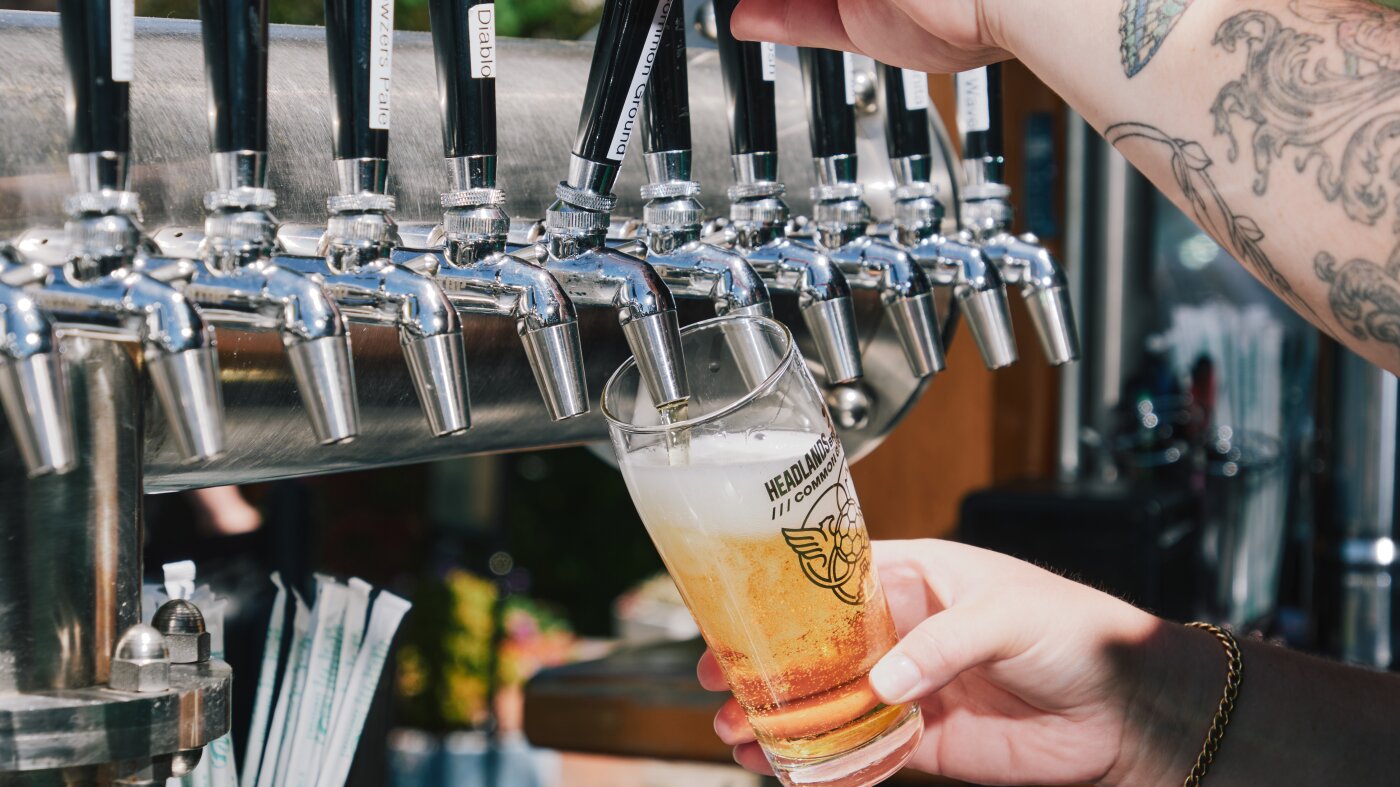
Headlands Brewing launched its World Cup-themed beer Common Ground ahead of the first World Cup game in June.
Justin Gellerson for NPR
hide caption
toggle caption
Justin Gellerson for NPR
The British betting company William Hill predicts that soccer fans will throw back more than 5 million pints of beer in stadiums and fan zones during this year’s World Cup. And that number doesn’t even account for the millions of pints being poured in bars as fans tune in to the global soccer event.
But while international soccer crowds are focusing on goals and penalties, a trio of craft breweries from the tournament’s three host nations are using the tournament to brew something increasingly rare: cross-border solidarity.

A shared recipe with local spin
The collaboration began months ago over a flurry of video chats and emails. The beermakers at Rey Árbol Brewing Co. in Mexico, Headlands Brewing in the United States, and Cabin Brewing Co. in Canada set out to design a single, unified recipe representing the brewing traditions of all three nations.
“It’s a Mexican lager,” said Alejandro Gomez, founder of Rey Árbol.
“That’s like a West Coast IPA,” said Ryan Frank, chief operating officer and brewmaster for Headlands.
“And up in Canada, most of our beers are hop driven,” said Haydon Dewes, co-founder of Cabin. “So we thought, let’s go for a dry-hopped Mexican lager.”
While all three breweries share the exact same recipe, each is giving the final product a distinct local spin, including unique, regionally designed labels. A four-pack of the U.S version costs $15.99. Frank said Headlands has produced about 130 cases of the limited-run brew.
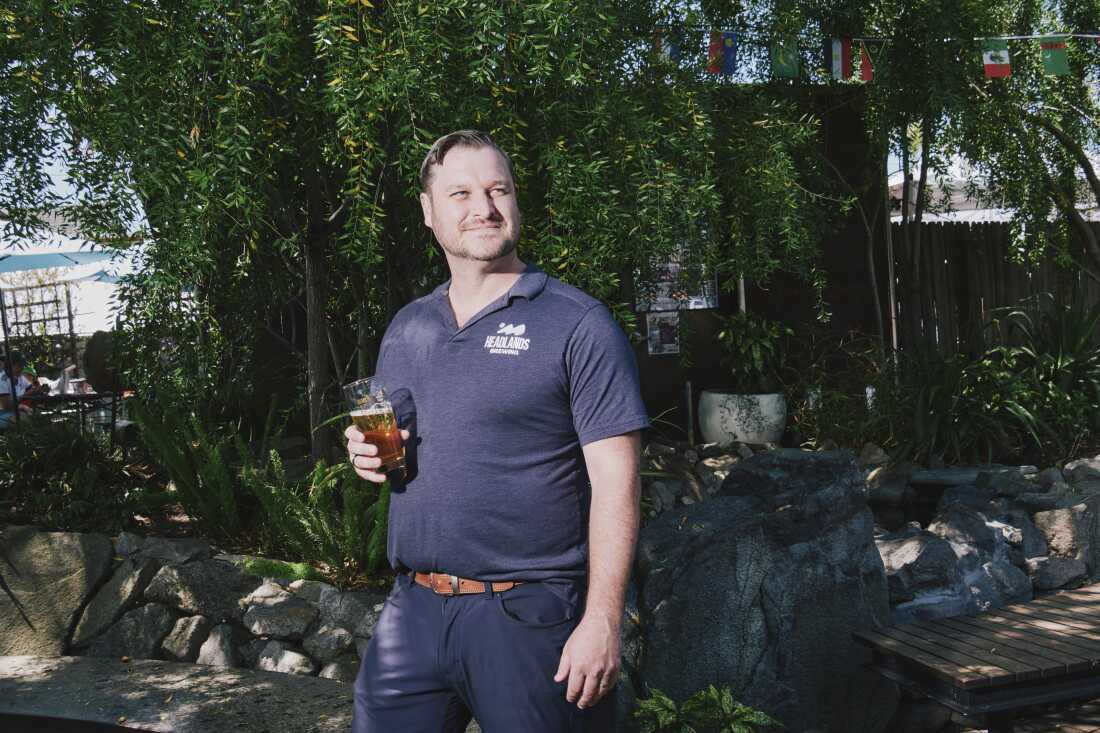
Headlands Brewing COO and brewmaster Ryan Frank drinks a Common Ground beer in Berkeley, Calif., on June 11.
Justin Gellerson for NPR
hide caption
toggle caption
Justin Gellerson for NPR
For the brewers, however, the project is less about marketing and more about connection: They named the multinational beer “Common Ground.”
“When I go to California or Canada, they will treat me like family,” Gomez said.
“It makes the world feel so much smaller,” said Dewes.
“It’s about building bridges and knowing what’s important in life,” said Frank. “And for us, that’s soccer and beer.”
Geopolitical friction in the taproom
The official rhetoric surrounding World Cup 2026 mirrors the brewers’ optimism, with promotional materials promising a tournament where billions are “united as individuals, united as billions.”
Yet this idealistic messaging stands in sharp contrast to a prickly geopolitical reality. Tensions between the U.S., Mexico and Canada have mounted over trade tariffs and auto manufacturing standards as the three nations renegotiate long-standing trade agreements.
The independent brewers behind Common Ground are feeling that friction firsthand through the rising costs of aluminum cans and raw ingredients.
“There are 15% tariffs slapped on any European-grown hops, which are really critical to some of our core brands,” Frank said.

Headlands Brewing brewmaster Ryan Frank and CEO Austin Sharp share a Common Ground beer in Berkeley, Calif., ahead of the first World Cup game on June 11.
Justin Gellerson for NPR
hide caption
toggle caption
Justin Gellerson for NPR
The political discord hasn’t just been confined to trade boards.
When signing an executive order to establish a White House Task Force for the World Cup in March 2025, President Trump suggested that cross-border hostilities might actually benefit the tournament. “Oh, I think it’s gonna make it more exciting,” the president said.
A bittersweet reminder
Tension on the soccer field is one thing; between nations, it’s another.
“It’s true that when it comes to the actual soccer, we’ve developed a very healthy, vibrant rivalry between the three countries,” said Andrés Martinez, the author of The Great Game: A Tale of Two Footballs and America’s Quest to Conquer Global Sport and co-director of Arizona State University’s Great Game Lab, which studies the intersection of sports, media and geopolitics. “But we’re also linked together in this very symbiotic relationship.”
Martinez said that when the U.S., Canada and Mexico initially launched their collaborative bid to host the World Cup back in 2017, the political climate was warmer.
“It was meant to showcase these tight bonds that had developed between the three countries,” Martinez said.

The makers of Common Ground used a shared recipe, but all created their own distinct packaging for the beer: Canada’s Cabin Brewing Co.; Mexico’s Rey Árbol Brewing Co.; the United States’ Headlands Brewing.
Cabin Brewing Company, Rey Árbol Brewing Company, Headlands Brewing
hide caption
toggle caption
Cabin Brewing Company, Rey Árbol Brewing Company, Headlands Brewing
But relations have soured since then, making cross-border business collaborations like Common Ground an anomaly rather than the norm for this tournament.
“To see craft beers across the three countries coming together like this, it’s a bittersweet reminder of what we were hoping to see a lot more of,” Martinez said.
Finding the real common ground
If trade wars and political posturing are looming large in Washington, D.C., Ottawa and Mexico City, they feel a world away at Headlands Brewing’s busy North Berkeley location.
As fans gathered to watch a crucial match between Mexico and South Africa at the start of the tournament, the sunny patio erupted into cheers and shrieks of “Goal!” when Mexico found the back of the net.

Headlands Brewing hosts a screening of the first World Cup game on June 11 in Berkeley, Calif.
Justin Gellerson for NPR
hide caption
toggle caption
Justin Gellerson for NPR
Hovering over a pint of the collaborative brew, soccer fan Roberto Mandujano reflected on the cross-border experiment.
“Three different ways, three different taste buds come together to make something cool,” he said.
When asked about the underlying political tensions between the host nations, Mandujano shrugged off the discord.
“We live in a world where everyone wants to make everything political,” Mandujano said. “But I think we’re all here for soccer. So I guess that’s the common ground.”
-
 Sports11 minutes ago
Teoscar Hernández returns, and Dodgers unleash 17-hit barrage in win over Athletics
-

 World19 minutes ago
DR Congo says 1,307 Ebola cases confirmed, including 377 deaths
-
 News44 minutes ago
Michigan governor threatens to pull troops from D.C. if used for Trump task force
-

 New York2 hours ago
Metropolitan Diary Challenge Day 2: How to Write Your N.Y. Story
-

 Los Angeles, Ca2 hours ago
Company has weeks to complete cleanup of Boyle Heights warehouse fire, officials announce
-

 Detroit, MI2 hours ago
18 New Kid-Friendly Places That Opened in Metro Detroit in 2026 (So Far!)
-

 San Francisco, CA3 hours ago
Anza expedition celebrates 250th anniversary in San Francisco
-

 Dallas, TX3 hours ago
Preston Hollow residents oppose proposed $800 million mixed-use development in Dallas, survey reveals

