Lifestyle
Best of L.A. home design: The 14 most memorable rooms of 2025


As a design writer, I feel lucky to get to peek inside some of Los Angeles’ most iconic homes.
This year, I visited many places, from Midcentury Modern landmarks by Edward Fickett and Raphael Soriano to humble apartments filled with Facebook Marketplace finds.
The rooms that stayed with me long after I left were not always the most luxurious or expensively furnished. Instead, they were the ones that made me smile and left a lasting impression of the person who lives there.
Here are the 14 rooms that resonated with me this year and the people who live in them who inspired me even more.
A colorful, sun-drenched kitchen in Mount Washington that connects to nature


(Mariah Tauger / For The Times)
Priced out of much of Los Angeles, architect Lindsay Sheron and her husband Daniel bought a vacant hillside lot in Mount Washington and proceeded to design and build their own home. Working over a three-year period, the couple served as general contractors and did much of the work themselves. The kitchen is a standout, featuring bright green custom kitchen cabinets painted Raw Tomatillo by Farrow & Ball, which add vitality to the single-wall layout. A custom metal hood by Practice Fabrication, powder-coated the color of a Pixie tangerine, adds a sense of fun.
“I wanted our house to feel really warm and bring nature inside,” says Lindsay, referring to the Western hemlock tongue and groove planks that she and Daniel installed on the walls and ceilings. “Wood does the heavy lifting in accomplishing that.”
Tour the custom built home here.
In Hollywood, a stunning living room that’s filled with second-hand furnishings


(Christina House / Los Angeles Times)
Caitlin Villarreal felt giddy the first time she stepped inside the Whitley Heights rental, a storied 1926 Mediterranean-style penthouse with towering ceilings, hand-carved wooden beams and a pair of arched bookcases alongside an oversize fireplace.
“It had good energy,” Villarreal said of the 1,500-square-foot apartment she rents in a historic neighborhood where Rudolph Valentino, Charlie Chaplin and Bette Davis once lived. “It’s iconic just by standing tall year after year. It has floor-to-ceiling Old Hollywood windows that blow open unexpectedly just like in the movies. It doesn’t feel like a rental. It feels like a forever home.”
Tour the Hollywood penthouse here.
A Midcentury Modern dining room in Studio City that Raphael Soriano would approve of


(Jason Armond / Los Angeles Times)
Architect Linda Brettler’s list of things she loves about her Raphael Soriano-designed home is long, even though the all-aluminum structure, which was designated a Los Angeles Historic-Cultural Monument in 1997, was in desperate need of updating when she purchased it in 2021. “I like doing projects like this where I get to have my own hand and feel, but I’m still honoring what was here,” Brettler says. “I’m trying to create an idealized version of what the house would look like now.” In the dining room, a reproduction of a Millard Sheets painting, rendered by Cal Poly Pomona students on Tyvek, is mounted on a cork-lined wall. Above the painting, she has mounted a projector screen for movie nights and video games.
Tour the historic all-aluminum home here.
A modern West Hollywood living room decorated with pets in mind


(Kit Karzen / For The Times)
“My original inspiration was to match the furniture to the kitties so I don’t see their cat hair,” anesthesiologist Jeffrey Hamilton says of the West Hollywood condo he shares with his boyfriend David Poli, his cats Romulus and Remus and Poli’s Husky mix, Janeway. “The cats very much informed the color scheme. I find them so handsome; it felt like having matching furniture was practical.”
In the living room, Hamilton chose a camel-colored Curvo sofa in velvet by Goop for CB2, which he found on Facebook Marketplace. Similarly, the accompanying swivel chairs from HD Buttercup and the barstool seats in the kitchen are upholstered in Bengal and Husky-durable textiles that camouflage their rescues pet hair.
“Jeffrey likes to say that everything in his apartment is a rescue, including me,” says Poli jokingly.
Tour the West Hollywood condo here.
A surprising Silver Lake kitchen that doubles as a retro video store


(Juliana Yamada / Los Angeles Times)
Chris Rose fondly remembers the days when he worked at the independent video store I Luv Video in Austin, Texas.
Now an L.A.-based writer, director and producer, Rose, 41, recalls the Austin store’s eclectic assortment of cult oddities and world cinema.
Although he can no longer visit the video store, Rose doesn’t have to go far to rent these days, as he has brought a similar yet distinctive collection to the kitchen of his one-bedroom bungalow in Silver Lake.
Tour the Silver Lake apartment here.
Two college friends transform a Glassell Park living room (and garage) into an art-filled escape


(Juliana Yamada / Los Angeles Times)
Antonio Adriano Puleo didn’t intend to renovate his traditional 1946 bungalow, but after consulting with architectural designer Ben Warwas, who told him he could transform the house into a “forever home,” the artist changed his plans.
“The living room wasn’t big enough, and it featured a huge red brick fireplace that had doors on either side of it, leading to the backyard,” said Warwas.
The living room of the main house is now open and airy, with custom cabinets and millwork by James Melinat that showcase the artwork Puleo made himself and the pieces he has collected for more than 30 years. The living room’s fireplace is gone, but the wooden mantle remains atop a console behind the sofa, graced with a series of colorful ceramic planters by Ashley Campbell and Brian Porray of Happy Hour Ceramics.
“Little tweaks totally transformed the house,” Warwas said.
Tour the house and ADU here.
A fabulous wet bar in a West Hollywood apartment that’s perfect for parties


(Jason Armond / Los Angeles Times)
Growing up in a small town outside of Cleveland, Tyler Piña was fascinated by Los Angeles and the glamour of Hollywood.
“My dad grew up out here, and it’s where my parents met,” says the 33-year-old screenwriter. “I remember looking at old Polaroids of them in the ‘80s and seeing how much fun they had.”
His attraction to Los Angeles, however, was more than just nostalgia. “I was mesmerized by the landscapes and architecture,” he says.
Looking back, he can’t believe he realized his dream of moving to Los Angeles from San Francisco in 2018 and eventually renting a Midcentury Modern penthouse by Edward Fickett steps from the Sunset Strip.
“A Midcentury Modern penthouse on Sunset Boulevard in the heart of West Hollywood, with a bar in the living room? I mean, does it get more iconic? I am, in no way, cool enough to live here,” says Piña.
Tour the Midcentury apartment here.
A bedroom in Beachwood Canyon is transformed into an art-filled office (and occasional guest room)


(Myung J. Chun / Los Angeles Times)
When Natalie Babcock and Samuel Gibson found a listing for a sunny apartment in Beachwood Canyon five years ago, they immediately fell for the two bedroom’s charming built-in bookshelves, faux fireplace, hardwood floors and formal dining room. Practical amenities such as an in-unit laundry and a garage, which are often elusive in Los Angeles rentals, didn’t hurt.
Today, however, the couple says they are most impressed by the sense of belonging they have found in the community just outside their 1928 Spanish fourplex. Here, where tourists and brides in wedding gowns often pose for photographs in the middle of the street in an effort to capture the Hollywood sign in the background, Babcock and Gibson have become part of a larger family. “Everyone knows our dogs’ names,” says Babcock.
The couple’s taste is vibrant, and the colorful interiors reflect their sense of fun and love of design. They painted one wall in Gibson’s office a dramatic Kelly green, which makes the white-trimmed windows and his extensive art collection pop.
“Art is one thing that I am always happy to spend money on,” Gibson says.
Tour the Beachwood Canyon apartment here.
A treasures-filled living room in Eagle Rock that’s a colorful showstopper


(Jason Armond / Los Angeles Times)
Isa Beniston and Scotty Zaletel are romantics. Not just in their love for each other, which they are as vocal about three years in as budding high school crushes, but also in the way they describe the contents of their 412-square-foot one-bedroom apartment. They can recall the season they discovered each treasure — from fruit-shaped throw pillows to more than 30 animal portraits — and the cross streets of the flea markets from which they bought them. They gush about the time they’ve spent together in fabric stores and flooring supply shops as if they were dimly lighted restaurants primed for date night.
“We both just love stuff,” the two said in near-unison.
— Lina Abascal
Tour the 412-square foot apartment here.
A tricked-out garage/ADU in Venice that serves as an office, gym and family hub


(Luke Johnson / Los Angeles Times)
“They’re fun,” architect Aejie Rhyu says of the creative couple Will Burroughs and Frith Dabkowski, as she walked by the undulating two-story ADU she helped them realize.
Rhyu’s assessment helps to explain the joy that permeates the family compound, from the pink Los Angeles Toile wallpaper in the bedroom (humorously adorned with illustrations of L.A.’s beloved mountain lion P-22, the La Brea Tar Pits and Grauman’s Chinese Theatre) to the tricked-out garage on the first floor, which includes overhead bike storage, an espresso maker, a mini-fridge and a large flat-screen TV that allows Sydney-born Burroughs to watch Formula One car races and cricket games at 4 a.m. when his family is asleep.
Burroughs even installed a subwoofer speaker beneath the sofa to give the garage the feel of a movie theater during family movie nights. “Jack went flying off the couch when we watched ‘Top Gun,’ ” he said of their son, laughing.
Tour the two-story ADU with a rooftop deck here.
A serene guest room in Mid-Wilshire that’s a light-filled studio for a textile artist


(Christina House / Los Angeles Times)
After living in her two-bedroom apartment in Los Feliz for more than a decade, Debra Weiss encountered a problem experienced by many renters in Los Angeles: She was evicted.
When her son-in-law spotted a charming two-bedroom apartment near the Los Angeles County Museum of Art on Zillow, her initial reaction was, “I want this,” Weiss said of the fourplex.
The rental had high ceilings, oak floors, ample sunlight, an appealing fireplace, a garage and a washer and dryer.
In the guest room, a wall hanging composed of three separate weavings in a gingham check pattern is embroidered with a series of characters she based on her 5-year-old granddaughter’s drawings. “It’s about people coming together in chaos and supporting each other,” Weiss said.
Even though the process of having to move was stressful, Weiss is happy with her new home and neighborhood. “I take the Metro bus everywhere and hardly ever drive,” she said. “Everything worked out perfectly.”
Tour the sunny Mid-Wilshire fourplex here.
A ’70s-inspired speakeasy/lounge in Highland Park that’s hidden behind a bookcase
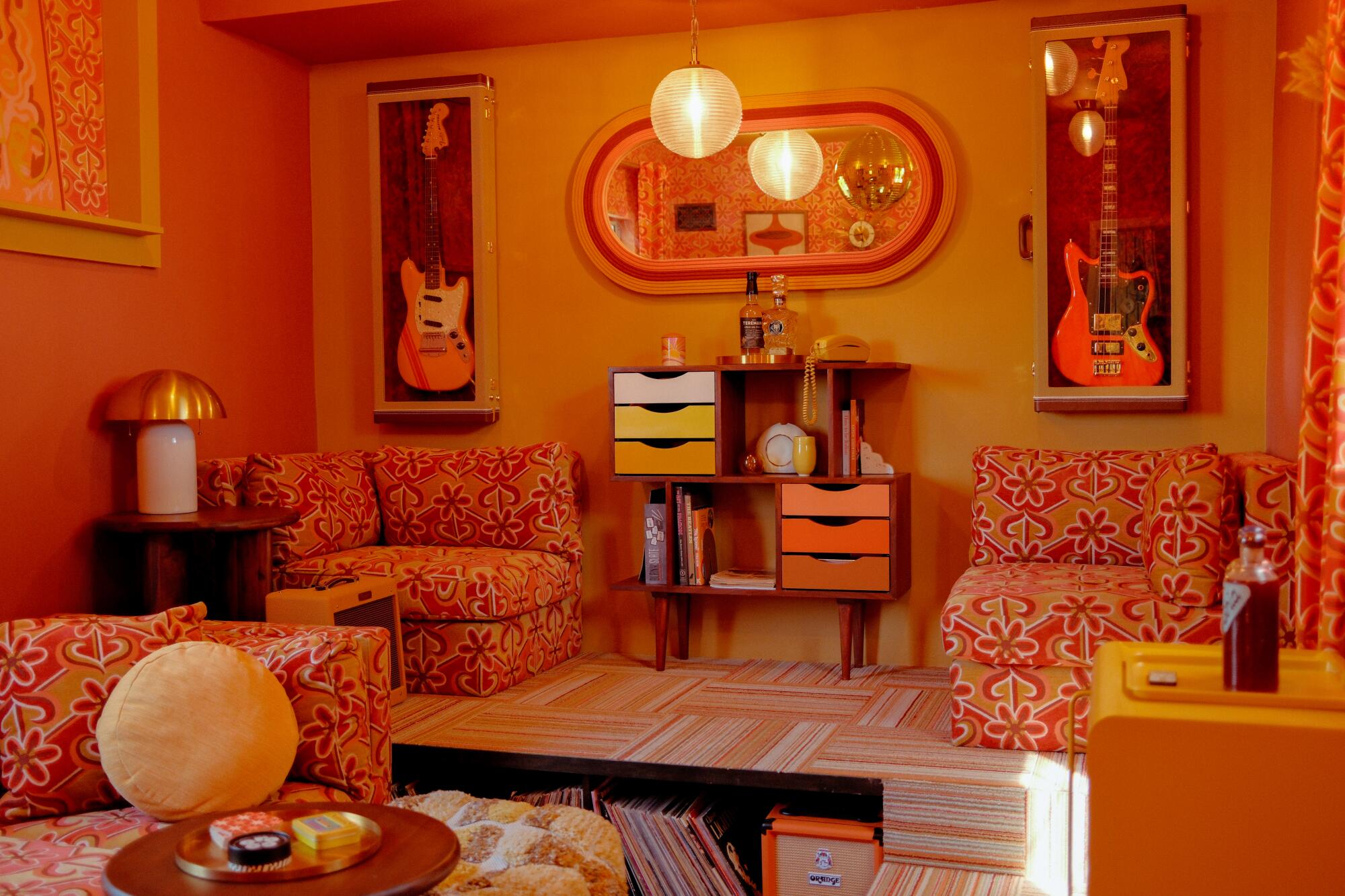


(Carianne Older / For The Times)
Standing beneath a glittering tiered chandelier in her pink “cloffice,” designer Dani Dazey shares the essence of her colorful style: “From the wallpaper to the artwork, my home is a reflection of me right now,” she explains. “It’s a personal and hip twist on traditional design.”
Rather than embrace rustic farmhouse style or minimalist Midcentury Modern design as is often the case in Los Angeles, Dazey has taken the Highland Park home she shares with husband Phillip Butler and given it an over-the-top maximalist spin.
The speakeasy lounge, accessible through a hidden door sliding bookcase, is a ‘70s-inspired sanctuary with a modular sofa, curtains and wallpaper in the same floral pattern.
Their home is proof, that our homes should make us happy by reflecting who we are. In Dazey’s case, that translates to bold color, lush textures and retro vibes.
Tour the Highland Park home here.
A memento-filled living room in Long Beach is an ode to ‘the people we love’


(Genaro Molina / Los Angeles Times)
A sense of fun permeates the rooms of Cecilia and Abraham Beltran’s colorful one-bedroom Midcentury apartment in Long Beach.
“We both have a deep passion for Midcentury design and color,” Cecilia shares.
The Beltrans’ apartment encapsulates their design sensibility and “above all, the people we love,” Cecilia says. There’s bold, Midcentury Modern-inspired furniture the couple found on Craigslist, tongue-in-cheek smiling pillows and the “Hole to Another Universe” wall decal by Blik, which can be removed when they move. Peppered throughout the space are mementos from their travels, such as the limited-edition art print “La Famille” purchased on a trip to London in 2023.
Ultimately, Cecilia says, she wants the apartment “to feel like us. I think we pulled it off.”
Tour the Long Beach apartment here.
In Reseda, an apartment where every antique tells a story


(Stephen Ross Goldstein / For The Times)
When Evelyn Bauer, 97, downsized from her four-bedroom home in Sherman Oaks to an apartment in Reseda in 2014, the longtime collector and antiques dealer was forced to relinquish many of her personal belongings.
“Collecting is my passion, my addiction, and I’m so happy to be afflicted with it,” says Bauer, whose two-bedroom, two-bathroom apartment at an independent living facility for seniors is filled with furnishings and decorative arts from her 65 years as a collector.
Step inside her living room, and the vast collection of antiques feels like entering the former Encino Antique Center, where she was once the proprietor during the 1990s. Each item has a story, a memory and a unique charm that she cherishes.
“There’s always room for one more gem,” she says.
Tour the Reseda apartment here.


Can you say no to a friend’s wedding?
Getty Images/Getty images
hide caption
toggle caption
Getty Images/Getty images
Are we spending too much on other people’s weddings?
Going to a friend’s weddings can be so fun and meaningful… but it can also really hurt your wallet. A survey by LendingTree found that 31% of people who had been to a wedding in the past five years had accrued debt to attend. So what’s driving up the cost of weddings for guests? And what makes it so hard to say no to these expenses?
Brittany breaks it down with Allyson Rees, senior analyst at trend forecasting firm WGSN, and Annie Joy Williams, assistant editor at The Atlantic.
This episode was produced by Liam McBain, with additional support from Corey Antonio Rose. It was edited by Neena Pathak. Our Supervising Producer is Cher Vincent. Our Executive Producer is Barton Girdwood. Our VP of Programming is Yolanda Sangweni.

After the eight-day-long fire in a 500,000-square-foot Boyle Heights warehouse, eastern Los Angeles residents are contending with putrid smells, soot and potentially hazardous airborne chemicals after heavy plumes of smoke spread throughout the city. But those who grow food in nearby neighborhoods may also be wondering: How will the fires affect the plants and produce in my garden?
The Boyle Heights warehouse, owned by Lineage — a global temperature-controlled storage facility operator — housed 85 million pounds of frozen food and other products. In the days since the fire, local emergency visits for smoke inhalation and throat pain spiked while agencies still scramble to measure the amount of PM 2.5 — harmful fine particles — and heavy metals, like lead and arsenic, in the air.
According to researchers, any toxic airborne chemicals would likely stem from the charred foam insulation, metal exterior, burned solar panels and any lithium batteries that might have been present inside the warehouse.
After a fire, heavy metal particles can spread through ash and smoke over gardens and inhibit growth, said Olukayode Jegede, an agricultural toxicologist and assistant professor at UC Davis. Since the warehouse fire is so recent and cleanup has just begun, Jegede said the precise impact on gardens can’t be measured until comprehensive soil tests are conducted in the area.
While the L.A. city government hasn’t announced plans for soil testing, the Contaminant Level Evaluation and Analysis for Neighborhoods project at USC is offering free contaminant testing for Boyle Heights and East L.A. residents. Residents can collect soil samples and deliver them to Boyle Heights City Hall and other locations for an evaluation of lead, arsenic, chromium and mercury levels.
The good news is produce, plants and roots can still be preserved. According to Jegede, many of the soil tests conducted last year in the Altadena area after the Eaton fire showed that gardens and poultry were not as contaminated as one might expect.
“Quite a number of the soils we tested [in Altadena] were not really contaminated,” Jegede said. “We weren’t seeing many soils with concerning elevated levels of metal, so gardeners should not be too alarmed when these things happen.”
Nevertheless, there are several measures that gardeners can take to keep themselves, their children, plants and produce safe from potentially harmful contaminants stemming from the fire. Researchers, gardening experts and horticulturists offered some guidance on the handling, recultivation and cleanup that can keep you and your garden in good health.
How do I remove ash and contaminants from my garden?
Altadena horticulturist Leigh Adams said Boyle Heights plants and produce already live in a difficult environment, surrounded by industrial warehouses that spread contaminants daily.
“That area has been used industrially for 100 years, and the soil is impacted by many, many, many things,” Adams said. “Low-income neighborhoods and gardens usually don’t have a lot of resistance against dominant manufacturing.”
This means that the contamination of gardens in eastern L.A. won’t be as catastrophic as compared with those in Altadena, a more suburban environment, Adams said. But fallen ash still poses major health risks if ingested or inhaled.
An advisory from University of California Agricultural and Natural Resources last year recommended suiting up in an N95/KN95 mask, long sleeves, pants, close-toed shoes and gloves before attempting to deal with ash in the garden to limit exposure to potentially toxic contaminants. The advisory added that individuals should make sure all of this gear is cleaned thoroughly before bringing it back inside.
Once in the proper gear, Adams recommends removing the top two inches of topsoil from gardens, where the highest concentration of contaminants will settle after a fire. Using a plastic bag to collect the soil and disposing of it in the garbage — not green yard waste bins — will help to reduce the spread of airborne chemicals.
Gardeners with raised beds are advised to remove approximately six inches of soil, because excess ash can raise the pH level and prevent nutrients from soaking into the soil bed.
After this, watering the garden gently but plentifully will help to promote soil health and get rid of most of the ash present on plant leaves and stems. Adams said replacing the top two inches of soil with store-bought mulch or straw will help to contain any remaining ash and prevent it from spreading any further.
Experts say to avoid using leaf blowers if ash is present in the garden because they can send particles airborne. Doing so will increase the likelihood of heavy metal particles, which can carry lung irritants and carcinogens, being spread and inhaled.
A Boyle Heights resident keep a watchful eye on the fire at the 5,000-square-foot commercial building, which stores 85 million pounds of frozen food.
(Genaro Molina / Los Angeles Times)
Is it safe for me to eat produce from my garden?
Several studies, including one from the UC Cooperative Extension of Sonoma County, have shown that consuming produce in a fire-affected area poses minimal health risks.
Jegede said most root vegetables like potatoes and carrots, along with any fruit that has an outer layer, can be washed to remove potential contaminants, even if they were covered in ash. Peeling the outer layer of your produce can also help to reduce potential risks, he said.
Lettuce and other leafy foods with multiple layers pose a higher risk of contamination, but with a vigorous wash and peeling the outer layers, even the greens can be saved. The County of Los Angeles Department of Public Health recommends soaking leafy produce and fuzzy fruits like peaches in a 10% white vinegar and 90% water mixture.
Jegede said if the leaves or fruit are too delicate to wash or ash is still visible, it would be best to dispose of the produce.
How can I tell if my soil is contaminated?
After ridding your garden of visible ash, you might wonder how to tell if your plants will still thrive in the soil.
At-home soil tests that measure for alkaline, fertility and pH levels are widely available and can be purchased for $15 to $100 (for more detailed results) online. But Jegede said these tests can’t tell the full story of soil health.
Comprehensive soil testing is “something you can’t do properly at home,” Jegede said. “In labs, we are testing for metals like lithium and zinc, stuff that an at-home test will not show … If it comes to the point that you’re worried about your soil, I would just send it out to a lab.”
Wallace Laboratories in El Segundo, Babcock Laboratories in Riverside, Waypoint Analytical in Anaheim and other labs offer more detailed soil tests that measure heavy metal particles in addition to other fertility factors. Prices at Wallace Laboratories can range from $115 to $295 for a complete compost test.
The soil below two inches should be unharmed, Adams said, so long as new compost is set and plants are watered plentifully, which will promote natural biological cycles.
“What you’re doing is capping the soil, so that moisture stays in there, and instead of being dirt, it’s a living system called soil,” Adams said. “The more carbon we can get into our soil, the better.”
What can I do to help my soil recover?
For the last 12 years, Adams has been working with Metabolic Studio, a Los Angeles-based art and research hub focused on environmentalism, on methods for bioremediation, the practice of using additional fungi, plants and compost to decontaminate ash and break down contaminants.
Adams said straw, mushrooms, corn, rye and sunflowers are great bioremediators that can help to repair damage to soils. She said certain samples she’s worked on with Metabolic Studio have gone from testing at high heavy metal levels to nearly contaminant-free.
But for a more immediate fix, wash your produce, water your plants and have a little patience during ash cleanups. Your garden should look better in no time, Adams and Jegede said.

Inde Navarrette and Michael Johnston in Obsession.
Focus Features
hide caption
toggle caption
Focus Features
Two big horror films, Obsession and Backrooms, just smashed all box office expectations. So much of their success has been driven by Gen Z, which is now the biggest moviegoing demographic. But what makes a movie a Gen Z movie? Today we’re bringing you an episode of NPR’s It’s Been a Minute. Host Brittany Luse talks about this trend with Sam Adams and Reanna Cruz.
If you want to hear more about these movies, check out these episodes:
In ‘Obsession,’ love hurts. It really, really, really hurts.
‘Backrooms’ brings YouTube horror to the big screen
Zendaya brings ‘The Drama,’ we bring the spoilers
Connect with Pop Culture Happy Hour:
Letterboxd / Facebook
Our weekly newsletter
Support Pop Culture Happy Hour+
-

 South Dakota3 minutes ago
As travel costs rise, many families find summer adventures closer to home
-

 Tennessee10 minutes ago
In-N-Out’s fifth Tennessee location is opening soon. Here’s how many stores are planned
-

 Texas12 minutes ago
Triple-digit heat returns to North Texas before weekend storms bring relief
-

 Utah18 minutes ago
Planned 60-foot long Liberty Arch in Utah sparks patriotism, but also concerns
-

 Vermont25 minutes ago
Vermont offers money to replace diesel vehicles with electric
-

 Virginia27 minutes ago
Virginia reports 10 cases of cyclosporiasis
-

 Washington33 minutes ago
Washington law says to alert the public when doctors are accused of misconduct. It can take months
-

 Wisconsin40 minutes ago
Former Wisconsin judge to be sentenced after conviction in obstructing arrest of Mexican immigrant

