Lifestyle
Ann Patchett finds bits of Catholicism and America appalling: 'But I am those things'


Ann Patchett says she was closer to her Catholic faith when she was in her mid 30s and writing Bel Canto.
Emily Dorio
hide caption
toggle caption
Emily Dorio
A note from Wild Card host Rachel Martin: Ann Patchett is a hugely popular writer. She was a Pulitzer finalist for her book The Dutch House. Her most recent novel, Tom Lake, was a New York Times bestseller. But she’s perhaps most well known for her 2001 book Bel Canto.
It tells the story of a group of strangers taken hostage somewhere in Latin America. It’s lyrical and heartbreaking and it has been adapted into an opera and a movie. Overall, it’s been a massively successful book. And Patchett recently decided to do a fascinating thing: She published an annotated version of Bel Canto with her own handwritten notes in the margins.

She calls out clunky turns of phrase, confusing plot points, repetitive language. She also gives herself credit for good writing and thoughtful observations about the human condition. But mainly, she is owning her shortcomings. Which feels like a bold quality that we need more of.
This Wild Card interview has been edited for length and clarity. Host Rachel Martin asks guests randomly-selected questions from a deck of cards. Tap play above to listen to the full podcast, or read an excerpt below.
Question 1: What’s a place that shaped you as much as any person did?
Ann Patchett: When I was a child, we lived on a farm for several years. It was in Ashland City, about 30 minutes outside of Nashville. It was not a working farm. It was just a collection of absolute weirdness.
We had a couple of horses. We had a rabbit. We had chickens, which were all named after members of Nixon’s cabinet. We had dogs, which meant that dogs would just go through and they would stay for a couple of years. Same with the cats. It was real country life. And most importantly, I had a pig, which I got from my ninth birthday because I was obsessed with Charlotte’s Web.
It was just a very animal-laden, isolated life. And because I’m an introvert, that worked out fine for me. And childhood was: you would go outside and climb up a hill. I collected moss, lots of flowers. I actually had a moss business. I sold moss in town when I was about 10 to florists.

Rachel Martin: Wait, other kids are like selling lemonade and little Ann Patchett is like, “Some moss, sir?”
Patchett: I’m in the moss trade. Make a lot more money off a moss than you do lemonade, Rachel.
And I remember my mother saying things like, “Remember the rattlesnakes are blind when they’re molting. So if you get into the blackberry bushes where the rattlesnakes go to shed their skins because they have those little tiny thorns on the blackberry bushes, just be aware because they can’t see you so they’re more likely to strike.”
That was the bedrock advice of my childhood.
Question 2: What’s an expression of love you’re trying to get better at?
Patchett: Complete acceptance. Complete blanket acceptance, which is the love my husband gives to me. He just accepts me for who I am. Always. No matter what. And I think I’ve always been somebody who wants to fix, and I work very hard to not fix and to just see the people in my life and accept them for who they are and love them for who they are.
The trailer for the film adaptation of “Bel Canto.”
YouTube
Martin: Is this right — that you dedicated the original version of Bel Canto to the man who is now your husband and you weren’t married, you were just dating?
Patchett: Yes. Yes! What kind of madness was that? And I want to tell you – my second novel, which was a book no one ever read called Taft – I dedicated it to my boyfriend at the time. And I found out that he was, shall we say, stepping out on me as the book was going to press. And I frantically called my publisher and said, “Can you pull this?” And they were like, “Hang on, let me check. Yes! We got it back!”
Martin: It’s like you stopped the tattoo artist right as they were about to go into your arm to put his name.
Patchett: It’s so true. And I dedicated it to my beloved cousins. And I thought, “Never gonna make that mistake again.” But then I met the right guy and I dedicated the book to him. And we weren’t married because I didn’t want to get married, but I knew that I would always be with him.
Question 3: How have your feelings about God changed over time?
Patchett: So there’s a lot about God in Bel Canto. There’s a lot about faith. And one of the things that I found very moving when I went back to it was I was much closer to my Catholic faith when I was 35 or 34, when I was writing that book.
You know, it’s a two-part thing. There’s God and then there’s Catholicism, which I always say, Catholicism is to God what sorority is to college. For some people, it’s everything. For some people, it’s nothing. For other people, it’s part of the experience.
I still believe in God. And here’s the thing, if I tried to tell you what that meant, I would be wrong. The only thing that I know for sure is that whatever I know is wrong. And it does not behoove me to spend a moment’s time thinking about it.
We are alive and that’s an astonishing gift. And it seems very possible to me that being alive is God and that the trick is whether or not we know it. The trick is whether or not we can keep our focus and remember that we are, for all of the suffering, the recipient of the most beautiful gift for a limited period of time, which is our life.

Martin: I’m interested in your preservation of the word “God” to define that. That the word carries so much for me because of how I was raised. And so it feels very dramatic for me to say, “I don’t believe in God.” But I guess I appreciate that you, even though you are no longer a Catholic and don’t identify that way —
Patchett: Yes I do. I don’t go to church, but I do still call myself a Catholic.
Martin: But that’s even more interesting!
Patchett: I am still a Catholic and there is an enormous amount about Catholicism that I don’t believe and am appalled by. I am still an American and there is an enormous amount about being an American that I don’t believe in and that I am appalled by. I am a Tennessean. There is an enormous amount about being a Tennessean that I don’t believe in and I am appalled by. But I am those things. And there are – about all of those things – parts that I love and I’m proud of.
When I was a sophomore at Sarah Lawrence, I had a humanism teacher. We had a class called “Humanism.” And it was a point in my life where I thought, “I loathe Catholicism. I want nothing to do with this. This is just an anathema to everything of who I am and who I believe in, what I believe in.”

And I went out to dinner at the Raceway Diner, I remember, in Yonkers with my humanism teacher. And I told him my problems. And he said, “If you’re going looking for something as big as God, just go where you’re comfortable. Go with what you know. It doesn’t make any difference. You’re not going to pick a better religion. You’re not going to pick a better set of words. It’s not about the words. It’s not about the religion. Don’t waste your time picking out your luggage. Just go on the trip.”
What matters is that we do our best with the life that we have, that we show up, that we love each other, and that we try to be as aware as is humanly possible of the life and the gift that we’re given, and to help other people wherever we can.



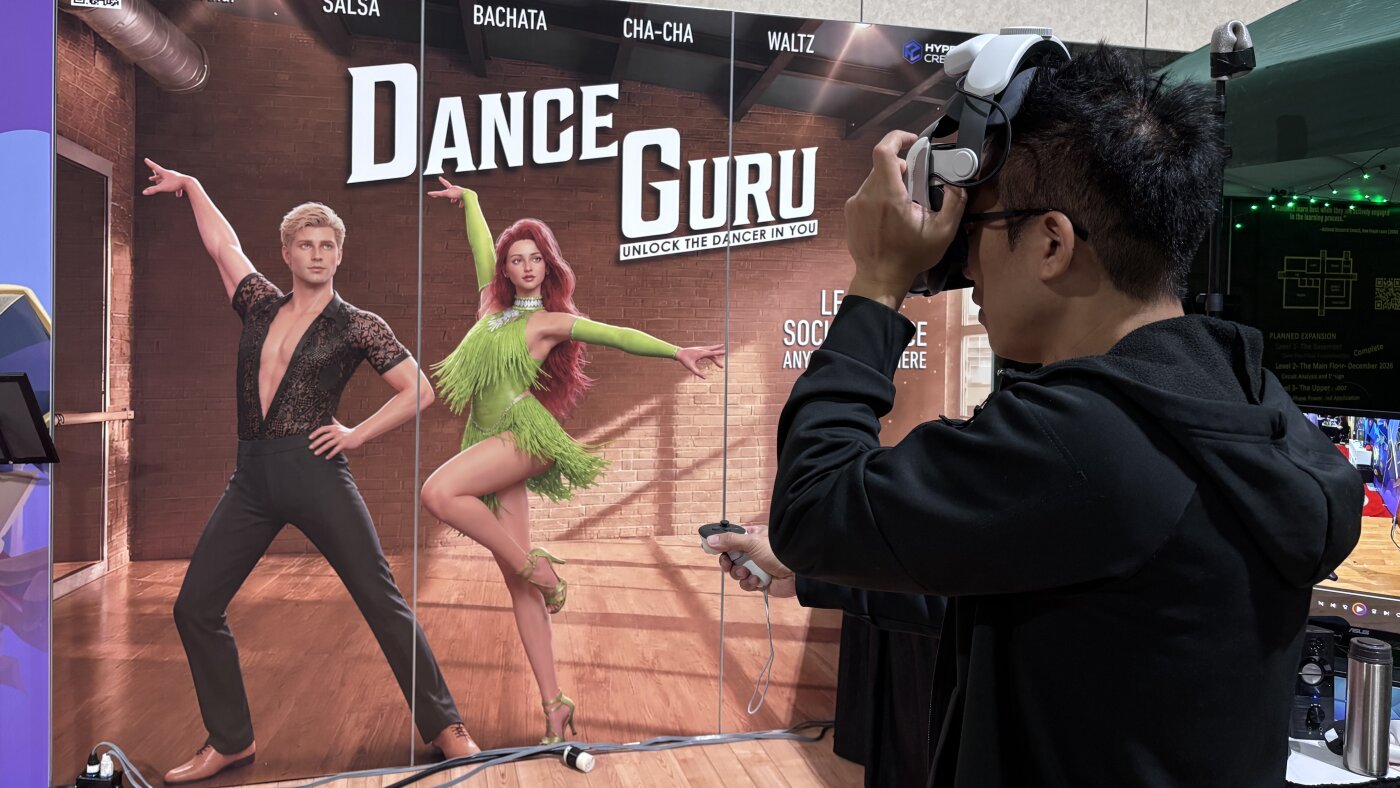
Entrepreneur David Huang tests out a VR headset while conducting demonstrations of the social dance lesson app Dance Guru at the Augmented World Expo in Long Beach, Calif., June 17, 2026.
Chloe Veltman/NPR
hide caption
toggle caption
Chloe Veltman/NPR
Wedding season is in full swing, bringing with it a familiar sense of dread for anyone who fears the dance floor.
But relief may finally be at hand with the help of a new app, Dance Guru, and a virtual reality (VR) headset.
The social dance instruction app transports users to a spacious, digital dance studio. Waiting inside is a computer-generated coach: a handsome, male avatar wearing a shirt open to his navel. He speaks with a slightly gravelly English accent.
“Watch me now,” he instructs at the start of a waltz lesson — which NPR tried out at the Augmented World Expo in Long Beach, Calif., an annual conference showcasing the latest developments in virtual and augmented reality.
The avatar then demonstrates a basic box step.
From there, the lesson becomes interactive. The coach tells the user to hold his hand while an electric pinging sound tracks the student’s foot placement.
“One, two, three, four, five, six,” the virtual teacher counts down.
When the user stumbles, he remains remarkably patient. “Do not worry, foundations take time. Let’s try that again. Work on grounding your steps more intentionally.”
Solving the beginner’s dilemma
Dance Guru creator David Huang said he came up with the idea for the app a couple of years ago out of frustration.
“I always wanted to learn to dance and I was always terrible at it,” Huang said. “And I always ended up stopping midway through the lessons.”
He soon realized that many beginners hit the exact same roadblocks.

“Private lessons are too expensive, and you feel like you’re always forgetting the dance steps,” Huang said. “You cannot find a partner to dance with. So I figured maybe I can create something like this.”
The Dance Guru platform currently offers tutorials in salsa, bachata, waltz, and cha-cha, in both lead and follow modes. To make the digital instruction feel authentic, Huang used motion-capture technology to record the movements of real-life dance teachers — with their permission.
Building on the legacy of online tutorials and video games
Dance Guru belongs to a small but growing wave of apps using VR to demystify social dance. At a nearby booth, conference attendee Victor Chen is testing out a competing app called Trip the Light. It currently offers salsa lessons, as well as freestyle options, where a user can dance with a partner without having to learn specific steps.

Trip the Light’s booth at the Augmented World Expo included posters of the app’s virtual instructors. Real-life performers, who gave Trip the Light permission to motion capture their movements, were used as a basis for these avatars.
Chloe Veltman/NPR
hide caption
toggle caption
Chloe Veltman/NPR
“A lot of times when you’re trying to learn a choreography, it’s watching a YouTube video and you have to pause it, rewind, and play it,” Chen said. “If you were to have a virtual avatar dancing in front of you and correcting for any parts that you missed, it might be a lot easier.”
Interactive video games like Dance Dance Revolution and Just Dance, and YouTube tutorials have been helping people improve their skills in private for years. But those games are mostly aimed at solo players. Unlike the new generation of immersive VR apps, they cannot simulate the mechanics or confidence required for partner dancing on a live dance floor.
The reality check
But this kind of app won’t work for every dancer.
“Everyone learns a little bit differently. And so unless you have a game that has lots of different ways of teaching, you’re going to have things that work for some people and don’t work for others,” said Ariana Katana, a trained contemporary dancer and dance content creator who’s active on YouTube, Twitch and other platforms. “Also, it’s hard to dance with a headset on.”
And then there’s the issue of not being able to physically feel a virtual partner’s hand or shoulder while dancing with them. Patrick Ascolese, the creator of Trip the Light, said the experience could become more tactile in the future. “Haptic suits and wearables will be coming, but I think we’re a little away from that,” he said.
Ascolese said even with their limitations, immersive tools like Trip the Light have immense potential as judgment-free training grounds — giving reluctant dancers the baseline confidence they need to eventually step onto the dance floor with real partners in the real world, including at weddings.
“Just like anything else, practice makes perfect,” said Ascolese. “So the more time you spend in VR with a virtual partner, it works towards helping you get over that social hurdle. We are teaching you the moves that you have to do in order to go out and have fun.”
Jennifer Vanasco edited the broadcast and digital versions of this story. Chloee Weiner mixed the audio.



For half a century, Deidre Hall has taken on every kind of disaster in the drama-packed town of Salem, Ill., as a star of “Days of Our Lives.”
There was the time — actually, it happened twice — when her character, Dr. Marlena Evans, was famously possessed by the devil and even levitated.

In Sunday Funday, L.A. people give us a play-by-play of their ideal Sunday around town. Find ideas and inspiration on where to go, what to eat and how to enjoy life on the weekends.
Or the time a serial killer, who was actually Marlena under hypnosis, seemed to kill several beloved characters. The long-running show’s storylines have become legendary, and in March, while promoting “Hail Mary,” actor Ryan Gosling even gave Hall a shout-out, admitting he was a fan, praising the hard work of soap opera actors and calling her an “OG acting inspiration.”
But Hall’s real life in Santa Monica is much quieter than her character’s, and she likes it that way.
“When I bought my house in Santa Monica, I didn’t realize how great it would be to live near Montana Avenue,” says Hall, 78, about the popular shopping spot. Every day, she walks to the main street with her golden retriever, Riley, and enjoys Pilates, art and good food along the way. “The owners of the Farms Market even keep dog biscuits, so guess where the dog wants to go every time we walk — the Farms, of course,” she says, laughing.
When she isn’t filming the daily soap opera, which airs on Peacock, Hall enjoys raising monarch butterflies, exploring the shops and restaurants on Montana, and hosting movie nights at home with her two sons.
Here’s what a perfect day in L.A. looks like for her.
This interview has been lightly edited and condensed for length and clarity.

7 a.m.: Breakfast and dog walk
I usually kick off my day with a protein shake, feed our golden retriever and take her out for a walk. She’s a phenomenal girl. When we adopted her, her name was Riley, but I did think about naming her after Mrs. Hughes from “Downton Abbey.”

10 a.m.: Church and garden time
After I walk the dog and go to church, I like to spend some time in my yard. I’m not a natural gardener, but I really enjoy it. I started raising monarch butterflies because my identical twin sister, who played my twin on the show, planted a butterfly garden. Monarchs are amazing because they are transitional. Every year, they travel from Mexico to southern New England, but it’s getting harder for them. Their numbers have dropped by about 80%. To help, I plant milkweed, which is what they need to survive. I buy my milkweed from the Staghorn Garden on Wilshire Boulevard in Santa Monica. Julie, who owns the nursery, is delightful and has a wide variety of milkweed. The monarchs always seem to find my garden. Julie was raising some caterpillars too, and she cared a lot about them. We talked about how important it is to help the butterflies. That’s why I do this. Sometimes I get milkweed with eggs already on it, and Julie knows her butterflies are going to a good home.

1 p.m.: Walk to Montana Avenue for some lunch
I live near Montana and love taking long walks, going to Pilates and trying out the great restaurants nearby, like R+D Kitchen and La La Land. I’m a big fan of the waffles at the Courtyard Kitchen. Just a few days ago, I had a chicken salad on raisin bread with an Arnold Palmer, and it was delicious. It is right on Montana and has a nice outdoor seating area. It’s one of my favorite spots. La La Land always has a long line in the morning, which is perfect if you want coffee. They serve coffee, doughnuts, croissants and avocado toast. There’s plenty of outdoor seating, and you can even bring your dog.

2 p.m.: Peek inside a clock shop
There’s a small clock shop on Montana Avenue that’s closed on Sundays, but if you walk by, you’ll see all kinds of clocks — standing, table and wall clocks. The owner is great at fixing them. Once, I bought a wall clock from MacKenzie-Childs, but it didn’t work. And I was really upset because it matched everything else on my countertop. I brought it to the owner and said, “I love this, but I can’t make it work.” He fixed it right away. His name is John, but I call him Geppetto. And we all know why. He really does have a magic touch.

2:30 p.m.: Visit a neighborhood art gallery
Ten Women Gallery is run by 10 artists, all of whom show their work there. I was drawn to some watercolors there, bought a few cards and spoke with one of the artists. She told me, “You seem to love watercolors,” and mentioned that the artist who painted them, Pamela Harnois, lives in Los Angeles and teaches nearby. I got Pamela’s name and found out she taught at the Brentwood Art School. I was so inspired by her gift that I started taking private lessons with her on Saturdays. That gallery is where I discovered my love for watercolor painting.

3 p.m.: Grab some ice cream at Rori’s
The other day, my longtime girlfriend wanted to get ice cream and told me, “We are walking to Rori’s Artisanal Creamery.” It’s a small shop on Montana near Lincoln. They make everything themselves, using local ingredients from grass-fed cows with no added hormones. The place is family-owned and probably has the healthiest ice cream you’ll find. They switch up their flavors often, but my favorite is the salted caramel.

6 p.m.: Family dinner and movie night at home
R+D Kitchen is always packed, so my sons, who are 31 and 33, do the cooking. They come over, and together we make salads and cook dinner. There’s a neighborhood grocery store called the Farms, off Montana, a small family-run place that has everything we need. Everyone knows each other there, and people bring their dogs. We try to have movie night every Sunday. Sometimes the day changes, but we always make sure to have one night a week where we cook a meal and sit down as a family. Keeping that tradition has become really important to us. My sons are great cooks, which is funny because they definitely didn’t get that from me. [Laughs]
9 p.m.: Take Riley for one last walk and visit neighbors
After dinner, I take my dog for a walk. It’s a great way to meet neighbors. We always go around the same block. We’ve met so many people, and since she’s a golden retriever, she loves meeting everyone.

10 p.m.: News, knitting and bedtime
I am a news junkie, so I usually watch whatever is on the news before I go to bed. I have a long-standing passion for knitting. Lately, though, the news would make me drop a stitch.
For Iris van Herpen, couture is a laboratory as much as a runway. Our chief fashion critic, Vanessa Friedman, takes us inside this Dutch designer’s latest Paris show — from sci-fi-inspired gowns to an audacious attempt at a dress made of charged plasma.
-
Crypto3 minutes ago
Trump’s crypto grift spins into its own industry
-

 Finance15 minutes ago
New changes to financial aid will be minor for UND students, bigger for loan borrowers in repayment
-

 Fitness18 minutes ago
The NHS has reignited the hybrid working debate – but WFH isn’t the health risk, this is
-

 Movie Reviews30 minutes ago
‘Only Beautiful Things to Look At’ Review: A Handsome but Muffled Portrait of State-Sanctioned Cruelty
-

 World38 minutes ago
Colombia Adds Massive Soundstage as Bogotá Audiovisual Market Attendance Soars and ‘Narcos’ Star-Led ‘Rookies’ Cleans Up in Project Prizes
-
News45 minutes ago
How a Beer Hall Keeps Up With a World Cup Crowd
-
Lifestyle1 hour ago
Shy on the dance floor? Virtual reality ‘partners’ aim to help you find your groove
-

 Technology2 hours ago
Are you filthy enough for a $700 portable shower?

