Fitness
Army to expand holistic health and fitness program to all soldiers


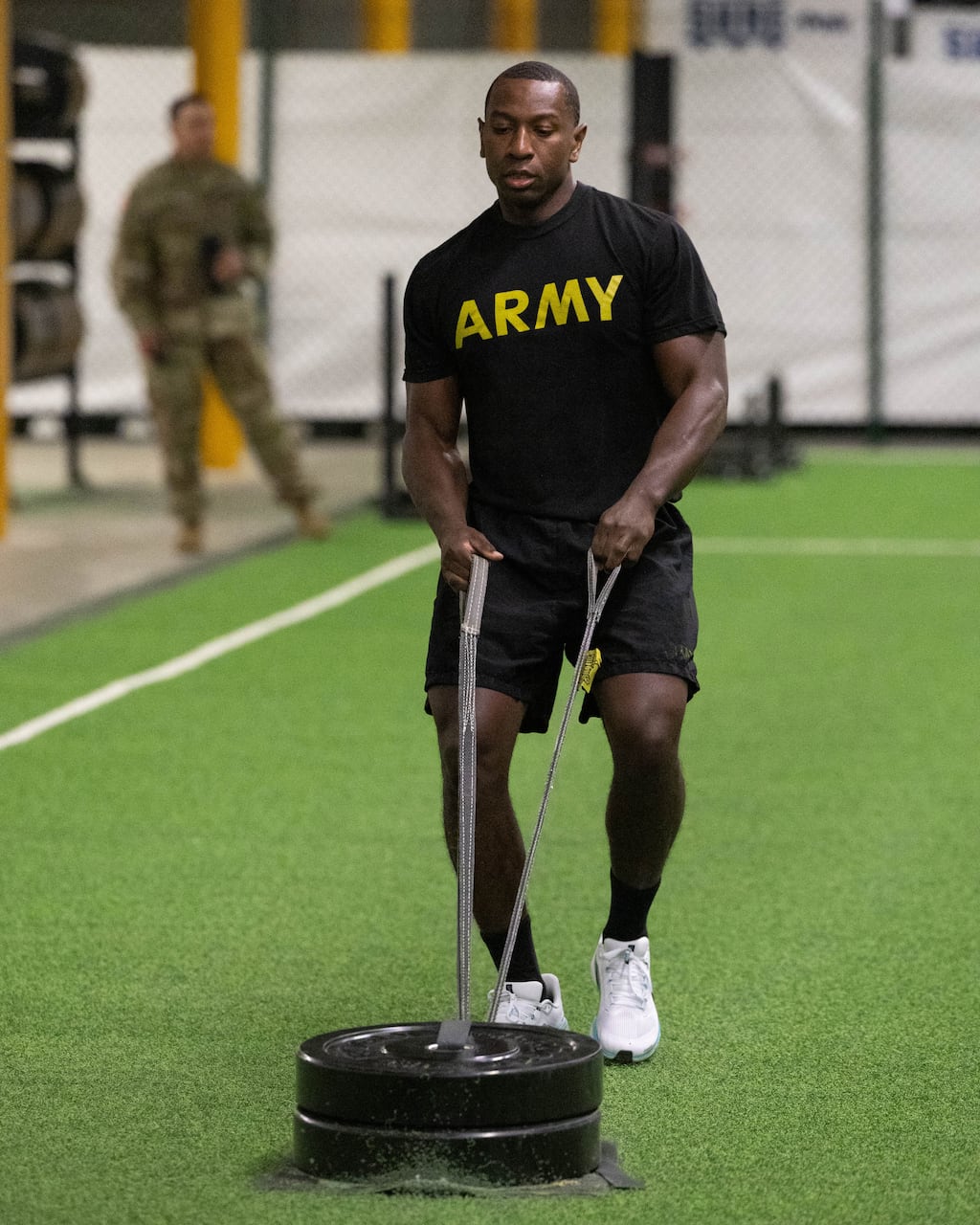
The Army is expanding its new all-around health and fitness program, which includes professional civilian staffing, workout gear and more, to all soldiers rather than only combat brigades.
Army Vice Chief of Staff James Mingus told soldiers at the Maneuver Warfighter Conference at Fort Moore, Georgia, on Wednesday that the Holistic Health and Fitness program, also called H2F, will roll out across the entire force.
The program was showing too much benefit to be used only by the combat arms brigades, according to the four-star.
“It is an Army program, and it is making a huge difference on how our soldiers are performing out there,” Mingus said.
The Army launched a pilot H2F program in late 2018 and began equipping combat arms brigades with full complements of gym equipment and H2F staff, including physical therapists, dietitians, occupational therapists, athletic trainers, strength and conditioning coaches and cognitive performance specialists, in 2020.
RELATED
The program’s holistic approach addresses five domains: physical, spiritual, mental, sleep and nutrition.
The original plan called for the service to outfit all 110 combat arms brigades by 2030. Chief of Staff Gen. Randy George announced last year that the Army would speed up fielding by increasing the annual number of brigades from 10 to 15. The fully resourced program had reached 50 brigades this year, including some military police, medical, engineer and sustainment brigades, according to Army data.
Mingus didn’t share specifics or timelines on the rollout, which will require more funding from Congress. But he advised leaders to begin work in their units now.
“A lot of our formations still don’t have it but there are things you can do,” Mingus said. “I would challenge you to study what is the essence of how you assess the program and execute functional fitness, nutrition, sleep.”
The Center for Initial Military Training, or CIMT, at Fort Eustis, Virginia, launched the Holistic Health and Fitness website in late August. The site contains information on all aspects of the program such as unit resources, the H2F Academy and the command’s annual H2F Symposium.
“We wanted to develop a website that provides tools for soldiers to help them take a hard look at themselves and really assess their personal health and fitness while also providing resources from subject matter experts so they can improve in all five readiness domains,” Lt. Gen. David Francis, CIMT commander, said in a statement.
Francis described the H2F program as the “largest human performance optimization project ever fielded.”
The program’s top priority since its inception has been reducing physical injuries among soldiers during deployment and training. Francis touted the results.
“The initial return on investment shows H2F will pay for itself as it decreases musculoskeletal injuries, reduces non-deployables, and helps soldiers who do get injured return to duty faster,” Francis said.
Early data released by CIMT in April showed H2F-resourced brigades saw a 23% higher increase in Army Combat Fitness Test (ACFT) passing rates, along with other performance and behavior improvements.
Behavior and performance data from H2F-resourced brigades compared with non-resourced brigades demonstrated:
- 14% lower increase* in musculoskeletal injuries = 6,489 fewer injured soldiers.
- 30% lower increase in musculoskeletal injuries lasting more than 90 days = 3,002 fewer injured soldiers on profile for more than 90 days.
- 22% lower increase in behavioral health reports = 2,962 fewer soldiers on behavioral health profiles.
- 20% lower increase in behavioral health reports lasting more than 90 days = 3,002 fewer soldiers on behavioral health profiles greater than 90 days.
- 502% lower increase in substance abuse profiles = 13,947 fewer soldiers on substance abuse profiles.
- 23% greater Army combat fitness test passing rate = 4,455 more soldiers passing the ACFT.
- 27% more soldiers reaching expert on rifle marksmanship qualification = 88,000 more soldiers receiving expert rifle marksmanship qualification.
*Brigades analyzed, both with and without H2F teams, saw increases in most areas from 2021–2023, but those units with H2F teams saw significantly lower increases in all categories.
Source: Center for Initial Military Training
As the Army implements the program across the force, the active-duty combat arms brigades remain a priority, with the Army National Guard and Army Reserve likely waiting longer for resources.
However, the new website can help fill those gaps in the meantime, Sgt. 1st Class Nicholas Rice, an Army Reserve H2F system developer, said in a statement.
“It’s a vital tool in our shared mission to ensure that every investment made in our Soldiers is an investment in a better, more capable version of themselves,” Rice said.
At Wednesday’s conference, the vice chief praised his experience with a precursor program that used similar principles when he served the 75th Ranger Regiment. That program, known as the Ranger Athlete Warrior Program, emerged in the early 2000s to decrease injuries in the notoriously demanding unit.
Mingus carried a version of that program with him when he assumed command of 4th Brigade Combat Team, 4th Infantry Division, at Fort Carson, Colorado, he said.
The program prepared his soldiers to perform in some of the roughest terrain during demanding missions during their 2012 deployment to Afghanistan, according to the general.
Todd South has written about crime, courts, government and the military for multiple publications since 2004 and was named a 2014 Pulitzer finalist for a co-written project on witness intimidation. Todd is a Marine veteran of the Iraq War.



Fitness
Alexandra Daddario, 40, relies on this underrated crunch upgrade for strong abs – here’s how to do it properly

From enduring some serious physical prep for Baywatch to working consistently with elite trainer Patrick Murphy, Alexanda Daddario’s dedication to fitness is well-documented. She often shares insights on social media, and in a recent Instagram post, the White Lotus star gave an insight into how she trains her core with one powerhouse movement: the reverse crunch into shoulder stand.
Why is it so good? Most traditional ab exercises require repetitive spinal flexion – the process of pulling your chest down toward your knees, like in a standard crunch. This isolates only the upper section of your abs, and for women who spend hours sitting at a desk, it can reinforce a slouched, rounded posture.
Daddario’s movement flips the mechanics entirely since you actively curl your pelvis up toward your chest. In doing so, you target not only your upper abs, but the lower portion and your obliques (the sides) simultaneously, all while keeping your chest open and your neck unstrained. This translates into a much stronger core, better posture and crucial lower back protection. Research also shows that a controlled posterior tilt – the lower-body curl that initiates Daddario’s move – recruits a significantly higher percentage of deep core muscle fibres than traditional crunches.

Daddario then drives her hips directly up into a vertical shoulder stand. This completely removes momentum from the equation (meaning you can’t “cheat”) and forces your abs – particularly your obliques – to balance your body and prevent you from tipping sideways.
She then takes it one step further into a Pilates plow position with her legs overhead, before reversing the movement and, again, using her abs to control the lowering of her entire lower body as she slowly unrolls her spine down onto the mat. The plow portion is optional (and super advanced); the slow, controlled, lowering phase, which happens whether you move into plow or not, is where the magic happens, challenging your core through both lifting and resisting gravity. Inspired? Here’s exactly how to do the move with good form, and how many reps and sets to aim for.
How to do a reverse crunch into shoulder stand
- Lie on your back (either on a mat, or on a reformer Pilates machine, like Daddario, with your arms anchored tightly to the floor.
- Engage your core to curl your knees toward your chest, then fluidly press your feet straight up toward the ceiling, lifting your hips and lower back off the floor.
- Slowly lower down, one vertebra at a time. Aim for 3 sets of 6-8 controlled reps.
Optional progression:
- As you reach shoulder stand with your legs extended to the ceiling, slowly start to lower your toes toward the floor over your head. Your weight should rest entirely on your shoulders and upper back – not your neck.
- Keeping your legs straight, use your core to extend them straight back up to the ceiling, then control the descent by rolling your spine down one vertebra at a time, with your legs remaining straight.

One of our most frequently asked questions here at Women’s Health? How to build muscle and burn fat at the same time. So, we asked superstar trainer Oyinda Okunowo exactly how to do it. In this 4-week plan – created exclusively for Women’s Health COLLECTIVE members – you’ll get the workouts and nutrition guidance needed to help you on your way to better body composition. Tap the link below to unlock 14 days of free access to Oyinda’s plan and start training today.
GET THE PLAN

As Women’s Health UK’s fitness director and a qualified Pilates and yoga instructor, Bridie Wilkins has been passionately reporting on exercise, health and nutrition since the start of her decade-long career in journalism.
After earning a first-class degree in journalism and NCTJ accreditation, she secured her first role at Look Magazine, where she launched the magazine’s health and fitness column, Look Fit, before going on to become Health and Fitness writer at HELLO!
Since, she has written for Stylist, Glamour, Cosmopolitan, Marie Claire, Elle, The Metro, Runner’s World and Red. Today, she oversees all fitness content across Women’s Health online and in print, spearheading leading cross-platform franchises, such as ‘Fit At Any Age’, which showcases the women proving that age is no barrier to exercise.
She has also represented the brand on BBC Radio London, plus various podcasts and Substacks – all with the aim to encourage more women to exercise and show them how. Outside of work, find her trying the latest Pilates studio, testing her VO2 max for fun (TY, Oura), or posting workouts on Instagram.
Fathers often share special bonds with their children. For 80-year-old Chanka Ramrattan, that bond is a shared love for fitness and exercise with his 46-year-old son Nari.
The Rousillac resident recalled that he began exercising at the age of 14, lifting weights and taking long walks, a passion that remains with him today. During his time working as a clerk at Texaco, he said he would walk from Forest Reserve to his Rousillac home, a distance of approximately 12 kilometres.
“I have done every marathon in Trinidad; you name a marathon, I could tell you. Miami Marathon, Tobago Sea-to-Sea, which is the most difficult marathon that I’ve ever done. I even have a trophy where I got the fastest speed walking man, and I have all my medals,” he recounted.
Chanka’s last marathon was a virtual one in 2021. Since then, his doctor has advised him to slow down because of his age. Now, he spends his time at the Health and Fitness Gym in Debe and South Oropouche about three times a week, walking marathons of his own on the treadmill.
“I do cardio walking for one hour, and I do weight training for one hour. Then, I go in the sea and I swim and dive for one hour,” he noted.
Chanka firmly believes regular exercise has contributed to his longevity and said he plans to keep going.
“Exercise is very important, and I like exercise. You go to Miami, and you’ll see 90-year-olds and 100-year-olds in the gym, walking, and even going to marathons. That’s because if you don’t exercise, you feel lethargic, you feel down. And you also have to read a lot. So, you exercise the brain, and you exercise the body,” Chanka advised.
His son Nari believes that perseverance was one of the most important lessons his father passed on to his children, along with a love of fitness and exercise.
“When you are looking at your dad, and your mom, and you are seeing them exercising and you are seeing them fit, why would you not want to do the same thing? So, it was instilled in all of us, myself and my two siblings. That exercising became a routine. My bigger sister, she would run, and my smaller sister would do cardio,” Nari explained.
The engineer and businessman recalled starting to exercise and lift weights with his father and uncle from a young age, crediting the experience with shaping the discipline and fitness mindset he still follows today.
However, in 2016, he faced a big obstacle after he hit his head during a diving accident, damaging his C6 and C7 vertebrae and spinal cord.
“I was 37 at the time when I got into the accident. I lost all feeling in my body. The person that you see in front of you now is not the person I was three years ago. I actually couldn’t move at all; I could only move my toe. It took a lot of hard work and will, to come out of that situation. Eventually, I started to transfer from my wheelchair to a bed, to a car. I even built a machine for me to stand up with a harness, and it pulls me up in the air so I can stand up straight. So, I used that for two years to get my body back to where it is,” Nari explained.
Nari, who is currently a quadriplegic, said he was only able to make progress through persistence and support from his loved ones. Chanka admitted that period was one of the most difficult experiences of his life as a parent.
“I wouldn’t like to explain that, that is a different thing altogether. He was in Mount Hope for six months, we had to go every day. It was a real trying thing, but you know, he is on the way to recovery. His mother wants to see everything good for him. For me, she will treat me second class and she will treat them first class, and she is right. Because the ones that are able to walk, you give them less attention because they are tending to themselves. You have to give more attention to the one that needs attention,” he acknowledged.
But their bond through exercising didn’t change. During COVID-19, Nari said his father returned to weightlifting under his son’s guidance.
“When my dad was trapped in the house and he couldn’t go anywhere, he was very miserable. So, we had a schedule where he and I would use the weights that I have at home, and I would tell him what to do. He actually got a six-pack during COVID. So, we stayed home and exercised with my wife and all too. After, I realised now I could start back to go to gym,” Nari reflected.
Chanka said his son’s determination continues to inspire him.
“When you see somebody who is a bit incapacitated and they’re exercising, they give you inspiration. Like if that man could do that, I could do that too. I wish Nari all the best. He is adhering to all his exercises, and he has a will that you won’t get in your next life. It’s probably my genes passed on to him,” Chanka shared.
Nari said none of that would have been possible without his father’s influence.
“Dad, I just want to tell you, thank you very much for being in our lives. You give us the encouragement to go day to day, and just keep being who you are, because you have a strong will, strong mind, and that is what keeps us going every day,” he said.
-

 Los Angeles, Ca15 minutes ago
Hospital needs help identifying man found unconscious in downtown Los Angeles
-

 Detroit, MI35 minutes ago
Large police presence for an investigation on Detroit’s west side
-

 San Francisco, CA45 minutes ago
No tolerance for hate or crime at SF Pride this weekend, officials say
-

 Dallas, TX50 minutes ago
Alanna Smith injury update: Dallas Wings player in concussion protocol
-

 Boston, MA60 minutes ago
Boy, 13, hospitalized after being found unresponsive in swimming pool at Beverly home
-

 Denver, CO1 hour ago
Denver Nuggets draft Trevon Brazile in the second round of the NBA Draft – Denver Stiffs
-

 Seattle, WA1 hour ago
Council eyes street barricades in fight against violence, sex trafficking in north Seattle
-

 San Diego, CA1 hour ago
What Travon Garrison brings to San Diego State’s 2027 recruiting class

