
Connect with us

Finance

These Stock Market Indicators Are Sounding the Alarm. Here’s What Investors Should Do Right Now. | The Motley Fool

Published

on

These Stock Market Indicators Are Sounding the Alarm. Here’s What Investors Should Do Right Now. | The Motley Fool

There’s no better time to start preparing your portfolio for volatility.

Stock prices may be surging, but many investors are having mixed feelings about the market.

While nearly 40% of investors still feel optimistic about the next six months, according to the most recent weekly survey from the American Association of Individual Investors, roughly 30% worry that stock prices will fall in the coming months.

Nobody can predict the future, especially the short term. But there are a couple of warning signs investors may want to pay attention to right now — along with some steps to prepare for a potential downturn.

Image source: Getty Images.

Advertisement

Will the stock market crash in 2026?

There’s no way to predict what the market will do this year, but it can sometimes be helpful to use historical context to get a sense of what’s happened in similar circumstances. And there are two stock market metrics that have not-so-good news for investors.

First, the S&P 500 Shiller CAPE (cyclically adjusted price-to-earnings) ratio. This metric is based on the average inflation-adjusted earnings over the last 10 years, and it’s commonly used to determine whether the S&P 500 is over- or undervalued. The higher the figure, the more overvalued the index may be.

Historically, the average Shiller CAPE ratio sits at around 17. As of February 2026, though, this metric is nearing 40. This is the second-highest value in history, next to the peak prior to the dot-com bubble in the early 2000s.
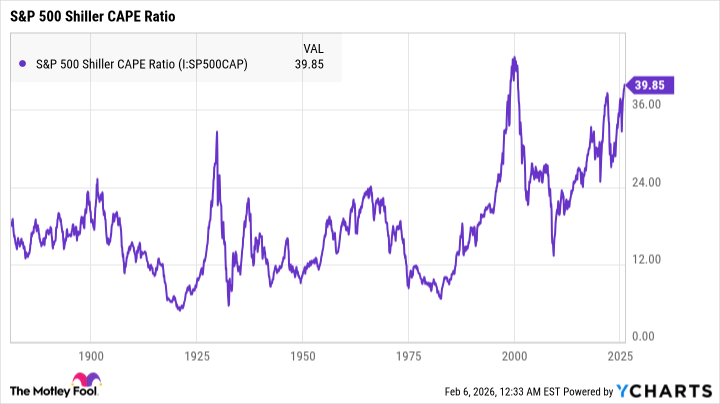
S&P 500 Shiller CAPE Ratio Chart

S&P 500 Shiller CAPE Ratio data by YCharts. CAPE Ratio = cyclically adjusted price-to-earnings ratio.

The second metric to watch is the Buffett indicator, which measures the ratio of U.S. gross domestic product (GDP) to the total market value of U.S. stocks. It was popularized by Warren Buffett, who explained in a 2001 interview with Fortune magazine how he used the metric to correctly predict the dot-com bubble burst.

Advertisement

“For me, the message of that chart is this: If the percentage relationship falls to the 70% or 80% area, buying stocks is likely to work very well for you,” he said. “If the ratio approaches 200% — as it did in 1999 and a part of 2000 — you are playing with fire.”

As of this writing, the Buffett indicator sits at 221%. The last time the metric neared 200% was in November 2021, just before stocks entered a bear market that would last nearly a year.

What should investors do right now?

No stock market metric is perfect, as past performance doesn’t predict future returns. Even if there are strong historical patterns suggesting a downturn could be looming, that doesn’t necessarily mean a crash, recession, or bear market is imminent.

Perhaps the best thing investors can do right now is ensure their portfolios are prepared for volatility, just in case. That involves double-checking that you’re only investing in stocks with strong fundamentals, such as:

  • Healthy finances: A company needs to be on a solid financial footing to survive an economic downturn. Shaky companies can still thrive when the market is surging, so stock price alone isn’t necessarily a sign of financial health. Now is a good time to comb through financial statements to review metrics such as profitability, debt, revenue growth, and other factors that can indicate whether a company is likely to survive tough economic times.
  • Competitive advantage: When the dot-com bubble burst in the early 2000s and much of the tech sector collapsed, the companies that survived were those that had a leg up over their peers. Organizations that didn’t offer anything unique or had nonviable business models crashed and burned, and the same could happen again if we face another significant downturn.
  • A strong leadership team: Sometimes, a company’s survival depends on the decisions by leadership during pivotal moments. Even a strong business may struggle if the executive team consistently makes poor choices, making this a key factor for long-term success.

The stronger your portfolio, the more likely it is that it will survive even the worst bear market or recession. By double-checking all your investments now, you’ll be prepared no matter what may lie ahead.

Advertisement
Continue Reading
Click to comment

Leave a Reply

Your email address will not be published. Required fields are marked *

This site uses Akismet to reduce spam. Learn how your comment data is processed.

Finance

By the Numbers: Financial report reveals scale of financial costs, growth

Published

on

By the Numbers: Financial report reveals scale of financial costs, growth

Following a year marked by financial turbulence, Northwestern’s financial report for fiscal year 2025 revealed the University’s struggles and growth as they navigated a tumultuous landscape in higher education.

The latest report detailed fiscal year 2025, which began Sept. 1, 2024 and ended Aug. 31, 2025. It did not include the University’s stipulated $75 million payment to the federal government, which was part of the agreement struck in November 2025.

According to the University’s 2025 financial report, net assets sit at $16.2 billion, up from 2024’s $15.6 billion. However, the University spent almost $148 million more than it brought in during fiscal year 2025. 


In the last five fiscal years, the University has increased steadily in operating costs for assets without donor restrictions.

Advertisement

Year-to-year increases in operating costs hovered around 10% in the past five fiscal years. Simultaneously, revenue growth has decreased year to year, from 12.8% between 2021 to 2022 to only 3.9% between 2024 to 2025.

Amanda Distel, NU’s chief financial officer, identified “rising benefits expenses, litigation, new labor contracts, and rapidly unfolding federal actions” as key challenges in fiscal year 2025 in the report.

Before the deal, NU invested between $30 to $40 million each month to sustain research impacted by the federal freeze, interim President Henry Bienen confirmed in an Oct. 24 interview with The Daily.

In an attempt to reduce costs, the University announced a switch in July to UnitedHealthcare from Blue Cross Blue Shield as the University’s employee health care administrator, effective Jan. 1. However, faculty and staff have reported increased out-of-pocket costs for certain services like mental health care.

Advertisement

Financial aid increased from $618.3 million in fiscal 2024 to $638.3 million in fiscal year 2025. Among undergraduate students in the 2024-25 school year, 15% are first-generation college students and 22% receive federal Pell Grants. According to the report, most families earning less than $70,000 per year attend at no cost, and most families earning less than $150,000 per year attend tuition-free.

Tuition is the second largest source of revenue behind grants and contracts. By the end of the fiscal year, the University held $778 million in outstanding conditional awards, an increase from fiscal 2024’s $713.5 million, according to the report. 

Distel wrote that the number of gift commitments above $100,000 reached its highest in University history, calling it a “strong year of philanthropic support.”

Donor funds are categorized by whether or not restrictions were imposed on the time, use or nature of the donation. In fiscal 2025, University net assets without donor restrictions totaled $9.59 billion, or 59.1%, while net assets with donor restrictions totaled $6.65 billion, or 40.9%, of total net assets.

Advertisement

The University’s investment in construction efforts saw an immense uptick from $275.2 million in fiscal 2024 to $750.5 million in fiscal 2025.

This cost is spread across multiple projects, such as Ryan Field, which started construction in 2024 and is slated to open October 2026. The project operates with a $862 million budget, including a $480 million contribution from the Ryan family.

The Ann McIlrath Drake Executive Center, Cohen Lawn and Jacobs Center renovations also continued during the fiscal year.

Email: [email protected] 

Related Stories:

Advertisement

The Daily Explains: How does Northwestern spend its money? 

Northwestern NIH, NSF grant cessations total more than $1 billion 

Northwestern announces 3.3% tuition increase ahead of 2025-26 academic year 

Advertisement
Continue Reading

Finance

When should kids start learning about money? Advice from local financial advisor

Published

on

When should kids start learning about money? Advice from local financial advisor

When should kids start learning about money, and preparing for adult expenses like rent, car payments, and insurance?

It’s a question asked recently by an ARC Seattle viewer.

We took the question to Adam Powell, Financial Advisor at Private Advisory Group in Redmond. Powell talked with ARC Seattle co-anchor Steve McCarron to share insights on the right age to form money habits, common financial mistakes parents unknowingly pass down to their children, and practical tips to set kids up for long-term financial success.

Find more ARC Seattle stories on our YouTube page.

Comment with Bubbles
Advertisement

BE THE FIRST TO COMMENT

Watch ARC Seattle weekdays from 7 to 10 a.m. and 10 to 11 p.m. on KUNS, The CW Network.

Continue Reading

Finance

Soft-saving era? Gen-Z embraces new financial trend that puts experiences over long-term planning

Published

on

Soft-saving era? Gen-Z embraces new financial trend that puts experiences over long-term planning

LOS ANGELES (KABC) — Many Gen-Zers are adopting a financial approach that prioritizes quality of life in the present, a trend that’s being called “soft saving.”

Bob Wheeler, a CPA, described the mindset as a shift in how young adults balance their current lifestyle with longterm planning.

“It’s really a financial approach of ‘I want to make sure I have a good quality of life, and I’m thinking about the future,’ but not as much as the present,” Wheeler said.

For many Gen Z consumers, that can mean spending more on experiences – like vacations or concerts – rather than saving for major purchases like a car or home.

Wheeler said the approach can offer emotional benefits.

Advertisement

“I think there are definitely benefits, I mean, less anxiety, feeling like life is what you want it to be, fulfillment, versus saving for later on,” he said.

Still, financial experts caution against ignoring longterm stability. Wheeler encouraged young workers to take advantage of employer-sponsored retirement plans.

“They’re not going to do the max. They’re going to do enough to make sure they’re getting the match from your employer, so maybe they’re doing 3% or 5%. Maybe they’re not maxing out their IRAs. Maybe they’re doing $2,500,” he said.

He also stressed the importance of building an emergency fund, typically enough to cover six months of expenses.

“I want people to enjoy their life now because tomorrow is not promised,” Wheeler said. “I also just really reiterate to them ‘and you need to have some money set aside because we don’t know.’”

Advertisement

But saving for a home may not be practical for everyone. In some places, renting can be cheaper, and tenants avoid maintenance costs.

Copyright © 2026 KABC Television, LLC. All rights reserved.

Continue Reading

Trending
