Entertainment
'What We Do in the Shadows' finale: All good things must end

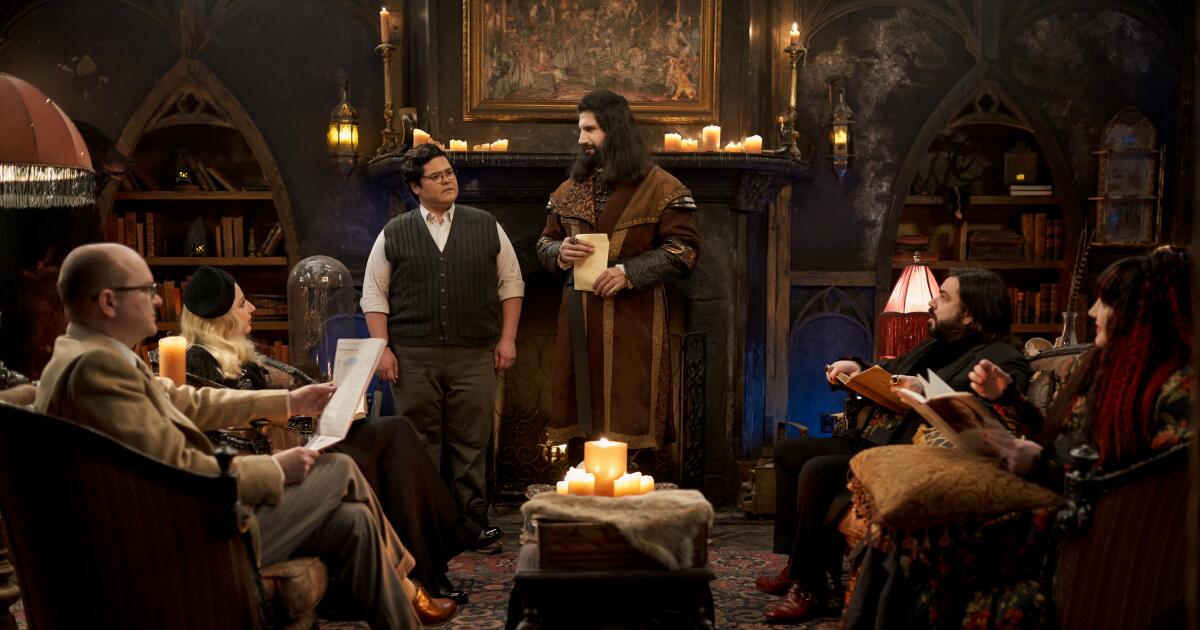
This article contains spoilers for the series finale of “What We Do in the Shadows.”
Can vampires be funny? After six seasons of “What We Do in the Shadows,” the answer is a resounding yes.
Like the 2014 film by Taika Waititi and Jemaine Clement that it is based on, the series is a mockumentary that follows a group of vampire roommates, Laszlo Cravensworth (Matt Berry), Nadja of Antipaxos (Natasia Demetriou), Nandor the Relentless (Kayvan Novak) and Colin Robinson (Mark Proksch), and their familiar Guillermo de la Cruz (Harvey Guillén). The vampires here are much like the ones you’ve seen in movies and read about in books: they’re immortal, blood-sucking creatures who kill mercilessly. But the series, like the film, shows that vampires are also multidimensional — vulnerable, emotional, funny, absurd — and completely out of place in the modern world. “Shadows” was often at its best when we saw the characters trying to blend in and act like everyday citizens of Staten Island, N.Y.
But what differentiated the FX series from its source material was how it expanded the vampire universe and our understanding of it. Case in point: the creation of energy vampires like Colin Robinson, who feed on emotional energy instead of blood. It was the perfect analogy to our tech-driven, capitalist, corporate society where meetings, office small-talk and bureaucracy often feel like they can drain us of our life force.
Now, the show is coming to a close, and not just in our world. In the “Shadows” universe, Guillermo and the vampires are saying goodbye to the documentary camera crew that have followed them for the past six years. For the vampires, it’s just another day as immortal beings; we learn they’ve been through this before, having shot a documentary in the 1950s. But for Guillermo, it’s bittersweet; he’s trying to come to terms with the news, what it means and what’s next for him.
The other question it raises: How do you come up with a perfect ending for a show? Guillermo ponders this and the finale plays with it. We see the boom mics, cameras and operators emerge from behind the scenes and a clapperboard close the documentary, but a twist at the end of the episode opens the possibility for more — will Guillermo start a new life as a vigilante with Nandor or leave the vampires behind? We don’t know for certain, but for now, Times staff writer Tracy Brown and television editor Maira Garcia discuss the finale of the series, favorite moments and what made the comedy so special.
Will familiar and vampire become vigilante and sidekick? Nandor (Kayvan Novak) and Guillermo (Harvey Guillén) in their superhero outfits.
(FX)
Maira Garcia: All good things must come to an end, to quote Nadja of Antipaxos, or was it Nelly Furtado who said that originally? In any case, we’ve come to the end of the road for “What We Do in the Shadows,” one of my favorite comedies of the past decade. Tracy, you’ve heard me wax on about this show and my love for Jackie Daytona and Matt Berry probably more than you ever wanted to hear, but its quirkiness, ongoing jokes and macabre humor were always my kind of humor.
Now that the finale has aired, I’m curious to hear what you thought of the episode and how it ties things up? We’ve seen the characters occasionally break the fourth wall by addressing the camera directly or acknowledging the documentary crew, but this was a wrecking ball.
Tracy Brown: I wouldn’t have had it any other way. I thought the episode was a very wild and fitting “Shadows” way to wrap things up. One of the things I’d asked showrunner Paul Simms before the season started was whether the finale was a period or more like a semicolon so I knew we were getting an episode more like the latter. Still, I wasn’t sure what to expect because series finales are tough — just look at all the best/worst lists that have been published. It was fun to see the show just skewer the whole idea of endings and closure and sticking the landing. Of course Guillermo got caught up in his feelings about the “documentary” coming to the end because it’s a very human thing to reflect on the crossing of milestones and to want the passage of time to mean something. And he experienced a lot of growth and change over the course of the show. But for the vampires, it’s just any other day. One of my favorite gags in the episode was the vampires revealing that this documentary (a.k.a. the show) wasn’t even the first time they’d let a film crew into their lives. The unreleased Maysles brothers film was great both thematically and as a way to revisit some favorite moments from the past.
How about you, Maira? What did you think of the episode? More importantly, how excited were you for Jackie Daytona’s return?

The vampires in a documentary — in 1958. (Russ Martin/FX)

Jackie Daytona from Tucson, Arizonia, has been around awhile. (Russ Martin/FX)
Garcia: I was thrilled. Jackie’s been around town for awhile, as we learn. I think the nod to “The Usual Suspects” was another moment that had me in stitches (and don’t laugh, but it took me a minute to realize what I was watching — the movie came out in 1995! I can barely remember what I had for lunch.) I was curious how they would tie everything together, considering so much of this season has been about Guillermo — played by Harvey Guillén, a brilliant actor who I hope we see more of soon — beginning to let go of the roommates/coven that he’s been with for so long. First, he decides he no longer wants to be a vampire, and he gets a corporate job in finance, but that ends up not working out either, as we see in the penultimate episode. In some ways, he still seems to be finding his way, but it’s true, he’s grown so much. He went from a meek, subservient familiar to realizing he has Van Helsing blood, and has the ability to lay waste to vampires (which he does, to Laszlo, Nadja, Colin and Nandor’s benefit), to the infinitely more confident person he is now. His arc, including when he came out to his family in Season 4, was handled with care and it showed that you can be sensitive and kind, but also a no-holds-barred vampire killer when you need to be.
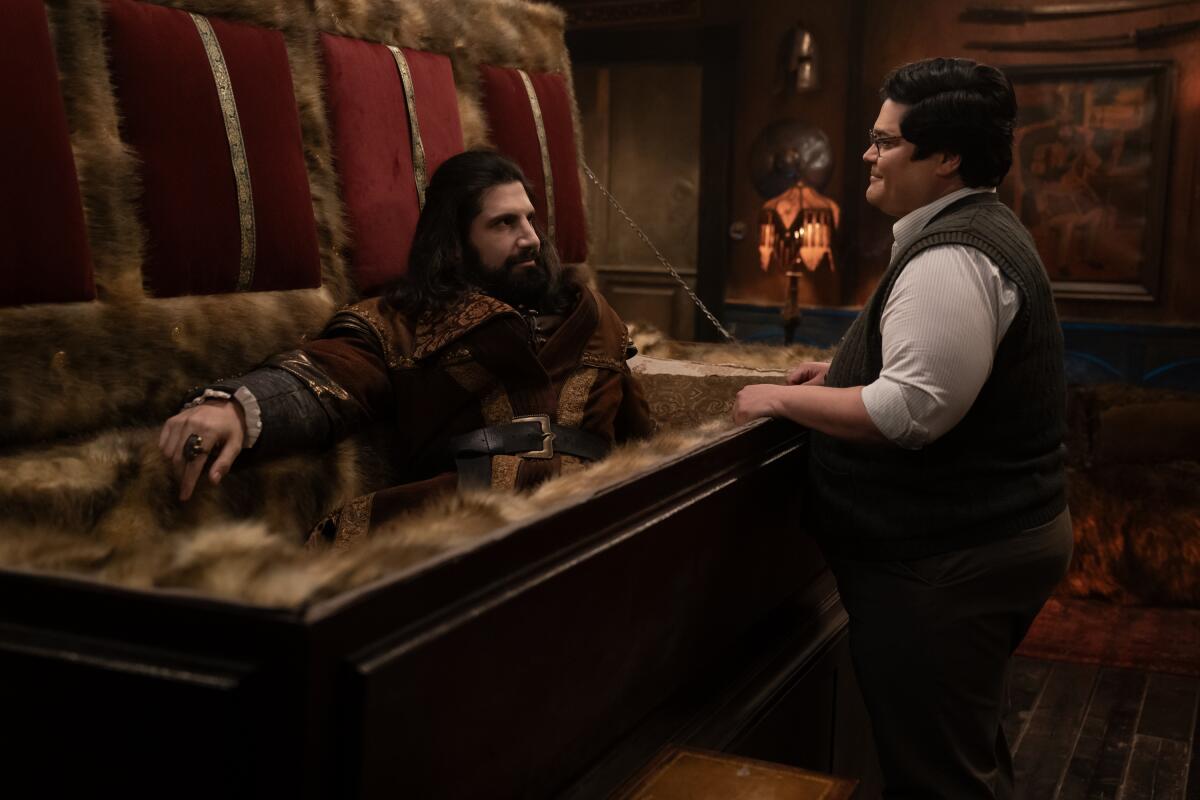
Nandor (Kayvan Novak) and Guillermo (Harvey Guillén) in one of the final scenes from the finale of “What We Do in the Shadows.”
(Russ Martin/FX)
Brown: Guillermo really was the beating heart of the show — literally! And I laughed when the Guide (Kristen Schaal) suggested turning Guillermo into a vampire for their perfect ending because it was a perfect nod to how most people probably expected the show to end before Season 5 happened. But I think for me that arc in particular really highlights what was special about this show. Guillermo standing up for himself to finally make his dreams come true on his own terms since his (toxic) boss had strung him along for years, only to realize the big life change wasn’t for him and that being OK. It was something very relatable wrapped up in the unabashedly silly vampire trappings of the show. “Shadows” was proudly a comedy through and through but it handled its deeper themes with care. Like the time in Season 3 when Nadja’s ghost felt so neglected that it jumped from her doll to possess various other things including a giant inflatable rat. A hilarious lesson on the importance of self care. But that levity and absurdity was really the show’s superpower at a time when a lot of the other buzzy comedy shows are making us cringe or cry.
Garcia: Absolutely. Sometimes I just need to laugh, and this show consistently delivered without being too heavy-handed. And each character was more than the face they put on; for example, Laszlo was a self-described lothario, but he was also the guy who became a father figure for Colin Robinson when he rebirthed himself, and he created the Monster, who he cares for like a son. Plus, we got a cameo this season from Steve Coogan, as Laszlo’s father Lord Roderick, which showed the complicated relationship between them, and again, showcases the depth of our vamps. Similarly with Nandor, who was once a great Ottoman warrior, we see that he is really just a big softie looking for love, romantic and platonic.
Tracy, you spent some time with the cast this year in the lead up to the final season. They seem like a group with a lot of chemistry from what we’ve seen on screen, and each has comedic chops that work well together. What did they say about the show coming to a close?
Brown: I got to talk to them right around the time that they would usually be heading to Toronto to film the next season, so they were all feeling a little nostalgic and mentioned how it was weird that they weren’t getting ready for more “Shadows.” The cast is really close so they shared how they had just been texting each other “I miss you” or even messages joking about their flight being delayed or making plans in Toronto as if they were about to go shoot another season. I’ll let you guess who was sending what. But the overall sentiment was love — for the show, for each other and for the fans. I think Natasia Demetriou said it best: “There wasn’t one season where I didn’t think at least 10 times a day, ‘I cannot believe this is my job. I cannot believe I get to do this.’ … I’m going to miss the show so much.” I’m going to miss it, too.
Garcia: That is genuinely heartwarming. I love it when a cast becomes real-life friends. But I’d be remiss if I didn’t mention the many guest stars on this series, a who’s who of comedy appeared over the six seasons. We even saw OG “Shadows” vampires Jemaine Clement, Taika Waititi and Jonny Brugh on the show. But it was the ongoing appearances of Haley Joel Osment as Topher and Benedict Wong as Wallace the necromancer that were among my favorites. Who were some of yours?

Matt Berry in the Season 5 episode “Pride Parade.” (Russ Martin/FX)

Vanessa Bayer and Mark Proksch in Season 5’s “The Campaign.” (Russ Martin/FX)
Brown: It’s tough to keep it to a short list but I’ll go with Vanessa Bayer as emotional vampire Evie Russell and, of course, Mark Hamill as Jim the Vampire. And Doug Jones as the Baron was my favorite recurring guest star. If we’re talking cameos, my absolute favorite moment was when Sofia Coppola, Phoenix’s Thomas Mars and Jim Jarmusch showed up as themselves in Nadja’s vampire nightclub. The vampire councils were great but I laugh at that scene every time. And since we’re reminiscing, I have to give a shout to Season 5’s “Pride Parade,” about the vampires helping Laszlo’s human buddy Sean appeal to the “LGBTQLMNOP community” to help his campaign, and Season 2’s “Ghosts,” which introduces Nadja’s human ghost that possesses her doll, as a couple of my favorite episodes. What about you?
Garcia: The Nadja nightclub storyline was so good, from start to finish. It’s so hard to pick. But since you mention Vanessa Bayer, that episode from Season 5 with the energy vampire council is a recent favorite. Evie and Colin’s meeting with them is the equivalent to the most painful Zoom meeting you’ve ever been on at work, where someone doesn’t know how to mute or notification pings keep interrupting the conversation or someone is trying to fix a tech problem as everyone else waits. It is breathtaking in its similarities and that feeling you get, like you just died inside a little. I’ve never seen anything capture that feeling so closely.
I think another favorite for me is the finale of Season 3, after Colin Robinson dies and it seems like everyone is going their separate ways, only for there to be a twist: Colin is alive. There’s also an earlier episode from Season 3, where Nandor joins a wellness cult, that’s great. From this final season, the ninth episode is a standout, where Guillermo’s cousin Miguel, played by Frankie Quiñones, arrives to help him battle other vampires, including barista vampires — ahem, I mean artists and writers. It demonstrates how intricate the vampiric world is on this show. Oh, and it’s hilarious.
As much as I wish this show would go on, ending on a high note is good, though I’ll miss hearing “You’re Dead” any time I started up a new episode.
Brown: At least Season 6 gave us the Matt Berry cover.







By John E. Finley-Weaver in San Diego
(SDJW photo)
My wife convinced me to watch a movie about ping pong. And, having acquiesced to her proposal, I dove face-first into a kettle of willful ignorance, knowing only that Some Guy Timothée Chalamet of Dune 1 and Dune 2 and A Complete Unknown (another of her suggestions) was the lead, and that what we were soon to watch might move me. Or, at the very least, that it might entertain me.
The movie did not disappoint.
In fact, Marty Supreme is the absolute best film about table tennis that I have ever seen. And I’ve seen all of one of them so far, although I am aware of and have seen a few clips of Robert Ben Garant’s Balls of Fury.
But, holy mackerel, Marty Supreme is not just a movie about some lanky goniff whose inner craving for focused dominance in one specific realm compels him to pursue a shiny, sportsball “X” trophy, culminating in a crowd-pleasing, applause roar of triumph . . . a n d . . . cut to the end credits, supplemented by a catchy, happy song . . . . “Honey, let’s get to the restroom, fast!”
Uh-uh. Nay. Marty Supreme is a lived-in world (like the Star Wars universe, but way different and way better) populated by tactile characters, each of whom has their own, inferred history and glob of yearnings. And they have warts. Lots of warts. Warts and all.
Marty Mauser, the Jewish protagonist of Marty Supreme, is a plucky ping pong imp and shoe salesman, in addition to being a nimble and loquacious malarkey artist. He is also a shockingly-gawdawful, verbal bastard person to his mother, played by Fran Drescher, who left her specific, discount Phyllis Diller voice in the dustbin of screen history where it belongs, much to the contentment of my sensitive ears.
Marty Mauser is even more a womanizer and a thief. And he is a delight. And, because boring, nice boys don’t have movies made about them, he does something for his ema that is chutzpahdik, illegal, vandalicious, unhistorical, and tear-inducingly sweet.
And again, dear Reader, I went into this movie knowing most of nothing about it. If you are like me, fear not: I shan’t disclose the plot.
Marty Mauser’s partners in life and “crime” are the facially-delicious Rachel, played by Odessa A’zion and best bud Wally, performed by Tyler Okonma, each complementarily savvy to Marty’s needs and wants.
The remainder of the film’s actors is a gathering of casting directorial genius: Kevin O’Leary, the that guy from some reality television show that I will never watch; Gwyneth Paltrow; director Abel Ferrara; Sandra Bernhard, my lukewarm, high school “bad girl” crush; Géza Röhrig, whose character is seven year’s fresh from a Nazi death camp and hauntingly beautiful; Koto Kawaguchi, the movie-world champion and legally-deaf Tommy-esque pinball wizard of ping pong and real-world champion of the game; Pico Iyer, Indo-Limey travel writer, meditator, and inveterate outsider; George Gerwin, a very retired basketball player; Ted Williams and his golden voice; Penn Jillette, agrarian and blasty; Isaac Mizrahi, obviously “out” in 1952; and David freaking Mamet.
Gush.
And great googly woogly. They all do their jobs so gosh darn well that I don’t notice them as actors acting.
And then, as I have done since I was a child, for science fiction books, for television, and for movies, I recast, in my mind’s eye, all of the characters and their associated journeys as different people. I made an all-Negro cast of the film. And it worked. No radical changes to the script were necessary. I did the same for a spunky, mid-West farm girl as the lead. That worked. I tried again, using a Colombian lesbian. That worked too.
I praise the cinematic vision of Director Josh Safdie. I praise the wide accessibility of the script he co-wrote with Ronald Bronstein: Thank you. The expected plot points, the tropes of moviedom, the “inevitable” happenings of standard movies never really happened. Marty Supreme zaggled and Zelig’d when I expected it to zig.
A lesser film would not have surprised me in most of its story structure, its scenes, or its character paths. A lesser film would have had me in my seat, either smugly prognosticating the next events, or non-thinkingly rapt for entire scenes. This film, this masterpiece of storytelling and visual and aural execution outsmarted me. It outsmarted my movie mind, and for that, I am grateful.
Marty Supreme is a very Brooklyn Jewy movie, but it sings from the standard Humanity of us all, to each of us. And that is movie making at its finest.
*
Cinema buff John E. Finley-Weaver is a freelance writer based in San Diego.

Brigitte Bardot, the French actor idealized for her beauty and heralded in the midcentury as the prototype of liberated female sexuality, has died at 91.
Long withdrawn from the entertainment industry, Bardot died at her home in southern France, Bruno Jacquelin of the Brigitte Bardot Foundation for the protection of animals confirmed to the Associated Press. He gave no cause of death. Bardot had dealt with infirm health in recent years, including hospitalization for a breathing issue in July 2023 and additional hospital stays in 2025.
Bardot was known for being mercurial, self-destructive and prone to reckless love affairs with men and women. She was a fashion icon and media darling who left acting at 39 and lived out the rest of her years in near seclusion, emerging periodically to champion animal rights, lecture about moral decay and espouse bigoted political views.
And, as if in protest of her famed beauty, Bardot happily allowed herself to age naturally.
“With me, life is made up only of the best and the worst, of love and hate,” she told the Guardian in 1996. “Everything that happened to me was excessive.”
In her prime, Bardot was considered a national treasure in France, received by President Charles de Gaulle at the Élysée Palace and analyzed exhaustively by existentialist philosopher Simone de Beauvoir. She was the girl whose poster adorned the bedroom of a teenage John Lennon.
While Marilyn Monroe was playing it coy, Bardot was forthright and free about her sexuality, sleeping with her leading men without apology, sweaty and writhing barefoot on a table in the controversial 1956 film “…And God Created Woman.” Though many of her films were largely forgettable, she projected a radical sense of self-empowerment for women that had a lasting cultural influence.
Born Sept. 28, 1934, in Paris, the daughter of a Parisian factory owner and his socialite wife, Bardot and her younger sister were raised in a religious Catholic home.
Bardot studied ballet at the Paris Conservatoire and, at her mother’s urging, pursued modeling. By 14, she was on the cover of Elle magazine. She caught the eye of filmmaker Marc Allegret, who sent his 20-year-old apprentice, Roger Vadim, to locate her.
Vadim and Bardot began a years-long affair during which he cultivated the sex-kitten persona that would seduce the world. But Bardot wasn’t one to be cultivated. As Vadim once said, “She doesn’t act. She exists.”
Bardot married Vadim at 18, and that same year he directed her in “…And God Created Woman,” as a woman who falls in love with her older husband’s younger brother. The film, which prompted moral outrage in the U.S. and was heavily edited before it reached theaters, made Bardot a star and an emblem of French modernity.
“I wanted to show a normal young girl whose only difference was that she behaved in the way a boy might, without any sense of guilt on a moral or sexual level,” Vadim said at the time.
In real life, Bardot left Vadim for her costar Jean-Louis Trintignant. She went on to master a comic-erotic persona in the popular 1957 comedy “Une Parisienne” and portrayed a young delinquent in the 1958 drama “Love Is My Profession.”
By 1959, she was pregnant with the child of French actor Jacques Charrier, whom she married as a result. Together they had a son, Nicolas.
In Bardot’s scathing 1996 memoir, “Initiales B.B: Mémoires,” she details her crude attempts to abort the child, asking doctors for morphine and punching herself in the stomach. Nine months after the baby was born, she said, she downed a bottle of sleeping pills and slit her wrists, the first of several apparent suicide attempts during her life. When Bardot recovered, she gave up custody of her son and divorced Charrier.
“I couldn’t be Nicolas’ roots because I was completely uprooted, unbalanced, lost in that crazy world,” she explained years later.
Bardot earned her greatest box-office success in the 1960 noir drama “The Truth,” playing a woman on trial for the murder of her lover. Her best performance likely came in Jean-Luc Godard’s acclaimed 1963 melancholy adaptation “Contempt,” as a wife who falls out of love with her husband. She was later nominated for a BAFTA award for her performance as a circus entertainer turned political operative in the 1965 comedy “Viva Maria!”
All the while, though, Bardot courted drama and lived large.
While she was married to German industrialist Gunter Sachs, she had an affair with French pop star Serge Gainsbourg. He wrote Bardot the erotic love song “Je t’aime … moi non plus,” which went on to become a hit by Donna Summer, altered and retitled “Love to Love You Baby.” By 1969, she had divorced Sachs and was romantically linked to everyone from Warren Beatty to Jimi Hendrix.
The celebrity life eventually exhausted Bardot, and she grew to fear that she’d end up dying young like Marilyn Monroe or withering away in public view like Rita Hayworth. Though she exuded confidence, she admitted in her memoir that she battled depression as she sought to juggle the many moving pieces of her chaotic life.
“The majority of great actresses met tragic ends,” she told the Guardian. “When I said goodbye to this job, to this life of opulence and glitter, images and adoration, the quest to be desired, I was saving my life.”
Nearing 40, she quit acting and spent the rest of her life bouncing between her Saint-Tropez beach house and a farm — complete with a chapel — outside Paris. She devoted herself to the Brigitte Bardot Foundation for the Welfare and Protection of Animals.
As an animal rights activist, her list of enemies was long: the Japanese for hunting whales, the Spanish for bullfighting, the Russians for killing seals, the furriers, hunters and circus operators.
At her home in Saint-Tropez, dozens of cats and dogs — along with goats, sheep and a horse — wandered freely. She chased away fishermen and was sued for sterilizing a neighbor’s goat.
“My chickens are the happiest in the world, because I have been a vegetarian for the past 20 years,” Bardot said.
In 1985 she was awarded the Legion d’Honneur, France’s highest civilian decoration, but refused to collect it until President François Mitterrand agreed to close the royal hunting grounds.
In 1992 she married Bernard d’Ormale, a former aide to Jean-Marie Le Pen, leader of France’s far-right National Front and frequent candidate for France’s presidency. Later, Bardot became an ardent supporter of Le Pen’s daughter Marine, leader of France’s anti-immigration far right.
Two French civil rights groups sued Bardot for the xenophobic and homophobic comments she made in her 2003 book, “A Cry in the Silence,” in which she rails against Muslims, gays, intellectuals, drug abusers, female politicians, illegal immigrants and the “professionally” unemployed. She was ultimately fined six times for inciting racial hatred, mostly while speaking out against Muslims and Jews. She was fined again in 2021 over a 2019 rant wherein she dubbed the residents of Réunion, a French Island in the Indian Ocean, “degenerate savages.”
“I never had trouble saying what I have to say,” Bardot wrote in a 2010 letter to The Times. “As for being a little bunny that never says a word, that is truly the opposite of me.”
Bardot stirred controversy again in 2018 when she dismissed the #MeToo movement as a campaign fueled by a “hatred of men.”
“I thought it was nice to be told that I was beautiful or that I had a nice little ass,” she told NBC. “This kind of compliment is nice.”
She remained firm in those views in the final year of her life, decrying the societal shaming of playwright-comedian-actor Nicolas Bedos and actor Gérard Depardieu, who were both convicted of sexual assault. “People with talent who grab a girl’s bottom are thrown into the bottom of the ditch,” she declared in a 2025 TV interview, her first in 11 years. “We could at least let them carry on living.”
As she aged, Bardot mostly kept to herself, content to do the crossword puzzle when the newspaper arrived, tend to her menagerie and mail off hotly written pleas to world leaders to halt their animal abuses. She was largely vague when asked if she was still married to D’Ormale.
“It depends what day it is,” she said, laughing gently.
Piccalo is a former Times staff writer. Former staff writer Steve Marble contributed to this report.

The Times of India
Dec 28, 2025, 5:26 PM IST
3.0
Story: Eesha centres on four friends who take it upon themselves to expose fake godmen and challenge blind belief systems that exploit fear and faith. What begins as a rational, investigative effort soon places them in an unfamiliar and unsettling environment, where unexplained incidents begin to blur the line between superstition and the supernatural. Review: Set largely within a confined, eerie space, the film attempts to merge social commentary with a traditional horror framework, positioning belief itself as the central conflict. Director Srinivas Manne establishes the premise with clarity, and the initial idea holds promise. The early portions focus on setting up the group dynamic and their motivation, grounding the narrative in realism before introducing supernatural elements. However, the film takes time to find its rhythm. The first half moves sluggishly, spending too long on familiar horror mechanics such as sudden loud noises, jump scares and predictable scare setups, which reduces their effectiveness over time.Performance-wise, Hebah Patel as Nayana and Adith Arun as Kalyan deliver earnest and committed performances, lending credibility to the film’s emotional core. Their reactions and emotional beats feel genuine, helping the audience stay invested despite the slow pace. Siri Hanumanth and Akhil Raj Uddemari support the narrative adequately, though their characters are written with limited depth, offering little room to leave a lasting impression. The supporting cast complements the leads well and helps maintain engagement during stretched sequences.Technically, the film benefits from effective sound design and atmospheric visuals that occasionally succeed in creating tension. The supernatural mystery does manage to grip attention in parts, particularly when the film leans into mood rather than shock value. However, the prolonged buildup works against the story, dulling the impact of a key twist in the climax that could have been far more effective with tighter pacing.While Eesha is driven by a unique concept that questions blind faith through a horror lens, the execution falls short of its potential. A more polished script and sharper screenplay might have elevated the film into a more compelling and consistently chilling experience.— Sanjana Pulugurtha

For those who help the poor, 2025 goes down as a year of chaos

Apex predator threatening Northwest salmon sparks rare bipartisan push to ‘kill more’

McDonald’s locks doors to keep out individuals who present ‘a risk’ in crime-ridden Minneapolis area

Missing 19-year-old Camila Mendoza Olmos believed to be ‘in imminent danger,’ Texas sheriff says

Murder in small-town America: The crimes that tore quiet communities apart in 2025

Florida High School Football Rankings: Top 25 teams – Oct. 21

Cleary's 21 help Le Moyne down Central Connecticut State 69-64 in OT

How old is Bo Nix? What to know about Oregon quarterback ahead of 2024 NFL Draft

99th annual Pony Swim held in Virginia

Video: ‘It Didn’t Have to Happen This Way:’ U.Va. Faculty Call for Review of Police Response to Protests
For those who help the poor, 2025 goes down as a year of chaos

Marjorie Taylor Greene criticizes Trump’s meetings with Zelenskyy, Netanyahu: ‘Can we just do America?’

US visa ban targets ex-Commissioner Breton over alleged censorship

‘Bomb cyclone’ forecasted to bring heavy snow, blizzard conditions and dangerous travel

The biggest losers of 2025: Who fell flat as the year closed
-
 Entertainment4 days ago
How the Grinch went from a Yuletide bit player to a Christmas A-lister
-

 Connecticut4 days ago
Snow Accumulation Estimates Increase For CT: Here Are The County-By-County Projections
-
 Entertainment5 days ago
Pat Finn, comedy actor known for roles in ‘The Middle’ and ‘Seinfeld,’ dies at 60
-

 Milwaukee, WI5 days ago
16 music and theater performances to see in Milwaukee in January 2026
-

 World1 week ago
Putin says Russia won’t launch new attacks on other countries ‘if you treat us with respect’
-

 Indianapolis, IN2 days ago
Indianapolis Colts playoffs: Updated elimination scenario, AFC standings, playoff picture for Week 17
-

 Southeast3 days ago
Two attorneys vanish during Florida fishing trip as ‘heartbroken’ wife pleads for help finding them
-

 World3 days ago
Snoop Dogg, Lainey Wilson, Huntr/x and Andrea Bocelli Deliver Christmas-Themed Halftime Show for Netflix’s NFL Lions-Vikings Telecast