Entertainment
Coachella 2026: How premium brands are cashing in on a ‘consumer wonderland’

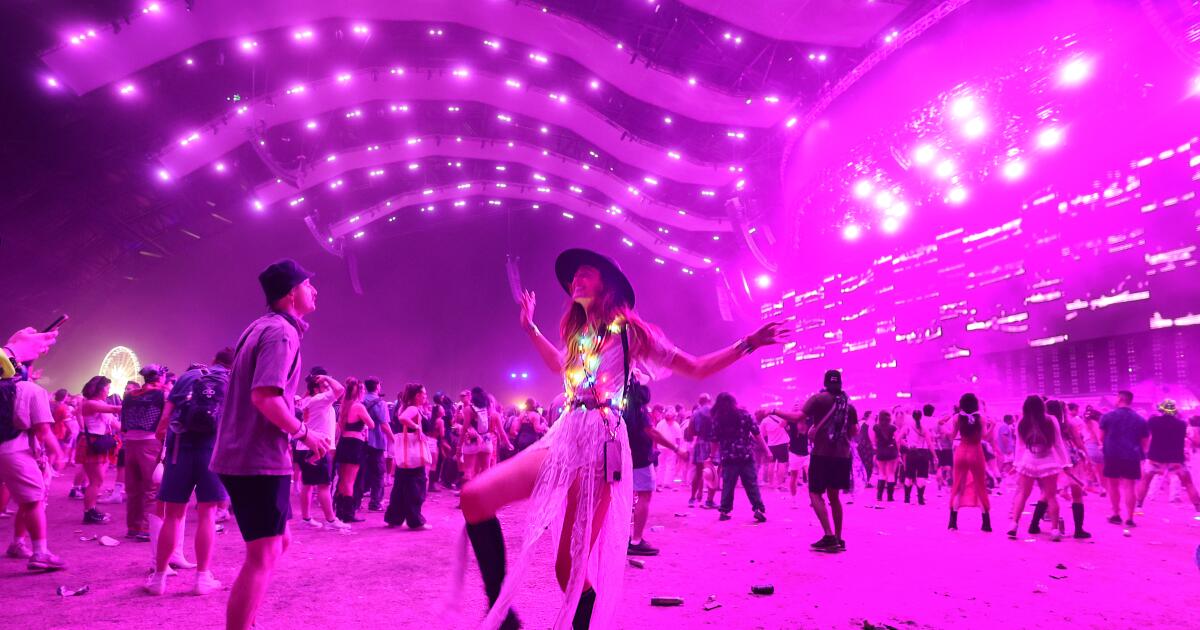
Coachella revelers are getting ready to pitch their tents, performing artists are running through their final rehearsals and thousands of global brands are gearing up for what will be one of the biggest content-making weekends of the year.
What began as a grungy early 2000s desert fest has since evolved into a high-end global cultural phenomenon. The Coachella Valley Music and Arts Festival at the Empire Polo Club in Indio is regarded as one of the largest of its kind in the world, drawing more than 125,000 people a day across two consecutive weekends in April.
As the festival has grown, so too has the allure for big brands like Guess, Rivian, Soho House and Kendall Jenner’s 818 Tequila looking to capitalize on Coachella as a marketing megaphone.
Both off and on the festival grounds, these brands host a series of parties, pop-ups and other VIP events that lavish celebrities, influencers and artists with premium experiences. The hope is they will then share those experiences with their large online audiences.
The Absolut Heat Haus, Soho House’s VIP pop-up The Hideout, and the Coca-Cola Pop Shop are just a few of the brand activations that aim to build a rapport with the festival audience.
This turn toward a high-end consumer market — which reflects a broader trend among many retailers to cater to the affluent — hasn’t been without its critics, especially from music purists who view the festival as overly commercial.
But in many ways, the festival creates the perfect marketing opportunity for global brands to reach Gen Z consumers, who accounted for approximately 17% of total global consumer spending of $57.6 trillion in 2024, according to Nielsen.
Music Fans at the “Do LAB” at the 2025 Coachella Valley Music and Arts Festival.
(Allen J. Schaben/Los Angeles Times)
“People come to Coachella with the idea in mind that brands will bring their best foot forward. Not only are they looking for their favorite, tried-and-true brands to be there, but they’re also looking at what’s the next big thing,” said Jessica Lanzon, director of partnerships and experiential at Ciroc.
The vodka maker offers the Ciroc Athletic Club, an invite-only pop-up that includes a padel tournament and many luxury amenities, like customized merch and bottomless cocktails.
Marc Lotenberg, the founder and chief executive of Dorsia, a members-only platform for exclusive restaurant reservations, estimates brands can spend up to tens of millions of dollars at Coachella.
The biggest global stage
“It’s Coachella, then it’s everything else,” said Lotenberg. “Nothing else compares to the amount of eyes that you get during Coachella. It’s the biggest global stage.”
Dorsia hosts the Zenyara party series, an exclusive after-hours gathering that transforms the private lakeside estate into a nightclub.
The company helped introduce Nobu to the festival last year. The famed Japanese restaurant is returning to this year with meals starting at $375 per person.
Dorsia also offers suites at Coachella’s main stage that start at $70,000 per weekend and accommodate 10 guests who will get backstage access, dedicated service and premium amenities.
“There’s no ceiling when it comes to how much people are willing to pay when it comes to experiences,” Lotenberg said.

Music fans at the 2025 Coachella Valley Arts and Music Festival in Indio.
(Allen J. Schaben/Los Angeles Times)
Some of Coachella’s most elite attendees won’t spend their day at the actual festival, choosing instead to hop between the many exclusive day parties, powered by brands like Revolve.
Over the last decade, the Cerritos-based online fashion retailer has hosted its own mini-festival featuring A-list performers and a star-studded guest list. Last year, Grammy-winning rappers Lil Wayne and Cardi B performed. The off-site festival held in the Coachella Valley is invite-only and hosts around 2,000 people.
“It was quite simple. We saw the impact pretty immediately in terms of traffic to the site and conversion sales,” said Raissa Gerona, chief brand officer for Revolve. “Because we’ve been doing it for so long, we have become the destination … to shop for all things festival and not just Coachella.”
It’s not all about high fashion and luxury mansions. The spirit of outdoor camping is in Coachella’s DNA. The nature-themed boutique hotel company AutoCamp and electric-truck maker Rivian have partnered up for Camp Rivian.
The companies are hosting a curated group of influencers and media partners to stay at a pop-up campsite featuring AutoCamp’s modernized Airstreams. Invitees get the opportunity to test drive Rivian’s newest R2 SUV to the festival and indulge in the communal glamping site.
AutoCamp’s Chief Operating Officer, Bryan Terzi, said it felt like the right moment to try out a deluxe festival camping concept.

People at the flower installation at the 2025 Coachella Vally Arts and Music Festival in Indio.
(Allen J. Schaben/Los Angeles Times)
“People would really get it because it’s happening at Coachella,” he said. “I don’t know if this type of experience would really work at other smaller festivals like Austin City Limits.”
L.A.-based clothing retailer Guess is going all-in on the accommodations with its Guess Compound. The denim brand rents out ten of the valley’s most luxurious villas, hosts up to 60 people, provides high-end amenities like IV drips, massage therapy and an onsite coffee pop-up from La La Land and puts on exclusive after-parties.
Nicolai Marciano, the chief business development officer at Guess, said the effort is about creating more brand equity and building relationships within Coachella’s creative community.
“There’s a lot of different types of talent from musical artists performing to people from reality TV shows and people that make great content — when you put them all together, it’s exciting to watch as an end consumer,” Marciano said.
Claudio Bravo, of Bravo Luxury Retreats, is the chief executive behind the private luxury community next to the festival that hosts Guess. The property contains 16 villas with more than 100 bedrooms, as well as a standalone 10-acre estate set aside for high-end stays and brand activations.
During festival season, Bravo charges around $150,000 for a weekend at one of the villas. He sells out every year, up to six months in advance, catering to wealthy individuals and corporate clients.
“These houses are very luxury, very modern. You feel like you are in a resort,” said Bravo. “I built these houses especially for this – like I was building a hotel.”
Bravo is developing another 14-villa project in nearby La Quinta, which hosts annual professional golf events.
Walker Drawas, a brand marketing agency which has worked at Coachella for years, is involved in six events at the festival, including Kendall Jenner’s “818 Outpost.”
“Brands today are starved for content and starved for news,” said Adam Drawas, co-founder of the agency. “The consumer needs to engage with newness and new content so many times a day, and so brands really need a content wonderland that can give them a big bank of content.”
Sean Breuner, the chief executive of luxury rental company Avant Stay, said at each of their properties, renters will interact with products and amenities from 15 to 20 brands — many of them in the fridge — seeking out high-end consumers.
VIPs expect a private chef, a driver to take them back and forth to the festival grounds or auxiliary events, private security, IV drips provided at home, an on-call cleaner and private tennis or pickleball lessons.
“The majority of festivals you go to don’t have art installations or people who are dressed to the nines in festival outfits,” Breuner said.
Drawas said he believes the market is only going to keep expanding.
“This began in music. It transitioned into fashion,” added Drawas. “Now it’s just a consumer wonderland.”



Movie Reviews
BAFTA Film Awards Review of Tourette’s Fiasco Finds “Weaknesses” in Planning and Crisis Procedures, But No “Malicious Intent”

An independent review of the BAFTA Film Awards has found a “number of structural weaknesses” in planning, escalation procedures, and crisis coordination before John Davidson‘s Tourette’s outburst.
Davidson, an executive producer on the BAFTA-winning I Swear, dominated headlines for weeks after involuntarily shouting the n-word as Michael B. Jordan and Delroy Lindo presented the award for best visual effects at the 79th British Academy Film Awards on Feb. 22.
The BBC has had its own questions to answer after airing the slur despite the two-hour tape delay, and just this week also ruled the incident a breach of the broadcaster’s editorial standards. Chief content officer Kate Phillips has maintained the breach was “not intentional,” though former director-general Tim Davie was unable to say why the ceremony remained available to stream on BBC iPlayer 15 hours after the event.
On Friday, a review commissioned by the BAFTA board and carried out by RISE Associates concluded its findings on what happened and what must change. Sent to The Hollywood Reporter, the review identified “a number of structural weaknesses” across the British Academy’s planning and crisis management.
“However,” said a note from the BAFTA board, “it did not find evidence of malicious intent on the part of those involved in delivering the event. We accept its conclusions in full.”
The board continued: “We apologize unreservedly to the Black community, for whom the racist language used carries real pain, brutality, and trauma; to the disability community, including people with Tourette Syndrome, for whom this incident has led to unfair judgement, stigma, and distress; and to all our members, guests at the ceremony and those watching at home. What was supposed to be a moment of celebration was diminished and overshadowed.”
The statement added: “We have written to those directly impacted on the night to apologize.”
The review is clear that while it is “not a failure of intent,” BAFTA’s planning and processes “have not kept pace with its diversity and inclusion goals.” The board also admits they did not “adequately anticipate or fully prepare for the impact of such an incident in a live event environment and as a result our duty of care to everyone at the ceremony and watching at home fell short.”
Work is already underway to address the specific areas of improvement recommended in the review to reduce the risk of this happening again. This includes improving the escalation process and the chain of information sharing around BAFTA Awards ceremonies, strengthening how they plan for and deliver access, inclusion, and support at their events, and addressing any internal cultural gaps or lack of knowledge that “may prevent BAFTA from meeting its commitment to diversity, equity, and inclusion across all our work.”
The BBC, too, has vowed to learn from their mistakes and prevent history from repeating itself. The corporation has set out measures to improve event planning, live production, and the iPlayer takedown processes.
The backlash from the incident lasted weeks. Davidson claimed he was “deeply mortified” if anyone thought his tics were “intentional.” It became a topic of discussion at the NAACP Image Awards, as well as the subject of a bad-taste SNL sketch that had The Hollywood Reporter asking: Is there a U.S.-U.K. gap on Tourette’s education?

How do you follow up a movie that begins with a woman being impregnated by a Cadillac and then travels so far from that point that by the end it could reasonably be described as tender? For Julia Ducournau—the sick, twisted, and, yes, French mind behind instant body-horror classics Raw (2016) and Titane (2021)—you retreat inward instead of expanding outward: more personal, more small-scale, and much, much more baffling.
Her third feature film, Alpha, could be described as an AIDS allegory, a sci-fi fable about familial trauma, or maybe an unsentimental addiction drama if you really want to get understated about it. In no world, however, is this the same brand of horror film on which Ducournau built her reputation. The title character is a 13-year-old girl who in the opening scene is given a stick-and-poke tattoo with a dirty needle while high at a party. The tattoo is a jagged “A” for “Alpha,” on her bicep, and while she’s anxious about the visible infection and accompanying oozing, her mother is much more concerned about an incurable autoimmune disease that has been spreading via bodily fluids since the mid 80s. If this unnamed virus sounds eerily familiar, then you already know the symptoms: Patients begin coughing up red dust, then their skin turns to craggly stone, and over time their entire body solidifies into polished marble. As Alpha waits for her test results, her classmates begin to viciously excommunicate her as a possible disease vector, and, to complicate things further, her mom’s heroin-addicted brother moves into Alpha’s bedroom for the indefinite future to detox for good.
As we hopscotch back and forth in time, eventually building to a climax that takes place in both the past and the present at once, things get unwieldy. Narrative coherence starts to slip away, and the bonk-you-over-the-head literary references begin to bonk with ever-greater force. This is a movie in which a young woman is literally branded with a scarlet letter “A” that turns her community against her, and that’s before the mysterious figure in red from Edgar Allan Poe’s “The Masque of the Red Death” makes a blink-and-you’ll-miss-it cameo. You may find it all a bit pretentious.
But subtlety is passé, and even if the pieces that make up Alpha never quite fit together, it’s still extraordinary on a scene-by-scene basis. I scoffed at the AIDS-but-they-turn-into-rocks virus, but when Alpha makes eye contact with her teacher at a clinic, arm-in-arm with his dying boyfriend, there’s a sense of gutting reality that cuts through any genre trappings. Ducournau is making an AIDS film, a COVID film, a grief film, and a film about her Berber identity, and she’s doing it all in a way no other director would ever think to do it.
More than anything, it’s thrilling to be blindsided by a film that dares to take big swings in 2026, when only the most risk-averse filmmakers survive and everyone else gets chewed up and spat out by one of the five remaining studios. When given the choice between an interesting mess and a safe success, I know my answer. R, 128 min.
Limited release in theaters
Our critics review the best on the big and small screens and in the media.
The Serpent’s Skin is a beautiful film, one that fits perfectly into Alice Maio Mackay’s ever-growing oeuvre.
In Kristoffer Borgli’s The Drama, the questions raised are more interesting than the attempts to answer them.
Romanian filmmaker Radu Jude’s Kontinental ’25 is the movie of the moment.
Meredith Alloway’s Forbidden Fruits is a horror-comedy cult classic in the making.
In Miroirs No. 3, Christian Petzold expertly explores character, grief, and fate.
Project Hail Mary is an immersive and occasionally unoriginal science-fiction spectacle.
Reader Recommends: FILM & TV


Entertainment
On the ‘Laguna Beach’ reunion, this former love triangle is back for nostalgia, not drama

It feels like a relic from a bygone age of simplicity: an entire season of reality TV hinging on the social lives of a group of unpolished teenagers. They gossiped, cried, partied and fought. They worried about college admissions and which shade of polish to choose at the nail salon. They cast longing looks from across the room.
That was “Laguna Beach.”
Series creator Liz Gateley had just started working at MTV in 2003 when she pitched an unscripted series following a real group of high schoolers in Southern California.
“The logline was, ‘90210’ and ‘Heathers’ meets ‘Dawson’s Creek,’’’ because we knew we wanted music to be a big part of it,” Gateley said. “We didn’t know it would be the phenomenon it became.”
Shot more like those glossy dramas than a reality series, every “Laguna Beach” episode opened with Hilary Duff’s “Come Clean” playing over the sun–kissed credits and a title card that let viewers know “the people, the locations and the drama are real.”
For the most part, they were.
At the heart of the first season was a quasi-love triangle between on-again, off-again Laguna Beach High School couple Stephen Colletti and Kristin Cavallari, and Colletti’s close friend (possibly more), Lauren Conrad.
The cast of MTV’s “Laguna Beach,” from left: Stephen Colletti, Kristin Cavallari, Morgan Olsen, Christina Schuller, Trey Phillips, Lo Bosworth, Lauren Conrad and Talan Torriero.
When the series premiered on MTV in 2004, it became an instant (and controversial) hit, made millennial household names out of Cavallari, Colletti and Conrad, and led to the spin-offs “The Hills,” “The City” and “Newport Harbor.”
Now, 10 original cast members, including those stars, have reunited for “The Reunion: Laguna Beach” premiering Friday on the Roku Channel. (The special was originally planned to coincide with the cast’s 20th high school reunion in 2024 but is now loosely timed to the anniversary of the show’s 2006 finale.)
Hosted by actor Casey Wilson, the reunion is an upbeat, feel-good affair, highlighting some of Season 1’s most memorable moments and faces. Cavallari, Colletti and Conrad all served as executive producers and wielded a degree of “creative control,” Colletti said.
“We didn’t want it to be this dramatic, ‘Housewives’-type reunion,” Cavallari said. “We wanted to do it for the nostalgia.”
Ahead of the reunion’s premiere, Colletti and Conrad, both 40, and Cavallari, 39, convened for a lengthy interview with The Times at a beachfront hotel restaurant in Santa Monica. Nestling into a corner booth with the trio felt like sitting with the cool kids you’d only ever watched from afar.
Yet, the three — even Cavallari and Conrad, who were pitted against each other in the 2000s — were warm and chummy, cracking jokes and enthusiastically agreeing with one another.
They’ve come a long way from their high school drama. Conrad has returned to Laguna Beach where she and her husband, the Something Corporate guitarist turned attorney William Tell, are raising their two sons. Cavallari oversees a lifestyle brand in Nashville and shares three children with her ex-husband, the former NFL quarterback Jay Cutler. And Colletti recently appeared on “The Traitors” and stars in the upcoming second season of the comedy “Everyone Is Doing Great.” He and his wife, NASCAR host Alex Weaver, are currently expecting their first child.
These are edited excerpts from the conversation.
How did the reunion come about? Did anyone require convincing?
Cavallari: I credit Stephen for all of this, because the [“Back to the Beach”] podcast [co-hosted by Cavallari and Colletti] was his idea, and then from there, the reunion.
Colletti: When I first called Lauren about it, she was like, “Alright, I have a few questions.” You didn’t shoot it down right away, but you could tell there were some things that we needed to work through for this to make sense, and rightfully so.
Conrad: For me, just the idea of bringing cameras back into my life was very nerve-racking, but we were all executive producers. We all had a say, so we felt like we had a bit of control, which, in the past, we haven’t.

Conrad, Colletti and Cavallari are all executive producers on “The Reunion: Laguna Beach.”
(Jason Armond / Los Angeles Times)
The “Laguna Beach” producers chose your high school for the show in 2003 and then began selecting interested students to star. What do you remember about your applications?
Cavallari: I just remember trying to make myself stand out. I was competitive. I didn’t even have the foresight to be like, “Do I want to be on TV?” It was more like, “I want to win this thing,” like I’m competing to be on TV. Everybody was vying for it.
Colletti: I remember doing some of the interviews [with the producers], and I’m freaking mumbling. I’ve got this pineapple hair. I’m trying to be like Freddie Prinze Jr. I didn’t know who I was.
What was your understanding of what being on reality TV entailed?
Conrad: Well, they put together a package for us. They had filmed for maybe a week, and they showed it to us and our parents before we signed on — and that was pretty different from where we landed.
Cavallari: It was more PG. No real drama, more like a documentary.
Colletti: No s— talking.
Conrad: Just like, “What’s it like to live in a beach town?”
Cavallari: I remember my dad being like, “Well, this is going nowhere. They’re really boring.”
When did you realize that your love triangle was going to be the central storyline of Season 1?
Cavallari: Pretty quickly. In my [audition] interview, a lot of the questions were geared toward it. Obviously, once we started shooting, we got a pretty clear idea.
Colletti: They started to hone in on certain things, or they fed our friends a question to ask us.
Cavallari: I remember having to be very careful about what I said — but not careful enough because I didn’t think about editing. I was just like, “Well, if I don’t say it, what are they going to do?”
Conrad: A look says it all. They’ve admitted to me that in the pilot, at the hotel, they used a scene where I’m looking at a tray of food, and they made it look like I was looking at Stephen.
Lauren and Kristin, you don’t ever really speak face-to-face on “Laguna Beach.” Were there more interactions happening at that time that we didn’t see?
Conrad: No, that was it.
Cavallari: We really did not.

“I have a lot of respect for Lauren, and I think it’s been really nice to get to know this version of her, as adults, as moms, as business owners,” says Kristin Cavallari about her former castmate Lauren Conrad.
(Jason Armond / Los Angeles Times)
You two share a really mature conversation in the reunion. How have your perceptions of each other changed over the years?
Cavallari: I have a lot of respect for Lauren, and I think it’s been really nice to get to know this version of her, as adults, as moms, as business owners. We have a lot more in common than I ever thought. I’m just really thankful that we can close this “Laguna Beach” chapter this way. It does feel really therapeutic.
Conrad: I echo everything you said. So much time has passed and pretty quickly after the show ended, we sort of squashed everything, but we’ve lived separately and we don’t see each other ever. So, this was a nice excuse to do it on camera because I think that actually is meaningful for people who were invested in that storyline to see — you grow up and you move on and these things are not that important.
The fashion on the show was pretty iconic during that era. Were you putting much thought into your TV outfits?
Conrad: Not in Season 1. I had to buy all my own clothes, so I’m mostly in a C&C tank top and Miss Sixty [jeans] that I saved up for. It’s all the same outfit, I’m just reversing tanks.
Colletti: For me, it was board shorts all the time. In Season 2, for some reason, we started wearing sports coats over hoodies. Not good.
Cavallari: I wish I cared more in Season 2. That was my senior year, and I was over high school in general, so that carried through to the show and my appearance. Maybe that was part of the appeal, as well. There was this innocence with us just being normal kids.
There were no false lashes or full faces of glam.
Conrad: Oh no, no, no. A lot of it’s, like, last night’s eyeliner.
Cavallari: I always had a zit.
Conrad: Oh, yeah, I know! Not for you, but for me. My skin wasn’t very good.

The cast in 2004, from left: Lo Bosworth, Trey Phillips, Kristin Cavallari, Lauren Conrad, Talan Torriero, Christina Schuller, Morgan Olsen and Steven Colletti.
(MTV)
You were all 16 and 17 when you were cast on “Laguna Beach.” Were there any discussions around, “Be mindful of what you do on camera,” or “This might follow you for the rest of your life”?
[All laugh]
Cavallari: Honestly, no.
Colletti: The only media training that we got was like 30 minutes before the VMAs [Video Music Awards] in Miami right before [the first season of] the show was about to air. They’re like, “If anybody asks, it’s all real.” That’s what we were told. “Don’t say this. Say this,” and “Good luck.”
The show was more tame than most of today’s reality TV, yet there was a lot of on-camera underage drinking.
Cavallari: Oh, yeah. A lot.
Conrad: [The producers] were very aware. They couldn’t buy us alcohol, but they were aware we were drinking.
Did anyone ever step in and say, “Hey, maybe we shouldn’t be filming these teenagers in an inebriated state”?
All: No.
Cavallari: I don’t even remember it ever being a conversation.
Colletti: There was a moment where producers said, “You know you guys are underage, so you can’t be drinking.” But they said it so casually and while the cameras were rolling —
Conrad: — Oh, liability.
Colletti: Yes. I actually felt for a moment, should we put [the drinks] away? And everyone’s like, “No, dude. It’s fine.”
Cavallari: In no way, shape or form was MTV ever pushing it. We were just naturally doing that, like most high school kids back then.
Conrad: On “The Hills,” they had to start filming morning scenes of us hungover because they showed so much drinking. They were like, “We have to show the consequences of drinking.”
Gateley noted that the “Laguna Beach” producers “would have, for sure, stepped in if anyone was not safe.”
Kristin, during the reunion you said that you didn’t realize saying “no” to the producers was an option. What would you have done differently?
Cavallari: I don’t regret anything, it just never crossed my mind. Maybe because I’m a high school kid, and I have these adult producers saying, “Hey, show up here and do this,” and I just assumed that was what I was supposed to do. I wised up later in my reality TV career, but not for a while.
Conrad: I remember [castmate] Lo [Bosworth] used to say no to a lot of stuff. She’d be like, “I’m just not going to go,” and I was like, “I don’t think we can do that!” I was very like, “I signed up, I need to show up.” I can’t remember ever saying no. I questioned stuff sometimes, like the voiceover. I would reword stuff because it would feel a little harsh.
Colletti: They never forced anything on us, but when you’re 17 years old and you’ve signed this contract with MTV, you felt that responsibility.
Cavallari: I realized too that they were going to get what they wanted no matter what, whether you put up a fight about a line or not.
Conrad: I went into the [production] office once and they had a storyboard on a big wall. I realized we were only halfway through the wall, and there was a card like, “Story continues.” I was like, “Oh, my God, what’s going to happen? What comes next?” It felt very “Truman Show.”

In a memorable Season 1 episode, the teens journey to Mexico to spend spring break in Cabo San Lucas. While there, they get drunk at a club. Kristin gets close with another boy and dances on a bar, while Stephen repeatedly yells that she’s a “slut.”
The first Cabo episode —
Colletti: It looms large.
Stephen and Kristin, how do you look back on that now?
Cavallari: We were so young. At 17 and clearly being intoxicated, my go-to was to pop off. So, when I watched it back, I was proud of myself for trying to remove myself from the situation. I can totally appreciate what Stephen was going through. Not everyone has a camera in their face at age 17, and we had to grow up in front of an audience.
Colletti: I had fully locked that away. I don’t even know if I even watched it all the way through [when it aired]. But, ultimately, it boils down to just not [being] proud of the way I acted.
I look at it feeling sorry for us, for those two kids, that this is an embarrassing moment that’s on camera. You wish it’s not there for them, but at the same time, look how far they’ve come from that time and that moment.
Did MTV show you the episodes before they aired?
Conrad: They came the day before.
Colletti: Sometimes, strategically, I think that they ended up arriving the next day. It was like, “Oh, we didn’t get it in the mail to you on time!”
Were they on DVD?
Conrad: VHS! [Executive producer] Adam DiVello bought me a VHS player for my dorm in San Francisco so that I could watch them.
When the show premiered, did your lives change instantly?
Conrad: It felt immediate for me. The first week I arrived at college, [MTV] came out with these posters that said, “They really are this rich and beautiful.” That was the tagline. And I was, like, at art school. I never got to have a college experience because pretty immediately it was like, “Oh, I’m that girl.”
Colletti: The irony is, I wanted to do the show to no longer conform to the trends of high school. I made the choice to go to San Francisco State because not a lot of people from Laguna were going there, and then [everyone] saw this version of me on the show. It was a lot to process — people in the dorm trying to take pictures of you when you’re walking to the shower, or guys at parties trying to fight you just because you’re a guy from a reality show.
Cavallari: I was sort of in a bubble still being in high school. Life felt fairly normal, but then they would call me and be like, “Hey, we need to get on a plane tonight to be on ‘TRL.’ tomorrow.”

The castmates say their lives changed after “Laguna Beach” aired: “It felt immediate for me. The first week I arrived at college, [MTV] came out with these posters that said, ‘They really are this rich and beautiful,’” Lauren Conrad, far left, says.
(Jason Armond / Los Angeles Times)
Do you remember what you bought with your first paycheck? It was around $2,000 for the whole first season.
Conrad: I bought a pair of Chanel sunglasses.
Cavallari: I bought a little Chanel purse. I think that was probably the second season, though.
Colletti: I blew it on some golf clubs. I’d always had hand-me-downs from my brother, so the fact that I could buy new golf clubs, I was on top of the world.
Cavallari: I would have done the show for free. I was like, “We’re going to get paid for this?!”
Would you let your kids be on a reality show when they’re in high school?
Cavallari: No, I would never let them do a show like we did. Those are such precious years. When you graduate and you turn 18, that’s one thing. But while you’re a kid, just be a kid.
Conrad: If we were going back and doing it during the time we did it and in that environment, maybe it’s a conversation. Now, with social media, I would have a hard time letting one of my children do it. It’s just so much pressure.
Colletti: I’ve got this master plan of telling my kid that his dad was on a TV show that was really cool back in the day. And then, when he sees his dad on it, he’ll be like, “It’s not cool. I don’t want to do what Dad did.” It’ll deter him or her.
Why do you think “Laguna Beach” continues to resonate?
Colletti: It represents a very specific time in society, and it was [showcasing] kids who were not trying to become famous. The whole fame machine that is reality TV these days, we really did not think we were getting ourselves into that.
Conrad: Nowadays, people do a show and they’re like, “This is going to kickstart my career.” I was looking to make some connections in the fashion industry, but besides that, I wasn’t looking to create a brand or do any of those things. We didn’t seek it out.
Are there any other paths you’d like to pursue that you haven’t? [“The Hills” star] Spencer Pratt is running for L.A. mayor — any chance you’ll have a political career?
Cavallari: No. I feel pretty fortunate that I’ve been able to do a lot of really exciting things over the years. I feel pretty content.
Conrad: Me too. I worked so hard in my 30s. I wanted to do everything, but I’m in a place where I’m so lucky to have my family, and I just want to be present for them.
Colletti: I’m excited to become a dad. It’s such an exciting time. Everything feels right where it should be.

Video: Mayor Mamdani Answers Questions From New Yorkers

How to buy Detroit Pistons 2026 NBA playoff tickets

Home of Sam Altman, CEO of OpenAI, hit with Molotov cocktail

Review: Sicily Comes to Dallas at Caffe Lucca, With Some Kinks to Work Out

A long line awaited the opening of Uniqlo in Downtown Crossing. Take a look inside. – The Boston Globe

Florida High School Football Rankings: Top 25 teams – Oct. 21

How old is Bo Nix? What to know about Oregon quarterback ahead of 2024 NFL Draft

Cleary's 21 help Le Moyne down Central Connecticut State 69-64 in OT

99th annual Pony Swim held in Virginia

Indiana Members Credit Union announced as new anchor tenant at Bottleworks District

Rep Randy Fine joins House Freedom Caucus: ‘Strongest group of conservative patriots in Congress’

Trump issues NATO ultimatum to reopen Strait of Hormuz ‘within days’

Women are getting most of the new jobs. What’s going on with men?

Video: How Trump’s Advisers Felt About Going to War With Iran

Unearthed clip exposes shocking claim by Newsom’s wife about inmates at violent California prison
-

 Atlanta, GA6 days ago
1 teenage girl killed, another injured in shooting at Piedmont Park, police say
-

 Education1 week ago
Video: We Put Dyson’s $600 Vacuum to the Test
-

 Movie Reviews1 week ago
Vaazha 2 first half review: Hashir anchors a lively, chaos-filled teen tale
-

 Education1 week ago
Video: YouTube’s C.E.O. on the Rise of Video and the Decline of Reading
-

 Georgia3 days ago
Georgia House Special Runoff Election 2026 Live Results
-

 Pennsylvania4 days ago
Parents charged after toddler injured by wolf at Pennsylvania zoo
-

 Education1 week ago
Video: Toy Testing with a Discerning Bodega Cat
-
 Milwaukee, WI4 days ago
Potawatomi Casino Hotel evacuated after fire breaks out in rooftop HVAC system