Business
An Illustrated Guide to Who Really Benefits From ‘No Tax on Tips’


There’s no question that President Trump’s proposal to stop taxing tips has broad appeal. It’s popular in polling, lawmakers in both parties support it, and now a version of the idea is on its way to becoming law.
But the effect of the policy would actually be quite narrow. About 3 percent of American workers receive tips, but about a third of those employees would not see a gain from the change.
That’s because of the way Republicans structured the policy in the tax legislation they passed through the House recently. Here’s who would benefit under their plan — and who wouldn’t.
The proposal would leave out workers who are not tipped.
The tax break is good news for people in industries like dining, where tips are a big part of worker pay. But it also means that two employees making the same amount, one a bartender and one a retail salesperson, could soon face very different tax bills.
These two workers each make $40,000, but the tipped worker would owe a lot less in taxes.
The tax exemption would create a huge incentive for more people to try to earn tips. The Republican legislation lays out some ground rules, tasking the Treasury Department to limit the tax break to jobs in which workers have traditionally received tips. This could become the subject of intense lobbying, as companies try to convince the government that their employees deserve the tax break. Uber and DoorDash have already pushed to make sure their drivers can qualify for tax-free tips.
Many of the lowest-earning tipped workers wouldn’t benefit much, or at all.
Another obstacle to benefiting from the tax break is the way income is taxed in America. In general, before they pay taxes, Americans subtract deductions from their income, and then the government assesses tax on that smaller amount of money.
Everyone can take the standard deduction, which would be worth $16,000 for individuals and $32,000 for married couples this year under the Republican tax bill. “No tax on tips” would take the form of a deduction people can claim on top of the standard deduction, shrinking their taxable income even more.
But for a tipped worker who doesn’t make much more than the standard deduction — say a college student who waits tables over the summer — the ability to claim an additional deduction would not generate much in tax savings. Someone making less than the standard deduction would have no taxable income to begin with.
The policy would save this low-wage waiter a small amount.
It’s important to note that the tips exemption applies only to the federal income tax. Workers would still owe payroll taxes, like the 6.2 percent Social Security tax, on their tipped income. They may also owe state income taxes on their tips.
For many low-income Americans, payroll taxes, rather than the income tax, are the biggest taxes they pay. Roughly 37 percent of tipped workers already don’t owe any federal income tax, according to an estimate from the Budget Lab at Yale.
Others wouldn’t gain because other benefits already eliminate their tax burden.
There are other tax breaks that could eliminate a worker’s tax liability before “no tax on tips” comes into the picture. For example, a full-time Uber or Lyft driver who can take advantage of the mileage deduction, which increases with every mile driven, may not have much use for another tax break.
The policy wouldn’t make a difference for this ride-share driver.
An exception to this would be tax benefits that are “refundable.” These are tax credits, like the earned- income tax credit, that give money to Americans even if they don’t owe anything in income tax. So these tax credits can become cash payments to low-income Americans. Because of that, workers could conceivably use the tips deduction to reduce their tax bills to zero and still receive the same benefit from a refundable tax credit.
The more money someone makes, the bigger the benefit.
The deduction would be most meaningful for those who make enough to owe a fair amount in income taxes. A typical tax cut for someone earning enough to benefit from the plan could be worth roughly $1,800.
This hairdresser would save the typical amount among those who would benefit.
This dynamic is a microcosm of how cuts to income taxes often work: The more money you make, the more you pay in tax and therefore the more you save from a tax cut. In this case, though, your benefit would depend both on how much you make and what share of your income comes in the form of tips.
This Las Vegas blackjack dealer would save a lot based on his significant tips.
This would be true up to a point. The Republican legislation would bar tipped workers making more than $160,000 from claiming the break. (That level would apply for this year and increase over time.)
The cut-off is a stark one. A tipped worker making $160,001 would, under the bill, receive nothing, potentially encouraging people to try to lower their earnings to claim the tax break. Making that extra dollar could mean thousands in additional taxes.
“No tax on tips” could end up as a short-lived experiment. In the House-passed bill, the policy would last only through 2028, though the legislation could change in the Senate.
Many tax-policy experts are rooting for the demise of the deduction, which they see as another potential hole in a tax system so strewn with carve-outs that it is often compared to Swiss cheese. In general, they would prefer a system that charges roughly the same tax on workers with roughly the same earnings, rather than creating a tax advantage for certain types of work.
“It’s the exact opposite of the general principles that tax policy purists advocate for,” said Joseph Rosenberg, a senior fellow at the Urban Institute.
About the data
Illustrated examples were constructed using data from a summary of the House Republican bill (proposed tips policy, standard deductions and tax rates); the Bureau of Labor Statistics (typical wages by occupation); companies and industry groups (estimated typical tip shares); and analyses from the Budget Lab at Yale and the Tax Policy Center (distributional effects of the policy). Workers in all examples have a single tax-filing status.



Business
Meta discontinues Instagram feature on new AI image generation tool after Hollywood backlash

A new tool that let people take publicly posted Instagram photos and use AI to generate new images from them drew such a big backlash in Hollywood that Meta has discontinued one of the features.
Instagram’s parent company, Meta, on Tuesday rolled out the new AI tool, called Muse Image, which makes it easy to “turn your ideas into high-quality visuals you can download and share anywhere.”
In a promotional video, Meta showed examples like adding a friend into a band photo.
But the tool came under fire from talent agencies, managers and union officials. They noted that many Instagram accounts were opted in by default, allowing users to manipulate the image and likeness of celebrities without their consent.
“I just think it’s wrong again to expect people to opt themselves out of something that literally has been proven to be able to create harm,” said Kyle Hjelmeseth, chief executive of Los Angeles-based influencer talent management firm G&B.
By Friday, Meta said a feature on Muse Image that helps pull photos from public Instagram accounts was no longer available.
“Earlier this week, we announced that one way for people to generate images in Meta AI is by @-mentioning public Instagram accounts that they want to reference,” Meta said in a blog post. “Our intent was to provide a useful creative tool and to give people control over whether their public content could be referenced in this way. We’ve heard the feedback that this feature missed the mark, so it’s no longer available.”
Creative Artists Agency, which raised concerns to Meta on behalf of its clients, commended the tech company for its swift decision.
“Putting individual rights and consent at the forefront is essential to building responsible technology,” the Century City-based talent agency said in a statement. “We look forward to ongoing conversations to ensure creators stay protected as technology evolves.”
Hollywood has long been wary of AI, after a string of deepfakes — videos or images depicting celebrities doing or saying things they never authorized. Jamie Lee Curtis and others have appeared in ads for products they never endorsed. Last year, OpenAI’s Sora 2 video tool drew outrage in Hollywood after users conjured up dead celebrities without their estates’ consent. OpenAI later said it would give rights holders more granular controls.
After Meta rolled out its new tool, there was immediate backlash from Hollywood.
“Anything other than a clear and conspicuous OPT-IN for these types of uses of Instagram users’ images is unacceptable, and an utter miscalculation of public sentiment regarding the obvious dangers and harms inherent in such use,” performers union SAG-AFTRA said in a statement.
United Talent Agency was also critical of Meta, saying it demands opt-in for the use of likeness, image and intellectual property of its clients on any platform.
“The use of such property without OPT-IN consent, credit and compensation is exploitation, not innovation,” the Beverly Hills-based talent agency said.
Meta’s initial response on Wednesday was that users can choose to opt out of having their photos used by Muse Image by changing their settings.
“We built Muse Image with strong controls and safety guardrails from day one,” Meta said in a statement. “Private accounts and those belonging to users under 18 are automatically excluded and adult users with public accounts can opt out with just a couple clicks. We will take action against any content that violates our Community Standards.”
Two days later, Meta removed a key feature from Muse Image, saying it received feedback that it “missed the mark.”
The launch fits a familiar Silicon Valley pattern — ship products first, ask for forgiveness later.
“They leverage their scale to make it easy to use the tools as well as to scale out the content that is available,” said Mickey Maher, chief business officer at Vermillio, which tracks people’s digital likenesses and intellectual property. “It’s not unique to this Meta product.”
Others said opt-out should be the default.
“This dark pattern of AI overreach, where essentially it’s a free-for-all when it comes to your content, information, is something that nobody actually wants,” said Lori Fena, former chair and executive director of the Electronic Frontier Foundation and co-founder of New York-based Personal Digital Spaces. “What we need in this new AI ecosystem is the ability to create trust and to have some sort of understanding and authenticity, and this does exactly the opposite.”

Television City, one of the most famous studios in the entertainment industry where generations of TV shows have been created, is expected to hit the market again as its owner grapples with debt.
It’s the latest sign of distress in Hollywood as the film and TV industry struggles from a sharp falloff in production activity across Southern California.
Television City’s owner, Hackman Capital Partners, is already in the process of selling the historic Radford Studio Center, which gave L.A.’s Studio City neighborhood its name. Hackman defaulted on a $1.1-billion mortgage in January and investment bank Goldman Sachs took over the property, which is now escrow for a sale to Netflix.
The sprawling Television City property is one of the most desirable locations in Los Angeles, sharing fences with the Original Farmers Market and the luxury Grove outdoor shopping center, each of which attracts millions of visitors every year.
If the studio at Beverly Boulevard and Fairfax Avenue where “American Idol,” “All in the Family” and scores of other shows were filmed becomes available as expected, the owners of the Grove and the Farmers Market would be among the likely contenders for the property for potential expansion of their businesses, said sources familiar with the matter who were not authorized to comment.
Grove owner Rick Caruso was among the bidders for Television City, formerly known as CBS Television City, last time it was on the market and could emerge as a possible bidder.
The highest bid when broadcaster CBS sold the studio in 2019 came from Hackman Capital Partners, an international movie studio operator and commercial property landlord that paid $750 million for the 25-acre site that is near Hollywood, Beverly Hills and and the Sunset Strip.
Hackman Capital’s plan to recoup its investment included continuing to operate Television City as a studio for rent while adding new revenue-generating features.
Last year the city approved Hackman Capital’s $1-billion plan to add 980,000 square feet of offices, sound stages, production facilities and retail space.
The original studio designed by famed Los Angeles architect William Pereira erected in 1952 has city landmark protections, but newer structures on the property do not and there are acres of surface parking that could be converted to other uses.
Both Caruso and Farmers Market owners A.F. Gilmore have sued to limit the planned expansion of the studio, calling it a “massively scaled” development that “would overwhelm, disrupt, and forever transform the community.”
The debate over the development has played out amid a serious downturn in the region’s entertainment industry, with studios shifting film and television production to Georgia, New Mexico and other out-of-state locations.
L.A.’s entertainment industry also suffered a series of blows including the COVID-19 shutdown, strikes by writers and directors in 2023 and cutbacks at studios that reduced demand for sound stages.
A group of Hackman Capital’s lenders led by Deutsche Bank filed a notice of default last month, saying they’re owed more than $357 million. Hackman Capital is still trying to renegotiate its debt.
“The studio market is evolving, and the financing environment for studio assets remains complex,” Chief Executive Michael Hackman said in a statement. “We are engaged in active discussions with our lending partners and are carefully evaluating all of the alternatives.”
A person familiar with the process but not authorized to speak about it publicly said Hackman Capital will be hard-pressed to pay its debt in light of challenges facing the industry. The notice of default is “the baby step to put Television City in play” for new buyers, the source said, “and it is in play.”
Already in play is Manhattan Beach Studios, another Hackman Capital property encumbered by a $240-million loan from Deutsche Bank that the lender is in the process of selling. A buyer could foreclose on the property and potentially change its use to advanced manufacturing such as aerospace or defense, which is in high demand in Southern California.
Brokerage Cushman & Wakefield, which is managing the sale, emphasized in marketing materials that the 22-acre site has “significant available power capacity” and “offers flexible uses” on “some of the most irreplaceable underlying land in the South Bay.”
After showing worryingly weak early interest, World Cup fans showed up at the last minute to boost Los Angeles hotel occupancy and room rates.
Ahead of the last tournament game in Los Angeles is on Friday, hotels popular with soccer fans said they were full and charging higher rates.
In early May, the American Hotel and Lodging Assn. reported a lack of hotel bookings just a month shy of the games.
About 80% of respondents said hotel bookings were below initial expectations, and more than 65% of L.A. respondents said bookings were lower than a typical summer. In the report, half of the L.A. hotel respondents said they assumed that visa barriers and distance from venues were contributing to the low early bookings.
The turnout that many were concerned had also been hurt by high ticket prices ended up being better than those first projections.
The Pierside in Santa Monica has been exceptionally busy during the World Cup, with many tourists opting to stay near the beach despite the longer trek to SoFi Stadium where the games are held. The Pierside has no rooms for this weekend.
“We’ll have a day or two gap, but other than that we’ve been full,” said a Pierside manager. “I think beach-side hotels have been busier, because tourists are more interested in going to the beach while here.”
In the so-called Stadium District, the Anthem Hotel saw even greater numbers of tourists than they had initially expected for the tournament, including both domestic and international guests.
Its few remaining rooms were going for more than $500 per night late in the week.
“Many guests are planning longer stays, using match days as the centerpiece of a broader Los Angeles itinerary,” said Ruben Flores, general manager at the hotel. “Being in the heart of the Stadium District puts us in a unique position to welcome fans who want the energy of the tournament to extend beyond the stadium.”
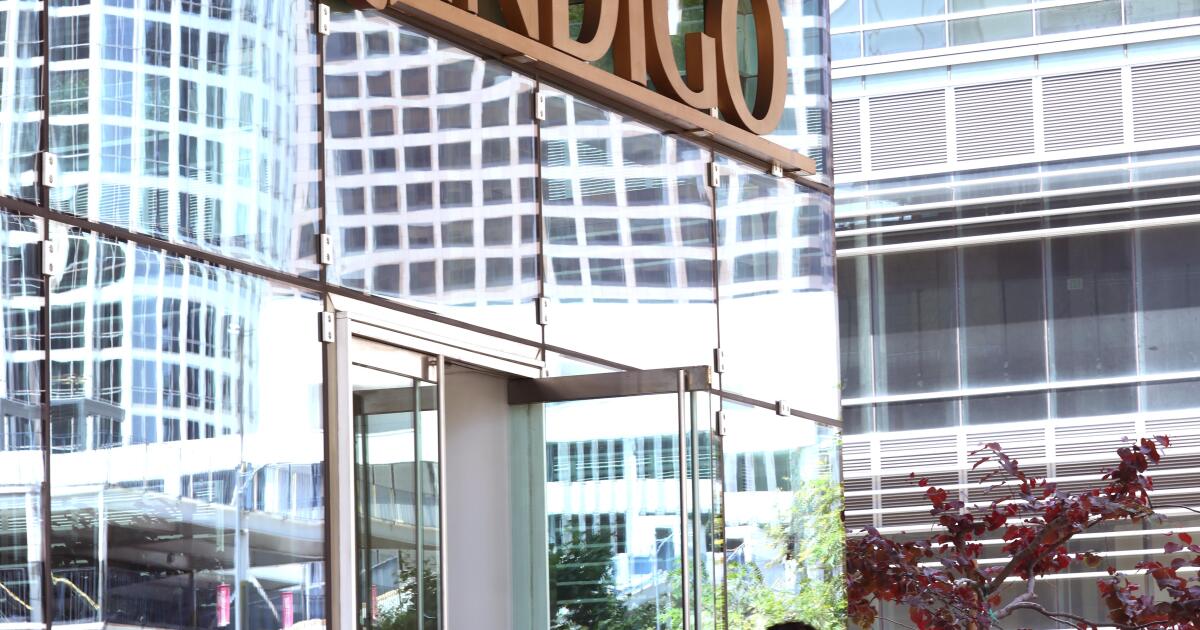
Downtown L.A.‘s Hotel Indigo got a surge in bookings the days leading up to the July 2 knockout game between Spain and Austria. Previously, FIFA had reserved thousands of rooms downtown for staff, media, and other stakeholders, but later canceled the reservation.
The American Hotel and Lodging Assn. attributed the delayed booking boom to young international travelers waiting until right before the game to book hotels in search of last-minute deals.
“Demand has picked up, consistent with a recent trend toward shorter booking windows for events of this caliber,” Rosanna Maietta, the association’s chief executive, said in a statement. “Unlike typical leisure travel, many travelers finalized plans and secured tickets closer to the start of the games.”
Not all hotels have seen the last-minute boom in bookings. Hotel June next to Los Angeles International Airport said its bookings were lower than expected.
“We were expecting more reservations, but I think it’s because the rates have gone up,” said Kira Moreno from Hotel June. “We have still been steady but not been too full or too busy, pretty similar to any other day.”
Airbnb proved to be a popular alternative to traditional hotels, with offers like the World Cup bundle, which included free World Cup tickets with select Airbnb stays at an average price of $365 per night.
In recent years, L.A. has struggled to bring tourists into the city. Last year, the number of international tourists went down by 5.5% from the year before, marking the first time tourism had fallen since the 2020 COVID-19 pandemic.
Immigration raids and wildfires dissuaded tourists from visiting, and even Canadian tourists who typically make up the largest number of foreign visitors to California dropped 21%.
Increased flight costs also discouraged many tourists. With the U.S.-Iran conflict continuing and the Strait of Hormuz closed, jet fuel prices skyrocketed, making international travel unrealistic for many tourists. International air travel to L.A. County had already fallen 30% from August to November 2025.
-

 Miami, FL23 seconds ago
South Florida businesses report economic boom, as FIFA officials estimate a billion dollar economic impact
-

 Boston, MA6 minutes ago
Forecast: Looking ahead to toasty temps next week
-

 Denver, CO13 minutes ago
Denver weather: Warming trend continues this weekend and into next week
-

 Seattle, WA15 minutes ago
Tech Investor Vinod Khosla to Acquire the NFL’s Seattle Seahawks for $9.6 Billion
-

 San Diego, CA20 minutes ago
Endo injury overshadows 2-0 Angel City victory over San Diego – Equalizer Soccer
-

 Milwaukee, WI28 minutes ago
IndyCar drivers make a pit stop at the Milwaukee Mile
-

 Atlanta, GA30 minutes ago
Man Blames Diet Drug After Gunning Down Police Officer and New Dad at Point Blank Range | Oxygen
-

 Minneapolis, MN36 minutes ago
INTERVIEW: 87th Minneapolis Aquatennial

