Lifestyle
L.A. Affairs: Everything was good. Then came the text I never wanted to get

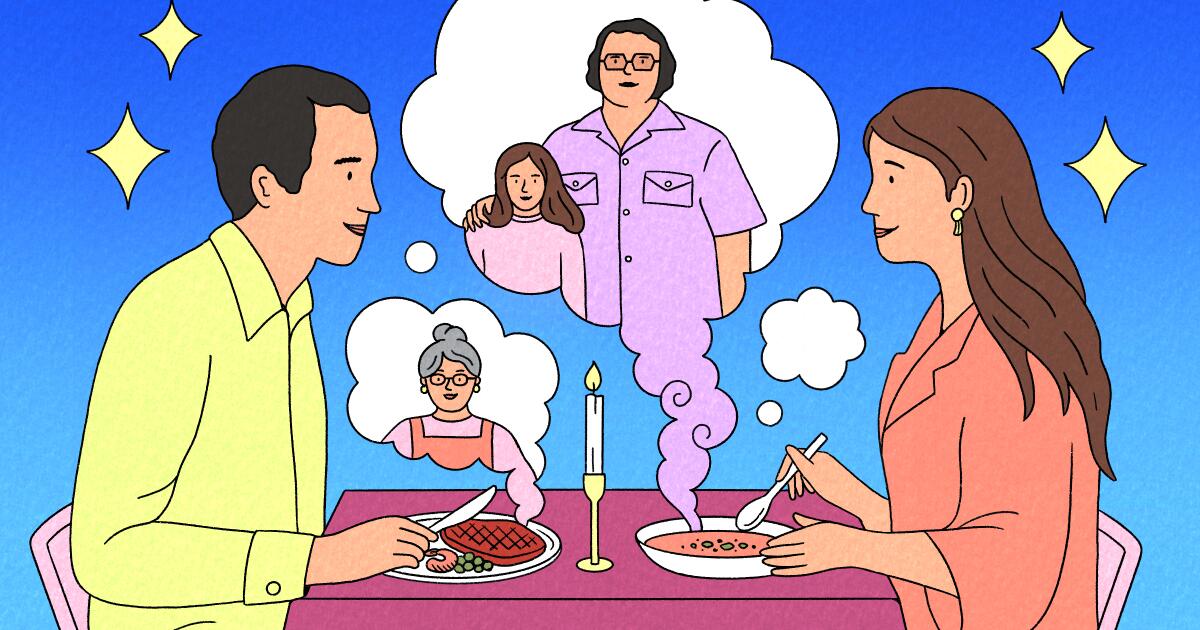
My father spent the 1970s selling hunger to America: soda, waffles, chips, anything that promised satisfaction in 30 seconds flat. He also weighed 450 pounds and was always on a new diet with me as his little diet coach. All his best material came from our kitchen table: “L’eggo my Eggo,” “Once You Pop, You Can’t Stop,” “Coke Is It” — the lines he’d toss out between bites.
My grandma Beauty did the opposite. She fed me comfort, one recipe at a time, until I believed emotions had a flavor. My dad could sell the American consumer comfort, but he couldn’t quite give that same safety to the girl sitting across from him. Between my dad, who treated cravings like a religion, and my grandmother, who treated food like therapy, I grew up thinking connection was something you could taste before you could name it.
So when I met my Bumble date years later after my divorce, it wasn’t fireworks. It was something quieter. A sense memory. A familiar click in the body before the mind catches up.
The first meal we ever shared was at Dan Tana’s: rare steak and shrimp swimming in oil and garlic. He ordered quickly, confidently, passing plates back and forth like this was something we’d always done. Somewhere in that meal, I felt that oyster-like disbelief when something simple tastes better than expected, and you pretend not to notice because the surprise feels too intimate to say out loud.
After that night, we slipped into a rhythm. We went out to dinner a lot. Before I could even open a menu, he’d tell the waiter, “Sauce on the side, she eats like a celebrity,” making me feel adored, not demanding.
The dishes were always exquisite. Slow-roasted bone marrow, branzino laced with herbs, the kind of flavors that made us lean in and feed each other. He’d study my face and say, “Love it or hate it?,” shooting me a warm smirk.
On quieter dates, we watched movies in bed, talked about our kids, anything except for whatever was forming between us. On the nights I slept over, he’d bring me matcha lattes in the morning casually like it was no big deal, and every single time, I felt like I’d won an Academy Award.
“Thank you, ladies and gentlemen!” I’d exclaim.
And he’d shake his head, amused. “You’re too easy to please.”
But what he didn’t realize was remembering that I liked only a splash of milk and an extra shot of matcha fed a hunger in me I didn’t know I longed for.
Our banter was fun, constant and warm. Everything worked except for when a question leaned into the future. That’s when something tightened, a brief, instinctual clam-closing and then loosening again just as fast. But I kept going because the present was good. Because we laughed a lot. Because the world felt softer when I was with him.
Then one Sunday evening, I asked, “What are you doing for the Jewish holidays?” He gave a quick, unreadable flicker. It was gone before I could interpret it. We didn’t talk about it. We didn’t need to. We were both leaving for our own family week. When I returned excited to see him and celebrate a big work milestone I’d helped him prepare for, I got “the text.” Careful. Polite. And at the end, a line that blew a hole through my chest.
“I don’t see a romantic future with you.”
I read it again and again until my body revolted. A wave of heat shot through me. I wanted to scream but I just stood there frozen, unable to breathe, like someone had cracked open my chest and scooped the air out.
Suddenly, I wasn’t a grown-up woman living in Hollywood. I wasn’t a mother, not a nutritionist, not someone who has taken care of people for years.
I was 9. I was in Chicago. It was 1975. I was in my grandma’s kitchen, the place I loved most in the world. The only place I ever remember feeling safe. My fingers were gripping her apron. The smell of dill wafting through the air. Her soup was bubbling. Nourishment, comfort, stability in the form of broth and steady hands. Then my mother’s voice sliced through it: “Dawn, get in the car.”
As I was pushed into the station wagon, there were boxes everywhere. Clio Awards, stacks of Playboy magazines with my dad’s byline, and when my mother slid in after me, she bumped into my dad’s cigarette and the ashes ignited the map — burning a hole straight through the Midwest. My stomach was in knots. I kept reaching my hand toward my grandmother.
“Don’t make me go.”
My mom, irritated, honked the horn, and my dad stepped on the gas.
Standing in my kitchen decades later, looking at the text message, the same feeling of nausea washed over me. The ground shifted. My friends, trying to support me, started texting me. “Don’t you dare text him.”
But I did.
“Hi.”
He responded immediately. We met for Japanese that night, and without trying, we fell right back into our rhythm over Santa Barbara uni and lamb chops cooked exactly the way we like them, crisp on the outside, tender on the inside, the kind of dish that cracks when your knife hits it and then gives way like warm silk. We were not awkward. We were not mad. We were not resolved. We were two people who kept finding each other at a table, even when everything else was uncertain.
Then, somewhere between courses, he looked up and said, “You remind me of my mother.”
The words hit something in me I couldn’t name. Not a wound, an internal flinch. He always told me his mother was unpredictable. Warm one moment, stormy the next. Comforting and chaotic in the same breath. I was none of those things. And I knew instantly that whatever he meant was tangled and that my warmth might feel like comfort to him, but also, unconsciously, like danger. That being cared for and being overwhelmed lived very close together in his body.
I didn’t take it personally. I took it as information. Maybe I felt familiar to him in a way that carried both safety and alarm. A green light and a red light at the same intersection. And the strangest thing was, in that same moment, he reminded me of my father, a man who could charm a room, feed America slogans that defined a generation, win awards and still feel shaky where it mattered most — with me.
Two grown-ups sitting across a table, mirroring childhood patterns that neither of us fully understood.
Later, when he drove me home, he dropped something heavy: his story, not mine to tell. The kind of truth that shifts the room without explaining the entire plot.
Sitting there in his car, I realized it was never just the two of us. We both brought our ghosts, and they probably showed up before we even opened our menus. Maybe that’s the real story. You can share the same cravings and still have to adjust the salt and heat as each new combination of flavors come together and unfold.
The author is a nutritionist who wrote the bestselling book, “My Fat Dad: A Memoir of Food, Love and Family, With Recipes.” Find her on Instagram: @DawnLerman.
L.A. Affairs chronicles the search for romantic love in all its glorious expressions in the L.A. area, and we want to hear your true story. We pay $400 for a published essay. Email LAAffairs@latimes.com. You can find submission guidelines here. You can find past columns here.
Editor’s note: On April 3, L.A. Affairs Live, our new storytelling competition show, will feature real dating stories from people living in the Greater Los Angeles area. Tickets for our first event are on sale now at the Next Fun Thing.


The first time Pop’s Social, a catering company in South Orange, N.J., that specializes in dirty soda, served an alcoholic drink at an event, something strange happened.
At the event in December, its nonalcoholic offering, a spiced pear-cider seltzer with vanilla and peach syrups, cream, lemon and cold foam, was a hit. The Prosecco-spiked version? Not so much.
“People were more interested in the mocktail than the cocktail,” Ali Greenberg, an owner of the business, said in an interview.
Dirty soda — a customizable blend of soda, flavored syrup, creamer and sometimes fruit, served over pebble ice — has been crossing into the mainstream for years, especially after the cast of “The Secret Lives of Mormon Wives,” the hit reality show that premiered in 2024, frequented Swig, the Utah chain that started it all.
But its reach has gone far beyond the Mormon corridor, and its rise in popularity has dovetailed with an overall decline in U.S. alcohol consumption. “There’s not a lot of Mormon people in our neighborhood,” said Greenberg. “But there are a lot of people who are sober-curious or not drinking.”
The reality show, which follows a group of Mormon influencers in Utah, helped popularize dirty soda beyond the Mountain States and inspired a wave of TikTok videos on the subject. Swig rapidly expanded — growing from 33 locations in Utah and Arizona in 2021 to now more than 150 locations in 16 states — along with other Utah chains, and spawned copycats nationwide.
Dirty soda has joined other Mormon cultural exports, like tradwife influencers, a “Real Housewives” franchise in Salt Lake City and Taylor Frankie Paul, the Bachelorette who wasn’t, that have captivated America.
With the recent rollouts of dirty soda at McDonald’s, Chick-fil-A and Dunkin’ — behold the Dunkin’ Dirty Soda: Pepsi, coffee milk and cold foam — and the appearance on grocery shelves of Dirty Mountain Dew and a coconut-lime Coffee Mate creamer for homemade dirty sodas, we may have reached peak dirty.
The idea for dirty soda came out of a desire for members of the Church of Jesus Christ of Latter-day Saints, which has millions of followers in Utah and surrounding states, to have more options for social drinking, as the church prohibits the consumption of alcohol, hot coffee and hot caffeinated tea.
When Swig introduced dirty soda in 2010, it filled a need, providing a pick-me-up for car-pooling moms and an after-school treat for their kids. It was quickly adopted by many in the community.
“In other cultures, parents go, they pick up their coffee in the morning, and for me and for a lot of my other friends’ parents, it was, ‘Let’s go pick up our dirty soda,’” Whitney Leavitt, a breakout star of “Mormon Wives,” said in an interview.
Leavitt was surprised when her dirty soda order became a recurring question from reporters in recent years. “They were so excited to hear all of the different syrups and creamers that we add to our drinks to make whatever your go-to dirty soda is,” Leavitt said. (Hers is sparkling water with sugar-free pineapple, sugar-free peach and sugar-free vanilla syrups, raspberry purée, a squeeze of lime, and fresh mint if she’s “feeling really fancy.”)
In April, Leavitt became the chief creative and brand officer at Cool Sips, a beverage chain based in New York that sells dirty sodas.
“Mormon Wives” inspired Kaitlyn Sturm, a 26-year-old mother of three from Jackson, Miss., to post recipes for dirty sodas on her TikTok. The one she makes the most contains Coke or Dr Pepper, homemade cherry syrup, a glug of coconut creamer and a packet of True Lime crystallized lime powder, which she combines in a pasta-sauce jar filled with pebble ice. “It kind of has become like a ritual, where I make one for my husband as well, and we have it most evenings,” Sturm said in an interview.
The trend has also hit fast-food menus. The new “crafted soda” menu at McDonald’s is riddled with dirty soda DNA. The Dirty Dr Pepper, with vanilla flavoring and a cold-foam topper, is the chain’s version of what has shaped up to be the universal dirty soda flavor. Since 2024, Sonic, beloved for its porous, soda-absorbing pebble ice, has offered “dirty” drinks — your choice of soda plus coconut syrup, sweet cream and lime.
These drinks might feel new, but there are antecedents in the Italian sodas of the ’90s (fizzy water and a pump of Torani syrup); the Shirley Temple (ginger ale or lemon-lime soda with grenadine and maraschino cherries); and the egg cream, a tonic of seltzer, chocolate syrup and milk. And what is a dirty Dr Pepper with cold foam if not a descendant of the root beer float? “It’s just a soda fountain from 125 years ago,” Kara Nielsen, a food and beverage trend forecaster, said in an interview.
Though Leavitt moved to New York City with her family in December, her dirty soda ritual has remained consistent, with one key difference. “In Utah, we don’t get to walk to dirty soda shops,” Leavitt said. “We have to drive there.”

Annuals include flowers like marigolds and nasturtiums. They grow fast but won’t come back the next spring (though they will drop seeds and possibly propagate). Perennials like lavender and sage will return year after year, but they may take longer to grow. Wildflower and pollinator packets often contain both annual and perennial seeds but are frowned upon by some serious gardeners, because the selection can be haphazard and ill-suited to the area.
It’s a good idea to exercise a little situational awareness. How much rain can you expect? How much sunlight? Dig the earth and feel it between your fingers — is it sandy? Loamy? These are things to keep in mind as you prepare for your journey into horticultural chaos.
“You want to prepare your soil, your site, at least a little bit,” said Deryn Davidson, a sustainable landscape expert at Colorado State University Extension in Longmont, Colo. “Try to get rid of weeds. Make sure the soil is ready to receive seeds.”
Davidson, who has written about chaos gardening, strongly advised covering the seeds with a layer of soil, lest they become bird food. As for watering, that depends on where you live, she added. On the whole, though, the formula is straightforward: “Soil, sun and water is what these seeds need,” Davidson said.
Not everyone is a fan of the trend, or at least the way it has been portrayed on social media. “Nature is not chaos — nature is pattern,” said Robin Wall Kimmerer, a botanist and the author of “Braiding Sweetgrass,” which recommends imbuing modern life with Indigenous wisdom.
“It seems unrealistic,” Kimmerer said of the chaos gardening videos she has watched. The feeling of effortlessness they convey — a common social media effect, almost always the result of deft editing — seems to elide the work that goes into a garden, whether chaotic or not, she suggested.
“I want my garden to be natural and biodiverse,” she said. “That’s a good impulse. I don’t think this technique is going to get you there, but that’s an important impulse.”
Boitnott, the maker of the viral video, offered a simple reason for why chaos gardening has become popular: “It just makes you happy.”
Admission: I suffer from eyestrain. Even right this very second. As a reporter working on a computer more than eight hours most days, my eyes often feel fatigued and itchy by evening.
I’m not alone: More than half of the U.S. population lives with computer vision syndrome, also known as digital eyestrain, and nearly 16.4 million Americans suffer from dry eye syndrome. So I was especially excited to stumble on New Vogue Spa, in the City of Industry, which offers a relaxing, if intriguing, treatment called “Eyeball Care” — something I’d never heard of before at a day spa.
New Vogue Spa is an Asian-style spa with Korean and Chinese influences. The spa’s offerings include massages and body scrubs — I was curious about the “Red Wine Body Scrub” — but I couldn’t help exploring eyeball care, which was much needed after my 50-minute drive from Silver Lake. (The City of Industry is about 30 minutes from downtown L.A. without heavy traffic.)
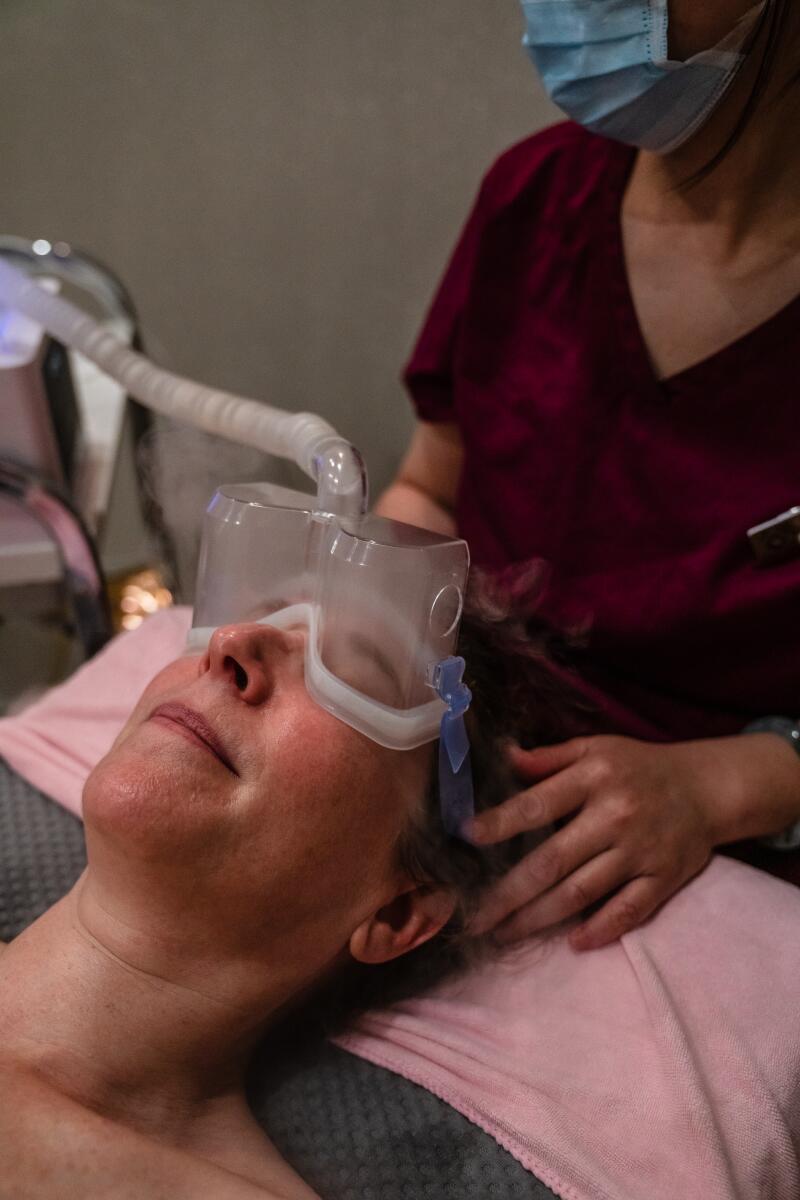
So it came to be that I found myself lying on a massage table, wearing what looked like protruding diving goggles, with clouds of cool, aromatic steam oozing from both sides of it and engulfing my face. A spindly plastic tube extended from my forehead to the “Eye Spa” machine. Serene spa music, a blend of classical piano and loudly chirping birds, trilled in the background as the machine sloshed and gurgled. It felt like lying, creekside, in a spa robe wrapped in a blanket of chamomile and rosemary-scented fog.
-
Share via
As my esthetician, Jenny Chen, adjusted the eye mask and added essential oils to the mist, New Vogue manager Lesley Xie explained that the 60-minute, $125 Eyeball Care treatment aims to hydrate and stimulate blood circulation in the eye area, decrease puffiness and dark circles and aid eye fatigue and dry eye syndrome.
“It’s really helpful for overall eye health for people who are on computers for a long time or sleep really late or who are reading a lot,” she said.
2

1. The Eyeball Care treatment included a mask filled with cool, aromatic steam to help relieve fatigued eyes. 2. Slippers in the Himalayan Salt Room.
Xie said that eyeball care treatments are common in China. When she was growing up in Guangdong in Southern China, elementary school students were given a break every afternoon to perform “eye exercises,” which involved gently massaging pressure points around their eye areas, for 5-10 minutes.
“It released eye stress because we studied from eight o’clock in the morning until almost noon time,” she said. “It was a break for our eyes to prevent nearsightedness and tired eyes.”
New Vogue Spa’s treatment was supremely relaxing from the onset — part Head Spa, part facial, part eye care. Chen began by massaging my scalp for about 10 minutes, as I tried not to fall asleep.
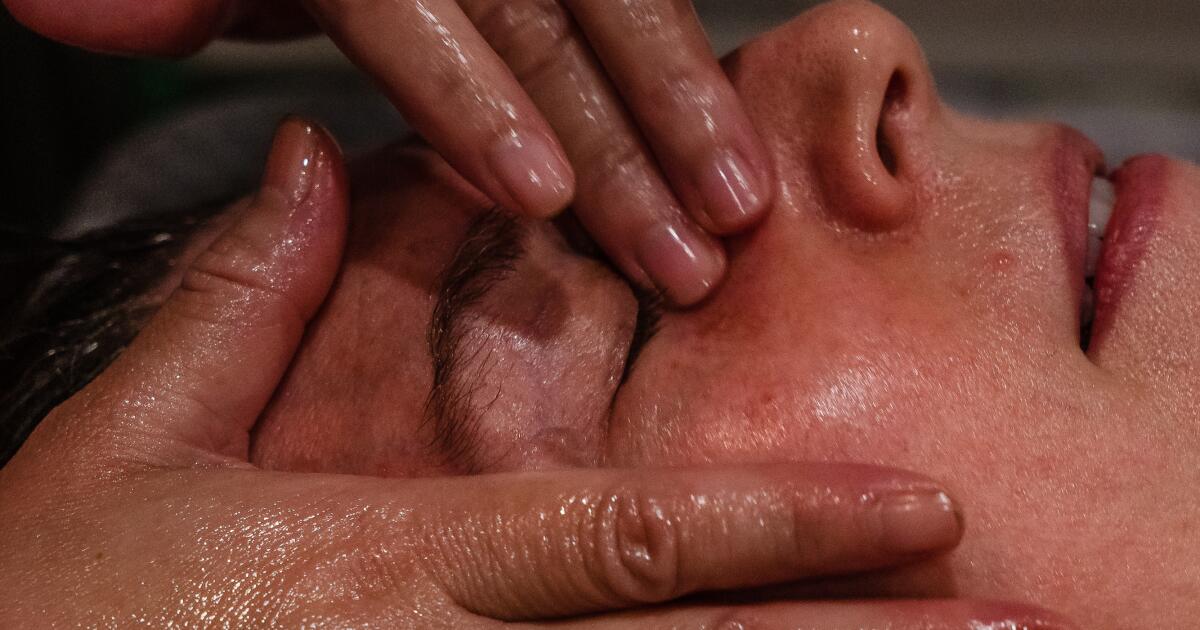
Next she cleaned my face, applied massage cream and gently massaged my face and eye area, manipulating the outer corners of my eye sockets as well as under my brow bones and on my temples. She was precise and firm but careful — as she pressed on the outside corner of my eye, I felt tension draining down the side of my cheek and neck.

Esthetician Jenny Chen conducts “Golden Eye therapy” on reporter Deborah Vankin.
Xie said the massage is based on traditional Chinese medicine, focusing on stimulating acupressure points around the eyes.
“Gentle massage of these areas is believed to help promote blood circulation, relax the muscles responsible for focusing and relieve visual fatigue,” she said. “While it’s not a medical treatment for vision conditions, it’s widely used as a preventative and restorative method.”
The massage was followed by “Golden Eye therapy,” during which Chen used an electronic device on my face with a metal roller ball on it. It uses “ultrasonic vibration technology,” Xie said, to help the skin absorb the applied moisturizing cream and combat eye puffiness.
The main event was the “cooling steam therapy,” which Xie said was meant to be calming and refreshing and help relieve tired eyes. Chen fitted me with what looked like an enormous diving mask that quickly filled with cool, hydrating mist — I felt droplets of water dripping from my eyes and down my cheeks. The Eye Spa machine uses a “cold mist atomization process,” Xie said, “that disperses micro-particles of moisture combined with soothing essential oils.”
At the end of my treatment, Chen gave me under-eye gel pad masks, for added hydration, while conducting one last head massage. She applied moisturizing eye cream, face cream and sunscreen before sending me off.
Dr. Kristina Voss, an ophthalmologist with Keck Medicine of USC, was enthusiastic about the Eyeball Care treatment.
“It sounds wonderful. Anything that makes you feel good, I generally support,” she said. “It sounds safe because they’re not putting pressure on the eye. Direct pressure on the eyeball [is dangerous]. And I’d be nervous if they were putting something in the eye, but they’re not. Steam, or even cool condensation from a humidifier, is effective for dry eye. Massaging pressure points probably doesn’t treat dry eye, but could potentially treat eyestrain or tension headaches that can be interpreted as eyestrain.”

Los Angeles Times features writer Deborah Vankin inspects her eyeballs after her treatment.
Temporary relief aside, however, Voss warned that the treatment is not a replacement for seeing a doctor if a condition is ongoing.
“It’s relaxing and complementary to a doctor’s dry eye treatments — like medicated drops or in-office treatments — but it’s not a simple fix or cure all,” she said. “Ongoing doctor’s care would be important.”
After my treatment, I was invited to linger in the co-ed Himalayan Salt Room and Red Clay Room or woman-only spa area, complete with a warm soaking tub, lounge area and treatment rooms for body scrubs. (I skipped the adjacent New Vogue MedSpa, where you can get botox, dermal filler or microneedling treatments.)
Guests are also treated to a cup of homemade snow fungus tea (made from tremella mushrooms) with a single jujube, or red, date, floating inside. New Vogue makes a fresh batch every morning for guests, simmering the collagen-rich drink so long it becomes somewhat gelatinous.

2

3

1. The Himalayan Salt Room. 2. The co-ed lounge area. 3. The Red Clay Room.
“Snow fungus focuses on deep hydration and skin plumping, while red dates support circulation and a healthy glow,” Xie said, calling the concoction “a warm bowl of snow fungus and red date soup.”
I can’t speak to the medicinal benefits of snow fungus tea. But after a glass of the warm, woody-tasting drink — together with the hour-long tension-taming eye treatment — I saw the world in a whole new way while walking out the door: clearly, from a relaxed perspective and with the bigger picture in focus.
-

 Maine26 seconds ago
How a data center derailed $240,000 for affordable housing in Wiscasset
-

 Maryland7 minutes ago
DC man wins $5M in Maryland lottery – WTOP News
-

 Michigan13 minutes ago
Michigan groom sentenced for killing his best friend on his wedding night
-

 Massachusetts18 minutes ago
Smoke from North Attleborough fire visible for miles
-

 Minnesota25 minutes ago
Minnesota gas prices surge: Twin Cities hits $4.18, costs climb $1.28 from 2025
-

 Mississippi30 minutes ago
Vote Clarion Ledger Mississippi girls high school athlete of the week May 4-9
-

 Missouri37 minutes ago
Judge denies Missouri AG’s bid to immediately halt 7-OH kratom sales by American Shaman
-

 Montana43 minutes ago
Half a million absentee ballots sent to Montana voters for primary election • Daily Montanan