South Dakota
South Dakota’s first astronaut makes pit stop in Madison


MADISON, S.D. — When a space shuttle blasts off, 6.5 million pounds of thrust propel it to the heavens, where it reaches 17,500 miles per hour in just over eight and a half minutes, traveling roughly 5 miles every beat of the heart.
This was one of the many fascinating and somewhat terrifying facts presented by NASA astronaut Charles Gemar during his Feb. 24 presentation for the Lake County National History Club, a dedicated group of high schoolers working with the Lake County Museum. The event was part of the club’s Time Traveler’s Symposium, with its president Grace Blessinger saying Gemar was an ideal guest as he’s the first astronaut to hail from South Dakota.
Raised in Scotland, South Dakota, Gemar has flown on three different space shuttle missions, logging over 580 hours in space during an 11-year career with NASA from 1985-1996. Gemar said that even at 70 years old with decades to reflect, he’s still working to fully appreciate just how special of an opportunity he received.
“I always knew what I wanted to do. I wanted to be an astronaut. I just never shared that because who’s going to believe that? You’re from South Dakota,” Gemar said.
Gemar explained that his journey began with his enlistment in the U.S. Army in 1973, which led to him attending the U.S. Military Academy at West Point and eventually earning the titles of Army officer and pilot. In 1985, he was selected as one of 13 NASA astronaut candidates, though he noted that being named a candidate is simply the first step in a long and intense training period.
Contributed / NASA, S85-41894
This entailed two years of general astronaut training, including mountain and water survival exercises, learning thousands of spacecraft systems and switches along with spending 45 hours per quarter flying the supersonic T-38 jet and more. Gemar noted this demanding routine did its best to simulate the harsh, unforgiving nature of space, yet nothing can truly prepare you for the real thing.
Gemar’s first flight came in November 1990, where he served on the five-man crew of STS-38, which conducted a classified operation for the U.S. Department of Defense. The shuttle made 80 orbits around the Earth in 117 hours, safely landing back at Florida’s Kennedy Space Center five days after launch.
He noted the day before launch is one of the hardest, as the astronauts are forced to quarantine to limit the possibility of in-flight illness, though they are permitted a final meal with limited family prior to takeoff. This day is often emotionally tense, he added, with the astronauts attempting to mentally prepare for space flight, while the families reckon with the inherent risk of seeing their loved ones shot into space.
“When I flew my first flight, one in 15 astronauts had lost their life in the performance of their duties. Those are pretty tough odds,” Gemar remarked.
Despite the danger, Gemar and the rest of his team strapped themselves in for the trip of a lifetime, pushing away any apprehension that might affect them from achieving their mission.
“Flying in space requires a level of confidence that almost borders on narcissism,” Gemar explained. “You have to believe you can strap 600 million pounds of thrust to your back, go to space, come home safely and get the girl at the end.”
The first time he saw his home planet from the vantage point of space was deeply humbling, Gemar said, adding how the one emotion he wasn’t prepared for was “this overwhelming feeling of insignificance.”

Contributed / NASA s38-s-040
“All of humanity is back there. There’s just the five of you in space,” Gemar stated.
While it may be isolated, life in space is anything but slow, as there were countless maintenance tasks, health precautions and scientific experiments to keep the astronauts occupied. He added that the work and view may be daunting, but it’s also breathtaking. Gemar described the beauty of seeing auroras from space, the awe of recognizing landmarks like the Black Hills, Mississippi River Delta and even the clouds of smoke from active volcanoes.
Gemar flew in two more space shuttle missions in 1991 and 1994, the second of which was the second longest space mission to date. This was STS-62, where on this mission alone, 60 experiments or investigations were conducted across a variety of scientific and engineering disciplines, including materials science, human physiology, biotechnology, protein crystal growth, robotics, structural dynamics, atmospheric ozone monitoring and more.
Gemar and his crew spent 13 days, 23 hours and 16 minutes in space throughout the mission, orbiting the Earth 224 times and traveling a collective distance of 5.8 million miles.
Following his presentation, Gemar answered some general questions about space travel before offering some advice to students on the importance of following your goals and working with others to make them a reality.
“Nobody does this on their own. If there’s something you want to do, let somebody know,” Gemar said, adding that people often talk themselves out of opportunities and are too prepared to take no for an answer.
Gemar’s message on the importance of community is shared in the mission of the Lake County History Club, which attempts to inspire students to rally together in their love of history.

Contributed / NASA 9802877
“We just grew this group of great kids who were really interested in history,” club president Grace Blessinger, who founded the group three years ago, remarked.
Blessinger and vice president JayLynn Mackert said the club’s guest speakers have been incredible thus far, as prior to Gemar, the group hosted Holocaust survivor Ben Lesser last year in another well-attended event. The duo thanked their sponsors and the Lake County Museum for their continued success, with Mackert noting that it gives community members a chance for experiences they may never have otherwise.
“I think it provides a lot of sort of firsthand understand of things that you don’t get from textbooks because, you know, you can read about wars all you want, but hearing from a Holocaust survivor is really different,” Blessinger noted.
“We definitely wouldn’t be able to do it without the community,” Mackert added. “No one’s forced to be here, so when we walk into a room full of 150 people, we know that everyone around us wants to be there.”



South Dakota is getting another chief elections officer.
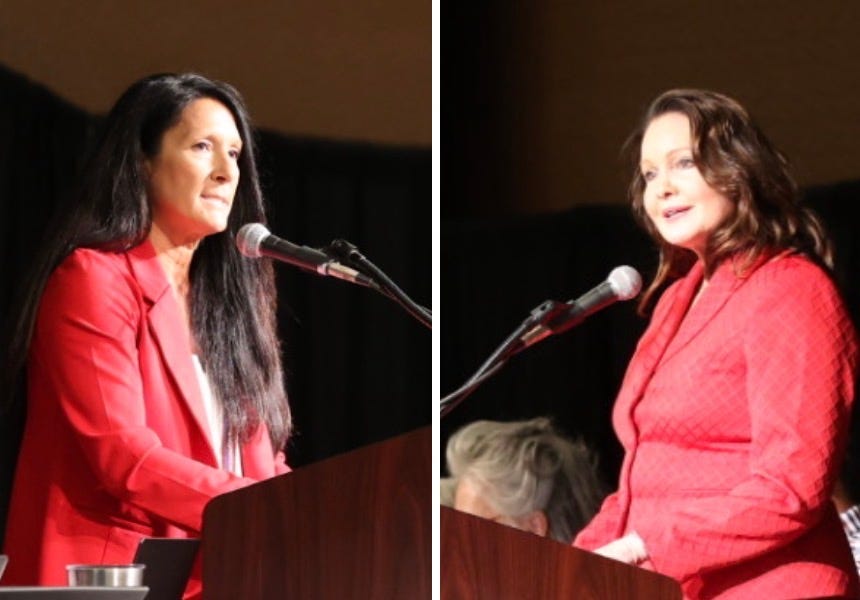
Secretary of State Monae Johnson failed to win the Republican nomination for a second term during the South Dakota Republican Party Convention Saturday in Rapid City, where GOP delegates instead favored another Pierre outsider to oversee the state’s elections for the next four years.
“When this office runs well, you don’t notice it. When it doesn’t, you feel it everywhere,” Rep. Heather Baxter told a capacity crowd of delegates and attendees at The Monument events center, where she received nearly 60 percent of votes cast by more than 700 party delegates.

Populist push falls short in South Dakota GOP contest for Public Utilities nod



South Dakota
Work, housing and staffing: How South Dakota’s corrections chief aims to keep inmates from returning

SIOUX FALLS – South Dakota’s repeat offense rate for people who leave prison can return to the low point it saw a a dozen years ago, the state’s corrections secretary said Tuesday.
Nick Lamb, now six months into his role atop the Department of Corrections, laid out the agency’s plan Tuesday at the Correctional Rehabilitation Task Force at its meeting in Sioux Falls. The plan includes work release programs, residential housing for inmates and a top-to-bottom restructuring of how the department operates.
Recidivism measures how many inmates return to prison within three years of their release. The figure for South Dakota stood at
50%
in the most recent data, which was based on the performance of inmates released in 2021.
South Dakota’s lowest recidivism rate in the last two decades was 39% in 2014.
“We’ll get back there,” Lamb said Tuesday.
Lamb told reporters after the meeting he wants “to start getting in the business of closing prisons” during his tenure.
“Our population is too high for our state,” Lamb said. “We need to get our population down, but we’ve got to give the offenders the tools they need that they haven’t always had.”
Several recommendations presented on Tuesday, by Lamb and other criminal justice experts, will require more staff and funding.
State Rep. John Hughes, R-Sioux Falls, worries that the Legislature’s budget-setting committee will balk at new spending.
“My concern is that we put all these elaborate proposals together, then when we get to appropriations we’re going to hit the wall,” Hughes said.
Inmates return to work release
Under Lamb’s predecessor, Kellie Wasko, pay for inmate work performed outside the prison walls
was increased to minimum wage
. After that policy change, fewer communities and organizations contracted inmate workers for community service jobs.
Rep. Tim Reisch, R-Howard, said most of the roughly 250 minimum-security prisoners he oversaw during his tenure as corrections secretary participated in work release.
“They got up and they all had jobs. They were used to getting out of bed, going to work, getting in a habit of that,” Reisch said.
When he toured the prison last year, fewer than 20 were working, he said.
Lamb has cut inmate wages below minimum wage since he started.
“We reached out to a lot of these communities, basically asking if they need help,” Lamb said. “We lowered the wage, which upset some people, but we need them out working.”
This summer, inmates will work at Sioux Falls parks and at its regional landfill, and they’ll prepare the fairgrounds in Huron for the State Fairgrounds in August. They’ll also help out during Riverboat Days in Yankton, and pitch in on tournament preparation for the National Field Archery Association.
Statewide residential facilities planned
Lamb also wants to establish a residential corrections program. He shared a presentation showing how such a program
operated in Iowa
, where he served as deputy director of institutional operations for the Iowa Department of Corrections before his move to South Dakota.
In Iowa, most residential facilities were filled with people on probation, parole or work release. He envisions a similar program in South Dakota, with housing outside of traditional prison settings designed to help transition back into the community, but he hasn’t finalized details or a timeline.
“We’re going to try it,” Lamb said. “I’ll be honest, I haven’t talked to the lieutenant governor or anybody else about it, but we need to try it. It works.”
The program has been in Iowa for decades. Iowa’s three-year recidivism rate peaked at 38.9% in 2019 and has since fallen to 32.8%, based on the
latest data available
.
“I’m not trying to throw you a sales pitch,” Lamb said, but residential programming is “a good idea.”
Lamb said he doesn’t want to replace programs like the one run by the Sioux Falls-based nonprofit St. Francis House, but to add to it.
St. Francis House doesn’t cap how long residents can stay and limits rent to $250 a month. Lamb said a state-run program would include a time limit and higher rent.
A lack of “felon-friendly housing” is a major driver of recidivism, said Sioux Falls Mayor Paul TenHaken, who’s leaving his position soon after two terms in office. The problem won’t improve without government involvement, he added.
“If the state ever chooses to invest in St. Francis House programming, it’s money well spent,” TenHaken said.
Justice Center recommendations
The percentage of inmates who got rehabilitative programming increased from 27%to 44% between 2023 and 2025, according to a report presented Tuesday by the Council for State Governments Justice Center.
The national nonprofit was contracted to analyze the state’s prison system and help guide the task force’s work.
Despite the gains in programming, the group reported, 46% of inmates released in 2025 received none. Access was also limited by where inmates were held, due to space and staffing restrictions.
The justice center recommended several changes, including:
- Creating a rehabilitation and reentry division and hiring several new positions.
- Creating a centralized waitlist for programs.
- Streamlining the program catalog to reduce overlap and fill gaps.
- Sequencing programming to cover an inmate’s entire stay, rather than stacking programs in the last few months of their sentence.
- Creating a dedicated parole violation program track.
Many of those recommendations hinge on hiring and retaining adequate staff — one of the department’s most significant challenges, according to the group.
Sara Friedman, program director with the Justice Center, said her team consistently heard in interviews that the department tends to shift employees around when attempting new initiatives, rather than hiring. That creates gaps for inmates seeking programming.
Sometimes, for example, shifting staffing patterns will leave facilities without enough security staff to transport inmates to classrooms.
“Technically, you’re fully staffed, but you’re fully staffed so thinly that the moment one thing goes wrong, the waterfall effect is people are not getting their rehabilitative services,” Friedman said.
Lamb told South Dakota Searchlight after the presentation that he wasn’t surprised by the staffing recommendations. The department lacks adequate staff to backfill for sick or vacationing employees, he said, though he didn’t say how many more employees would need to be hired to address the issue.
The department is already working to create the new rehabilitation and reentry division and centralize its scheduling.
The task force plans to meet two more times before it’ll finalize its recommendations for the Legislature ahead of the next session, which starts in January.
— This story was originally published on southdakotasearchlight.com.

South Dakota Republican delegates rejected a push to censure Senate Majority Leader John Thune (R-S.D.) over the stalled SAVE America Act, exposing a fight within the GOP over how far the party should go to force through sweeping new voting restrictions.
South Dakota Republicans voted down a proposed censure of Thune at the state party convention Friday after a resolution accused him of blocking President Donald Trump’s election agenda.
The measure had advanced out of the party’s Resolutions Committee, but failed before the full convention.
The resolution targeted Thune for what it called “his failure in regards to the SAVE America Act,” a Republican-backed bill that would impose strict proof-of-citizenship and photo ID requirements to vote.
Voting rights advocates have warned the bill could block millions of eligible Americans from registering, especially people who do not have easy access to passports, birth certificates or documents matching their current names.
Trump has sharply escalated pressure on Republicans to pass the bill. This week, he abruptly canceled a planned signing ceremony for a bipartisan housing affordability bill, tying the unrelated legislation to his demand that Congress first pass the SAVE America Act.
“Today’s Housing News Conference and Signing is hereby cancelled until such time as we pass the desperately needed SAVE AMERICA ACT, which I consider to be a National Emergency,” Trump wrote.
The censure push reflects growing anger among Trump allies who want Senate Republicans to change or bypass filibuster rules to pass the bill. A filibuster is a Senate procedure that usually requires 60 votes to move most legislation forward. Republicans do not have those votes.
“We don’t have the votes, either to proceed to a talking filibuster nor to sustain one if we got one,” Thune said last week. “That’s just a function of math. There isn’t anything I can do about that.”
For pro-democracy advocates, the fight is not simply about Thune. It is about a broader Republican effort to turn Trump’s election denialism into federal policy. Noncitizen voting is already illegal and exceedingly rare.
But the SAVE America Act would use that false crisis to create new barriers for eligible voters.
The South Dakota vote shows the limits of MAGA pressure even in a deep-red state. Delegates were willing to debate punishing their own Senate majority leader, but ultimately rejected escalating the internal fight.
Still, the episode underscores how central voting restrictions have become to the Republican agenda ahead of the midterms.
-

 Movie Reviews1 minute ago
Hollywood Pariah Kevin Spacey Opens in a Straight to Video Movie with 25 Producers, 1 Review, No Theaters, No Press – Showbiz411
-
World13 minutes ago
Rescue Workers and Aid Arrive in Venezuela, Official Says
-
 Lifestyle51 minutes ago
This mindset shift can help you get better at using up your leftovers
-

 Technology1 hour ago
TMD’s keyless bike lock is a $280 solution to a $60 problem
-

 World1 hour ago
American rescue teams pull infant alive from rubble in Venezuela days after devastating twin earthquakes
-

 Politics1 hour ago
Trump scores another endorsement win with Louisiana Senate runoff victory
-

 Health1 hour ago
New blood test detects 90% of aggressive prostate cancer cases, beating current screenings
-

 Sports1 hour ago
2026 World Cup Round of 16 Odds: Which Teams Will Make It?

