South-Carolina
Connect to the Capitol: Remembering Jesse Jackson, sports gambling in SC


COLUMBIA, S.C. (WACH) – This week, South Carolina leaders on mourned the death of the Rev. Jesse Jackson, remembering the Greenville native as a towering figure in the civil rights movement whose decades of activism reshaped American politics and opened doors for generations of Black leaders.
Gov. Henry McMaster called Jackson “a native son of South Carolina, and an icon of the civil rights movement.”
McMaster said he would direct flags over the State House to be lowered at the appropriate time to honor Jackson’s legacy and memory.
Congressman Jim Clyburn called Jackson “one of the most quintessential civil rights leaders” and recalled their lifelong friendship, which began at rival South Carolina high schools and continued in college.
Clyburn highlighted Jackson’s early activism in Greenville in 1960, including efforts to desegregate the public library and lead sit-ins, and his founding of the Rainbow PUSH Coalition to uplift the “voiceless and downtrodden.”
He also noted Jackson’s presidential campaigns in 1984 and 1988, as well as his work with Operation Breadbasket, anti-apartheid activism, voter registration, and corporate diversity initiatives, which advanced opportunity and equality for Black Americans.
It should not be lost on any of us the impact that Reverend Jackson has had on the nation, Black Americans, and movements to encourage civic participation around the world. His vision is his legacy, and his teachings continue to inspire me as I continue the pursuit of justice and equality, Clyburn said.
President and CEO of the Columbia Urban League, J.T. McLawhorn also said Jackson achieved international objectives that helped secure the release of dozens of hostages and prisoners in situations where the U.S. government had been unable to do so.
I consider him a global diplomat. Look at him, he should have received the Nobel peace prize because I think a lot of people look at Dr. Jackson as someone who only promoted equal opportunity in the south, but he was a global person.
CAMPUS SAFETY IN SOUTH CAROLINA
In the wake of this month’s deadly double shooting at South Carolina State, lawmakers at the State House are moving forward with a proposal aimed at tightening safety requirements on college campuses across South Carolina.
The state House Education and Public Works Committee voted unanimously Thursday morning to immediately send a college safety bill, H-5205, to the House floor.
The proposal has been under discussion for several months and would strengthen security measures and improve emergency response on college campuses as schools across the state continue to face concerns about violence and campus readiness.
“I pray that the parents see that we’re trying to protect their children as well and that’s important,” said Rep. Terry Alexander, a Democrat from Florence County.
Beaufort County Republican Shannon Erickson, the committee chairwoman, said the bill is intended to address urgent safety concerns for students and families.
“Our families need the confidence that their children are going to safe place when they’re there. We’ve been working on the campus safety bill for quite some time and I think recent events really pushed us forward in moving it in a faster way,” Erickson said.
RELATED || After fatal shooting, South Carolina State announces tighter visitor access, dorm checks
Erickson said last week’s shooting at South Carolina State intensified the call for change.
Two teenagers were killed and a student who was wounded remains in the hospital. It was the second deadly campus shooting at South Carolina State since October.
“It really hit home for us. SC State is one of our most wonderful historically Black Colleges, we are very supportive of their administration and what they’re trying to do and what we now know is that this crime came from unaffiliated people and that is a problem we’ve got to address. That’s the piece that really hit home to us what could have been different,” Erickson said.
If the proposal passes, college campuses would be required to provide mandatory safety training for students during orientation or within their first 30 days.
Campuses would also be required to report both student-affiliated and non-affiliated crimes on campus to local law enforcement.
SPORTS GAMBLING IN SOUTH CAROLINA
Sports betting on a mobile device could become legal in South Carolina under a proposal state lawmakers are now debating, setting up a fight over regulation, revenue and the expansion of gambling.
After a roughly two-hour hearing Wednesday, a legislative subcommittee decided to continue conversations about a bill that would legalize online mobile sports betting in South Carolina.
Supporters say betting is already happening and that the state is missing out on revenue, while opponents warn it would increase addiction and other harms.
Trevor Hayes of Caesar’s Entertainment told lawmaker data from Caesars Entertainment shows legal operators are allowing people to place bets from South Carolina and the state does not profit from it.
Hayes told the panel:
“These companies started offering bets at the end of 2024 and last month Kalshi, the largest operator among them, took over $10 billion in handle for the month. 10 billion. This is happening right now in your state.”
If approved, South Carolina could join 38 other states that have legalized mobile sports betting.
Even if the proposal were to pass both the House and Senate, Gov. Henry McMaster has indicated he would not sign something into law that makes gambling like this legal.
Gov. McMaster has long said that he would not sign such a plan into law. He said this back in April:
“Once you start letting gambling into the house it will grow and by the time such a bill makes it all the way through, you’re going to have all sorts of gambling ideas.”
His office says his position on sports betting remains consistent and that there needs to be another way to bring revenue into the state.
Sen. Josh Kimbrell, a Republican from Spartanburg County who is a member of the subcommittee, argues that a regulated market would be better than illegal gambling.
“415,000 South Carolinians have accounts right now and they’re driving across the border to North Carolina or to Tennessee or a state where it’s currently legal to go place their sports bets and so what we’re saying is let’s get rid of the black market and make sure there’s not some underground bootlegger sort of operation and make it clear and regulated.”
Kimbrell said he supports the bill, while emphasizing he does not want broader gambling expansion in the state.
.Opponents, including members of Palmetto Family Alliance, told lawmakers the proposal would do more harm than good.
They argue men ages 18 to 29 are the most vulnerable to gambling harm, including higher bankruptcy risk and bad credit.
Randy Page, executive vice president of Palmetto Family Alliance, said:
“The concern that we have is the predatory nature of gambling and how it affects people and particularly looking at online sports betting and how it affects young men and the addiction just the availability of it.”
The panel expects more discussion on the bill before making a decision on the proposal.


STARKVILLE — Mississippi State baseball landed a potential starting infielder from the transfer portal.
Will Craddock, who played one season at South Carolina, committed to the Bulldogs on June 26.
“Hail State,” Craddock wrote on Instagram.
The freshman batted .260, leading the Gamecocks in home runs (10) and runs (36) while ranking third with 29 RBIs. In SEC play, his average dipped to .172 with two home runs, six RBIs and 14 runs.
Craddock primarily played first base, but also made starts at second base, third base and designated hitter. He started all three games against Mississippi State in April, batting 3-for-14 with a walk, no RBIs but two runs.
He was a standout player for T.L. Hanna in Anderson, South Carolina, and was the state’s 5A Player of the year in 2025. He hit .442 that season with eight doubles, 10 home runs and 10 stolen bases while ranked as the No. 26 player in South Carolina.
Mississippi State’s starting first baseman, Reed Stallman, is out of eligibility.
The transfer portal opened June 1 and closes June 30.
Mississippi State baseball transfer portal class
Craddock is the 10th transfer to commit to Mississippi State and the second South Carolina player, joining relief pitcher Zach Russell.
Other position players who are transferring to MSU include Georgia Southern catcher/outfielder Brady Christman, Samford outfielder Jake Souders, Army utility player Josiah Overbeek, South Dakota State third baseman Nolan Grawe, Oregon catcher Burke-Lee Mabeus and North Florida outfielder Carter White.
Twelve Mississippi State players have entered the transfer portal as of June 26, including relief pitcher Tyler Pitzer who committed to South Carolina.
Sam Sklar is the Mississippi State beat reporter for The Clarion Ledger. Email him at ssklar@usatodayco.com and follow him on X @sklarsam_.


USA TODAY 250th anniversary travel guides and American stories
USA TODAY marks America’s 250th with travel guides, culture, history, and local stories.
As the nation prepares for its 250th anniversary, one of the efforts underway is America’s Time Capsule.
The time capsule project is led by America250 and meant to bring together carefully selected artifacts and documents from all 50 states, five U.S. territories, the District of Columbia, and each branch of the federal government.
This national project is designed to capture the story of the United States at this historic 250th birthday, according to America250.
Here’s what South Carolina contributed to the national project.
What did South Carolina put in the America250 time capsule?
South Carolina is marking the nation’s 250th anniversary by contributing two historic items to the national America’s Time Capsule project, according to America250.
As part of the SouthCarolina250, which is the state’s initiative for the U.S.’s 250th celebration, commemoration effort, the state has provided a commemorative challenge coin and an official SC250 lapel pin.
Both will be buried inside the capsule on July 4, along with items from other states. And it is set to be reopened 250 years later in 2276.
Where will the Americ250 time capsule be buried?
The ceremonial burial of America’s Time Capsule is set to take place at Independence National Historical Park, located at 599 Market Street in Philadelphia, Pennsylvania, on July 4, according to america250.org.
What else is in America’s 250th anniversary time capsule
As America’s 250th anniversary approaches, the national time capsule has been filled with items meant to capture the character and diversity of the country in this moment.
The collection spans a range of items, from archival letters and state proclamations to student work from the America’s Field Trip contest, uncirculated currency, and even pieces of national sports memorabilia.
Time capsule engineered to last centuries
As planners work to ensure America’s Time Capsule endures for the next two and a half centuries, engineers and archivists have focused heavily on long‑term preservation.
The capsule itself is a cylinder‑shaped stainless‑steel vessel, precision‑designed by the National Institute of Standards and Technology in partnership with archival scientists at the Library of Congress, according to the Institute.
Travis Jacque Rose is the trending news reporter for the Greenville News, part of the USA TODAY Network. Reach him at trose@gannett.com.

In Laurens County, a dual-sided historic marker stands next to a mailbox off the side of the road. The name Jonathan Downs was commemorated on one side, while the other side was signed with the story of Lindley’s Fort in the American Revolution.
The Battle of Fort Lindley took place July 15, 1776, some 1,800 feet away from the modern-day historic marker. Private farmland now sits where the battle ensued, but physical pieces of history and oral retellings of the battle have continued to propel the story in Laurens County lore.
Loyalists to the British crown and Cherokee citizens planned an attack on a group stationed at the fort. The Little River Regiment used the fort as their base. Loyalist Capt. David Fanning described the scene as a “fort built with logs” in his autobiographical retelling of the Revolutionary War.
Cherokee land had continually been encroached on, which pushed members of the tribe to retaliate.
The loyalists who joined in the attack were dressed as Native Americans. They – along with other South Carolina backcountry loyalists – were referred to as Scopholites. The group took action at midnight for what became a two-hour fight in one of the first conflicts of the Cherokee War of 1776.
Historian Durant Ashmore said the crux of the battle was a clash of culture and a fundamental lack of understanding among the groups.
“One thing that has been very important to understand is the conflicts between cultures – the misunderstandings between cultures – and the deadly consequences that can result from that,” he said.
Luis-Alfredo Garcia
/
South Carolina Public Radio
Troops at the fort had at first not believed word of the upcoming attack when informed by a group of soldiers, according to a pension application of Matthew Brown, who was a 16-year-old boy stationed at a fort about 20 miles away from Fort Lindley. The men were drunk from a night of indulging in rum, which Ashmore said was a common occurrence during the war.
“The Little River Regiment did not believe them. They actually even leveled their guns at them, saying, ‘Who’s telling you such lies as this?’” he said.
Maj. Downs, however, prepped the troops for defense. Downs was a previous member of the First Provincial Congress, Second Provincial Congress, and South Carolina General Assembly.
A sizable chunk of the Patriot troops had already experienced fighting Cherokee citizens during the Anglo-Cherokee War that lasted from about 1758-1761. Soldiers at Fort Lindley responded to the attack by sending out troops in lines of 10. Eventually, the loyalists and Cherokee citizens retreated.
The patriot victory boosted local morale and belief in their cause, but for some unscathed loyalists and Cherokee citizens, the aftermath’s impact trumped the actual battle loss in consequences.
The morning after the battle, troops from the fort found about 30 horses at a campsite. One saddlebag contained the commission papers of Capt. James Lindley. Lindley was a staunch loyalist and the eponymous owner of Fort Lindley.
Six months prior to the battle, he had been captured at the Battle of Great Cane Break. Lindley had promised to not take up arms against patriot forces again, or he would face death. Although he was not captured in the midnight battle, he did succumb to patriot troops at the Battle of Kettle Creek and was hanged for breaking his parole.
As for the Cherokee citizens, their land was further encroached upon and people killed; about 2,000 were killed during the Cherokee War of 1776.
Ashmore said the consequences from escalating conflict were terrible.
“Patriots gathered together with the idea of a plan, the goal of eliminating the Cherokees. Genocide,” he said. “That’s what was preached to the backcountry settlers along with the ability to make their own decisions. A primary motivating factor in the American Revolution is the right of self-determination.”
Luis-Alfredo Garcia
/
South Carolina Public Radio
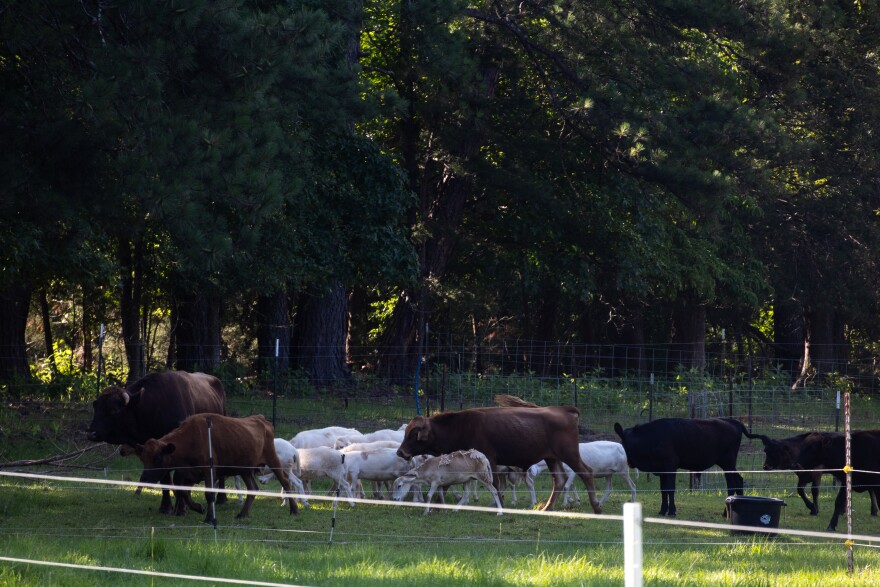
Now, private land with cows and sheep sits on the area where the fort once stood. Ashmore said he gives tours just during the winter to avoid the risk of ticks. The area where trenches once helped shield soldiers are still visible.
Some remnants from the fort now reside at the Laurens County Museum in the city of Laurens’ downtown area. The objects, although not individually labeled, will be part of an upcoming opening collection.

Luis-Alfredo Garcia
/
South Carolina Public Radio
Museum docent Julia Sermons said being informed of local history helps shape modern decisions.
“You have to know where you’re coming from to know where you’re going,” she said.
Ashmore, too, saw the same value.
“We are all in the middle of this,” he said. “This history – the important role that South Carolina played in the Revolution.”
An estimated 14 battles took place in Laurens County, according to Ashmore. He has been keeping track of local history for about 6 years. He said the county has set a 50-year plan to help with future record keeping.

Luis-Alfredo Garcia
/
South Carolina Public Radio
-

 Kansas4 minutes ago
Salina Stars Unite for Final High School Stage at Kansas Shrine Bowl
-

 Kentucky6 minutes ago
Beechwood’s Tyler Fryman commits to the Kentucky Wildcats
-

 Louisiana12 minutes ago
Southern football’s Marshall Faulk visits Central Louisiana
-

 Maine19 minutes ago
Gov. Mills to decide on Maine school choice tax credit program
-

 Maryland22 minutes ago
Maryland Lottery Mega Millions, Pick 3 results for June 26, 2026
-
Michigan27 minutes ago
Michigan Lottery Daily 3, Daily 4 results for June 26, 2026
-

 Massachusetts34 minutes ago
As Mass. ballot initiatives multiply, critics want to limit them
-

 Minnesota36 minutes ago
Minnesota man accused in a $250M fraud scheme taken into custody in Somalia | CNN

