Lifestyle
What playing a 7-hour video game with strangers in L.A. taught me about the resistance

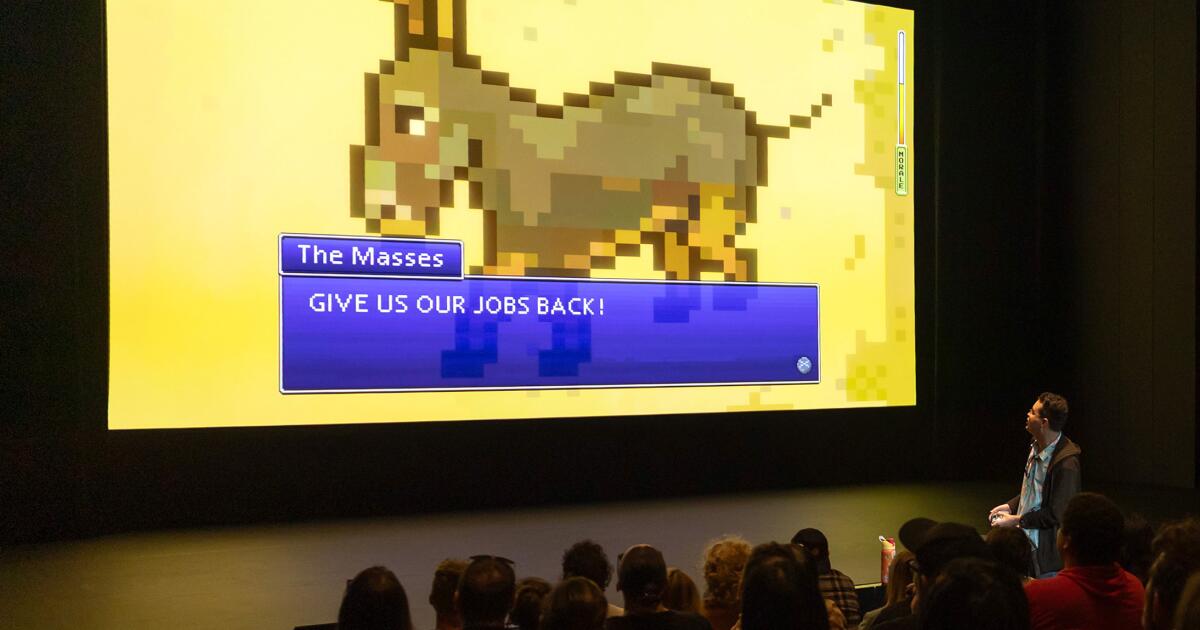
The donkeys are pissed off. Put upon, out of work and victims of decades-long systemic abuse, it’s time, they have decided, to protest.
The donkeys, metaphorically, are us.
At least that’s the premise of “asses.masses,” a video game played by and for a live audience. It’s theater for the post-Twitch age, performance art for those weaned on “The Legend of Zelda” or “Pokémon.” Most important, it’s entertainment as political dissent for these divisive times. Though the project dates to 2018, it’s hard not to draft 2026 onto its narrative. Whether it’s unjust incarceration, mass layoffs or topics centered around tech’s automation of jobs, “asses.masses,” despite generally lasting more than seven hours — yes, seven-plus hours — is a work of urgency.
The audience cheers various decisions made during the playing of “asses.masses” at UCLA Nimoy Theater.
(Myung J. Chun / Los Angeles Times)
And for the audience at the Saturday showing at the UCLA Nimoy Theater, it felt like a call to arms. Citizens executed in the street for exercising their right to free speech? That’s in here. Run-ins with authorities that recall images seen in multiple American cities over the past few months? Also in here, albeit in a retro, pixel art style that may bring to mind the “Final Fantasy” series from its Super Nintendo days.
In a city that’s been ravaged by fires, ICE raids and a series of entertainment industry layoffs, the sold-out crowd of nearly 300 was riled up. Chants of “ass power!” — the donkey’s protest slogan — were heard throughout the day as attendees politely gathered near a single video game controller on a dais to play the game, becoming not just the avatar for the donkeys but a momentary leader for the collective. Cheers would erupt when a young donkey reached the conclusion that “I kinda think the system is rigged against everyone.” And when technological advances, clearly a stand-in for artificial intelligence, were described as “evil, soulless, job-taking, child-killing machines,” there were knowing claps, as if no exaggeration was stated.
“Our theater is supposed to be a rehearsal for life,” says Patrick Blenkarn, who co-created the game with Milton Lim, interdisciplinary artists from Canada who often work with interactive media.
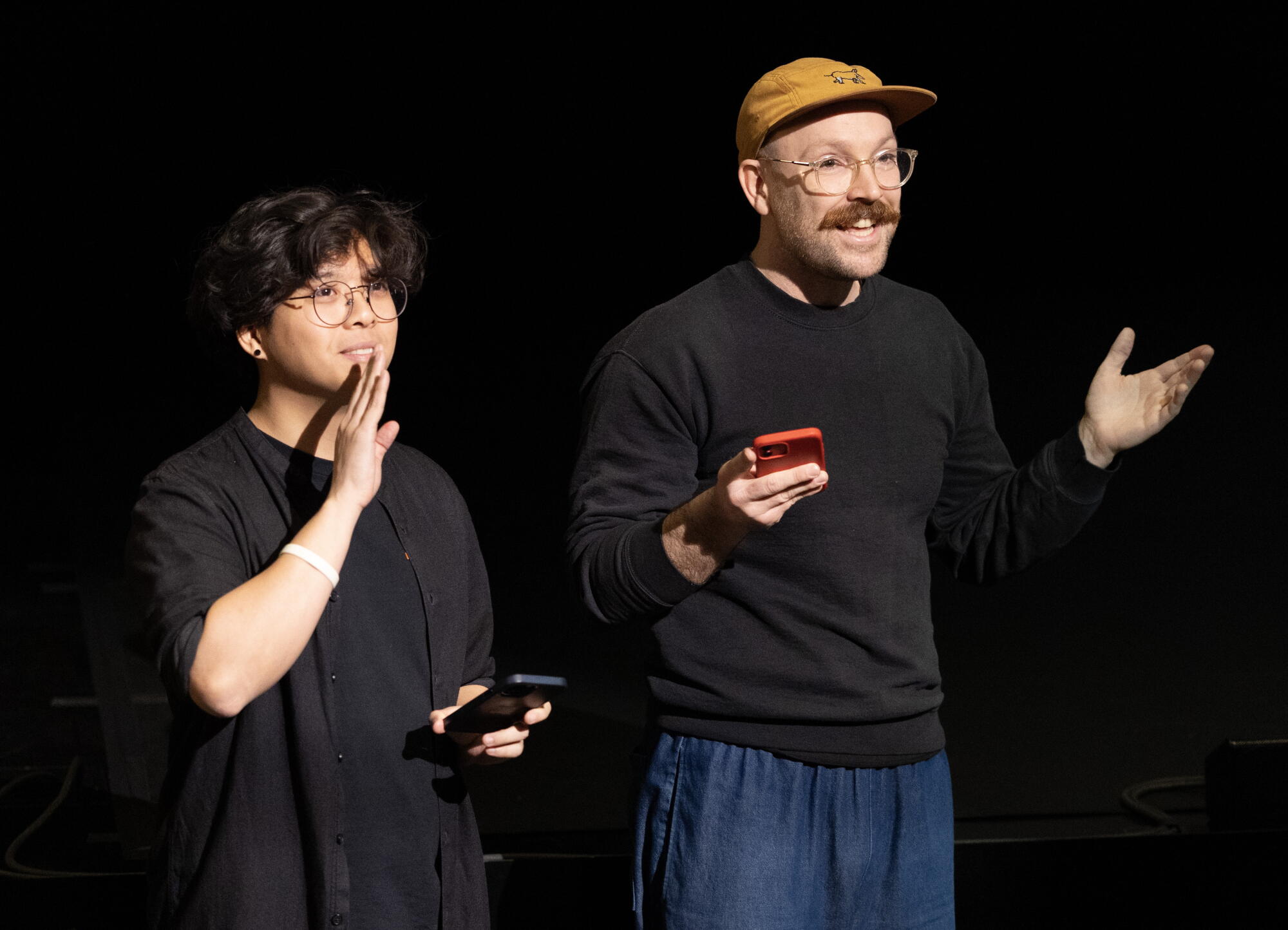
“We grew up in a radical political tradition of theater,” says Patrick Blenkarn, right, who co-created “asses.masses” with Milton Lim.
(Myung J. Chun / Los Angeles Times)
“We grew up in a radical political tradition of theater, where this is where we can rehearse emotional experience — catharsis,” Blenkarn says. “That is what art is supposed to be doing. We have been very interested in the idea that if we come together, what are we going to do and how are we going to do it? What we are seeing in your country, and other countries, is the question of how are we going to change our behavior, and will the people who currently have the controller listen? And if they don’t, what do we do?”
Video games are inherently theatrical. Even if one is playing solo on the couch, a video game is a dialogue, a performance between a player and unseen designers. Blenkarn and Lim also spoke in an interview prior to the show of wanting to re-create the sensation of gathering around a television and passing a controller back and forth among family or friends while offering commentary on someone’s play style. Only at scale. And while I thought “asses.masses” could work, too, as a solitary experience at home, its themes of collective action and reaching a group consensus, often through boos or shouts of encouragement, made it particularly well-suited for a performance.

The UCLA Nimoy Theater played host to “asses.masses” this weekend.
(Myung J. Chun / Los Angeles Times)
Beginning at 1 p.m. and ending shortly after 8 p.m., coincidentally, says Blenkarn, the length or so of a working day, not everyone made it to the “asses.masses” conclusion. About a quarter of the audience — a crowd that was clearly familiar with the multiple video game style represented in “asses.masses” — couldn’t stand the endurance test. But in a time of binge-watching, I didn’t find the length prohibitive. There were multiple intermissions, but those became part of the show as well, as there was no set time limit. Blenkarn and Lim were asking the audience, via a prompt on the screen, to jointly agree upon a length, emphasizing, once again, the importance of collective cooperation.
And “asses.masses” holds interest because it, in part, embraces the animated absurdity and inherent experimentation of the medium. While often in a retro pixel art style, at times the game shifted into a more modern open-world look. And the story veers down multiple paths and side-quests — some requiring wild coordination such as a rhythm game meant to simulate donkey sex, and others more tense, such as “Metal Gear”-like sneaking, complete with the donkeys hiding in cardboard boxes.
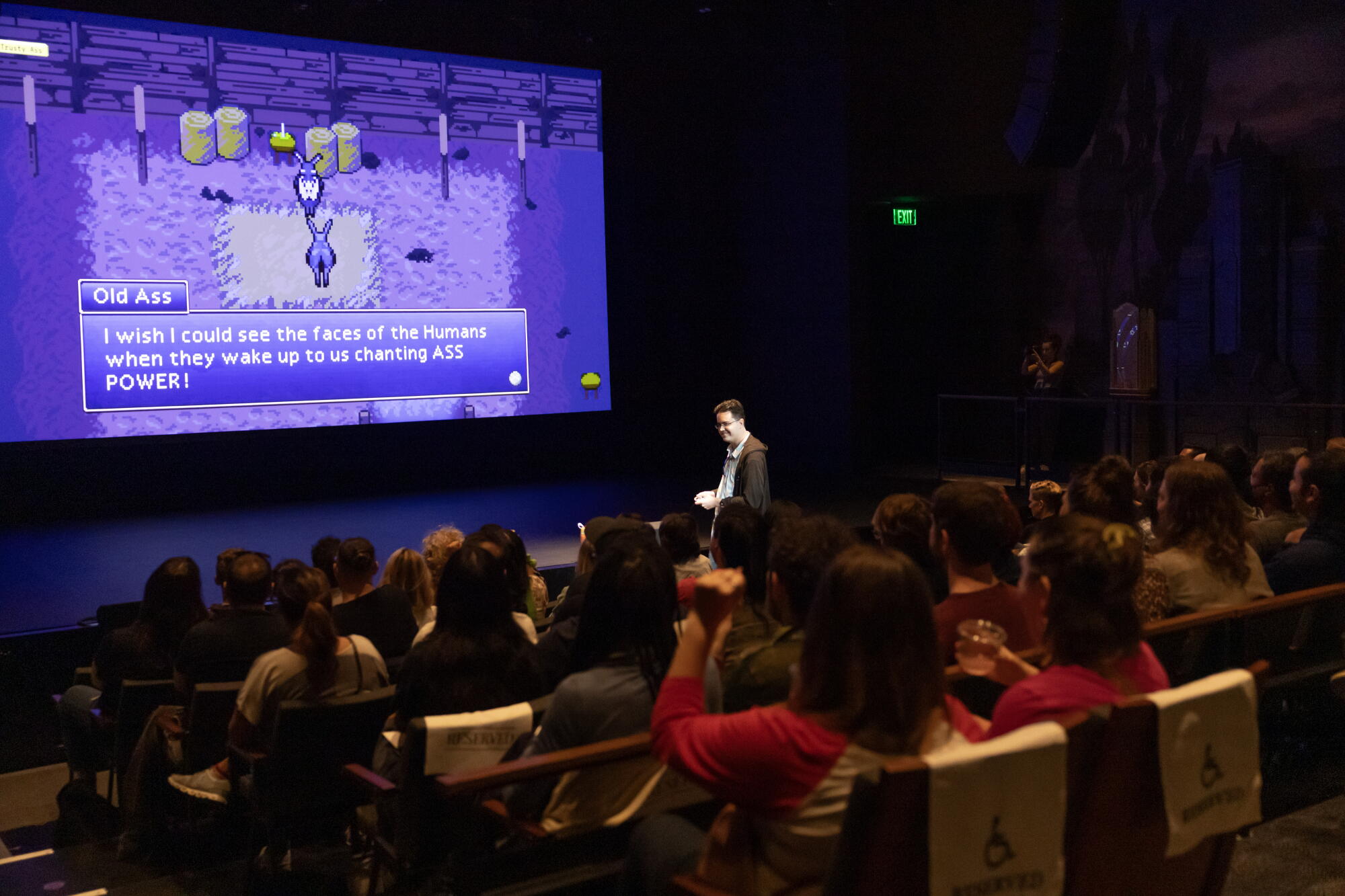
Audiences vote, often by cheering or booing, on choices in “asses.masses.”
(Myung J. Chun / Los Angeles Times)
The way “asses.masses” shifted tones and tenor recalled a game such as “Kentucky Route Zero,” another serialized and alternately realistic and fanciful game with political overtones. Other times, such as the surreal world of the donkey afterlife, I thought of the colorfully unpredictable universe of the music-focused game “The Artful Escape,” a quest for personal identity and self-actualization. The donkeys in “asses.masses” are an ensemble, often trying to steer the audience in different directions. As much as some push for a protest as a way for communal healing and progressive action, others take a cynical outlook, viewing that path as “intellectually compromised” by a “commitment to past ideals.”
The goal, says Lim, is to create a sort of game within a game — one that’s being played with a controller and one of debate among a crowd. “It’s not about having a billion endings,” Lim says. “We understand it’s a theater show, and we as writers have objectives for what we want it to go towards. But the decisions people make in the room really matter. The game is half in the room and half on the screen.”
The audience, for instance, can play a role in keeping certain donkeys alive. Or what jobs a group of renegade donkeys may choose. Our audience voted for the donkeys to enter the circus, at least until they were deemed obsolete and sent to detention centers, which felt uncomfortably of the moment. Such topicality is what drew Edgar Miramontes, leader of CAP UCLA, to the show, despite his admittance to being largely unfamiliar with the world of video games.
“It doesn’t shy away from the nuances of when organizing happens and what we’re seeing in our world right now,” Miramontes says. “There are instances in which a donkey may die because, in organizing to achieve their goals, these things happen. We have seen this in our Civil Rights Movement and other movements and the current movement that’s happening right now around ICE.”
The Nimoy event, part of UCLA’s current Center for the Art of Performance season, was the 50th time “asses.masses” had been performed. The show will continue to tour, with a performance in Boston set for this upcoming weekend and it will reach Chicago later this year. Our donkeys on Saturday didn’t solve all the world’s inequalities, but they did live full lives, attending raves, engaging in casual sex and even playing video games.

A player celebrates during “asses.masses,” live action theatrical video game.
(Myung J. Chun / Los Angeles Times)
The show is an argument that progress isn’t always linear, but community is constant. As one of the donkeys says at one point, “If you aren’t doing something that brings you joy, do something different.”
“In case anyone is like, ‘I don’t want to be lectured at,’ or I don’t want to do all this work, it feels like you’re just having fun with friends,” Lim says. “Maybe revolution doesn’t always look like just this. Maybe it’s also this.”
And like many a video game, maybe it’s a chance to live out some fantasies. “We do beat up riot cops in the game,” Blenkarn says, “in case anyone is hoping for that opportunity.”


In Alice and Steve, Jemaine Clement and Nicola Walker play long-time friends who turn on each other after he gets involved with her 26-year-old daughter.
Lara Cornell/Disney+
hide caption
toggle caption
Lara Cornell/Disney+
I grew up watching episodic shows on network TV, nearly all of them formulaic but some indelibly great. Then, like everyone else, I moved into the days of what my colleague David Bianculli dubbed Platinum TV, where series like The Sopranos and The Wire and Fleabag aspired to something higher. What both these eras had in common was that their shows were carefully crafted — they had an internal logic, and a tone, that held them together.
In recent years, though, there’s been a proliferation of shows that, possibly obeying some algorithm, care less for coherence than sensation. They lurch among tones, from cuteness to sentimentality to meanness, stirring in random plot twists along the way. Bouncing all over the emotional map, these shows depend on compelling actors and a few memorable scenes to make us overlook their loose construction.
A great example is Alice and Steve, an entertaining but sometimes exasperating six-part British comedy on Hulu about two 50-something best friends who turn on each other after he gets involved with her 26-year-old daughter.


While the premise is juicy, it’s also a tad yucky, and I mainly tuned in because its title characters are played by performers Jemaine Clement from Flight of the Conchords and Nicola Walker, whom I’ve raved up on this show more than once.
The series starts poorly with Steve and Alice going on a cutesy bender after a friend’s funeral. Now, I always hate drunk scenes, which are an invitation to overact. As Clement and Walker bray their lines, we learn that Steve’s a divorced celebrity hair stylist who can’t find a girlfriend while Alice is a clothes designer with a doting younger husband, nicely played by Joel Fry, a sweetie-pie of a teenage son — that’s Tyrese Eaton-Dyce — and, of course, that 26-year-old daughter, Izzy, who has inherited her mother’s willfulness. Played by Yali Topol Margalith, Izzy kickstarts the plot by flirting with Steve. Predictably, he succumbs.

Almost immediately, they think they’re in love. While the weak-willed Steve wants to hide their romance — he knows it’s inappropriate — Izzy just blurts out the facts to her mom. Alice flips. And from hereon out in this series where the women are as alpha as the men are hangdog, Alice drives the action. Betrayed and violently angry, she’ll do whatever it takes to break them up — no matter who gets hurt. Her antics unleash Steve’s own malice. We’re in Beef territory.
At its core, Alice and Steve hinges on the way that platonic friendships are often richer and more powerful than romantic ones. It’s a fascinating subject, which may be why I found the script by Sophie Goodhart so frustrating. I wanted her to dig deeper. While the show’s got some very funny bits — Alice’s sharp-tongued mother is a blast — it’s often annoyingly lax.

If Steve really does the hair of Charli XCX, how come he’s a clueless older guy whose pop culture references are Willie Nelson and Woody Allen? If Izzy truly adores her mother as she claims, why does she keep rubbing her relationship with Steve in her mom’s face? Halfway through, one character nukes the other’s career, but this life-shattering event has no real weight: It’s barely even mentioned for the rest of the series.
That said, Alice and Steve is worth seeing for scenes like the one in which Steve spinelessly sells Izzy out or the lacerating discussion between Alice and her husband when he fully grasps that he adores a woman who views him as a reliable but dull concierge, not a man she likes hanging with. Most touching of all may be the lovely sequence when Alice, wise for once, smooths a romantic crisis between her son and his would-be girlfriend, a pair who are the show’s emblem of hope. For once, we understand why people love her.

While most viewers will find Steve more likable than Alice — the show takes pains not to make him appear predatory or creepy — the role doesn’t give Clement a whole lot to do except play variations on shambolic dread and discomfort. The show gets its galvanizing zing from Walker, a beloved star in England with amazing, luminous eyes. Her Alice is the kind of complicated, volcanic heroine that you don’t see in movies and rarely see on TV, one who shows her apocalyptic rage freely and in many different forms.
At least once in every episode, something would lead me to say, “Man, is this show a mess.” But that wasn’t a deal breaker. I kept watching. After all, life is messy, too.


How to enter your Sporty Spice era.
Getty Images/quantic69/Olga Kurbatova/Anastasiia Zvonary/Photo Illustration by NPR
hide caption
toggle caption
Getty Images/quantic69/Olga Kurbatova/Anastasiia Zvonary/Photo Illustration by NPR
Reality dating and professional sports are not as different as you’d think.
Brittany is in her Sporty Spice era – she watched the NBA playoffs, she’s following World Cup games, and she’s watching the New York Liberty play their WNBA season. These games are daily – and so is the reality dating show Love Island. And she noticed that the two formats are not very different at all. Defector.com staff writer and co-owner Kelsey McKinney came to the same conclusion – so the two of them discuss why these games of athleticism and love can bring us together… and why they get valued differently in our culture.
For more episodes on sports and reality TV, check out:
Get rich or die trying: how sports betting is changing our love of the game
Is this the end of reality TV?
The ugly truth of America’s expensive homes
Support Public Media. Join NPR Plus.
Follow Brittany on Instagram: @bmluse
This episode was produced by Liam McBain. It was edited by Neena Pathak. Our Supervising Producer is Cher Vincent. Our Executive Producer is Barton Girdwood. Our VP of Programming is Yolanda Sangweni.

-

 World5 minutes ago
Cuba sees nationwide power blackout for third time in six months
-
 News28 minutes ago
The U.S. men’s run at the World Cup ends with a 4-1 Round of 16 loss to Belgium
-

 Los Angeles, Ca2 hours ago
L.A. man who violently crashed into Border Patrol agents sentenced to 5 years in prison
-

 Detroit, MI2 hours ago
Fans pack Detroit’s Campus Martius for USA-Belgium World Cup match
-

 San Francisco, CA2 hours ago
Terrified passengers film Waymo autonomous vehicle driving into live fireworks in San Francisco
-

 Dallas, TX2 hours ago
WATCH: USA vs. Belgium watch party at FIFA Fan Festival Dallas
-

 Miami, FL2 hours ago
Tim Hardaway Jr. returns home as Miami Heat sign veteran guard:
-

 Boston, MA3 hours ago
‘Enough is enough’: Weekend violence in Boston sparks calls for change, from more police to community investment – The Boston Globe

