Washington, D.C
House Passes Bill To Keep Blocking Washington, D.C. From Legalizing Marijuana Sales – Marijuana Moment


The U.S. House of Representatives has passed a spending bill that contains a provision to continue blocking Washington, D.C. from legalizing recreational marijuana sales while also warning local officials about approving cannabis dispensaries near schools.
The appropriations legislation covering Financial Services and General Government (FSGG) as well as National Security, Department of State, and Related Programs Appropriations Act for Fiscal Year 2026, was approved on the floor in a vote of 341-79 on Wednesday.
A report attached to the legislation also contains a section directing federal officials to submit a report on Chinese-linked drug syndicates that operate illicit cannabis grows.
The District has long been barred from allowing regulated adult-use marijuana sales under a spending bill rider led by Rep. Andy Harris (R-MD), despite voters approving legalization of possession and personal cultivation in 2014.
Leaders of the House and Senate Appropriations Committees who negotiated the legislation ahead of its release on Sunday evidently didn’t see reason to shift away from that policy.
Here’s the text of the D.C. sales rider:
“SEC. 809. (a) None of the Federal funds contained in this Act may be used to enact or carry out any law, rule, or regulation to legalize or otherwise reduce penalties associated with the possession, use, or distribution of any schedule I substance under the Controlled Substances Act (21 U.S.C. 801 et seq.) or any tetrahydrocannabinols derivative.
(b) No funds available for obligation or expenditure by the District of Columbia government under any authority may be used to enact any law, rule, or regulation to legalize or otherwise reduce penalties associated with the possession, use, or distribution of any schedule I substance under the Controlled Substances Act (21 U.S.C. 801 et seq.) or any tetrahydrocannabinols derivative for recreational purposes.”
The language may ultimately be rendered moot, however, if the Trump administration moves forward with an order from the president to expeditiously reclassify cannabis as a Schedule III substance under the Controlled Substances Act (CSA).
In a report published in 2024, the Congressional Research Service (CRS) said that while federal cannabis prohibition would still be the law of the land even if it’s rescheduled, the reform “would permit the District government, as a matter of local law, to authorize the commercial sale of recreational marijuana, establish market regulations, and levy marijuana taxes, among other policy options.”
There is a complication, however, because the congressional rider also stipulates that the District of Columbia can’t use funds to legalize or reduce penalties for “any tetrahydrocannabinols derivative.” But that term isn’t clearly defined in the rider or anywhere else in federal law.
Meanwhile, the FSGG report attached to the new spending bill also reminds D.C. officials that cannabis remains federally prohibited, and there are enhanced penalties for manufacturing or distributing marijuana within 1,000 feet of various public and private entities like schools and playgrounds.
Here’s that D.C.-specific language:
“Marijuana Dispensary Proximity to Schools.-The agreement reminds the District of Columbia that the distribution, manufacturing, and sale of marijuana remains illegal under Federal law, which includes enhanced penalties for such distribution within one thousand feet of a public or private elementary, vocational, or secondary school or public or private college, junior college, or university, or a playground, among other real property where children frequent.”
Another section of the report for the National Security and State bill concerns illegal drug syndicates based out of the People’s Republic of China (PRC).
Here’s what that section says:
“PRC-linked Criminal Drug Syndicates.-Not later than 45 days after the date of enactment of the Act, the Secretary of State, in consultation with the heads of other relevant Federal agencies, shall submit a report to the appropriate congressional committees regarding PRC-linked criminal syndicates or nationals who may be directly or indirectly involved in illegal drug and money laundering operations in the United States, including in Maine, California, and Oregon. The information should include, as relevant, information on the involvement of officials of the Government of the PRC and PRC-linked syndicates operating in Southeast Asia.”
While the provision doesn’t mention marijuana specifically, it seems intended to target illicit Chinese cannabis operators, which were also the focus of a House subcommittee hearing last September. Much of the talk about the issue has centered around Maine, California and Oregon, as referenced in the report section.
The appropriations deal was unveiled just days after the House passed a separate spending package that would continue protecting state medical marijuana programs from federal intervention—while excluding a provision that previously advanced to block the Justice Department from rescheduling cannabis. That proposal now heads to the Senate for consideration.
—
Marijuana Moment is tracking hundreds of cannabis, psychedelics and drug policy bills in state legislatures and Congress this year. Patreon supporters pledging at least $25/month get access to our interactive maps, charts and hearing calendar so they don’t miss any developments.
Learn more about our marijuana bill tracker and become a supporter on Patreon to get access.
—
GOP senators have separately tried to block the administration from rescheduling cannabis as part of a standalone bill filed in 2023, but that proposal did not receive a hearing or vote.
Meanwhile, last week, the Drug Enforcement Administration (DEA) said the marijuana rescheduling appeal process “remains pending” despite President Donald Trump’s recent executive order directing the attorney general to finalize the process of moving cannabis to Schedule III.
Advocates may welcome the exclusion of the rescheduling provision and inclusion of medical marijuana protections in the CJS bill, but many cannabis stakeholders have protested Trump’s signing of a separate appropriations measure in November that includes provisions to ban most consumable hemp products.
Marijuana Moment is made possible with support from readers. If you rely on our cannabis advocacy journalism to stay informed, please consider a monthly Patreon pledge.



US President Donald Trump escalated his criticism of Democratic mayoral nominee Janeese Lewis George, describing her as a “communist” and warning that her policy agenda could negatively affect Washington, DC, ahead of the city’s November mayoral election. Trump made the remarks on his Truth Social platform, placing crime, immigration and policing at the center of his criticism.Trump attacks Democratic agenda
In his statement, Trump claimed George supports measures including reducing prison populations, expanding sanctuary city policies, opposing Immigration and Customs Enforcement (ICE), restoring cashless bail, cutting police funding and resisting anti-crime initiatives. He argued that such proposals would weaken public safety in the US capital and reverse recent improvements.
George becomes favorite after primary victory
Janeese Lewis George secured the Democratic nomination earlier this month after winning the party’s mayoral primary in Washington, DC. Given the city’s strong Democratic voting base, her victory has positioned her as the leading candidate to succeed outgoing Mayor Muriel Bowser in the November general election.
Trump vows to protect Washington
Trump insisted that his administration would not allow Washington, DC, to be “destroyed,” arguing that the city has become significantly safer through crime reduction efforts and urban renewal projects. He also announced that he intends to meet with George, while describing the US capital as “again a Safe and Prestigious Community.”
Repeating his criticism, Trump said: “Many people, including myself, have worked long and hard to get it there, and we will not let it be destroyed by a Communist adherent who has no intention to, MAKE WASHINGTON GREAT AGAIN!”
Berk Kutay Gokmen
28 June 2026•Update: 28 June 2026
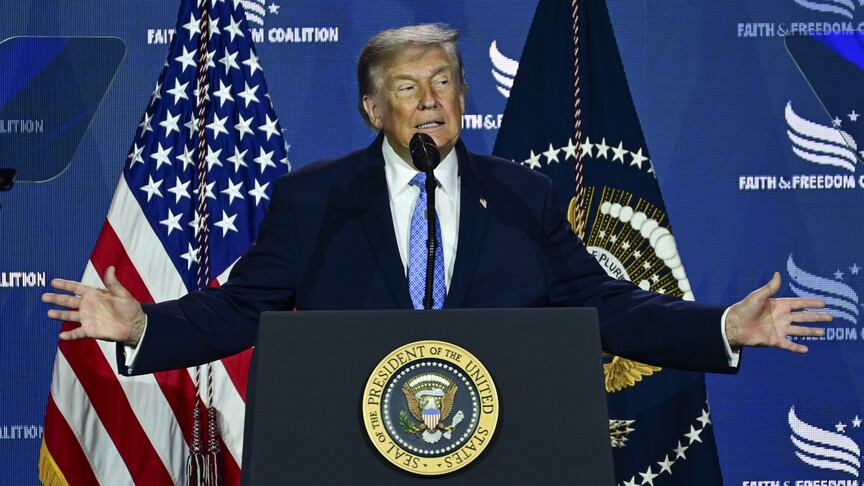
US President Donald Trump on Sunday criticized Democratic mayoral nominee Janeese Lewis George, calling her a “communist” and attacking her policy positions ahead of Washington, DC’s mayoral election.
“Janeese Lewis George, the Communist who is almost certainly going to be elected Mayor of Washington, D.C., has stated that she wants to empty the prisons, make D.C. a Sanctuary City, oppose ICE, welcome Criminal Illegal Aliens back into our beloved Capital, resist Anti-Crime Crackdowns, Defund the Police, continue and expand Cashless Bail, and so many other Capital destroying ‘things’,” Trump wrote on his Truth Social platform.
George won the Democratic primary for mayor of Washington, DC, earlier this month, securing her party’s nomination in the heavily Democratic city and becoming the likely successor to outgoing Mayor Muriel Bowser after the November general election.
Trump said he would not allow Washington, DC, to be “destroyed.”
“In the end, it will never work out, nor will I let it even have a chance because I have worked too hard to make Washington, D.C., the Envy of the World, with almost No Crime, and a Beautification process that has been second to none,” he said.
Trump also said he would “meet with Janeese Lewis George,” adding that Washington, DC, is “again a Safe and Prestigious Community.”
“Many people, including myself, have worked long and hard to get it there, and we will not let it be destroyed by a Communist adherent who has no intention to, MAKE WASHINGTON GREAT AGAIN!” he added.

Just in time for the Fourth of July, the Smithsonian Institution in Washington, D.C., has rolled out a big new exhibit highlighting nature in all its glory, with specimens from across America. But the Hawaiʻi offerings are a bit of a dud.
The Smithsonian’s National Museum of Natural History is a vast repository, occupying a stately edifice on the National Mall. It holds some 148 million objects, including more than a million from Hawaiʻi, including eight priceless feathered cloaks, but when the institution’s curators picked out one item to exemplify each state for this exhibit, they gave Hawaiʻi a rock.
Yes, a rock.
Seen in person, it’s a striking black clump of glittering pāhoehoe lava, and of course we are proud of our lava, but it comes across as, well, underwhelming.
Millions of visitors are expected to arrive in Washington, D.C. in the next two weeks. Many will be drawn by the fanfare associated with the 250th anniversary of the signing of the Declaration of Independence. In the eyes of many Americans, President Trump has tainted the occasion by claiming personal sponsorship of it.
To be fair, the city is looking pretty good, decked out in its finery for the events, and some improvements have been made. Flags are flying; the lawns look green and lush. The scene is drawing large crowds of tourists from all over the world, cheerfully milling about and popping into the many free museums that line the mall.
There are also some notable exceptions: The reflecting pond by the Lincoln Memorial is definitely tainted by algae infiltration. There’s also a bit of slime attached to what was reportedly a no-bid job for the renovation work by a Trump donor.
Also to be fair here: Hawaiʻi has had difficulties with its own reflecting pool, the now-waterless water feature at the State Capitol.

Amid the ongoing partisan warfare, Hawaiʻi’s state government, along with about 10 other Democratic-controlled states, has decided not to participate in the D.C. festivities. That includes the Great American State Fair, now being set up on the National Mall, which will host some 56 themed pavilions where individual states are expected to highlight what they believe makes them special. Sprawling over 10 city blocks, crowned by a 110-foot ferris wheel, the festival will feature concerts, military flyovers, fireworks displays, movie screenings and exhibit spaces representing the nation’s states and territories.
In a statement, Erika Engle, a spokeswoman for Gov. Josh Green, said the state is not officially participating, adding that no funds had been allotted for it by the Legislature or Congress.
She added that Washington, D.C, “is 5,000 miles away.”
That’s a distance that hasn’t previously inhibited the governor, whose peregrinations to the nation’s capital have almost qualified him as a frequent flyer.
This is supposed to be a sign of how Hawaiʻi’s leaders are effectively rejecting Trump. As if Trump cares whether Hawaiʻi participates or not.
It’s a strange place to make a stand. July Fourth is bigger than any president. The signing of the Declaration of Independence represents a rare kind of bravery. The 56 signers risked their lives to sign it, knowing they would have a target on their backs, placed there by King George III, one of the world’s most powerful monarchs.
In fact, people who signed resolutions against the king in the past could expect persecution not just in this life but in the next. In England in the 1630s, the autocratic King Charles I decided to bypass the elected body and instead to rule by executive order. Discarding established law and tradition, he disbanded Parliament for 11 years.
The English people thought that was high-handed and, amid a set of bloody civil wars that killed 200,000 people, he was eventually executed. But when his son was restored to the throne in 1660, the 59 people who had signed the former king’s death warrant were themselves hunted down. Many were drawn and quartered; the lucky were imprisoned for life.
Oliver Cromwell, the Parliamentary ringleader, had already died but his corpse was exhumed and he was hanged. His body was hung in chains and his decapitated head was impaled on a pike and put on public display for 20 years. Almost 100 years later, his embalmed head was still being carted about as a gruesome trophy, even as the signers of the Declaration of Independence put pen to paper.
Back in 1776, the memory of what vengeful kings do to their enemies was high in the minds of those who were publicly protesting Charles II’s autocratic heir, George III. In fact, one of the first ships built and commissioned by the Connecticut General Assembly, launched just two weeks before the Declaration of Independence was signed, was named the Oliver Cromwell.
Democracy has had its ups and downs.
Back to the exhibit at the Smithsonian.

The goal of the curators was to reflect America’s natural diversity and how humans interact with it. In dozens of exhibits spread over 5,000 square feet, visitors can learn about the oddities and idiosyncrasies in the natural world, from rocks to birds to butterflies to snakes to fossils to plants and also how humans have incorporated these items into crafts and artistry. It touched on the problems of animal extinction and climate change.
A video graphic allows people to track bird migration routes across the continental United States.
One display explains the long history of traditional blacksmithing in Guam, another provides examples of Samoan siapo bark cloth.
In addition to several lava rocks representing Hawaiʻi, the exhibit also featured a lovely Niʻihau snail shell necklace and a goby fish from Kāneʻohe Bay, which the exhibition touted as one of the largest sheltered bodies of water in Hawaiʻi, known for its living corals.
But more striking symbols of Hawaiʻi seemed notably sparse and some obvious elements are missing. How nice it would have been to see a feathered cape or an example of one of the brightly colored lizards that have played such an important role in Hawaiian mythology. I would have liked to have seen more of Hawaiʻi’s beautiful birds and butterflies.
Another thing that appears to have gone missing are Hawaiian philanthropic donors making the case for the state’s natural splendors. The display’s list of financial sponsors shows philanthropy from both blue and red states but nothing from Hawaiʻi.
That’s partly because we are suffering another form of extinction. We have a lot fewer large companies based in Hawaiʻi than we once did, and so there are fewer corporate sponsors. Even Hawaiian Airlines, once a mainstay of exhibits like this that appeal to frequent travelers, has been subsumed into an airline from another state.
We do have more billionaires than we once did, of course, but they own estates in so many places that it is hard to know what they actually consider home.
They just better not steal our rocks.
Sign up for our FREE morning newsletter and face each day more informed.
-

 San Diego, CA3 minutes ago
Feds Will Finally Help Oceanside 73 Years After Admitting Fault for Its Disappearing Beaches
-

 Milwaukee, WI6 minutes ago
Brewers open 4-game series with the Reds
-

 Atlanta, GA11 minutes ago
Atlanta Braves Manager Makes Honest Statement After Giants Game
-

 Minneapolis, MN18 minutes ago
MN weather: Extreme Heat Warning issued for Minnesota Monday
-

 Indianapolis, IN21 minutes ago
Where to find cooling stations in central Indiana
-

 Pittsburg, PA26 minutes ago
Pittsburgh horror film history honored with new award
-

 Augusta, GA33 minutes ago
Augusta Fire Department holds hurricane season preparedness event
-

 Washington, D.C36 minutes ago
Trump targets Washington mayoral nominee ahead of DC election

