Midwest
Street takeovers and traffic control by agitators in Minnesota cross legal lines, retired detective says

NEWYou can now listen to Fox News articles!
Agitators directing traffic and impeding law enforcement activity in Minnesota are drawing sharp criticism from a former police official, who warns the scenes signal a dangerous normalization of obstruction that threatens public safety and the rule of law.
Retired NYPD detective and adjunct professor Mike Alcazar told Fox News Digital the behavior would never have been tolerated during his career, calling the lack of intervention a clear departure from long-standing enforcement standards.
“It would have been shut down immediately. It never would have happened,” Alcazar said.
Drawing on decades of experience policing large-scale demonstrations in New York City, Alcazar said protesters were historically permitted to exercise their First Amendment rights, but only within clearly enforced boundaries intended to prevent disorder and violence.
ANTI-ICE AGITATORS THREATEN AGENTS IN CHAOTIC MINNESOTA PROTESTS: ‘YOU’RE GOING TO F—ING DIE’
Residents barricade the 3300 block of Portland Avenue in Minneapolis on Thursday, Jan. 8, 2026, where Renee Nicole Good was shot the day before by an ICE agent. (Derek Shook for Fox News Digital)
He said civilians were not allowed to take over roadways, direct traffic or block pedestrian access, and officers routinely used barriers, separation tactics and a visible uniformed presence to maintain control.
“You cannot take over a roadway. That is not part of your right to protest,” Alcazar said. “That’s where we draw the line.”
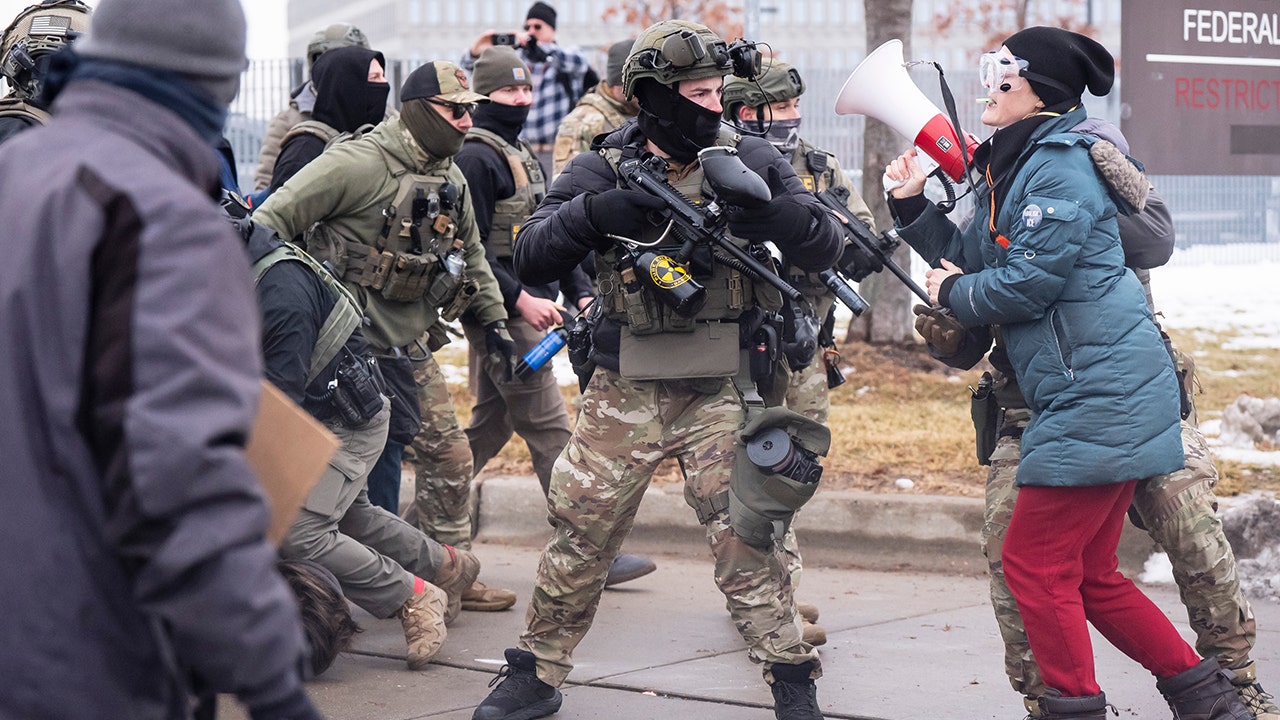
Alcazar said those lines now appear increasingly blurred, allowing demonstrations to drift into obstruction. When enforcement standards are not clearly maintained, he said, agitators exploit the absence of consequences — surrounding officers, escalating confrontations and introducing items that can be used as weapons, such as wooden poles.
NOEM ALLEGES WOMAN KILLED IN ICE SHOOTING ‘STALKING AND IMPEDING’ AGENTS ALL DAY
An onlooker holds a sign reading “Shame” as law enforcement officers work the scene following a shooting by an ICE agent in Minneapolis on Wednesday. (Stephen Maturen/Getty Images)
According to Alcazar, the risks intensify when federal agents are operating without visible local law enforcement support. Immigration enforcement operations, he said, are not designed to manage hostile civilian crowds and instead rely on local departments to secure scenes and prevent interference.
“ICE agents are trained for enforcement operations — not crowd control,” Alcazar said. “When local police pull back, you’re leaving federal agents exposed.”
Those risks were visible on the ground. Fox News correspondent Matt Finn captured a tense moment in downtown Minneapolis when a resident used a vehicle to briefly block Border Patrol agents during an active enforcement operation, forcing agents to order the driver to move. Finn reported that Border Patrol units often avoid remaining in one location for extended periods because agitators frequently attempt to surround or impede them, making even brief delays a safety risk.
MINNESOTA SCHOOLS SHUT DOWN, TEACHERS UNION DEMANDS ICE LEAVE CITY
Tensions escalated in Minneapolis after a fatal shooting Wednesday during a federal immigration enforcement operation, when 37-year-old Renee Nicole Good was shot and killed by an ICE agent.
Federal officials said Good attempted to drive her vehicle toward agents during the encounter, a claim disputed by family members and some local leaders. The shooting led to agitators taking to the streets and heightened scrutiny of federal enforcement activity in the city, contributing to repeated confrontations between demonstrators and federal agents.
City officials, however, said recent demonstrations have largely remained peaceful and that steps are being taken to ensure public safety.
A spokesperson for the Minneapolis Police Department said lawful assemblies had been peaceful and comparable to other small- and large-scale demonstrations that regularly occur in the city. Police emphasized that keeping streets clear is critical to protecting lives, property and first responders.
City Council member Jason Chavez addresses onlookers following a shooting by an ICE agent on Jan. 7, 2026, in Minneapolis. (Stephen Maturen/Getty Images)
The city said it was removing barriers blocking streets near the site of Wednesday’s shooting to ensure emergency access.
Minneapolis Fire Department Interim Chief Melanie Rucker warned that blocked streets can delay emergency response and endanger lives.
“Safety has to come first — every second matters when lives are on the line,” Rucker said, noting crews recently responded to a three-alarm fire just blocks from the area. “When streets are blocked, it slows our response and puts both residents and emergency responders at risk.”
City officials said residents have raised concerns about neighborhood access, with multiple 311 calls requesting barrier removal. While memorials created by community members will remain intact, the city said surrounding streets must stay clear to ensure emergency access.
MASKED AGITATOR TELLS LAURA INGRAHAM SHE’S ‘GETTING PAID RIGHT NOW’ AT ANTI-ICE PROTEST
Residents barricade the 3300 block of Portland Avenue in Minneapolis, Thursday, Jan. 8, 2026. The block is where Renee Nicole Good was shot by an ICE agent. (Derek Shook for Fox News Digital)
Minneapolis Mayor Jacob Frey has sharply criticized the presence and actions of federal immigration agents following the shooting, telling ICE to “get the f— out of Minneapolis” and rejecting the Department of Homeland Security’s account of the incident. Frey said the city does not want federal agents there, arguing their presence has contributed to chaos and undermined public safety.
Additional concerns were raised by Adam Swart, CEO of Crowds on Demand, who told Fox News Digital his firm declined to participate in Minneapolis demonstrations because many crossed into illegal activity, including blocking streets and obstructing federal law enforcement.
RENEE NICOLE GOOD PART OF ‘ICE WATCH’ GROUP, DHS SOURCES SAY
Fox News host Laura Ingraham speaks with an agitator during a demonstration in Minneapolis. The agitator claimed she is being paid “right now” to attend the demonstration. (The Ingraham Angle)
Swart said mixing peaceful protesters with individuals engaging in obstruction creates serious safety risks, as officers cannot easily distinguish between lawful demonstrators and agitators.
“When you’re blocking streets, clashing with law enforcement, and obstructing federal agents, those are illegal protests,” Swart said. “Law enforcement can’t easily distinguish between peaceful protesters and people creating those obstructions.”
Swart rejected claims that blocking roadways or restricting law enforcement movement constitutes “nonviolent resistance,” warning that preventing federal agents from moving freely puts officers, protesters and emergency responders in danger.
He added that such tactics are often counterproductive, saying efforts to obstruct ICE operations are more likely to trigger an increased federal presence rather than deter enforcement.
Mark Ross, president of the St. Paul Police Federation, also weighed in, sharply criticizing local political leadership and the impact of so-called separation ordinances on public safety.
“It’s a recipe for disaster,” Michael Alcazar said about leaving federal officers to operate amid disorder. “That’s how civilians get hurt, officers get hurt and situations spiral out of control.” (Stephen Maturen/Getty Images)
Ross said city leaders have conflated routine crowd control support with “working with ICE,” despite local police departments having no role in federal immigration enforcement.
“As far as I’m concerned, these mayors and councils have some blood on their hands and bear some responsibility,” Ross said.
Ross argued that allowing local police to provide basic crowd control — rather than restricting coordination — could have reduced risks during recent confrontations. He said police assistance focused solely on keeping crowds from interfering with federal agents might have prevented dangerous escalation.
Ross added that his department has repeatedly offered help limited to crowd management, not deportations or federal enforcement duties, to ensure the safety of both agents and demonstrators.
CLICK HERE TO DOWNLOAD THE FOX NEWS APP
Alcazar said the unrest underscores the danger of leaving federal agents to operate amid disorder without local law enforcement support, warning that the absence of a visible police presence increases the risk of escalation and injury for officers and civilians alike.
“It’s a recipe for disaster,” he said. “That’s how civilians get hurt, officers get hurt and situations spiral out of control.”
Alcazar warned that allowing obstruction to go unchecked sends a dangerous signal that enforcement standards no longer apply.
“Once civilians start controlling the streets, police lose control of the streets,” Alcazar said. “When people don’t know where the limits are, they’re going to take advantage.”
Fox News’ Matt Finn and Louis Casiano contributed to this report.
Stepheny Price covers crime, including missing persons, homicides and migrant crime. Send story tips to stepheny.price@fox.com.
Read the full article from Here



By TARA SUN
Medill Illinois News Bureau
news@capitolnewsillinois.com
Article Summary
- Family farm bankruptcies surged 46% nationwide in 2025. In the Midwest, filings jumped 70%. In Illinois, they rose 55%.
- Total farm debt is forecast to hit a record $624.7 billion in 2026, as overhead costs like land rent and interest keep climbing.
- Farmers bought a record 2.54 million crop insurance policies in 2025. But when the guaranteed revenue floor falls below production costs, farmers lose money on every bushel.
This summary was written by the reporters and editors who worked on this story.
SPRINGFIELD — With the growing season well underway in Illinois, farmers once again are struggling to turn an abundant harvest into survival.
In 2025, family farm bankruptcies surged 46% nationwide — reaching 315 filings and marking the third consecutive year of increases. The Midwest recorded 121 filings in 2025 — up 70% from the prior year.
The trend has only accelerated. In April alone this year, 62 Chapter 12 farm bankruptcies were filed nationwide – a 130% jump from the prior year and the highest monthly total since February 2020. The USDA projects total farm debt will rise 5.2% to a record $624.7 billion in 2026, with 330 bankruptcy cases filed.
“I’m scared about there being a real farm crisis,” said Eliot Clay, executive director of the Association of Illinois Soil and Water Conservation Districts. “This could come down to people being able to save their farms – just knowing that they could put it into some conservation easement or something. Like, they need anything that they can get.”
For Illinois, the crisis is playing out as lawmakers just finished a budget session that delivered few meaningful results for an industry under siege. Gary Asay, who has farmed in Illinois since 1976 and sold crop insurance for more than 20 years, sees clear reasons to worry.
“The increase in the number of bankruptcies and the increased buying of higher-level crop insurance are both signs of the stress that’s in the industry,” Asay said. “Farmers are under stress. They may be having to borrow more money. Therefore, they want more protection.”
Crop insurance, he pointed out, can’t fully protect farmers from losses. The most common policy, Revenue Protection, covers only up to 85% of projected revenue.
“Even with the best crop insurance coverage you can buy, if that coverage is below your cost of production, you can still lose money without even collecting,” Asay said.
In 2025, U.S. soybean production totaled 4.26 billion bushels, with the average yield per acre estimated at a record high 53.0 bushels per acre. Illinois alone harvested more than 639 million bushels in 2025.
Then, in February 2025, the U.S. imposed a 10% tariff on Chinese products. And China – once the world’s largest buyer of U.S. soybeans – stopped purchasing U.S. crops. Last September marked the first month since 2018 that imports from the U.S. fell to zero, according to China’s General Administration of Customs.
Farmers had entered the 2025 season with a smaller safety net after the projected price for the crop insurance guarantees fell by 8.7% that year. The drop meant less protection heading into the spring planting. But because yields were high, most farms still generated revenue above their guaranteed floor. Although farmers grew plenty, they sold every bushel for less than it cost to produce.
“A lot of farmers cannot sell their corn or soybeans at a profit right now, just because the price is so low,” Asay said.
Bankruptcies in agriculture rarely follow a single bad year. For U.S. farmers, the financial squeeze began well before 2025.
Real estate debt – tied to the land farmers rent or own – is expected to reach $404.3 billion in 2026, a reflection of the high cost of farmland that has squeezed so many operators.
“Overhead costs represent the largest cost component on the U.S. farm, accounting for nearly one-half of total costs during the 2020-24 period,” said Joana Colussi, a research assistant professor of agricultural economics at Purdue University, citing Purdue data. “Eighty percent of the farmers in the Midwest, they rent the land.”
Colussi has tracked the financial squeeze on farmers across the Midwest. When land prices rise, so does the rent – a fixed cost that farmers pay regardless of crop prices or yields. That leaves farmers searching for ways to keep operations going. “The way to continue being competitive is to try to reduce the costs,” she said.
Diversification into niche markets — non-GMO (genetically modified organism), organic or specialty crops — offers one path forward, though Colussi mentioned it’s not a quick fix
Farm crisis reminiscent of the 1980s.
Rep. Charlie Meier, R-Okawville, who is a farmer himself, described the current moment as reminiscent of the 1980s farm crisis. “There were massive bankruptcies in the ‘80s,” Meier said. “A lot, a lot of farms went under.”
The trigger now and then is the unstable export market. But the financial strain was already visible. In 2025, the Federal Reserve Bank of Chicago reported that 5.6% of farm loans were classified as having “major” or “severe” repayment problems — the highest since 2020. That means borrowers were falling behind on payments or reworking their loans. It’s an indicator that many farmers were struggling to repay old debt while borrowing more to plant the next crop.
Ahead of the 2026 legislative session, farm groups pushed for estate tax relief, one of the Illinois Farm Bureau’s top priorities, along with payouts for farmers to protect their land and programs that help them find new buyers for their crops. But in a tight budget year, those priorities stalled.
The Illinois Farm Bureau did not secure passage of the Family Farm Preservation Act, which would have raised the state’s estate tax exemption from $4 million to $6 million, reducing the tax burden on inherited farms and making it easier for young farmers to keep the land and operations intact.
State Rep. Sharon Chung, D-Bloomington, who serves on the House Agriculture Committee, was also unable to get a relatively small boost for farmers through this session.
She pushed for a $10 million increase in funding for Soil and Water Conservation Districts through House Bill 4755. But the final Fiscal Year 2027 budget held funding at $4.5 million for the third straight year, far short of what advocates say districts need. These districts are trusted by local farmers because they work alongside them, offering advice on how to farm more efficiently at a lower cost.
Clay, the district’s executive director, said the biggest need is giving districts “the financial certainty that they can hire and keep people hired.”
Without that, districts see constant turnover. That means farmers lose access to experienced local advisors who understand their land and can help them navigate conservation practices that might save money and keep them afloat.
“Agriculture is the No. 1 producer for our economy in Illinois,” Chung said. “Anything we can do to help prop that up is so important.”
Despite those unpassed bills, farmers did secure a few victories. The final budget included changes to the Farmland Assessment Law — extending a tax break for conservation practices through 2031 — and avoided cuts to key programs, including the Illinois Department of Agriculture, agricultural education and cover-crop incentives that enrich the soil.
While farmers had hoped Springfield could do more, they also recognized that forces shaping the industry go far beyond the influence of legislators: falling crop prices, an unstable export market and rising costs.
As farmers face mounting distress, the history of the 1980s hangs over the heartland.
“There’s just not enough room for error right now. Something that happened in the past can take down a farmer today,” Asay said.
Tara Sun is a graduate student in journalism with Northwestern University’s Medill School of Journalism, Media and Integrated Marketing Communications, and is a fellow in its Medill Illinois News Bureau working in partnership with Capitol News Illinois.
Capitol News Illinois is a nonprofit, nonpartisan news service that distributes state government coverage to hundreds of news outlets statewide. It is funded primarily by the Illinois Press Foundation and the Robert R. McCormick Foundation.

A statewide competition at Indiana county fairs is returning with a focus on fighting hunger as youth participants collect food for local food banks.
The Fight the Hunger, Stock the Trailer contest will again bring together junior fair boards across the state, including those in Carroll and Clinton counties, according to a community announcement. The initiative, organized by Farm Credit Mid-America and sponsored by Rural 1st, encourages young leaders to coordinate donation drives throughout their county fairs.
Participants gather nonperishable food and work with local communities to support nearby food banks. The effort emphasizes youth leadership while creating a direct impact for families facing food insecurity, according to the announcement.
“We’re glad to bring this initiative back to county fairs across Indiana and to see young people step up and get their communities involved,” Craig Carter, regional vice president of agricultural lending at Farm Credit Mid-America, said in the announcement. “The Carroll and Clinton County Fairs bring people together, and this contest gives folks a simple way to come alongside a cause that supports neighbors right here at home. In the end, our communities are the ones who benefit most.”
Record collections highlight growing participation
Youth-led donation drives have expanded steadily since the program began in 2022, with recent totals showing a sharp increase in contributions.
In 2025, participants collected 233,500 pounds of food for more than 70 food banks across Indiana. That total more than doubled the previous year’s 108,000 pounds and marked the fourth consecutive year of record-setting donations, according to the announcement.
Lake County recorded the largest contribution during that period, bringing in 75,122 pounds of food.
Since the competition began, more than 1 million pounds of food have been collected and distributed across Indiana and Ohio.
Financial support and community investment
In addition to food donations, Farm Credit Mid-America provided financial contributions to support participating youth organizations.
Each fair board received $500 for taking part, with additional funding awarded to regional winners. In total, $56,000 was distributed to junior fair boards across Indiana.
The contest is part of broader community investment efforts by Farm Credit Mid-America and its consumer lending brand, Rural 1st, which contributed more than $4 million to programs in 2025. That total included $1.59 million dedicated to youth, college students, and young and beginning farmers.
More information about the initiative is available on Farm Credit Mid-America’s Community Investment webpage.
This story was created with the assistance of Artificial Intelligence (AI). Journalists were involved in every step of the information gathering, review, editing and publishing process. Learn more at cm.usatoday.com/ethical-conduct.

IOWA CITY, Iowa — An Iowa City man is facing a felony theft charge after police say he was involved in an armed robbery in downtown Iowa City earlier this year.
According to the criminal complaint, 20-year-old Boubacar Dioubate is charged with second-degree theft.
Police say the robbery happened around 12:49 a.m. on April 18 in the 100 block of South Clinton Street.
Court documents allege the victim was approached by three suspects who threatened to stab and shoot him. Investigators say one of the suspects held a knife while demanding the victim’s cellphone.
The victim reported that his $500 cellphone, a $1,000 necklace and $200 in cash were stolen, for a total value of about $1,700.
According to the complaint, security cameras captured the incident. Investigators say the footage shows Dioubate assaulting the victim, repeatedly grabbing the victim’s phone and taking the victim’s necklace.
Police also say the stolen cellphone was tracked to Dioubate’s Iowa City address a few hours after the robbery.
Dioubate was arrested, and the charge was filed in Johnson County District Court. The case remains pending.
-

 Arkansas6 minutes ago
Harrell Wilson enters Arkansas Senate District 1 race as Gilmore seat opens
-

 California9 minutes ago
Suspected Northern California library shooter charged with murder, faces life in prison
-
 Connecticut24 minutes ago
New CT laws taking effect July 1: Absentee ballots, zoning, AI
-

 Delaware29 minutes ago
State Police Investigating Shooting in Newark – Delaware State Police – State of Delaware
-

 Florida36 minutes ago
10 places to watch the fireworks in South Florida for 4th of July 2026
-

 Georgia39 minutes ago
Bottoms wants Georgia to meet its universal pre-K pledge | Chattanooga Times Free Press
-

 Hawaii44 minutes ago
Washington Football Pursuing Coveted 2028 Four-Star Hawaii Athlete
-
Idaho51 minutes ago
BYU-Idaho Launches BYUI Live! as New Name for Campus Entertainment

