News
U.S. to exit 66 international organizations in further retreat from global cooperation

The symbol of the United Nations is displayed outside the Secretariat Building on Feb. 28, 2022, at United Nations Headquarters.
John Minchillo/AP
hide caption
toggle caption
John Minchillo/AP
WASHINGTON — The Trump administration will withdraw from dozens of international organizations, including the U.N.’s population agency and the U.N. treaty that establishes international climate negotiations, as the U.S. further retreats from global cooperation.
President Trump on Wednesday signed an executive order suspending U.S. support for 66 organizations, agencies, and commissions, following his administration’s review of participation in and funding for all international organizations, including those affiliated with the United Nations, according to a White House release.

Most of the targets are U.N.-related agencies, commissions and advisory panels that focus on climate, labor, migration and other issues the Trump administration has categorized as catering to diversity and “woke” initiatives. Other non-U.N. organizations on the list include the Partnership for Atlantic Cooperation, the International Institute for Democracy and Electoral Assistance and Global Counterterrorism Forum.
“The Trump Administration has found these institutions to be redundant in their scope, mismanaged, unnecessary, wasteful, poorly run, captured by the interests of actors advancing their own agendas contrary to our own, or a threat to our nation’s sovereignty, freedoms, and general prosperity,” Secretary of State Marco Rubio said in a statement.

Trump’s decision to withdraw from organizations that foster cooperation among nations to address global challenges comes as his administration has launched military efforts or issued threats that have rattled allies and adversaries alike, including capturing autocratic Venezuelan leader Nicolás Maduro and indicating an intention to take over Greenland.
U.S. builds on pattern of exiting global agencies
The administration previously suspended support from agencies like the World Health Organization, the U.N. agency for Palestinian refugees known as UNRWA, the U.N. Human Rights Council and the U.N. cultural agency UNESCO. It has taken a larger, a-la-carte approach to paying its dues to the world body, picking which operations and agencies it believes align with Trump’s agenda and those that no longer serve U.S. interests.
“I think what we’re seeing is the crystallization of the U.S. approach to multilateralism, which is ‘my way or the highway,’” said Daniel Forti, head of U.N. affairs at the International Crisis Group. “It’s a very clear vision of wanting international cooperation on Washington’s own terms.”

It has marked a major shift from how previous administrations — both Republican and Democratic — have dealt with the U.N., and it has forced the world body, already undergoing its own internal reckoning, to respond with a series of staffing and program cuts.
Many independent nongovernmental agencies — some that work with the United Nations — have cited many project closures because of the U.S. administration’s decision last year to slash foreign assistance through the U.S. Agency for International Development, or USAID.
Despite the massive shift, the U.S. officials, including Trump himself, say they have seen the potential of the U.N. and want to instead focus taxpayer money on expanding American influence in many of the standard-setting U.N. initiatives where there is competition with China, like the International Telecommunications Union, the International Maritime Organization and the International Labor Organization.
The latest global organizations the U.S. is departing
The withdrawal from the U.N. Framework Convention on Climate Change, or UNFCCC, is the latest effort by Trump and his allies to distance the U.S. from international organizations focused on climate and addressing climate change.
UNFCC, the 1992 agreement between 198 countries to financially support climate change activities in developing countries, is the underlying treaty for the landmark Paris climate agreement. Trump — who calls climate change a hoax — withdrew from that agreement soon after reclaiming the White House.

Gina McCarthy, former White House National Climate Adviser, said being the only country in the world not part of the treaty is “shortsighted, embarrassing, and a foolish decision.”
“This Administration is forfeiting our country’s ability to influence trillions of dollars in investments, policies, and decisions that would have advanced our economy and protected us from costly disasters wreaking havoc on our country,” McCarthy, who co-chairs America Is All In, a coalition of climate-concerned U.S. states and cities, said in a statement.
Mainstream scientists say climate change is behind increasing instances of deadly and costly extreme weather, including flooding, droughts, wildfires, intense rainfall events and dangerous heat.
The U.S. withdrawal could hinder global efforts to curb greenhouse gases because it “gives other nations the excuse to delay their own actions and commitments,” said Stanford University climate scientist Rob Jackson, who chairs the Global Carbon Project, a group of scientists that tracks countries’ carbon dioxide emissions.

It will also be difficult to achieve meaningful progress on climate change without cooperation from the U.S., one of the world’s largest emitters and economies, experts said.
The U.N. Population Fund, the agency providing sexual and reproductive health worldwide, has long been a lightning rod for Republican opposition, and Trump cut funding for it during his first term. He and other GOP officials have accused the agency of participating in “coercive abortion practices” in countries like China.
When President Biden took office in January 2021, he restored funding for the agency. A State Department review conducted the following year found no evidence to support GOP claims.
Other organizations and agencies that the U.S. will quit include the Carbon Free Energy Compact, the United Nations University, the International Cotton Advisory Committee, the International Tropical Timber Organization, the Partnership for Atlantic Cooperation, the Pan-American Institute for Geography and History, the International Federation of Arts Councils and Culture Agencies and the International Lead and Zinc Study Group.


Lionel Messi #10 of Argentina celebrates scoring his team’s second goal during their World Cup match against Egypt in Atlanta on Tuesday.
Elsa/Getty Images
hide caption
toggle caption
Elsa/Getty Images
They looked beaten. And out. Argentina, the defending World Cup champion and No. 1-ranked team, was down 2-0 late against Egypt.

Then, in a span of 13 remarkable minutes, Argentina scored not once, not twice, but three times, capping a comeback for the ages and leaving Egypt stunned and shellshocked.
For much of the game in Atlanta, Egypt was in control, hobbling Argentina early. The Egyptian attack began almost immediately with a stunning header goal delivered by Yasser Ibrahim in the 15th minute. After that, Egypt’s defense closed ranks, making it practically impossible for Argentina to equalize.
It was downhill from there for the Argentines: team captain Lionel Messi failed to convert a penalty kick, and in the 67th minute, Egypt got a second goal from Mostafa Ziko (after an earlier Egyptian goal had been disallowed after a video review). It looked like Argentina was finished. On the brink of elimination.
But no one told the Argentine players that.
In the 79th minute, Lionel Messi began doing his thing. He fired a cross near the Egyptian goal, and Cristian Romero headed it in. Messi was not done. Four minutes later, he powered a shot past the Egyptian keeper. It was his eighth goal of this tournament, the most of any player. The score was 2-2.
Then, in stoppage time, yet another Argentina header and another goal, this time from Enzo Fernandez.
“This is the World Cup for you,” said Messi after the game. “It wasn’t easy to come back from two goals down. But as I always say, this group never gives up. We always try to fight until the end.”
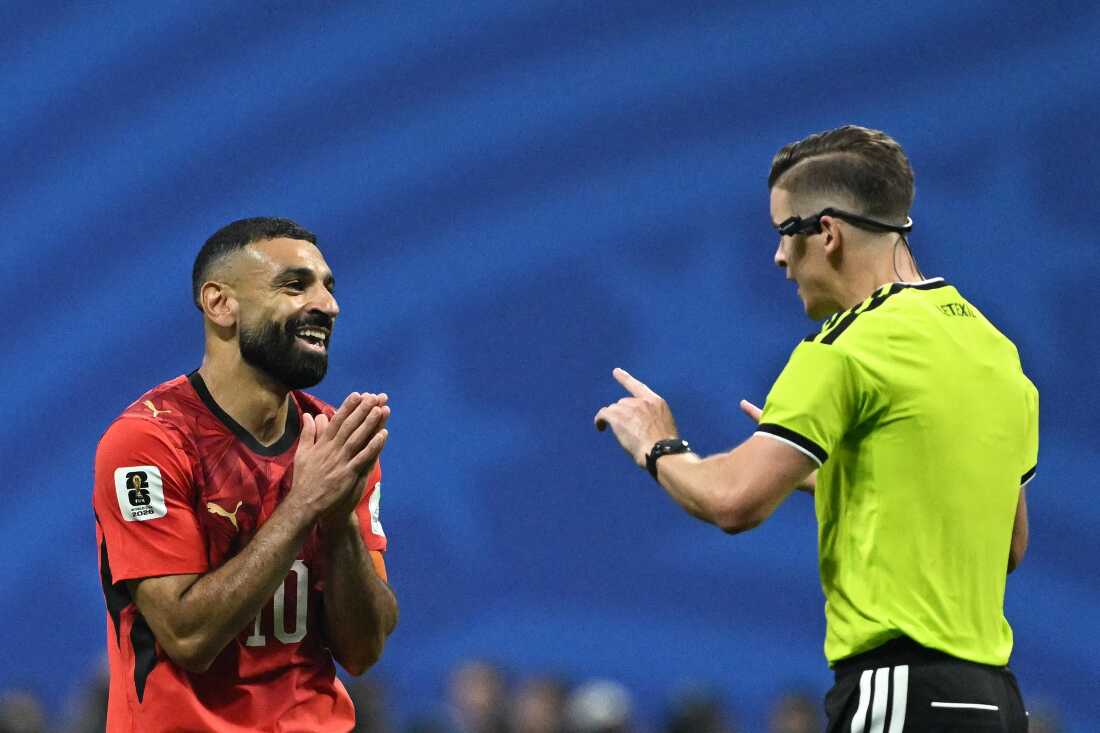
French referee François Letexier speaks with Egypt forward Mohamed Salah during the World Cup Round of 16 match between Argentina and Egypt in Atlanta.
Roberto Schmidt/AFP via Getty Images
hide caption
toggle caption
Roberto Schmidt/AFP via Getty Images
Afterward, Egypt coach Hossam Hassan complained about the French referee and the officiating. “I am not convinced. I am not convinced with this outcome. I’m not convinced with the way things unfolded during this match,” said Hassan in a post-match news conference. “We have been treated unfairly today. We have suffered injustice.”
“We would have deserved to earn this win, but we are leaving with honor, with pride, regardless of this defeat,” said Hossan.
African soccer teams have been the stars of this World Cup. Morocco has yet to lose a game. Cape Verde qualified for the first time in its history and stymied Spain, Uruguay and Saudi Arabia. Argentina barely beat them in a nail-biter of a match.
For Egypt, getting this far in the tournament is historic in itself: it’s the first time the team has made it this far. For Argentina, it was a terrifying yet relieving victory: several players, including Messi himself, cried after the game.
Next, they move to the quarterfinals and will play the winner of today’s Switzerland-Colombia match.

Top Senate Democrats are pushing for answers on whether a provision in a controversial settlement agreement between President Trump and his own administration applies to companies co-founded by or affiliated with the Trump family.
As part of a deal struck in May by the Justice Department to resolve a lawsuit brought by Mr. Trump, the Internal Revenue Service is permanently barred from pursuing claims against Mr. Trump, his oldest sons Don Jr. and Eric, and the Trump Organization based on prior tax returns.
In a one-page document signed by Acting Attorney General Todd Blanche and dated May 19, the Justice Department said the defendants in the president’s lawsuit — the IRS and the Treasury Department — are “FOREVER BARRED and PRECLUDED” from “prosecuting or pursuing, any and all claims” arising from tax returns filed before the settlement took effect. Blanche also wrote that the settlement applies to “parties including trusts, parent, sister, or related companies, affiliates, and subsidiaries.”
Now, Senators Elizabeth Warren of Massachusetts, Senate Minority Leader Chuck Schumer of New York, and Ranking Member of the Senate Finance Committee Ron Wyden of Oregon are pushing 11 businesses and organizations with ties to the Trump family to get answers for the “significant questions” the settlement raises relating to the tax audit provision, and whether the companies are included in the deal.
“Under the guise of a so-called legal settlement, the Trump administration has attempted to decree that the President, his family, and their entire business empire — potentially including entities with even the vaguest ‘affiliation’ to the family — are to face zero consequences if they have committed a range of financial crimes or misdeeds — regardless of the severity of the violation,” the senators wrote in letters transmitted to the companies Monday night.
The letters were sent to mining company Kaz Resources, defense firm Powerus, cryptocurrency companies World Liberty Financial and American Bitcoin, robotics startup Foundation Future Industries, investment firm 1789 Capital, private aviation company Tag Air, and prediction markets Polymarket and Kalshi.
All of the companies either were founded by Mr. Trump and his two adult sons, or list members of the Trump family as advisers, board members, or partial owners. Donald Trump Jr. sits on Polymarket’s advisory board and 1789 Capital, where he’s a partner, has invested in Polymarket. Days before Mr. Trump took office for his second term, Kalshi also announced Trump Jr. would be a strategic adviser.
The Democrats, who are in the minority, lack subpoena power, so Mr. Trump, his children and his companies can’t be forced to answer the questions posed by the senators.
According to recent financial disclosures, the president earned more than a billion dollars from cryptocurrency ventures alone last year, including from his meme coin business and World Liberty Financial, his family’s cryptocurrency firm.
Separately, the senators also asked the Trump Organization in a separate letter if it believes it has “immunity from all audits, civil penalties or federal prosecution” for any crimes that could have occurred before the settlement.
Trump Media and Technology Group, which is majority owned by a trust that lists Mr. Trump as the sole beneficiary and operates the Truth Social platform he uses daily, also received a letter from the Democratic senators.
“The public deserves transparency about the scope of this get-out-of-jail free card for Trump-aligned businesses, and about whether you intend to rely on this settlement as a free pass for any possible violations of the law,” the senators continued in their letter, which also seeks any communications that executives at the companies have had with the Justice Department and White House leading up to or after the settlement was signed.
The settlement was announced months after Mr. Trump and two of his sons and the Trump Organization accused the IRS and Treasury Department of unlawfully allowing a government contractor to leak tax returns to media outlets in 2020.
In a statement, a Justice Department spokesperson said “the IRS routinely provides releases as part of resolving taxpayer reviews and audits. This settlement follows that same standard practice.”
The spokesperson did not provide specific information about which companies are covered by the audit provision, or whether the Trump Organization and Trump family are the only entities covered by that addendum.

Charles De Ketelaere #17 of Belgium celebrates after scoring his team’s second goal during the World Cup Round of 16 match against the United States on Monday in Seattle.
Alex Grimm/Getty Images
hide caption
toggle caption
Alex Grimm/Getty Images
SEATTLE — This time was supposed to be different.
The U.S. men’s national team came into this FIFA World Cup with a lineup full of players with key roles in Europe’s top leagues. They had the name-brand coach — Mauricio Pochettino, of Tottenham, PSG and Chelsea fame. And they had homefield advantage, with every game on U.S. soil for the first time in three decades.

For weeks, the hype seemed like it might be real: The team’s three wins over Paraguay, Australia and Bosnia-Herzegovina were the most ever by a U.S. men’s squad in a World Cup. A new generation of American fans filled stadiums by the tens of thousands and tuned in on TV by the tens of millions.
But in the end, the Americans’ exit was the same as it ever was: Eliminated yet again in the Round of 16 at the hands of a European team — this time, Belgium, by a score of 4-1.
From the moment they stepped onto the Seattle field, the U.S. was outclassed by their opponent, No. 9-ranked Belgium. Countless turnovers and defensive lapses were seized on by the Belgians, who needed only nine minutes to take a 1-0 lead.
Then, once the Americans equalized on a free kick by midfielder Malik Tillman, Belgium scored yet again in barely a minute of play. Belgian forward Charles De Ketelaere scored both his team’s first-half goals.
After halftime, came an embarrassing nail in the coffin that silenced the Seattle sellout crowd for good — a 57th minute roll-in by Hans Vanaken after a slip-up by goalkeeper Matt Freese outside of the penalty area left the goal unguarded. Belgian forward Romelu Lukaku added a stoppage-time goal to seal the final score at 4-1.

Malik Tillman #17 of the United States celebrates scoring his team’s only goal during their World Cup match against Belgium. In what was one of the few bright spots of the game, the U.S. pulled even with Belgium at 1-1. The tie lasted less than two minutes before Belgium scored again.
Luke Hales/Getty Images
hide caption
toggle caption
Luke Hales/Getty Images
“It stinks,” said U.S. midfielder Tyler Adams. “Tonight was not a good performance overall. It’s not what we look to achieve. There [were] a lot of things that we could have done better.”
The U.S. had entered Monday’s game under a cloud of controversy around their striker Folarin Balogun, who was shown a red card in last week’s Round of 32 match against Bosnia-Herzegovina. An automatic one-game suspension was set to sideline Balogun, the Americans’ leading scorer at the World Cup, for Monday’s game.
Then, the day before the game, a FIFA disciplinary panel took the highly unusual step of delaying Balogun’s suspension by a year to allow him to participate. Then, news broke that President Trump had personally called FIFA president Gianni Infantino to encourage him to review the red card.
The Royal Belgian Football Association said it would protest Balogun’s inclusion in the lineup. But even at full strength, the U.S. were never real contenders in Monday’s game.
U.S. defender and team captain Tim Ream said the controversy swirling around the team had no impact. “We were fully focused on us as a group and as a team and fully focused on the game and not really worrying about what was being said or debated in the outside world.”
Belgium will advance to the quarterfinals for the third time in the past four World Cups, where it will face Spain on Friday in Los Angeles.

Mauricio Pochettino, Head Coach of the United States, walks down the touchline during the Round of 16 World Cup match between the USA and Belgium in Seattle on Monday.
Carl Recine/Getty Images
hide caption
toggle caption
Carl Recine/Getty Images
-

 Denver, CO3 minutes ago
City of Denver says images of piling waste a case of illegal dumping
-

 Seattle, WA8 minutes ago
14-year-old dies in electric motorcycle crash at Seattle bike park
-

 San Diego, CA15 minutes ago
Serial sex abuser sentenced to over 300 years for crimes against young relatives
-

 Milwaukee, WI18 minutes ago
13 Things to Do in Milwaukee This Weekend: July 9-12
-

 Atlanta, GA23 minutes ago
Atlanta City Council member proposes citywide heat safety plan as temperatures climb
-

 Minneapolis, MN30 minutes ago
I-394 traffic shift between Minneapolis and St. Louis Park starts on Wednesday
-
 Indianapolis, IN33 minutes ago
Indiana officials call for action after 2 children die in retention ponds
-

 Pittsburg, PA38 minutes ago
Fayette County man facing 1,000+ charges related to animal cruelty, neglect

