Lifestyle
‘This feels like home.’ A fashionably late night out to the Pico Rivera Sports Arena

This story is part of Image’s December Revelry issue, honoring what music does so well: giving people a sense of permission to unapologetically be themselves.
The belt used to belong to his father. Black leather, silver stitching, “RUBEN” spelled across the side with the initials “R.V.” on the buckle, for Ruben Vallejo, a name both men share. Now it sits on the waist of the younger Vallejo as he gets ready for a night out at the Pico Rivera Sports Arena, a place he’s been to “over 50 times,” he says, but this one’s special. He tucks in his thrifted button-up shirt, adjusts his belt buckle and looks in the mirror.
For the Vallejo family, the arena is a second home and dancing there is tradition. It stands as a cultural landmark for Los Angeles’ Mexican community, hosting decades of concerts, rodeos and community celebrations. Vallejo’s parents first started going in the early ’90s, when banda and corridos began echoing across L.A. Tonight, the beloved crooner Pancho Barraza is performing and Vallejo is going with his mom, sister, aunt and godmother.

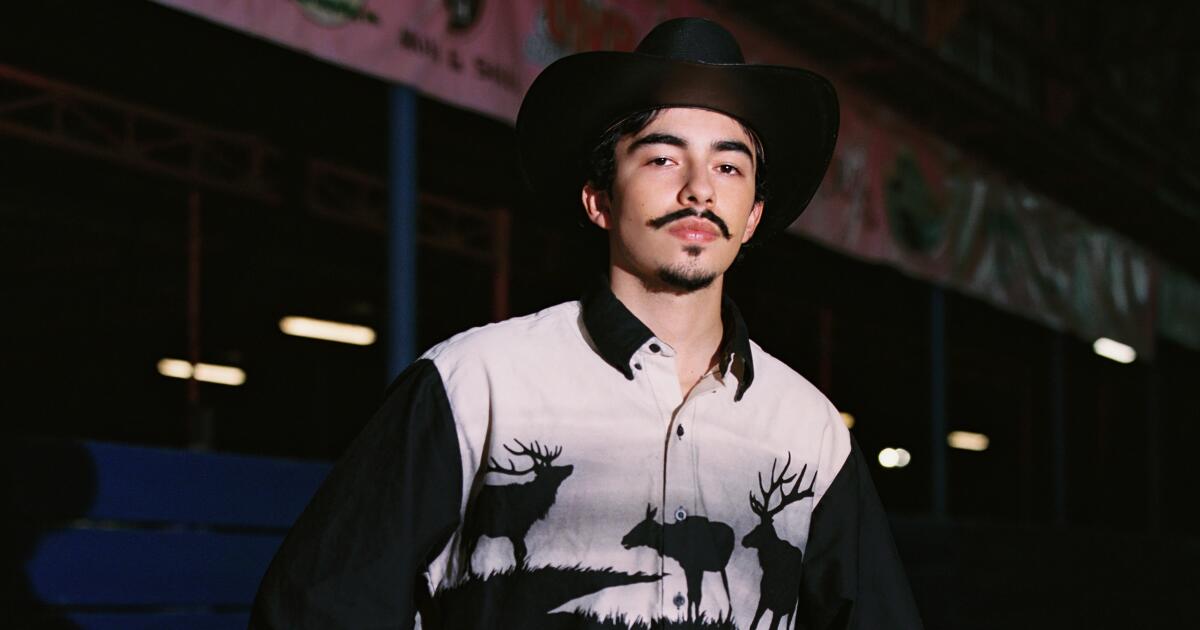
Vallejo wears a black tejana from Marquez Clásico, a thrifted vaquero-style button up, thrifted jeans and a belt passed down from his father.
At 22, Vallejo doesn’t see música regional Mexicana as nostalgia — it’s simply who he is, something he wears, dances to and claims as his own. “I want to revive this and let other people know that this art and culture is still alive,” says Vallejo. “From the way that I dress, from the music I listen to, I want to let everybody know that the kids like this.”
It’s a little past 6:30 p.m. on a Sunday in late October, and the sound of a live banda carries from a small Mexican restaurant near the Vallejo family’s Mid-City home as the excitement for the night builds. The horns and tambora spill into the street as the neighborhood celebrates early Día de los Muertos festivities. Inside, Vallejo opens the door to his storybook bungalow, where his parents lounge in the living room. But it’s his bedroom that tells you who he is — a space that feels like a paisa museum.
Thrifted banda puffer jackets hang on the closet wall: Banda Recodo, Banda Machos, El Coyote y su Banda Tierra Santa. Stacks of CDs and cassette tapes line his dresser, from Banda El Limón to Banda Móvil and a signed Pepe Aguilar. On one wall, a small black-and-white watercolor of Chalino Sánchez he painted himself hangs beside a framed Mexico 1998 World Cup jersey. “Everything started with my grandpa,” Vallejo says. “He was a trombone player and played in a banda in my mom’s hometown in Jalisco.”


Music runs in the family. His uncles started a group called Banda La Movida, and Vallejo is still teaching himself acoustic guitar when he’s not apprenticing as a hat maker at Márquez Clásico, crafting tejanas and sombreros de charro.
“I feel like being an old soul gives people a sense of how things used to be back in the day,” he says of the intergenerational bridge between his work and personal interests. “That connection is something so needed right now.”
Beyond the banda memorabilia, the real story lives in the old family photos — snapshots of backyard parties, his parents in full ’90s vaquero style in L.A. parking lots and a large framed portrait of his uncles from Banda La Movida, posing in matching blue jackets and white tejanas.
“This is a picture of us in the [Pico Rivera Sports Arena] parking lot. We’d go to support my cousins in a battle of the bandas. Which also meant fan clubs against fan clubs. The pants were a lot more baggy then,” explains Vallejo’s mother, Maria Aracely, in Spanish.


The belt used to belong to his father. Black leather, silver stitching, “RUBEN” spelled across the side with the initials “R.V.” on the buckle, for Ruben Vallejo, a name both men share.
Vallejo’s look for the night is simple but intentional: a black tejana from Márquez Clásico, a thrifted black-and-white vaquero-style button-up patterned with deer silhouettes, loose “pantalones de elefante,” as he calls them, his dad’s brown snakeskin boots, and, of course, the embroidered belt that ties it all together.
“This is very Pancho Barraza-style, especially with the venado shirt. I looked up old videos of him performing on YouTube. I do that a lot with these older banda looks,” Vallejo says.
A rustic leather embroidered bandana with “Banda La Movida” stitched vertically hangs from his left pocket — a keepsake his mom held onto from her brothers’ group back in the day.

“I feel like being an old soul gives people a sense of how things used to be back in the day. That connection is something so needed right now.”
Running fashionably late, Vallejo arrives at Barraza’s concert with less than an hour to spare, but he seems unbothered. His mom and older sister, Jennifer, are there, along with his aunt and godmother. A mix of mud and alcohol hangs in the air as the family makes their way across the fake grass tarps covering the lower level of the arena. Barraza is onstage with a mariachi accompanying his banda. With the amount of people still out drinking and dancing, it’s hard to believe it’s past 10 o’clock on a Sunday night.
Walking past the stands, Vallejo’s mother is in awe as she points out a certain upper level section of the arena and recalls the amount of times she would sit there and see countless bandas before she had Ruben and his sister. As the concert nears the end, Barraza closes with one of Vallejo’s favorite songs, “Mi Enemigo El Amor,” which Vallejo belts out, jokingly heartbroken.
“I hadn’t seen him live yet and the ambiente here feels great because everyone here is connected to the music. Even though we’re in L.A. this feels like home, like Mexico.”
Frank X. Rojas is a Los Angeles native who writes about culture, style and the people shaping his city. His stories live in the quiet details that define L.A.
Photography assistant Jonathan Chacón



Can you say no to a friend’s wedding?
Getty Images/Getty images
hide caption
toggle caption
Getty Images/Getty images
Are we spending too much on other people’s weddings?
Going to a friend’s weddings can be so fun and meaningful… but it can also really hurt your wallet. A survey by LendingTree found that 31% of people who had been to a wedding in the past five years had accrued debt to attend. So what’s driving up the cost of weddings for guests? And what makes it so hard to say no to these expenses?
Brittany breaks it down with Allyson Rees, senior analyst at trend forecasting firm WGSN, and Annie Joy Williams, assistant editor at The Atlantic.
This episode was produced by Liam McBain, with additional support from Corey Antonio Rose. It was edited by Neena Pathak. Our Supervising Producer is Cher Vincent. Our Executive Producer is Barton Girdwood. Our VP of Programming is Yolanda Sangweni.
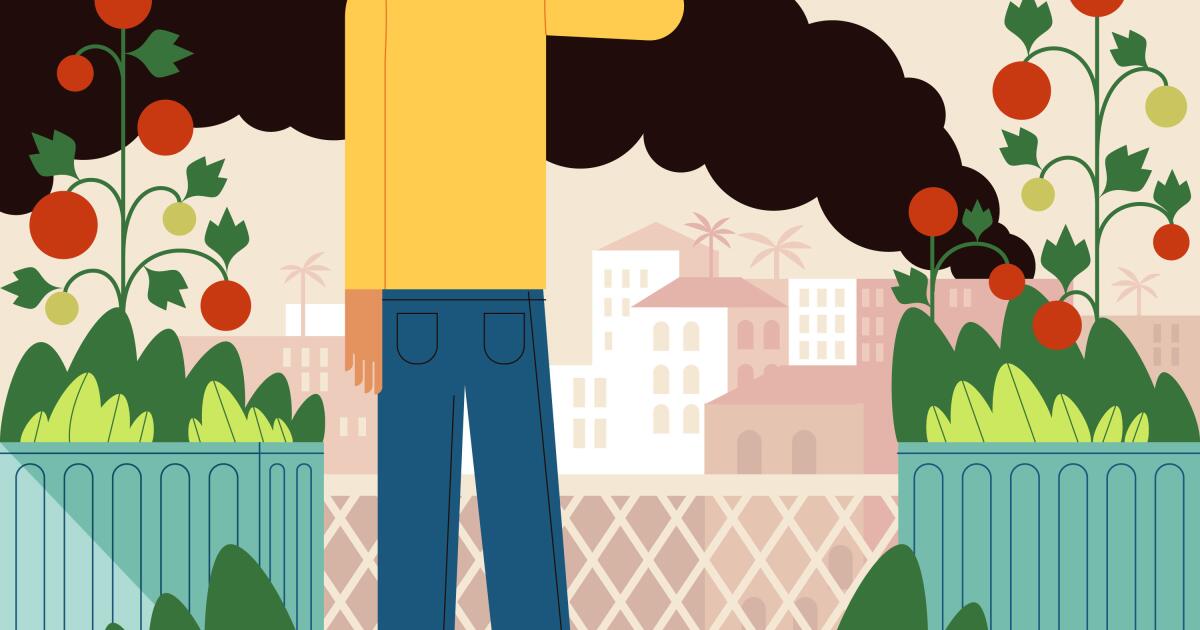
After the eight-day-long fire in a 500,000-square-foot Boyle Heights warehouse, eastern Los Angeles residents are contending with putrid smells, soot and potentially hazardous airborne chemicals after heavy plumes of smoke spread throughout the city. But those who grow food in nearby neighborhoods may also be wondering: How will the fires affect the plants and produce in my garden?
The Boyle Heights warehouse, owned by Lineage — a global temperature-controlled storage facility operator — housed 85 million pounds of frozen food and other products. In the days since the fire, local emergency visits for smoke inhalation and throat pain spiked while agencies still scramble to measure the amount of PM 2.5 — harmful fine particles — and heavy metals, like lead and arsenic, in the air.
According to researchers, any toxic airborne chemicals would likely stem from the charred foam insulation, metal exterior, burned solar panels and any lithium batteries that might have been present inside the warehouse.
After a fire, heavy metal particles can spread through ash and smoke over gardens and inhibit growth, said Olukayode Jegede, an agricultural toxicologist and assistant professor at UC Davis. Since the warehouse fire is so recent and cleanup has just begun, Jegede said the precise impact on gardens can’t be measured until comprehensive soil tests are conducted in the area.
While the L.A. city government hasn’t announced plans for soil testing, the Contaminant Level Evaluation and Analysis for Neighborhoods project at USC is offering free contaminant testing for Boyle Heights and East L.A. residents. Residents can collect soil samples and deliver them to Boyle Heights City Hall and other locations for an evaluation of lead, arsenic, chromium and mercury levels.
The good news is produce, plants and roots can still be preserved. According to Jegede, many of the soil tests conducted last year in the Altadena area after the Eaton fire showed that gardens and poultry were not as contaminated as one might expect.
“Quite a number of the soils we tested [in Altadena] were not really contaminated,” Jegede said. “We weren’t seeing many soils with concerning elevated levels of metal, so gardeners should not be too alarmed when these things happen.”
Nevertheless, there are several measures that gardeners can take to keep themselves, their children, plants and produce safe from potentially harmful contaminants stemming from the fire. Researchers, gardening experts and horticulturists offered some guidance on the handling, recultivation and cleanup that can keep you and your garden in good health.
How do I remove ash and contaminants from my garden?
Altadena horticulturist Leigh Adams said Boyle Heights plants and produce already live in a difficult environment, surrounded by industrial warehouses that spread contaminants daily.
“That area has been used industrially for 100 years, and the soil is impacted by many, many, many things,” Adams said. “Low-income neighborhoods and gardens usually don’t have a lot of resistance against dominant manufacturing.”
This means that the contamination of gardens in eastern L.A. won’t be as catastrophic as compared with those in Altadena, a more suburban environment, Adams said. But fallen ash still poses major health risks if ingested or inhaled.
An advisory from University of California Agricultural and Natural Resources last year recommended suiting up in an N95/KN95 mask, long sleeves, pants, close-toed shoes and gloves before attempting to deal with ash in the garden to limit exposure to potentially toxic contaminants. The advisory added that individuals should make sure all of this gear is cleaned thoroughly before bringing it back inside.
Once in the proper gear, Adams recommends removing the top two inches of topsoil from gardens, where the highest concentration of contaminants will settle after a fire. Using a plastic bag to collect the soil and disposing of it in the garbage — not green yard waste bins — will help to reduce the spread of airborne chemicals.
Gardeners with raised beds are advised to remove approximately six inches of soil, because excess ash can raise the pH level and prevent nutrients from soaking into the soil bed.
After this, watering the garden gently but plentifully will help to promote soil health and get rid of most of the ash present on plant leaves and stems. Adams said replacing the top two inches of soil with store-bought mulch or straw will help to contain any remaining ash and prevent it from spreading any further.
Experts say to avoid using leaf blowers if ash is present in the garden because they can send particles airborne. Doing so will increase the likelihood of heavy metal particles, which can carry lung irritants and carcinogens, being spread and inhaled.
A Boyle Heights resident keep a watchful eye on the fire at the 5,000-square-foot commercial building, which stores 85 million pounds of frozen food.
(Genaro Molina / Los Angeles Times)
Is it safe for me to eat produce from my garden?
Several studies, including one from the UC Cooperative Extension of Sonoma County, have shown that consuming produce in a fire-affected area poses minimal health risks.
Jegede said most root vegetables like potatoes and carrots, along with any fruit that has an outer layer, can be washed to remove potential contaminants, even if they were covered in ash. Peeling the outer layer of your produce can also help to reduce potential risks, he said.
Lettuce and other leafy foods with multiple layers pose a higher risk of contamination, but with a vigorous wash and peeling the outer layers, even the greens can be saved. The County of Los Angeles Department of Public Health recommends soaking leafy produce and fuzzy fruits like peaches in a 10% white vinegar and 90% water mixture.
Jegede said if the leaves or fruit are too delicate to wash or ash is still visible, it would be best to dispose of the produce.
How can I tell if my soil is contaminated?
After ridding your garden of visible ash, you might wonder how to tell if your plants will still thrive in the soil.
At-home soil tests that measure for alkaline, fertility and pH levels are widely available and can be purchased for $15 to $100 (for more detailed results) online. But Jegede said these tests can’t tell the full story of soil health.
Comprehensive soil testing is “something you can’t do properly at home,” Jegede said. “In labs, we are testing for metals like lithium and zinc, stuff that an at-home test will not show … If it comes to the point that you’re worried about your soil, I would just send it out to a lab.”
Wallace Laboratories in El Segundo, Babcock Laboratories in Riverside, Waypoint Analytical in Anaheim and other labs offer more detailed soil tests that measure heavy metal particles in addition to other fertility factors. Prices at Wallace Laboratories can range from $115 to $295 for a complete compost test.
The soil below two inches should be unharmed, Adams said, so long as new compost is set and plants are watered plentifully, which will promote natural biological cycles.
“What you’re doing is capping the soil, so that moisture stays in there, and instead of being dirt, it’s a living system called soil,” Adams said. “The more carbon we can get into our soil, the better.”
What can I do to help my soil recover?
For the last 12 years, Adams has been working with Metabolic Studio, a Los Angeles-based art and research hub focused on environmentalism, on methods for bioremediation, the practice of using additional fungi, plants and compost to decontaminate ash and break down contaminants.
Adams said straw, mushrooms, corn, rye and sunflowers are great bioremediators that can help to repair damage to soils. She said certain samples she’s worked on with Metabolic Studio have gone from testing at high heavy metal levels to nearly contaminant-free.
But for a more immediate fix, wash your produce, water your plants and have a little patience during ash cleanups. Your garden should look better in no time, Adams and Jegede said.

Inde Navarrette and Michael Johnston in Obsession.
Focus Features
hide caption
toggle caption
Focus Features
Two big horror films, Obsession and Backrooms, just smashed all box office expectations. So much of their success has been driven by Gen Z, which is now the biggest moviegoing demographic. But what makes a movie a Gen Z movie? Today we’re bringing you an episode of NPR’s It’s Been a Minute. Host Brittany Luse talks about this trend with Sam Adams and Reanna Cruz.
If you want to hear more about these movies, check out these episodes:
In ‘Obsession,’ love hurts. It really, really, really hurts.
‘Backrooms’ brings YouTube horror to the big screen
Zendaya brings ‘The Drama,’ we bring the spoilers
Connect with Pop Culture Happy Hour:
Letterboxd / Facebook
Our weekly newsletter
Support Pop Culture Happy Hour+
-

 Alaska5 minutes ago
Climate Change Is Helping an Invasive Predator Wreak Havoc on Iconic Alaskan Fish
-

 Arizona8 minutes ago
Arizona man pleads guilty after illegally living in forest for years among ‘1,000lbs of trash’
-

 Arkansas13 minutes ago
Army names intelligence facility for Arkansas Tech graduate
-

 California20 minutes ago
How California Effectively Legalized an Open-Air Sex Market
-

 Colorado23 minutes ago
Julian Lewis Says Deion Sanders’ Colorado ‘Wasn’t Really Looking at Defenses Much’ Last Season
-
 Idaho28 minutes ago
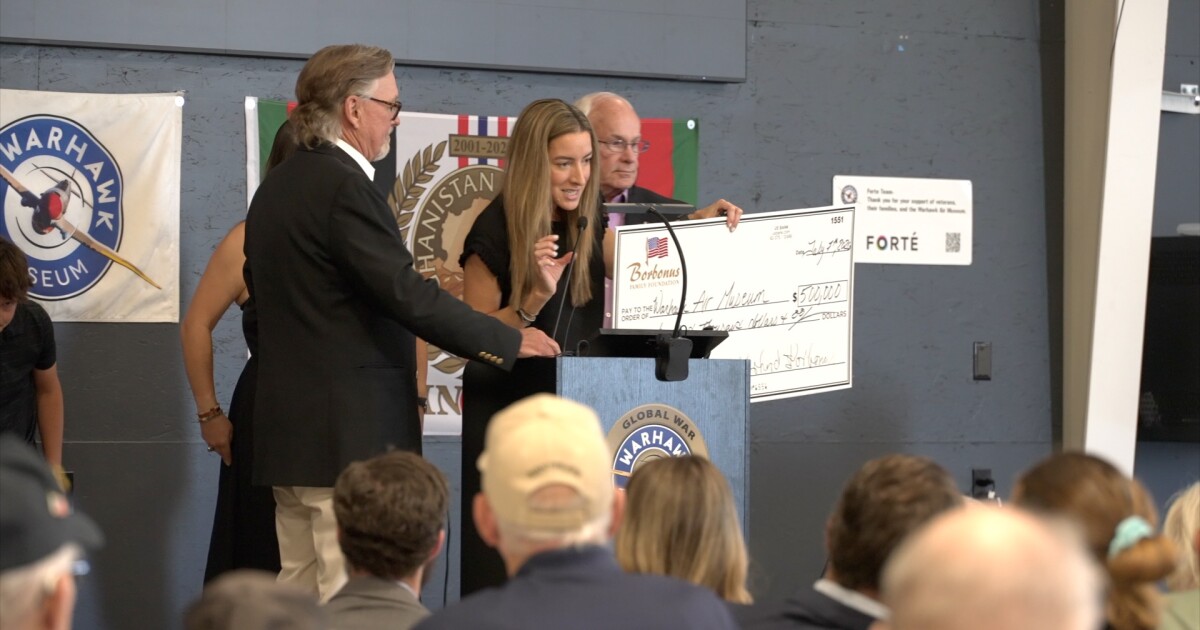
Warhawk Air Museum receives $500K grant honoring fallen Idaho soldier
-

 Connecticut28 minutes ago
Several beaches closed to swimming due to potential bacteria in the water
-

 Delaware35 minutes ago
Delaware Libraries Introduce Digital Literacy Specialists Program – State of Delaware News

