Business
Auto Tariffs Take Effect, Putting Pressure on New Car Prices


Tariffs on imported vehicles took effect Thursday, a policy that President Trump said would spur investments and jobs in the United States but that analysts say will raise new car prices by thousands of dollars.
The 25 percent duty applies to all cars assembled outside the United States. Starting May 3, the tariff will also apply to imported auto parts, which will add to the cost of cars assembled domestically as well as auto repairs.
There will be a partial exemption for cars made in Mexico or Canada that meet the terms of free trade agreements with those countries. Carmakers will not have to pay duties on parts like engines, transmissions or batteries that were made in the United States and later installed in cars in Mexican or Canadian factories.
That provision will reduce the impact on vehicles like the Chevrolet Equinox electric vehicle, which is assembled in Mexico but includes a battery pack and other components made in the United States. General Motors will pay a tariff only on the portion of the car made abroad.
At the same time, the duty on parts will raise the cost of cars made in Michigan, Tennessee, Ohio or other states. That is because most cars rolling out of U.S. factories contain components made abroad, often amounting to more than half the cost of the vehicle.
About 90 percent of the value of some Mercedes-Benz cars made in Alabama, for example, is in engines and transmissions that are imported from Europe, according to data compiled by the National Highway Traffic Safety Administration.
The impact of the tariffs on individual vehicles will vary widely. Cars like the Tesla Model Y, made in Texas and California, or Honda Passport, made in Alabama, have high percentages of U.S.-made parts and will pay lower tariffs.
Tariffs will be highest on cars manufactured abroad, like the Toyota Prius made in Japan or Porsche sports cars made in Germany.
Even people who don’t buy new cars will be hit by the tariffs because they will pay more for parts like tires, brake pads and oil filters.
Michael Holmes, co-chief executive of Virginia Tire and Auto, a chain of auto repair and maintenance shops, said he and his suppliers would initially try to absorb most of the increased cost.
“That’s not sustainable,” Mr. Holmes said. “It’s magical thinking to think businesses won’t pass this on.”
The auto tariffs could also push up prices for used cars over time, analysts said, by increasing demand for those vehicles as new ones become unaffordable for many buyers. Insurance premiums may also rise because repairs will cost more.



Los Angeles has one of the deadest downtowns in the world, according to a new survey.
Out of 75 of the top cities around the world, L.A. ranked among the lowest for vibrancy in Gensler’s 2026 City Pulse report released this week.
Around 65% of those surveyed found DTLA vibrant compared to more than 80% vibrancy scores for New York, Chicago, Sydney and Shanghai.
The urban planning and consulting company surveyed 35,000 city residents on how they ranked their city for a variety of statements. Los Angeles ranked 20th-lowest globally and 11th-lowest among 34 U.S. cities in vibrancy.
Downtown Los Angeles needs more people to return to downtown to work, shop and eat if it wants to boost its scores, said Kelly Farrell, the managing director of Gensler’s L.A. office
“L.A.’s kind of central problem is that businesses have left L.A. We need them to bring the offices back in,” she said. “Bring the people back in so they’re staying after work and interacting with those businesses that are in the area.”
While there are pockets of downtown that are thriving and local residents say life is improving, Los Angeles’ downtown suffers from an image problem that is weighing on how it is perceived.
Gensler’s report highlights key factors that contribute to a thriving downtown area. Downtowns should have a blend of shops, offices, and housing, walkability, and a role as a cultural and entertainment hub.
Despite its status as the city’s historic seat of government, finance, arts and sports, downtown L.A. has experienced a trend of offices leaving post-pandemic, leading to fewer visitors and the remaining stores and restaurants struggling.
The Los Angeles Office of Finance showed that the number of businesses reporting leaving downtown has increased greatly over the last two years, following a lull post-pandemic. Similarly, downtown has accounted for a growing share of overall exits from the region in the last five years.
According to a Times data analysis, downtown has regularly accounted for the highest number of closures. Among the neighborhoods hit the hardest by closures, South Park, the Fashion District, Central City and Pico-Union had the highest number of closures from 2024 to 2025. Nearly 40% of the office space in the Financial District is functionally empty, and 30% of retail space is vacant, according to CBRE.
Another important factor is whether or not people linger there. Rather than the number of visitors, Gensler said in the report, the amount of time spent downtown matters more in cultivating a thriving downtown area.
L.A. has consistently struggled to get locals back into downtown in recent years.
Perceived safety issues downtown are one major reason businesses are leaving downtown, and locals won’t go there.
Vandalism, assaults and robberies downtown have driven businesses out, and a noticeable lack of police presence makes people reluctant to return. Still, Los Angeles Police Department Capt. Kelly Muniz said in April that crime is down 10% from last year.
Gensler’s L.A. director says that as people flood back into downtown, crime will continue to decline.
“One of the best things we can do for safety is have an abundance of population,” said Farrell. “You will see right now that we have a lot of great ground-floor retail that’s empty. As that gets fuller, we typically see that crime starts to go down with it.”
Farrell said results can change dramatically between each year of the survey, and as L.A. sees more offices return to downtown, perception of vibrancy will increase with it.
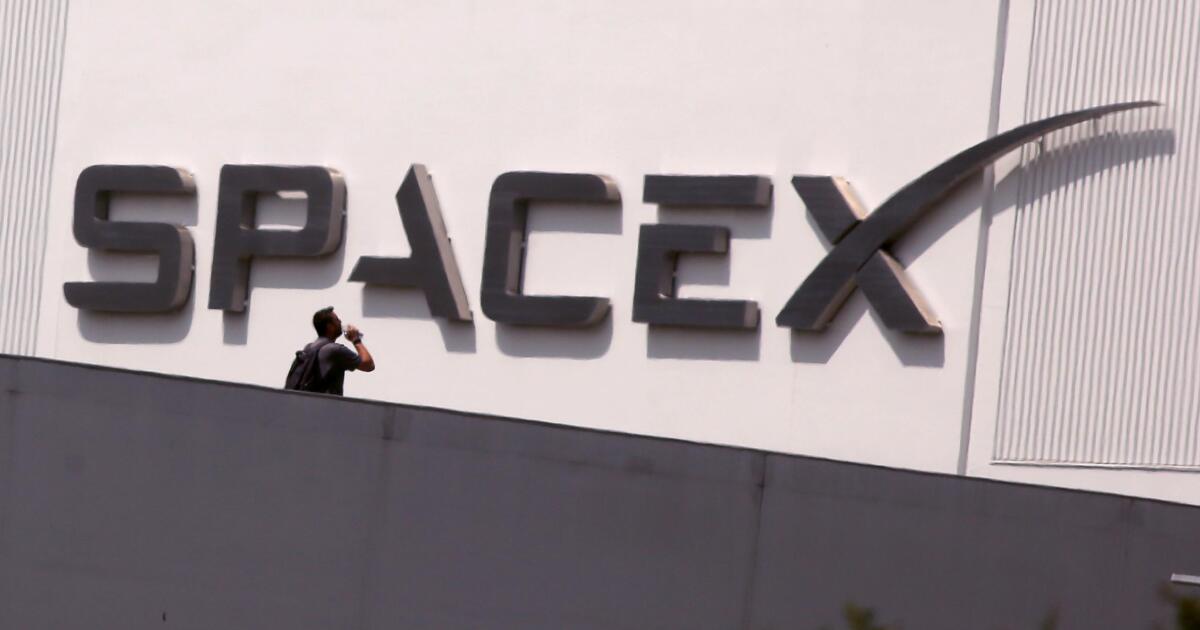
SpaceX, the once fledgling aerospace company that Elon Musk predicted had a slim chance of survival, reached new heights on Friday with a historic initial public offering.
Shares of SpaceX, trading under the ticker SPCX, closed the day at $160.95, 19% above the offering price, transforming it into one of the world’s most valuable companies with a $2.2-trillion market cap. The IPO also made the 54-year-old Musk the world’s first trillionaire.
The IPO capped a remarkable journey for a 24-year-old company that nearly shut down after a series of failed launches until its Falcon 1 rocket in 2008 orbited the earth and clinched a crucial NASA contract.
“It is certainly hard to believe that a little company that started in a warehouse in El Segundo is now going public with the largest IPO ever,” Musk told cheering employees at the company’s Texas headquarters.
The company raised $75 billion in the offering after selling 555 million shares at $135 to institutional and retail investors. With the shares in high demand, SpaceX could raise even more money.
It granted the nearly two dozen underwriters of the IPO, led by Goldman Sachs and Morgan Stanley, an additional 83 million shares, which could raise its total take to $86 billion.
The IPO is easily the largest on record, surpassing the 2019 offering by Saudi Aramco, Saudi Arabia’s state-owned oil giant, which raised $29.4 billion.
“They clearly priced it right, at least for one day. It should just make you optimistic for the markets for, especially for growth stocks,” said Robert Gruendyke, senior portfolio manager at Allspring Global Investments.
Musk has big plans for the company, which already dominates the world’s rocket launch business and is the leading satellite-based broadband provider with its Starlink service. It also has spent billions to buy spectrum for satellite-based mobile communications service.
Key to its efforts is Starship, a rocket being tested that is larger than the Saturn V that took astronauts to the moon. NASA is relying on it to return Americans there, while Musk eventually wants to fly it to Mars.
Musk sees it as crucial to his AI ambitions. Musk merged his xAI artificial intelligence company into SpaceX this year, with the combined entity recently announcing it was leasing computer power to rivals Anthropic and Google at two terrestrial data centers it has constructed.
Musk contends the future of AI lies in launching thousands of satellite data centers into space, where they will perform computer calculations while orbiting the Earth powered by a continuous supply of solar energy — a vision critics see as far-fetched.
However, Musk has proved skeptics wrong in the past, especially those who bet against Tesla when it conducted its $1.7-billion IPO in 2010. At the time, CNBC personality Jim Cramer called the $17 shares a “sell, sell, sell.”
While it took until 2020 for the stock to really take off as Model 3 sales grew, shares of the electric vehicle maker closed Friday at $406.43, giving Tesla a market capitalization of $1.5 trillion.
The SpaceX IPO was a gold mine for Musk’s venture capital backers in Silicon Valley, including Peter Thiel’s Founders Fund, Andreessen Horowitz and Sequoia Capital, which reportedly had stakes now valued at $10 billion or more.
It also made an estimated 4,000 current and former SpaceX employees millionaires, with another 400 achieving a net worth exceeding $100 million, said Andrew Benson, chief executive of Hill.com, an investment platform for trading stock in pre-IPO tech companies.
SpaceX is currently headquartered in south Texas after moving there in 2024 from Hawthorne, where it had its executive offices for years after expanding from its original El Segundo warehouse.
However, the company retains large operations in the South Bay city, where it has more than 6,000 employees out of at least 22,000 companywide. And it blasts off its Falcon 9 rocket regularly from Vandenberg Space Force Base in Santa Barbara County.
Benson said that he estimates the “vast majority” of current and former employees with more than $100 million in stock are in Southern California due to a stock awards plan that has favored length of tenure over an employee’s role.
“It’s just great to see employees be able to convert their labor into capital,” he said.
Even before Friday’s IPO, former employees of SpaceX have helped seed an aerospace and defense boom largely in Southern California, starting some 70 companies, including well-known startups Relativity Space, Impulse Space and K2 Space, according to the alumnifounders.com tracking site.
Van Espahbodi, co-founder of Generational Partners, a Los Angeles venture capital fund, expects the IPO will result in even more employees taking a crack at their own firms.
“It will allow many of them to pursue their vision,” he said. “I am aware of extreme cases where people took on credit card debt to maximize preserving their shares and not having to sell off, so that they can go and do their thing.”
Demand for the IPO shares was feverish on Wall Street.
The offering was reported to be oversubscribed four times over by big institutional investors. Blackrock, the New York money manager that is the world’s largest, was seeking to buy as much as $5 billion of the stock, Bloomberg reported.
That was despite concerns by critics that the company was overvalued and skepticism of a governance structure that puts few constraints on Musk. He holds special shares with 10 times the voting power of common shares that put him in control of the company’s board.
Investment research firm Morningstar placed a $780 billion valuation on SpaceX, focusing on its core rocket and Starlink broadband satellite businesses. It suggested investors wait a few months for the stock to settle before buying in.
With AI leaders OpenAi and Anthropic next lined up to conduct initial public offerings, Jim Chanos, a veteran short seller, likened the era to the first dot.com boom, which ended with a tech bust — except more extreme.
“This is much bigger,” he said, in a Bloomberg News interview.
Whatever the hype or unease about the offering, SpaceX reached the IPO after an impressive record of achievements that transformed the space business.
After outgrowing its original El Segundo space and moving into a massive former Northrop facility in 2007, the next year it launched its first successful rocket and set about developing its now workhorse Falcon 9.
The rocket, first launched in 2010, is partially reusable and is estimated to have lowered launch costs by some 95% compared to traditional single-use rockets.
It’s estimated the Falcon 9 accounted for more than 80% of the mass sent up into space last year — giving rise to the new generation of aerospace companies that rely on it.
It also has been key to the company’s Starlink business, which sent up its first satellites in 2019. SpaceX even launched 29 Starlinks on Friday. There are now more than 10,000 in orbit with plans for thousands more as demand grows.
Paul Habibi, a real estate lecturer at UCLA and principal of Grayslake Advisors in El Segundo, said he believes the IPO should boost the South Bay real estate market, as insiders granted stocks spend some of their newfound wealth.
“A lot of those folks are probably going to line up around the block to buy into neighborhoods like Manhattan Beach,” he said.
Meanwhile, retail investors placed more than $100 billion in orders, far more than had been reserved for them in the IPO, Bloomberg said. It was expected individual investors would end up with a 20% share of the offering.
Many of those retail buyers are devoted Musk fans and are assumed to want to hold the stock, but others were expected to have flipped the stock Friday for a quick profit.
Angela Lee, a professor at Columbia Business School, thinks the individual investors who think they will strike it rich could be mistaken — though she doesn’t entirely discount the possibility.
“I think they think it’s a golden ticket, when it’s more likely they are holding a lottery ticket,” she said.
Bloomberg News contributed to this report.

Betting is fundamentally about risk: You might win or you might lose. But what if you could always win?
Enter prediction markets, sites that let users bet on pretty much anything. Most of those users lose. But a savvy few have made a fortune using basic math.
Will Gavin Newsom win the 2028 Democratic presidential nomination?
Will the Fed raise interest rates in 2026?
Will Jannik Sinner win Wimbledon?
Here, you can bet “Yes” for 60 cents, implying a 60 percent probability; or you can bet “No” for 40 cents, implying a 40 percent probability. If either bet hits, you win $1.
Prediction sites like Polymarket and Kalshi offer many of the same markets. And usually, they post the same odds.
But sometimes the odds diverge — like in these markets about the 2028 Democratic presidential primary race.
In March, Kalshi had Gavin Newsom’s odds of winning at 29 percent, but Polymarket had them at 24 percent. These disparities are good news, if you’re gambling.
Taking both sides of the same bet is usually a wash. But not when there’s a price disparity.
If this sounds like printing money, that’s because it basically is. It’s called “arbitrage,” long a favorite strategy of quantitative traders trying to juice profits from the stock market with minimal risk. You buy something at a cheap price, and simultaneously sell it at a more expensive price. It’s a win-win.
Some bettors are now using the same strategy to rake in thousands of dollars from online prediction sites. Moving quickly, they can take advantage of price gaps between exchanges like Polymarket and Kalshi, or even between the prediction sites and sports-betting sites like DraftKings and FanDuel. The wider the spread, the bigger the potential profit.
Ryan Noel, 25, has built a career arbitrage-betting (or “arbing,” as he calls it) during sports games. He regularly makes more than 1,000 arbitrage bets per week on prediction sites like Polymarket, Kalshi, Novig and ProphetX, in addition to online sportsbooks, he said.
“Software shows me the price of every sort of market at the same time,” said Mr. Noel, who started arbing in late 2023, while working as an actuary, before quitting his job last year. So far, the strategy has netted him more than $1 million, he said. “I don’t care about sports at all. I think watching sports is the most boring thing you can do with your time. I’m a mathematician.”
Math skills are essential — but so are the right tools, said Aidan Gawlowski, a Chicago-based college student who started arbing last year before coding his own software to hunt down prediction-market price discrepancies. Mr. Noel buys software from OddsJam, Pick the Odds and Bookie Beats that tracks price changes across thousands of markets, flagging the possible arbitrage.
“I figured out that there was this opportunity,” said Mr. Gawlowski, 21, who said he started betting when he was 14. “You’re mathematically guaranteed to make money.”
Some moneymaking opportunities last longer than others. The arbitrage with Mr. Newsom? It existed, unexploited, for weeks. During that period, you could’ve bought “Yes” on Polymarket and “No” on Kalshi, for a roughly 3 percent profit. (The probability spread of around five percentage points, minus Kalshi’s transaction fee.)
But there are a couple of reasons that opportunity was an anomaly. For one, the market doesn’t resolve for two years. That’s a long time to tie up money you could invest elsewhere, said Abraham Wyner, a professor of statistics and data science at the Wharton School at Penn. There’s also additional risk that some bets carry more than others: What if the election gets weird, and the sites don’t agree on what defines a Newsom nomination? Then, you might lose both sides of your bet.
That was enough to deter Mr. Noel and Mr. Gawlowski, who spend most of their time arbing on sports. There are loads of sites that let users bet on sports, meaning more chances for price discrepancies. And during games, odds must constantly update to keep up with live developments. That process takes time, which can translate into arbitrage opportunities.
“You can make a significant amount of money on a big N.B.A. day,” Mr. Gawlowski said. During sports games, Mr. Noel’s price-tracking programs catch an arbitrage opportunity every minute or so, he said.
These discrepancies often emerge when casual users, betting based on vibes, move a market just a hair out of alignment. Then arb bettors pounce, and their actions end up evening the odds across the sites again.
Taking advantage of these short-lived opportunities is hard enough for you and me. But the window is closing even for bettors like Mr. Noel and Mr. Gawlowski, as big financial institutions get in on the action with automated bots that can trade faster than any human.
Sophisticated bots compare prices across platforms and identify arbitrage opportunities — just like software Mr. Noel and Mr. Gawlowski use — but they also execute trades, fast. Many prediction platforms let computerized agents place orders without a human. That gives institutions with the wherewithal to deploy bots effectively, and at scale, a huge edge.
Wall Street quant firms like Susquehanna International Group have been recruiting algorithmic traders specifically for prediction markets.
“In the prediction-market space, arbitrage is being dominated by bots,” said Ron Yurko, director of the Carnegie Mellon Sports Analytics Center. “Kalshi and Polymarket encourage it.”
Unlike traditional sportsbooks, prediction markets make money mainly from transaction fees — more transactions, more money. And because bots facilitate speedier trading at higher volumes, the sites have a financial incentive to allow them.
“The big institutions will take out a lot of the arbitrages,” said Nicholas Burgess, who builds and deploys bots for financial institutions, “but they’ll always leave the small ones for retail investors.”
Even so, what’s left is slim pickings. More bots mean the disparities between sites are smaller, and they vanish faster.
“Back in 2022, these arbitrage opportunities would last 30 seconds,” said Alex Llewellyn, 36, a professional sports bettor. “These days I execute bets in two to five seconds. And instead of 8 percent arbs, you generally see 4 to 5 percent.”
Prediction sites are also raising their fees, squeezing the tiny statistical edges that make arbitrage possible. When Polymarket added new fees in late March, Mr. Noel calculated that they would have cost him more than $30,000 a month, if he kept trading at his usual volume.
All this means that free money on prediction markets is probably out of reach now for many ordinary investors.
Prediction sites, awash in Wall Street money and bots, are heading toward the same fate as other major financial markets. One-tenth of the top one percent of accounts on Polymarket rake in more than two-thirds of the profits, a Wall Street Journal analysis found.
“You’re not betting against Joe Schmo anymore,” said Alex Monahan, the founder of OddsJam. “You’re betting against a quant firm with infinitely better technology than you.”
-

 Alabama7 minutes ago
OU baseball vs Alabama score: Cord Rager, Sooners shut out Tide in College World Series
-
 Alaska10 minutes ago
U.S. Wildland Fire Service Sends Strong Initial Attack for New Fire Northeast of Fairbanks
-

 Arizona15 minutes ago
Convicted child molester found in Scottsdale after nearly 10 months on the run
-

 Arkansas22 minutes ago
Strong Storms Possible Saturday Night
-

 California25 minutes ago
California man convicted of child molestation arrested after 10 months on the run
-

 Colorado30 minutes ago
Colorado wildlife officers kill gray wolf linked to attacks on 22 sheep
-

 Connecticut37 minutes ago
2 rescued, fisherman still missing after getting trapped in rising water at Connecticut beach
-

 Delaware40 minutes ago
Luv Your Neighbor Breaks Through With Delaware Oaks Win

