Kansas
This Kansas photographer’s view of the Flint Hills tells of ‘fire and death and rebirth’


When photographer Jim Richardson first pitched National Geographic Magazine on a story about his home state of Kansas, his editors at the time were focused on covering some of the most dramatic scenery in America.
“The biggies were getting all the attention,” Richardson remembers, almost two decades later. “The Grand Canyon, Zion National Park, and all the rest of those places that get inundated every summer with tourists.”
“I thought, why not propose something on the Flint Hills?” he says.
National Geographic is best known for photography, in-depth articles, and coverage of science, geography, history and global culture. At its peak, the magazine had a global circulation of more than 10 million copies per issue.
“You really had to be on your game for the pictures to rise to the level that they would make it into the pages of National Geographic,” Richardson says. “You were looking for great weather, great drama.”
His assignment in the Flint Hills was a high-profile chance to spotlight one of the last remaining tallgrass prairie ecosystems in the world — a 4.5 million acre grassland spanning eastern Kansas and into north-central Oklahoma — and it was practically in Richardson’s backyard.
After more than five decades making pictures all over the world, Richardson’s been looking back at his Flint Hills project as he painstakingly digitizes his work.
His images from the Flint Hills gives Kansans a chance to experience an annual ritual that most will never have a chance to experience up close.

“When you put a painting on the gallery wall behind the red velvet ropes, you figuratively tell people to look at this — ‘Isn’t this something?’” Richardson says. “That was what we did with the National Geographic story, was to get it to the place that we could say to people both inside and outside of Kansas, you know, ‘This is something.’”
On a 12-week assignment for National Geographic, Richardson would often shoot a thousand rolls of film. Those 36,000 images would be edited down to just a handful of photographs in the magazine. Each image had to be powerful enough to make an impression.
“It was never just sort of random shooting to keep the button going, but always trying to elevate the images,” Richardson says. “Many of those pictures would be redundant, because I went back to the same place over and over again, trying to get it to the place where you found something transcendent, so that eventually those really good images call out to you.”
Richardson’s years working for the magazine spanned a time when a shelf of National Geographic issues in American schools, libraries, and households was a mark of interest in a wider world.
“It was a very clear sign of the era and that you were not just locked into the limits of where you lived, but that you could reach out further and understand things on a grander scale,” he says.
‘Fire and death and rebirth’
Like on any assignment, in the Flint Hills Richardson was looking to capture moments in time that were more than just a bunch of pretty pictures. They had to tell a bigger story.
“I wanted the seasons, but it wouldn’t be the seasons of summer or spring, but seasons like fire and death and rebirth — almost biblical, life-cycle seasons,” he says.

As fire season reaches its apex in late March and early April, billowing clouds of smoke often hang over Chase County, in the heart of the Flint Hills. The fires play a critical role in the life cycle of the prairie ecosystem.

“These grasses have evolved with fire,” Richardson says. “By February, they’re brown, they’re like standing tinder. They are meant to burn, and they burn ferociously well.”
The region plays host to between 400 and 600 different species of plants — mostly grasses but also many broadleaf varieties and wildflowers. Fire suppresses the growth of woody plants and stimulates the growth of native grasses like big bluestem, little bluestem, and Indian grass. The spring blazes also ignite a cycle of renewal, welcoming the return of insects, small mammals, birds and grazers.
“There’s actually a rather dynamic battle going on there and, by burning, they beat back all their enemies,” Richardson says. “You have to understand the trees are the enemy of the prairie and enemy of the grasses.”
What follows close on the heels of fire are brand new shoots of grass that gleam in the sun and feed the bison and cattle that graze there.
“There’s an amazing phenomenon after the burn,” he says. “You can go out sometimes the next morning, look across to the hills that are now blackened, and you see this faint greenish glow on the cusp of the hills.”

“Within five or six weeks, what had been blackened hills is the most verdant, emerald green of any green on the planet,” Richardson says.

Organizing the images of a lifetime
These days, when Richardson isn’t on the speaking circuit lecturing on his long career in photojournalism, he’s perched at a light table poring over a lifetime of images in his neatly-appointed office on North Main Street in the small, central Kansas town of Lindsborg.
“The tedious part is finding all those negatives, finding the right one, and digitizing it, all of which is a huge time suck,” Richardson says. “It just takes huge amounts of time.”
He’s been busy organizing the many thousands of images to ensure his vast photo archive is accessible long after he is gone. It’s important work that will preserve his photographs for future generations.
Richardson has a strong presence on the web and almost all of his work is available online. He also owns Small World Gallery in Lindsborg with his wife, Kathy, and displays his photographs as fine art prints, posters and greeting cards.
“There comes a point in which the organization of all that stuff has an impact on whether or not it is going to live,” he said. “Photographs that don’t get seen are like the tree in the forest that falls and no one’s there to hear it,” he said.

Julie Denesha
/
KCUR 89.3
This article was reported during a weeklong artist-in-residence program hosted by the Raymer Society, which preserves The Red Barn Studio in Lindsborg, Kansas, as a museum and provides cultural programming.



HUTCHINSON — Throughout their formative years, they grew up playing side-by-side, on rival teams or simply admired each other’s success from afar.
Now that their high school football careers are over, Salina Central’s Cooper Reves and Jesus Delgado, Salina South’s Jaxon Myers and Brody Chambers from Southeast of Saline, share the honor of playing for the West team in this weekend’s Kansas Shrine Bowl.
Perhaps just as important in their minds, they get to represent Salina for either the first or the last time wearing identical uniforms.
Jesus Delgado
“Us Salina guys are kind of sticking together, I like to say,” Delgado, an all-state linebacker on Central’s 2025 Class 5A state championship team, said Tuesday during the West training camp Tuesday at Hutchinson Community.
On Thursday, the East and West teams convened in Emporia, site of the 53rd annual Shrine Bowl, set for 7 p.m. Saturday at Emporia State’s Welch Stadium. But not before four days of intense practice at their respective camps in Hutch and Ottawa.
For the Salina contingent, the free time between workouts and meetings was an opportunity to connect, reconnect and reminisce.

Jaxon Myers
“We’re all from near each other, so we kind of know each other, or we’ve heard of each other,” said Myers, a standout wide receiver at South. “We’ve got some pretty good dudes in Salina.
“It’s not just us, but there’s a lot more that could have been here.”
While Reves, an all-state running back, and Delgado helped lead Central to a 12-1 record and its first state title since 2005, Myers was part of a struggling South team that suddenly caught fire in the playoffs after a 1-7 regular season. Road victories in the first two rounds led to the Cougars’ first postseason showdown with their crosstown rivals since 2004.
“That was one of the craziest football games I’ve been a part of in my entire life, just from the fan bases to everything building up to it,” Delgado said of Central’s 49-24 victory after trailing 17-14 at halftime. “But as of right now, it’s really just trying to soak everything in, going to college, and we’re all going on to different opportunities.”
“Some people are playing ball, some people are doing other things, but we’re really all just trying to get to know each other, build some connections and embrace it.”
While Myers’ memories of the playoff game aren’t as fond as those of his rivals, he said it spoke to the mutual respect the teams shared amid all the hoopla.
“It was fun, but not fun at the same time,” said Myers, who did catch a touchdown pass in the game. “You want to win those types of games and you want to keep the Cinderella story going, but they’re a tough team and they won state, so it’s not much you can do about that.”
“You’ve got to eat it from time to time, but this is a part of the game, and it’s all respect. We all respect each other.”
Myers, a Class 5A all-state selection by KSHSAA Covered, caught 45 passes for 871 yards and 10 touchdowns in just nine games for South as a senior. He will play at Garden City Community College this fall.
“Jaxon’s been killing it,” Reves said of Myers’ early West camp practices.

Cooper Reves
Reves, a KSHSAA Covered Top 11 selection and first team 5A pick, knows a little about killing it. As a senior, he rushed for 2,814 yards and 32 touchdowns, including 243 with four scores in the Mustangs’ 51-34 state championship victory over Basehor-Linwood.
Reves also caught 28 passes for 256 yards and another touchdown to finish with 3,070 total yards for the season.
Reves is not the only KSHSAA Covered Top 11 pick representing Salina. Chambers, a 6-foot-1, 285-pound lineman, helped Southeast of Saline to a Class 2A runner-up finish, one game shy of a second straight state championship. While also starting on the offensive line, he had 85 tackles, including 17 for loss, for the 12-1 Trojans.
And then there’s Delgado, the heart of Central’s defense, a first team 5A all-state selection, who had 145 tackles, 21.5 for loss, a sack and an interception in the Mustangs’ championship run.
Among the Salina players, there are several unique connections.
Cooper Reves and Jesus Delgado: One last game together
Delgado, who has signed with Butler Community College in El Dorado, will play his final game alongside Reves, who is headed to Northern Iowa on a wrestling scholarship after winning two state titles at Central.
“Having that state championship, there’s not really much like it,” Reves said. “I feel like me and Jesus were leaders, and we kind of felt like we’d take that role on this year.”
“Just having someone like that next to you the whole way and being able to bring each other up and be there for each other has been great.”
Good memories, indeed, Delgado agreed.
“Early on, when we got (to camp), we were kind of chatting about what it’s going to be like in a different environment,” he said. “We’ve been looking back on old memories, videos and things like that with the guys.
Jesus Delgado and Jaxon Myers: Teammates for just one game
For Delgado and Myers, their history as rivals also represents the future. After teaming up in the Shrine Bowl, they are headed back to rival camps in the Jayhawk Conference.
“He’s like, ‘Some things just never change.’ But right now, for one week, we’ll just let it slide,” Delgado said with a smile. “What some of the guys are doing is putting some of the other team’s decals on their helmets. It might be the only time I agree to put some of the other guys’ decals on.”
Myers, for his part, isn’t too worried about future rivalries.
“It’s fun not having to go against them just because of how good they are and seeing how hard they work,” he said. “It’s a lot different, but it’s fun watching them play.”
Appreciating success at different levels
While South and Central were doing their thing, including the historic playoff clash, they were not too busy to appreciate what Chambers, all-state running back Grady Gebhardt and Southeast of Saline were accomplishing just 15 miles away near Gypsum.
“They’ve been successful, and I think Brody’s been a big part of that,” Reves said. “He’s a good dude and amazing athlete.”
Chambers has something else in common with Reves as a two-time state wrestling champion, and he played both football and baseball with Delgado growing up.
Like his South and Central counterparts, Chambers kept an eye on their postseason successes.

Brody Chambers
“It was definitely fun to watch Central’s run to the state championship and winning it,” said Chambers, who will continue his football career at Grand View University, a high-level NAIA school. “We kind of came up short, unfortunately, but it was really cool that we had two Salina teams I the state championship.”
“We didn’t watch any of the games because we were still focused on us, but I did see a whole bunch of Facebook stuff about (the South-Central playoff game), and we were excited for them. We root for each other since we’re not in the same division.”
Proud to represent Salina in Shrine Bowl
When the final whistle blows at the Shrine Bowl on Saturday, Delgado, Reves, Myers and Chambers all will go their separate ways.
But not before proudly representing their hometown.
“It’s awesome to say that we have four guys from Salina be on this team when there’s only 40 guys from around the state,” Reves said. “So, that’s 10% of the team just from Salina.
“It says we have the right people doing the right things, and I think that’s pretty special.”

WICHITA, Kan. (KSNW) — Colorado-based chicken restaurant Birdcall is expanding into Kansas.
The company announced Friday its plans to expand into Kansas and five other Midwestern states over the next five years. Birdcall plans to add six to eight fast-casual restaurants in Wichita and Topeka.
“The Midwest represents a tremendous opportunity for Birdcall,” CEO Mark Lohmann said. “From our award-winning chicken sandwiches and other handcrafted menu offerings to our commitment to innovation and community, we believe Birdcall offers an experience that resonates with today’s guests and is a natural fit for the region.”
Other locations announced are:
- Indiana – 10 to 15 restaurants across Indianapolis, Bloomington, Evansville and Fort Wayne
- Missouri – Up to 18 restaurants across St. Louis, Columbia, and Kansas City
- Nebraska – Seven to 10 restaurants across Omaha and Lincoln
- Ohio – Up to 20 restaurants across Cleveland, Cincinnati, Columbus and Toledo
- Wisconsin – 10 to 15 restaurants across Milwaukee, Madison and Appleton
Birdcall’s menu features a variety of chicken sandwiches, chicken fingers and nuggets, salads, tater tots, fries, and more. The restaurant also makes its own in-house sauces and serves up draft beer and house-made margaritas, with happy hour specials.
The company said each restaurant will use self-service kiosks and occupy about 2,300 square feet, with indoor and outdoor seating that can serve up to 150 people.
Birdcall currently operates 17 restaurants across Colorado, Arizona and Texas.
For more Kansas news, click here. Keep up with the latest breaking news by downloading our mobile app and signing up for our news email alerts. Sign up for our Storm Track 3 Weather app by clicking here. To watch our shows live on our website, click here.

KSHB 41 reporter Ryan Gamboa covers Miami County in Kansas and Cass County in Missouri. He also covers agricultural topics. Share your story idea with Ryan.
—
A video shared by a viewer, shows a resident speaking at the Osawatomie, Kansas City Council meeting being escorted out by police on Thursday evening.
The video shows a man holding a “Hell No Alcove” sign, while commenting about a blighted property, which according to public records is owned by Pacific Apartments, LLC, operating out of the same address as Alcove Development in Lawrence, Kansas.
KSHB 41
Alcove Development is behind the effort to build a $1 billion, 283-acre data center development in Osawatomie’s northland property.
The video, shared by a viewer, goes on the show two law enforcement officers approaching the individual, who is Lee Brewer, at the podium, after he begins to yell, while the crowd joins in behind him. Lee Brewer reached out to KSHB 41 late Thursday night, identifying himself as the person who was escorted out.
Osawatomie, Kansas Police Chief Dave Stutteville is seen in the video also approaching the man.
Fabian Rosales/KSHB
KSHB 41 Miami County Reporter Ryan Gamboa reached out to the Police Chief, City Manager, and Mayor Nick Hampson for comment late on Thursday night and is waiting on a response.
Residents in contact with Gamboa attending the meeting shared the meeting was still in session after 9:30 p.m.
Thursday night’s meeting was the city and Alcove Development’s attempt at sharing potential benefits of a data center for the community.
Gamboa has long covered the data center project in Osawatomie, Kansas — and neighbors to the project have voiced their opposition to the proposed development.
Brian Luton/KSHB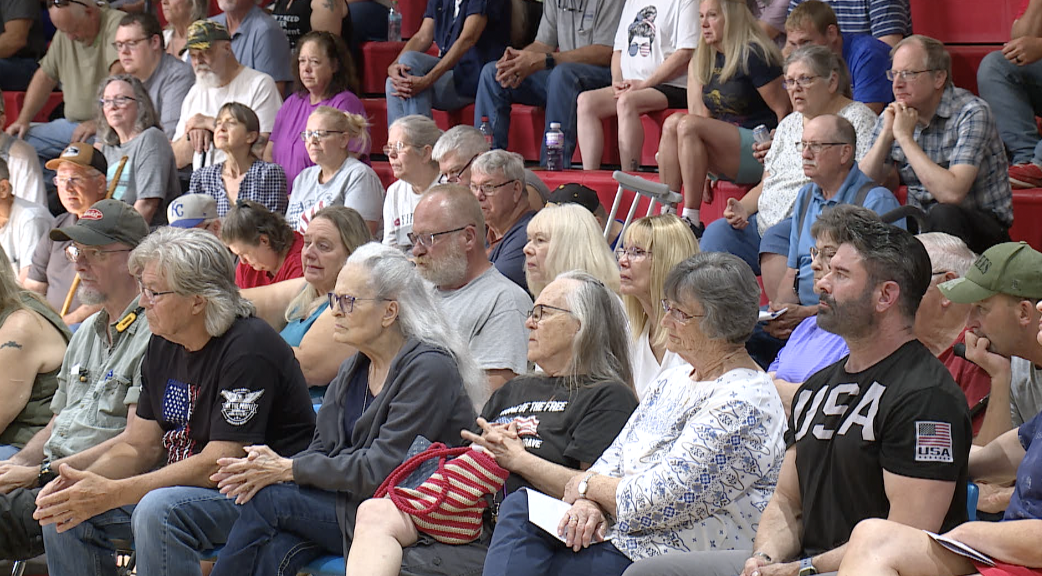
This is the first time Alcove Development has approached the public, but not the first time it has worked with the city of Osawatomie.
In late 2025, Alcove Development approached the city with the project and weeks later, a pre-development agreement was signed giving Alcove exclusive rights to the development for three years.
But city council meeting records from 2023 show, the city of Osawatomie entered into a pre-development agreement with Alcove Development to redevelop a property known as Old Swenson School.
Alcove Development had six months to asses the condition of the property and determine a course of action for redevelopment, and the overall agreement would last 18 months, according to public records.
Will Shaw/KSHB
The pre-development agreements states, Alcove would consider asking for tax breaks on the project, including utilizing the Low-Income Housing Tax Credit.
At the time, the property had sat in disrepair since 2016, according to the records, and was frequently found in violation of city code.
If the re-development were to fall through, the city would be on the hook to purchase the property from the developer for $25,000, with unclear total costs for infrastructure improvements.
KSHB 41

KSHB 41 will follow up on the status on this project at a later date.
Earlier this week, Miami County Reporter Ryan Gamboa, sat down with Donna Ingram who doesn’t live far from the data center site.
Ingram expressed her concerns about the amount of infrastructure that would be built to operate a data center, and how it might overtake the land around her home.
Ryan Gamboa/KSHB

She expressed concerns because the City of Osawtomie changed the public comment guidelines of a promise town hall with the developer.
“Watching this process play out is disheartening,” Ingram said in an interview on Monday. “A town hall was promised that didn’t come to fruition… I don’t believe it’s the definition. This is a city council meeting. We’re the ones that are gonna live next to it. We’re the ones that live in the path of the infrastructure.”
The city told KSHB 41 on Monday in a statement, they changed the format to prioritize the voices of city taxpayers, as county taxpayers have dominated the public comment periods over the past couple of months.
Brian Luton/KSHB

Mayor Nick Hampson also told Gamboa in an earlier interview he was hoping to have a productive “town hall” — instead, the first meeting with the public and the developer of the project was during a formal and regularly scheduled city council meeting.
The city also required residents to submit questions ahead of time, and the city would filter questions to the developer, while limiting public comment to three minutes.
“We have been and will continue to hear from the residents that are in the county and closest to this project,” Hampson told KSHB 41 in an email on Monday.

Miami County, Kansas
Residents shared a record to KSHB 41, submitted to the city for a formal investigation into 1009 Pacific Avenue in Osawatomie, which is owned by a company operating out of Alcove Development’s address.
The dilapidated property is the a former school house, that sits with broken windows, and other parts of the building breaking down.
The Miami County Republic reporting on Thursday, the city launched an investigation into the building.
Ryan Gamboa/KSHB
Residents cite the buildings deteriorating condition and potential danger to the public, and lack of property maintenance.
Lee Brewer issued a comment regarding the incident at Thursday night’s meeting, stating he was escorted out after the Mayor closed public comment, and he was not on the list.
Brewer told KSHB 41, he has a time -stamped email of pre-submitted questions ahead of the meeting. KSHB 41 asked Brewer to review the email, and is waiting for an answer.
I am severely disappointed in our Mayor and the city council. They told us we were required to send in an email with our questions and our address to prove we were citizens of the town by Wednesday the 24th at noon. I have my email which is timestamped at 10:26 a.m. Wednesday the 24th. They shut me down and first told me I didn’t put the email in and then once I was kicked out of there I was told by people coming out that they were told I turned in my email too late. I’m not a math teacher but last time I looked at my clock 10:26 a.m. falls just over an hour and a half before noon. I mean correct me if I’m wrong. I thought because the mayor and I were having decent conversations on Facebook Messenger, whereas I would ask him questions and he would answer to the best of his ability. And I would thank him I thought we were pretty cordial. So to basically call me a liar in front of the entire town on video recording, take away my freedom of speech My first amendment right, and have me removed from a public building was completely wrong I am very disappointed in our city council and mayor. When I approached the podium all I was trying to do was point out that resolution number 1169 in Osawatomie Kansas refers to Alcove development LLC being the owner of the old Swenson School at 1009 Pacific. As I pointed out in these earlier messages to you Alcove has left this building dilapidated in ruins and a danger to our community. Our great city council and mayor seem to have other plans for me being able to speak though.
Lee Brew, via Facebook to KSHB 41 News
KSHB 41 reached out to Alcove Development late on Thursday night, and is waiting on a response.
—

-

 South-Carolina6 minutes ago
Myrtle Beach is a hotspot for sharks and the potential to be bit
-

 South Dakota9 minutes ago
Work, housing and staffing: How South Dakota’s corrections chief aims to keep inmates from returning
-
Tennessee14 minutes ago
Tennessee GOP leaders denounce antisemitic Young Republicans mailers | The Jerusalem Post
-

 Texas21 minutes ago
A truck crash released 20 million bees. Local beekeepers rushed to save them.
-

 Utah24 minutes ago
‘2.5 minutes of terror’: Passengers sue Delta, alleging crew flew into dangerous weather despite warnings, injuring dozens
-

 Vermont36 minutes ago
Four Vermont beaches named among New England’s best. How to go
-

 Virginia39 minutes ago
Virginia Thomas – Scranton Times-Tribune
-

 Washington44 minutes ago
Where to watch Washington Nationals vs Baltimore Orioles: TV channel, start time, streaming for June 27

