Midwest
Wisconsin governor's push to erase gendered language from state law ignites debate

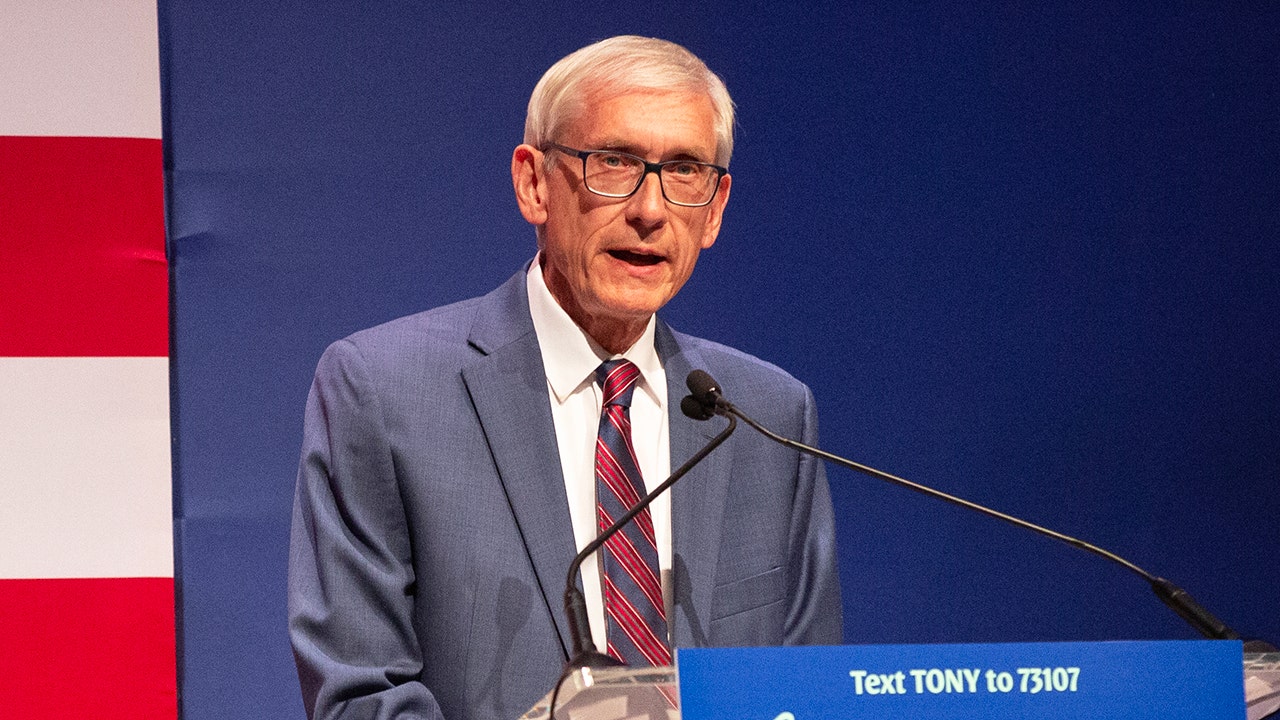
Democratic Wisconsin Gov. Tony Evers’ proposal to apparently remove gendered language from state law is sparking debate about the impact it could have on the family and society at large.
Evers has come under fire after introducing a budget recommendation that would change the word “mother” to “inseminated person” in the context of IVF and “paternity” to “parentage” in some parts of state law.
The Evers administration’s budget recommendation for the 2025-2027 fiscal period also advises several other gendered terms be changed. References to “wife” or “husband” are changed to “spouse” in the proposal. In other places, the word “father” is changed to “parent,” and “mother” is swapped out for the phrase “parent who gave birth to the child.”
Now, critics are analyzing the impact these changes could have on culture as a whole.
AG BONDI DISMISSES DEI LAWSUITS BROUGHT AGAINST POLICE, FIRE DEPARTMENTS UNDER BIDEN ADMINISTRATION
Democratic Wisconsin Gov. Tony Evers speaks to supporters during an election night event at The Orpheum Theater on November 8, 2022 in Madison, Wisconsin. (Jim Vondruska/Getty Images)
Jay Richards, the director of the DeVos Center for Life, Religion and Family, argued that the proposal is an “ideological campaign” and explained that understanding reality is partly shaped by the language the culture uses. If people cannot distinguish between the sexes in language, it will be more difficult for young people to understand the reality of sex and marriage, he argued.
“If somebody says these kind of word changes are not a big deal, I always say, ‘OK, then why are you trying to do it?’ ….Clearly, somebody thinks it’s a big deal, or they would not have bothered to actually do it,” he told Fox News Digital.
Richards said that gender ideologues are trying to “erase language that would refer to the reality of sex” and proposals like Evers’ could cause confusion among young people about marriage. The most “perverse” consequence of gender ideology, he argued, is that many children growing up in 2025 entertain the “thought that they might be born in the wrong body.”
“In other words, that their self and their body are these two fundamentally different things, and so if they feel discomfort with their body, rather than learning to become satisfied and content with their body, they imagine that through drugs and surgery, they can transform their body to conform to some kind of internal idea,” he said. “That, to me, is the most toxic aspect of gender ideology because it essentially alienates children from the bodies that God has given them.”
Laura Dunn, a civil and victims’ rights attorney and Bailey Duquette partner, had a different perspective, explaining she is “happy” and “hopeful” to see Evers’ proposed changes because they take into consideration “generations that are feeling more free to express gender identity” while under “heavy attack.”
Dunn argued that those hoping to stick to the “gender binary” don’t often consider the “real-life consequences from individuals who are being discriminated, targeted, harassed and even abused as a result of breaking those forced norms and deciding to identify how they want.”
“Our Constitution doesn’t just guarantee liberty, it actually guarantees the pursuit of happiness, which is self-expression, which is allowing people to identify how they feel,” she said. “It is inherently part of the freedom of our country to have more openness and inclusiveness, and it’s very alarming in this political era, to see a backlash against that.”
Evers defended the changes by arguing they’re designed to provide legal clarity in state law for families and those who use IVF.
“What we want is legal certainty that moms are able to get the care they need,” Evers told reporters in Wausau on Monday. “That’s it. End of story.”
Fox News Digital reached out to Gov. Evers, and his office did not respond to requests for comment. However, he has argued the proposals are designed to provide legal clarity in state law for families and those who use IVF.
“What we want is legal certainty that moms are able to get the care they need,” Evers told reporters last month. “That’s it. End of story.”
Read the full article from Here

Milwaukee, WI
Carin León, Summerfest’s first regional Mexican music act, draws new visitors to Milwaukee


MILWAUKEE – Summerfest wrapped up its first weekend Saturday with headliner Carin León, who organizers said is the first regional Mexican music artist to hit the stage.
Out-of-town draw
What they’re saying:
The performer drew visitors to the festival from Chicago to Michigan.
FREE DOWNLOAD: Get breaking news alerts in the FOX LOCAL Mobile app for iOS or Android
“I love the experience, it’s really cool,” Gigi Acosta, who traveled from Chicago, said. “We love it, it’s so much fun here.”
Folks flocked into Henry Maier Festival Park to take part in the fun.
“He puts on a great show,” said Karina Rodriguez, who came from Chicago with her family.
“Five hours, to me, is really nothing to come see him,” said Tracey Solis, who along with Filberto Solís, traveled from Michigan.
Tourism in Milwaukee
Big picture view:
It is an impact Summerfest leaders said will have a greater impact on the city.
“We drive over $160 million in tourism to this economy,” Jerrod Woods, senior director of marketing for Summerfest, said. “Carin is another huge aspect of that to help bring all the tourism to the city.”
Woods said León’s performance is an example of the diverse number of artists they want to keep bringing to the festival.
“The amount of people and outpour that you receive, like, ‘thank you for bringing such an incredible artist,’ like Carin León, who represents the Latin community not only here in Milwaukee but around the region,” Woods said.
It’s what brought new visitors, like the Rodriguez family, to Milwaukee.
SIGN UP TODAY: Get daily headlines, breaking news emails from FOX6 News
“We brought my mom because she’s a super fan,” said Karina Rodriguez. “She loves him, and this is our first time at Summerfest.”
Acosta even made a poster hoping to get her favorite artist’s attention.
“I love you Carin León,” she said as she blew a kiss.
What’s next:
Organizers said Saturday’s show is another example of giving people what they want. They told FOX6 News that they are already planning for 2027.
The Source: Information in this story is from FOX6 News interviews with Gigi Acosta, Tracey Solis, Filberto Solís, Karina Rodriguez, Georgina Rodriguez, Casey Rodriguez, and Jerrod Woods.

A child was seriously injured after a car hit them in an alley in Minneapolis on Saturday morning.
Minneapolis police say a child was playing in an alley near 29th Avenue North and Lyndale Avenue North around 11:30 a.m. when a car hit them. The child was brought to the hospital with potentially-life-threatening injuries, police added.
The child’s age was not released by law enforcement.
The driver of the car stayed at the scene and is cooperating with law enforcement, Minneapolis police said.
There have been no arrests at this time.

CINCINNATI — The Savannah Bananas are back in Cincinnati, but this year they face a new opponent: the Indianapolis Clowns.
The Clowns were implemented into Banana Ball this season to honor the original Negro League team that played from the 1930s to 1989. The team also had stints in Miami (Florida) and here in Cincinnati as the Ethiopian and Cincinnati Clowns.
Rashawn Merchant
So, when 93-year-old West Chester resident Myra Merchant heard the Clowns were coming to town, she said she was shocked.
“It brings back a lot of beautiful memories,” she said.
Merchant’s husband, Henry Lewis “Speed” Merchant, was an outfielder for the original Clowns team. He coined the nickname “Speed” because of his pace on the bases.
WATCH: Meet the family of Indianapolis Clowns legend Henry Lewis “Speed” Merchant
The Savannah Bananas are back in Cincinnati, but their opponents hit home for one family
In 1950, he won the title for most stolen bases in a single season with 45 bases stolen in 80 games.
“(He) was a hell of a ball player,” Merchant said of her late husband. “He could run, he was a beautiful runner.”
“Speed” died of prostate cancer in 1982, but even four decades later, at the Merchant family’s table, sit dozens of photos and memorabilia — a physical record of a legacy Merchant refuses to let fade.
Noelle Blumel
“I can’t help it, it’s part of history,” she said. “I thank God he had a chance to prove himself in the Negro League.”
Their three children, Charisse, Herma Jean and Rashawn Merchant, still live in the Cincinnati area as well and remember the tricks he used to do as a player.
“They came up with tricks (like) hiding the ball and digging into the dirt and coming up (with it),” Charisse said.
Charisse added that even after his time as a player, their father would still perform the tricks from time to time.
“He just knew how to do so many things,” Rashawn said. “He could take the baseball and roll it down his shoulder… could catch the ball behind his back, over his head.”

Myra Merchant
Myra said the tricks, in addition to the baseball, made the games a joyful spectacle.
“There was laughter and fun in the game, the way they played it, and it was enjoyable,” Merchant said.
That enjoyment, however, came with adversity. The Clowns often had to perform in the face of open discrimination.
“It was rough,” Charisse said. “(Going to) certain places to eat, they would send whoever was the lightest-skinned guy on the team. He would go to the back and get the sandwiches or whatever to eat.”
The hostility didn’t stop there.
“Players being thrown ice, (patrons) would throw the bottles at them,” Charisse said. “But (the players) kept going and they would win the game and hurry up and get on the bus.”
Charisse added that sometimes the players could not change out of their jerseys after games because they had to leave the hostile environment immediately to avoid things escalating.
Myra described the era with unflinching clarity.
“Prejudice, back in the, the ’30s and ’40s, and even a lot of times in the ’50s, that prejudice was still there,” she said. “And you had to endure it, take it, smile and keep going.”
When asked what made the players want to keep going, Myra’s answer was immediate.
“I’ll put it this way, our Lord came here, and he knew what he had to endure,” she said. “He kept going, and that’s what the Black man has done. He kept going. Because had he stopped, where would he have been today?”
Charisse and Rashawn echoed that sentiment.
“He loved the game. It was just in his blood, and that’s what he wanted to do,” they said.
Now with a new generation of the Clowns making headlines, the Merchant family said their hope is that the fans and players know about the pioneers who wore the name first.

Rashawn Merchant
“I thank God because it lives on. He’s part of history. And it lives on through the children and every Black player. Every Black man that came through hell,” Myra said.
Charisse and Rashawn said they want that history to be part of the celebration.
“Just remember that it started through a lot of hardship, that it wasn’t all fun and games,” Rashawn said. “There’s a history there and all of it’s not the best, but they made the best of what they had.”
Myra said the struggles they went through, though grueling, are part of what makes America a great country.
“They were part of America. That’s what makes America great, and it is a great country,” she said. “This is a melting pot of beautiful colors. She have her problems — What country has none? But we can solve them together, united as one.”
This story was reported on-air by a journalist and has been converted to this platform with the assistance of AI. Our editorial team verifies all reporting on all platforms for fairness and accuracy.
-

 San Francisco, CA3 minutes ago
San Francisco celebrates Black freedom at weekend Juneteenth parade: ‘We’re all people’
-

 Dallas, TX6 minutes ago
Redesign debate intensifies as Dallas convention center faces costly delays
-

 Miami, FL12 minutes ago
‘An insane memory’: New World Cup super hero plays in Miami but not with Messi
-

 Boston, MA19 minutes ago
FAA investigates close call between two aircraft at intersecting runways at Boston Logan International Airport | CNN
-

 Denver, CO21 minutes ago
Proposed September 2026 Service Changes
-

 Seattle, WA26 minutes ago
Seattle gets a heat wave and rain storm in the same week? – Emerald City Weather Blog
-

 San Diego, CA34 minutes ago
Photos: Cooper Family Foundation’s Juneteenth celebration
-

 Milwaukee, WI36 minutes ago
Carin León, Summerfest’s first regional Mexican music act, draws new visitors to Milwaukee

