Connect with us

West

Search underway for Colorado man in Black Canyon of the Gunnison National Park

Published

on

Search underway for Colorado man in Black Canyon of the Gunnison National Park
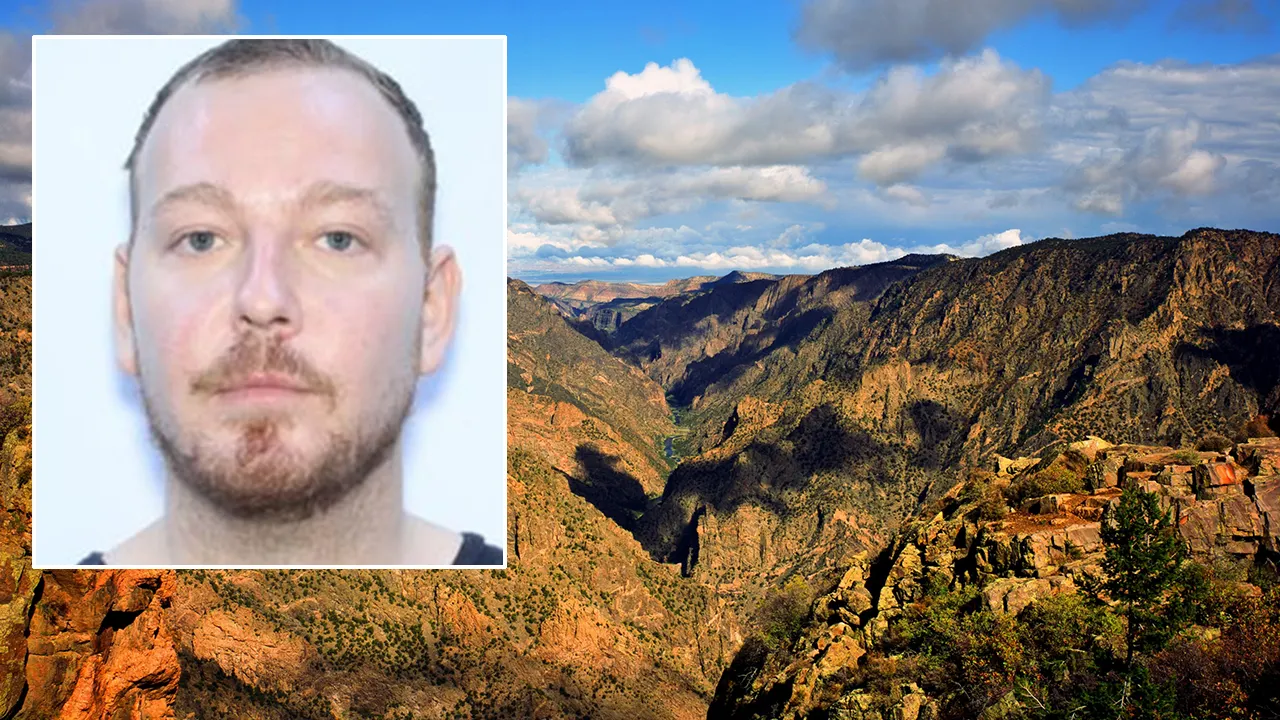
A search is underway in Black Canyon of the Gunnison National Park in Colorado for a Denver man who vanished nearly two weeks ago, officials said Monday.

Jordan Marsters, 31, was traveling through Grand Junction on Feb. 11 and was in Montrose, a city near the park, on Feb. 12 and Feb. 13, the National Park Service (NPS) said in a news release. 

One of Marsters’ last known locations was at the park around 7:20 a.m. on Feb. 13, NPS said.

Park officials did not specify where Marsters was last seen in the park.

COLORADO COLLEGE STUDENT’S BODY FOUND IN RUGGED TERRAIN, POLICE BELIEVE

Advertisement

Jordan Marsters has been missing for nearly two weeks. It was unclear when he was reported missing. (National Park Service)

It was unclear when exactly Marsters was reported missing. NPS said Monday that park staff and the Montrose County Sheriff’s Office were now searching for the missing man.

Jordan Marsters was traveling through Grand Junction on Feb. 11 and was in Montrose, a city near the park, on Feb. 12 and 13. (Black Canyon of the Gunnison National Park )

Marsters was described as a White man with blonde hair and blue eyes, weighing about 140 pounds and standing 5-feet-7-inches tall. He was last seen wearing a tan jacket and black hoodie and was driving a white Kia Fuente rental car with Texas license plates.

MISSING NORTH CAROLINA HIKER, 73, FOUND DEAD IN GREAT SMOKY MOUNTAINS NATIONAL PARK

Advertisement

The park in western Colorado is known for its rugged landscape that surrounds part of a deep canyon carved by the Gunnison River. Trails and roads run along parts of the rim.

Colorado, Black Canyon of the Gunnison National Monument on the Gunnison River from near Pulpit Rock. (Universal Images Group via Getty Images)

The park’s website shows that three major roads have remained closed for winter, while conditions at the park were described as icy and slippery, with “packed snow and ice” reported on multiple trails.

CLICK TO GET THE FOX NEWS APP

Authorities asked anyone with information or who was in contact with Marsters in the days leading to his disappearance to contact Black Canyon of the Gunnison National Park at 970-249-1914 ext. 436.

Advertisement

Read the full article from Here

Continue Reading
Click to comment

Leave a Reply

Your email address will not be published. Required fields are marked *

This site uses Akismet to reduce spam. Learn how your comment data is processed.

Washington

Washington Nationals recall Zak Kent

Published

on

Washington Nationals recall Zak Kent


The Washington Nationals recalled right-handed pitcher Zak Kent from Triple-A Rochester on Wednesday and optioned right-handed pitcher Andre Granillo to Triple-A Rochester on Tuesday. Nationals President of Baseball Operations Paul Toboni made the announcements.
Kent, 28, joins the Nationals after he was claimed off waivers from the Minnesota Twins on


Source link

Continue Reading

Wyoming

Father and son Blackfeet creatives give a peek into their ledger art process

Published

on

Father and son Blackfeet creatives give a peek into their ledger art process


A father-and-son duo of Blackfeet artists are visiting Riverton and Jackson this week to share their unique takes on ledger art. The events are part of Central Wyoming College’s week-long Native Voices celebration.

Terrance Guardipee and Terran Last Gun will share their work and perspectives during “Behind Linear Narratives: Indigenous Plains Ledger Art,” at the Intertribal Center at CWC’s Riverton campus on May 6 starting at 5:30 p.m.

The two also have an exhibition opening at the Jackson Hole History Museum on May 7, which will be part of an art walk featuring Native artists and Indigenous-inspired food tastings taking place that same evening.

Plains Indian communities lost one of their main canvases when the U.S. government and white settlers started eradicating bison in the mid-1800s. That’s how ledger art was born: Instead of documenting significant events on hides, people would find ways to acquire and draw on filled-out accounting books as a way to keep telling their stories.

Advertisement

Terrance Guardipee

/

Central Wyoming College

Terrance Guardipee, “My Grandfather My Gun.”

Terrance Guardipee was introduced to the visual storytelling style by his mentor George Flett in the late 1990s. Flett gave Guardipee eight sheets of ledger paper to try it out.

“ He was a huge influence on me and guided me through my art career,” said Guardipee. “I went to the Institute of American Indian Arts and so did he. We had that connection.”

Advertisement

Flett, Guardipee and a collection of other artists worked together to revitalize and elevate the art form, and eventually succeeded in getting it recognized as its own competitive category at the Sante Fe Indian Market in 2009.

“ All of us had our own role in what we were doing and none of us looked the same,” he said. “Our art didn’t look the same. We were all individual people.”

Over time, Guardipee developed his own unique ledger art style, moving from a more traditional single-page approach to mixed-media collages that include old documents and antique maps – the more coffee-stained and marked-up, the better.

“ I grabbed stock certificates, checks, receipts, music paper, anything I thought my ancestors, if they came across it and they were doing this kind of work, they would’ve used,” he said. “ Each document wasn’t just a random document to me. They all went with the piece.”

The art form, in its many different iterations, has now grown far beyond its Plains roots, expanding all over Indian Country and among women artists, according to Guardipee. But he said his advice to people curious about the form is to create from their own cultural experiences, rather than replicate the symbols or imagery used by other artists.

Advertisement
An old receipt from 1913 in Choteau, Montana, with two bright orange arcs of color and a small blue half-circle imposed on top of the writing.

Terran Last Gun

/

Central Wyoming College

Terran Last Gun, “Surrounded by Greatness.”

“ Get maps of where you’re from. That’s your homeland. Your ancestors are there,” he said. “Their blood’s been there [for] thousands of years. Draw on those. Represents where you’re from.”

Guardipee’s son, Terran Last Gun, is an acclaimed visual artist in his own right and also attended the Institute of American Indian Arts in Sante Fe, New Mexico. He took up a version of ledger art, but with his own more contemporary twist grounded in geometric shapes and bright colors.

Advertisement
An adult father and son pose together on a street outside, with a partially cloudy blue sky behind them. The son is holding a ribbon and a certificate from the Sante Fe Indian Market.

Terrance Guardipee

/

Instagram

Terran Last Gun (left) and his father, Terrance Guardipee (right), stand together, with Last Gun’s first place ribbon. In the Instagram post, Guardipee wrote, “I’m proud of him for what he’s accomplishing with his Ledger Art. Congratulations for taking first at Santa Fe Indian Market 2023.”

“ Our ancestors evolved. We evolve. Ledger art evolves,” said Guardipee. “You go to my son, doing very abstract-looking ledger art, but it still connects to our culture. It still has to do with who we are, just in a different way of telling the story.”

The duo have both come away with top prizes at the Santa Fe Indian Market in recent years. For Guardipee, watching the ledger art movement grow and then seeing his son find his own path with the form is “the icing on the cake.”

Advertisement

CWC’s Native Voices event also includes screenings of the documentary “Free Leonard Peltier” in Riverton on May 5 and in Jackson on May 6. Film producer Jhane Meyers, who also worked on the 2022 film “Prey” in the “Predator” franchise, will be at both screenings for a post-showing discussion.

The celebration will wrap up on May 9 with the free sixth annual Teton Powwow at the Snow King Event Center in Jackson. The events are free and open to all.


Source link

Advertisement
Continue Reading

San Francisco, CA

DoJ closes San Francisco immigration court in move critics say worsens case backlog

Published

on

DoJ closes San Francisco immigration court in move critics say worsens case backlog


The Department of Justice shuttered a major San Francisco immigration court last week, a decision attorneys say could exacerbate the Bay Area’s immigration case backlog.

Early in the year, news reports emerged of the closure of the courthouse on 100 Montgomery Street slated for January 2027. Over the last year, the Department of Justice had fired 20 of the court’s 22 judges (the Trump administration has been accused of culling certain immigration judges, in favor of those more amenable to its ongoing mass deportation agenda).

The justice department’s executive office for immigration review (EOIR) described the court’s closure as “cost effective” in a statement last week. A smaller court in San Francisco remains open, but the majority of court operations will move to an immigration court 35 miles (56km) away in the East Bay city of Concord.

The Concord court opened in 2024 amid a Biden-era push to trim the ballooning immigration case backlog. As of September 2025, nationwide there are 3.75m pending immigration cases, according to data from the EOIR. In San Francisco, there are 120,000, per the Transactional Records Access Clearinghouse (Trac), a research center at Syracuse University.

Advertisement

Some legal experts doubt the Concord court, where six judges were recently removed, has the capacity to inherit the closed San Francisco court’s caseload. A justice department spokesperson did not immediately reply to a request for comment.

“With so few judges at the Concord court, we’re going to see a lot of people waiting years and years and years to have their cases heard,” said Milli Atkinson, director of the San Francisco Bar Association’s immigrant legal defense program.

“These delays deeply affect people. They affect people’s ability to have resolution … to have an answer and closure, whether a positive one that they’d hoped for or a negative one,” said Shira Levine, a former judge at the San Francisco immigration court, who is now legal director for the Immigrant Institute of the Bay Area.

The passage of time could also weaken the presentation of a case.

At asylum hearings, people are “presenting a lot of oral testimony from themselves and from witnesses. Over years, testimonial memories can fade,” Levine said. “Even if you submit the written evidence, years later, someone may not be available to testify in support of that evidence.”

Advertisement

The San Francisco court’s closure coupled with the exodus of judges has sown “a lot of chaos”, Atkinson said. There are court dates being pushed back and others being pushed up as a result of recent changes.

Atkinson expects that there several individuals will fall through the cracks of the court system.

“A lot of migrants have unstable addresses or don’t receive their mail,” she said, also adding that notices in English may not be heeded by those who don’t speak or read it.

People could then be placed on Immigration and Customs Enforcement (ICE)’s radar if they miss their hearings, Atkinson said.

“If someone gets the wrong date, gets the wrong time, gets the wrong place, doesn’t file something exactly correct … the consequences are in some cases – where they really do have a serious fear of return – life-threatening.”

Advertisement


Source link

Continue Reading
Advertisement

Trending

