Sports
Neymar back to Barcelona: Is that a good idea?


No, you’re not dreaming, it is the year 2025.
You might be wondering how on earth, then, we are sitting here discussing the possibility of Neymar returning to Barcelona this summer.
After all, the Brazilian has just turned 33 years old and has only played 13 games of football in the past two seasons.
I’m not going to blame you for scratching your head. However, this is the world of football transfers — and the world of Barcelona football club — which means: don’t rule anything out.
As unreasonable of a fit as he might seem for Hansi Flick’s Barcelona, it is an idea being explored behind the scenes, as reported by my colleague David Ornstein.
I’ll start by laying out the state of play.
Neymar signed a six-month deal with his boyhood club Santos last month, after reaching an agreement with his Saudi club Al Hilal to leave on a free transfer. He moved to Saudi for €90million (£80m/$102m) in 2023 and scored once in seven appearances, with his stay disrupted massively by the anterior cruciate ligament injury he suffered while playing for Brazil just months after he joined.
His short-term contract at Santos will, in theory, allow him to get back in shape — and he has made a bright start, scoring twice in his six appearances so far. Despite the stuttering return with Al Hilal after his ACL injury, Neymar is now on a mission.
It is no secret that Brazil’s record goalscorer has pushed to come back to Barcelona multiple times since he joined PSG in 2017 for a fee of €222million — which remains a world record. Neymar never felt as comfortable in Paris as he did in Barcelona, and his entourage have let the club know that for years.
In 2019, the Barcelona president, Josep Maria Bartomeu, tried and failed to bring him back. Four years later, when Neymar left PSG to join Al Hilal, he tested the waters with Barcelona before committing to Saudi. At that time, the Catalans were drowning in a financial turmoil and they could not even dream of paying a fee to PSG. Neymar accepted the reality of the situation and agreed to join Al Hilal.
(Fayez Nureldine/AFP via Getty Images)
But why should it be different now, with Barcelona still fighting over salary limits and player registrations? And most importantly, in what world can club executives think it is a good idea to sign an older player and risk disrupting the established order of a young squad bursting with talent?
Pini Zahavi, the player’s agent, is a key figure when it comes to trying to understand what is happening here. Zahavi holds a tight friendship with the Barca president Joan Laporta, who has sanctioned in recent years the arrival of two of Zahavi’s biggest clients: Robert Lewandowski and Hansi Flick. The relationship between the agent and the executive has been essential in those transfers, and will surely be again in the future; Jonathan Tah, the Bayer Leverkusen centre-back available on a free this summer, is another player managed by Zahavi who has been linked with Barcelona.
With the club due to be playing at the renovated Camp Nou in 2025-26, the arrival of a star name like Neymar would be appealing to Laporta — to celebrate the return to the stadium and to help sell out the 60,000 seats initially available when the team does return.
Inside the dressing room, Neymar would have some influential allies. The club captain and star performer this season, Raphinha, has always been close to Neymar from their time together with the Brazil national team. Then there is Lamine Yamal, who grew up worshipping Neymar. The two met at the Globe Soccer Awards Gala in December and have been interacting with each other on social media in the months since.

(Marc Atkins/Getty Images)
One positive for Barcelona’s precarious financial situation is that Neymar would arrive on a free transfer, with his short-term deal with Santos expiring this summer. With his sight set on representing Brazil at the 2026 World Cup in the United States, Canada and Mexico, he may even agree to personal terms that were favourable to Barcelona in order to be back at a club he loves on the biggest stage.
From a football perspective, it is difficult to argue how this move would make sense. It’s hard to see how a 33-year-old Neymar, with his extensive injury record, would fit in Flick’s high-pressing system, which requires a significant amount of off-the-ball work from his forward line. This exact issue, in fact, is the reason why the 36-year-old Lewandowski has been dropped from the starting line-up several times this season.
It is no secret that Barcelona’s sporting director, Deco, is exploring the market for a new forward — preferably one that can play on the left-hand side as well as in a central position.
Club sources, who asked to speak anonymously to protect their jobs, told The Athletic that some of the players favoured by Deco are Liverpool’s Luis Diaz, Milan’s Rafael Leao and Newcastle’s Alexander Isak. They look like far more suitable profiles to how Flick wants his Barcelona to play — but all three will have plenty of suitors this summer should they leave their current clubs.
But what if Barcelona’s financial hurdles do Neymar a favour here? What if the club can’t fight to sign one of Deco’s top targets because of more registration problems? What if Neymar is the most feasible option available, and one that would please the club’s president and likely give a boost to matchday ticket sales?
This is certainly going to be the biggest decision facing Barcelona this summer. As relevant as Laporta’s criteria has always been when it comes to Barcelona’s business activity, the preferences of Deco and the amount of money that the club recoup from player sales are important factors too.
And, above them all, there should be the thoughts of Flick, the manager who has invigorated Barcelona and turned them into La Liga and Champions League contenders. No relevant signing will be made next summer without him giving it the green light — even if he and Neymar do share an agent.
But, as we said: this is the sometimes unfathomable world of football transfers, and this is Barcelona, so don’t rule anything out…
(David Ramos/Getty Images)



NEWYou can now listen to Fox News articles!
Toronto Maple Leafs No. 1 draft pick Gavin McKenna has already been on the ice with the team as it held its development camp this week, but the highly-touted rookie is going to have to make a big change for this fall.
His number.
When he was playing for the Western Hockey League’s Medicine Hat Tigers and then again at Penn State this past season, McKenna wore the No. 72.
THE TALLEST PLAYER EVER SELECTED IN THE NHL BLEW MINDS IN HIS DEBUT WITH THE SAN JOSE SHARKS
Toronto Maple Leafs top pick Gavin McKenna has revealed that he’ll be opting for a new number for his rookie campaign. (Photo by Brian Babineau/NHLI via Getty Images)
The expectation was that McKenna would wear No. 72 with the Maple Leafs, and he did so this week at development camp. Plenty of fans have also already ordered No. 72 jerseys with his name on the back.
On most rosters, No. 72 is unique enough that he wouldn’t run into any issues wearing it. However, on July 1, the Leafs signed two-time Stanley Cup champion goaltender Sergei Bobrovsky, who has worn No. 72 for most of his career, except during his first two seasons with the Philadelphia Flyers, when he wore No. 35.
So, some were wondering how this would work out. Would the Leafs want their new franchise player to get his pick of the number litter, or would they defer to a two-time Vezina winner?
FLYERS MAKE STUNNING OFFER SHEET FOR DUCKS STAR LEO CARLSSON IN BLOCKBUSTER NHL MOVE
Gavin McKenna wore No. 72 in juniors, as well as last season at Penn State. (Photo by Richard T Gagnon/Getty Images)
Well, it turns out that McKenna will be the one swapping numbers, and he’ll be switching to No. 92 this season.
McKenna had to get creative here because the obvious number changes were a no-go in Toronto. Adding 7 and 2 would be 9, but that was retired in honor of Charlie Conacher and Ted Kennedy.
Another option would’ve been to flip the digits and go with No. 27, but that was retired in honor of Frank Mahovlich and Darryl Sittler.
ALEX OVECHKIN SIGNS A ONE-YEAR DEAL TO RETURN FOR ANOTHER NHL SEASON WITH THE CAPITALS
So, 92 it is.
However, McKenna reached out to one of the three previous players to wear the number, Jeff O’Neill, to ask whether he was comfortable with him using it.
It’s fair to say he was down with the idea.
CLICK HERE TO DOWNLOAD THE FOX NEWS APP
McKenna will be a key piece of a Maple Leafs team that is looking to bounce back after a nightmare 2025-26 campaign that saw them finish last in the Atlantic Division.
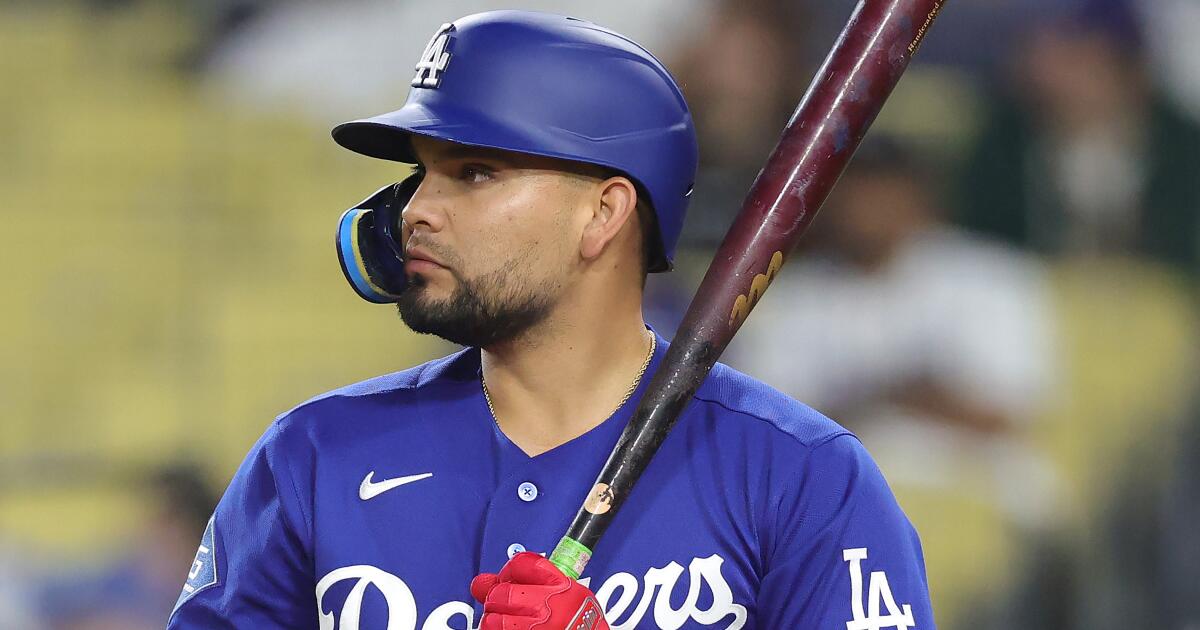
It’ll be the culmination of nine minor-league seasons. But Eliezer Alfonzo‘s major-league debut on Sunday won’t include his family watching from Dodger Stadium.
Alfonzo’s younger sister, Eliana, and stepmother, Patricia, have been missing since last month when earthquakes caused widespread devastation in his home country of Venezuela.
“I’ve been trying to support my dad a lot, every day talking to him, trying to be with him,” Alfonzo said of the elder Eliezer Alfonzo, a retired major-league catcher. “It’s a little tough from here because I would like to be there with him, supporting him every day.”
His father, of course, would love to be in attendance for his son’s debut. He told him as much when he heard the Dodgers were calling him up.
The Dodgers switched their backup catchers Saturday, optioning Chuckie Robinson. They saw an opportunity to give Alfonzo some runway behind Dalton Rushing, with starting catcher Will Smith’s stay on the injured list expected to extend through the All-Star break.
The elder Eliezer Alfonzo, however, is doing whatever he can to locate his wife and daughter. Their dog was found alive, which gave the younger Eliezer Alfonzo hope.
“We’ve just gotta stay together as a family, as a country,” Alfonzo said. “Because I feel like we’re a beautiful country, we’re a really beautiful people over there. It’s not just about my family, it’s all families that have lost people already. But we’ve got hope. We just pray, we ask God to give them back to us alive.”
Alfonzo’s locker in the clubhouse is next to countryman Miguel Rojas’ stall. Rojas’ wife, Mariana, and their two children were in Venezuela, planning to renew Mariana’s passport and seek Venezuelan citizenship for their children, when the earthquakes hit. They managed to stay safe and have returned to the U.S.
“I just want to be here for him,” Rojas said. “At the end of the day, that’s the best thing I can do for him, is being a good teammate and being a friend for him. Because I know there’s going to be ups and downs. He’s going to have a lot of time to be caught [up] in baseball, and that’s going to probably take his mind away from stuff. But sometimes he’s probably going to feel weak, and he’s going to start thinking about his family. So I’m going to be here, I’m right next to him. And that’s what I told him.”
Rojas, who played against the elder Eliezer Alfonzo for years in Venezuela, reached out Saturday morning and promised him he’d save the ball from his son’s first major-league hit.
Sports
Kylian Mbappé’s seventh goal of the World Cup lifts France past Paraguay in physical Round of 16 match

NEWYou can now listen to Fox News articles!
The United States may not have been in action on Independence Day, but France — who fittingly played an important role in the Revolutionary War — was on the pitch in Philadelphia against Paraguay in a massive Round of 16 clash for a trip to the quarterfinals.
It was a hot day in the birthplace of our nation, and that made things difficult for both teams in more ways than one.
While Paraguay is a great squad, they were significant underdogs against a heavily favored French team led by superstar Kylian Mbappé, who has been lighting it up this tournament.
THIS ‘AMERICA THE BEAUTIFUL’ RENDITION BEFORE THE FRANCE VS PARAGUAY MATCH WILL GIVE YOU GOOSEBUMPS
French and Paraguayan players get into a shoving match during their Round of 16 match on Saturday in Philadelphia. (Kyle Ross-Imagn Images)
Obviously, the heat itself is a factor, but it also made for a slower pitch, something that was believed to play into the hands of Paraguay.
However, most of the action in the first half was played on their end as France put the pressure on through the first half hour of the match.
It was intense, and that intensity boiled over in the 35th minute with some pushing and shoving after Mbappé and Paraguay’s Andrés Cubas started a wild shoving match.
VAR DENIES CROATIA’S GAME-TYING GOAL AS CRISTIANO RONALDO LEADS PORTUGAL TO ROUND OF 16
But while the intensity ramped up — and stayed high for pretty much the entire game — Paraguay weathered the storm and had every reason to feel good about reaching halftime with the game scoreless.
France got some more scoring opportunities in the early part of the second half, including a near-breakaway for Mbappé.
France’s Kylian Mbappe scored the go-ahead and ultimately game-winning goal against Paraguay on a penalty kick. (James Lang-Imagn Images)
In the 67th minute, France was awarded a penalty kick for a foul against Desire Doue that had to go to VAR for review, and it was Mbappé who took it.
MESSI, ARGENTINA AVOID A SHOCKING UPSET IN WILD KNOCKOUT STAGE MATCH AGAINST CAPE VERDE
Mbappé has tended to do most of his damage in the second half, and that trend continued here with him drilling the penalty past Paraguay goaltender Orlando Gill.
That was his 19th career World Cup goal, and his seventh of this tournament alone, tying him with Argentina’s Lionel Messi for the tournament lead.
Paraguay seemed to fade after the Mbappé goal, but turned it on again late, forcing Mike Maignan to make his first save of the day about 89 and a half minutes into the match.
CLICK HERE TO DOWNLOAD THE FOX NEWS APP
It seemed like Paraguay’s plan was to try and get a rise out of the French, and they succeeded in drawing three yellow cards. In fact, they even tried to keep that going after the match with players meeting near midfield for some more pushing and shoving.
But France is moving on, and they will take on Morocco in a quarterfinal match on Thursday in Boston.
-

 West Virginia3 minutes ago
Ex-WVU Guard Kerr Kriisa Arrested by FBI in Alleged Fraud Scheme
-

 Wyoming10 minutes ago
Your Sunday, July 5 Guide: Three things to do in the Oil City
-

 Crypto13 minutes ago
How the Mighty Have Fallen. But That’s Crypto, Baby! – Week In Review
-
Finance18 minutes ago
I’m a 25-year-old grad student on a budget. I’ve struggled to accept financial help from my Boomer and Gen X friends.
-

 Fitness25 minutes ago
Why 21-15-9 Might be the Smartest Workout Format in Fitness – and How to Use it to Drive Muscle Growth
-

 Videos28 minutes ago
https://www.youtube.com/watch?v=7rSqnRw9t6E
-

 Movie Reviews33 minutes ago
Movie Review – The Isolate Thief (2025)
-

 World43 minutes ago
Jesse Eisenberg on Why It Would Be ‘Silly’ to Leave U.S. Because of Trump, Says ‘The Debut’ Is ‘The Opposite of AI’ Following A24 DeepMind Partnership


