Northeast
Man suffers 'life-threatening electrical shock' while installing Christmas lights

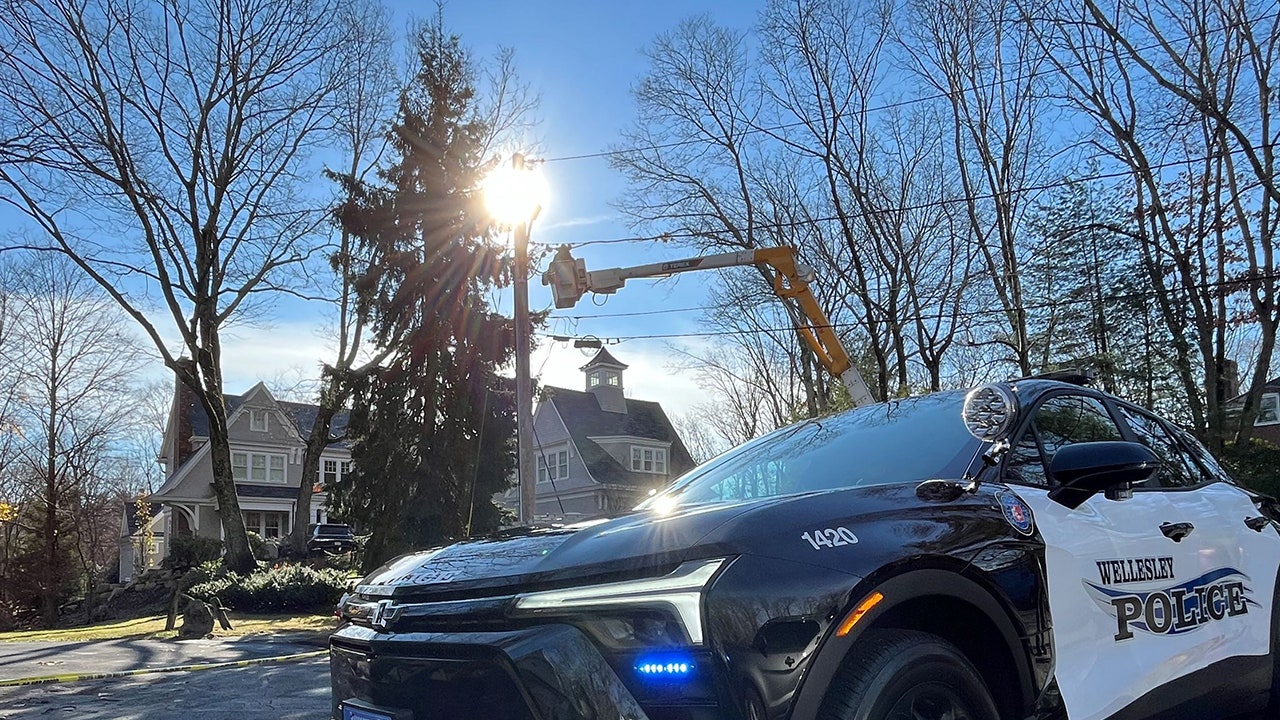
A man in Massachusetts suffered a “life-threatening electrical shock” while installing Christmas lights on a large tree, police say.
The incident happened Wednesday morning in Wellesley as the victim – identified as a contractor hired by a homeowner – was hanging up the holiday lights using a pole, according to the town’s police department.
“It appears that the pole being used came into close proximity, or contact with, a primary electrical line on a utility pole,” the Wellesley Police Department said in a statement. “The victim appears to have then received a life-threatening electrical shock.”
“The 911 caller indicated that the male party was unconscious and appeared to be having a seizure and had stopped breathing,” police added.
MAN AND HIS DOG ELECTROCUTED IN FREAK ACCIDENT DURING THUNDERSTORM
A man suffered a “life-threatening electrical shock” in Wellesley, Mass., on Wednesday morning while installing Christmas lights, the Wellesley Police Department says. (Wellesley Police Department)
Authorities say the 911 caller then started performing CPR on the individual until first responders arrived and “observed that the victim appeared to be in sudden cardiac arrest.”
“Wellesley first responders delivered multiple shocks from the AED in between providing CPR and breathing for the victim,” police said. “The last shock administered to the victim by the AED appeared to revive him as he regained a pulse.”
The victim was then taken to a local hospital.
MEXICO HOT TUB DEATH: US TOURIST WHO WAS ELECTROCUTED REMEMBERED AS ‘BIG FAMILY MAN’ WHO HAD ‘HEART OF GOLD’
The victim in Wellesley “appeared to be in sudden cardiac arrest,” police say. (Wellesley Police Department)
“It was a power wash company, some young guys who were just trying to make some extra money for the holidays, hang up some Christmas lights around a pretty tall evergreen tree,” Wellesley Police Officer Michael Pino told WHDH. “Happened to be a little too close to the primary wire on the telephone pole, and that’s where we believe the electricity came down the metal pole.”
A review of the area by the Wellesley Municipal Light Plant determined that there was no danger to the public.
A review of the area determined that there was no danger to the public, the Wellesley Police Department said. (Wellesley Police Department)
“The Wellesley Police, Fire, and Wellesley Municipal Light Plant Department extend our thoughts and prayers to the victim and his family during this tragic incident,” police also said.
Read the full article from Here


Rudolph W. Giuliani, the former mayor of New York City, is in a Florida hospital in critical condition, his spokesman said Sunday.
The spokesman, Ted Goodman, would not specify which hospital and said that the former mayor “remains in critical but stable condition.”
“Mayor Giuliani is a fighter who has faced every challenge in his life with unwavering strength, and he’s fighting with that same level of strength as we speak,” he said, before asking “that you join us in prayer” for the former mayor.
It is unclear when Mr. Giuliani, 81, was taken to the hospital.
President Trump, in a post on Truth Social, called Mr. Giuliani a “True Warrior, and the Best Mayor in the History of New York City, BY FAR.”
He used the occasion to again advance his false claim that Democrats “cheated” in the 2020 election.
“They cheated on the Elections, fabricated hundreds of stories, did anything possible to destroy our Nation, and now, look at Rudy. So sad!” he said.
Mr. Giuliani has struggled with legal and financial problems in recent years, and in the summer of 2025, he was involved in a car crash in New Hampshire in which he suffered a fractured vertebra. After that, Mr. Giuliani made at least one public appearance in a wheelchair.
Mr. Giuliani became mayor in January 1994 after he defeated Mayor David N. Dinkins, who was running for a second term. He remained in office until December 2001 and helped lead the city in the aftermath of the Sept. 11 terrorist attacks.
Later, he became a personal lawyer to Mr. Trump during the president’s first term and quickly became embroiled in a number of investigations related to the presidency.
Mr. Giuliani was a crucial part of the team that helped Mr. Trump advance the claim that he won the 2020 election. After Mr. Trump left office, Mr. Giuliani was indicted multiple times and contended with a number of costly defamation suits related to those efforts. Now disbarred, he has kept a far lower profile during Mr. Trump’s second term in office.
Maggie Haberman contributed reporting.

Gunshots were fired in a daytime armed home invasion in Saugus, Massachusetts, on Sunday, police say, and the two suspects are in custody.
No one was hurt in the shooting on Oakwood Avenue about noon, Saugus police said. Two Boston men, Derek Matarazzo and Timothy Gregory, are facing felony charges including home invasion after their arrest shortly after the 911 calls came in.
The calls reported two men in masks, dressed in black, armed with guns, breaking into a house, police said. They didn’t share what led to the gunfire or how the men were tracked down, saying only that the department wasn’t speculating on their motivation.
Matarazzo and Gregory are believed to be the only people directly involved in the home invasion, police said, and it’s believed to be an isolated incident, so there’s no danger to the public.
Neighbors who spoke with NBC10 Boston say they are shaken up by what occurred, describing a shootout right outside their homes in the middle of the day.
Ring camera video from a nearby home shows the aftermath, as neighbors say you can see the homeowner running into the middle of the street with a phone pressed to his ear, desperately flagging down police — after the chaos.
A neighbor tells us his family first heard what sounded like a pop — something they thought could’ve been a lawn mower backfiring, until they realized it was gunfire. That neighbor says one of his daughters then saw a man carrying a safe — dropping it in their front yard — while shots were being fired.
“I saw somebody come out of the house shooting and then we all hit the deck, because you didn’t want a stray bullet to ricochet off something and come through the window or anything like that,” George Benn said.
“I saw the shots. I saw a man go down. I thought he was going to be dead but apparently he just flipped on that hill,” Tom Bushee said.
The investigation is ongoing.

This year’s Pittsburgh Marathon is one for the record books. More than 52,000 runners crossed the finish line, with more than 300,000 spectators cheering them on.
“We’re welcoming people from around the world,” P3R CEO Troy Schooley said. “This event has turned into an international event for our city. We’re going to show it off today. The runners will run through 14 neighborhoods. We have 33 different countries represented today and all 50 states.”
Advertisement
Mohammed El Youssfi claimed the men’s division of the Pittsburgh Half Marathon, crossing the finish line and immediately wrapping himself in the Moroccan flag.
“This is my first time in Pittsburgh, but the special moment for me today is the people here cheering me on,” El Youssfi said. “That helped me to win the race.”
Emotions ran high for Pittsburgh’s very own Will Loevner. The Winchester Thurston graduate has run the Pittsburgh Marathon multiple times, finishing as the runner-up in 2024 and fifth in 2025. But in 2026, he took home top honors, crossing the finish line first at 2:14.
“I’ve now won the Philadelphia marathon, the Cleveland marathon twice,” Loevner said. “To win Pittsburgh, I feel like it was the trifecta and the most special one for me. I mean, being in the hometown, nothing even compares.”
Advertisement
Buze Diriba Kejela is 2026’s women’s Pittsburgh Half Marathon champion, setting a course record for women and crossing the finish line at 1:08:39.
“I’m happy to set the course record. I like it,” she said.
Before the runners crossed the start line, the handcyclists got a head start. Marshall Tempest of Monroeville came out on top in the Pittsburgh Marathon Handcycle Division, finishing at 1:40:16.
“I’ve done 13 Pittsburgh marathons, and this is my 5th time winning it, in a row,” he said. “It feels good. It was a rough one, but I was determined to get that 5th one.”
“I love running,” said Will Henry Lawrence, who ran the half-marathon. “I love being able to have breath in my lungs and let my feet hit the pavement. I had a stroke six years ago, and so I give all glory to God for being able to get out and exercise.”
Advertisement
Tickets for the 2027 Pittsburgh Marathon are on sale for 48 hours, starting at 3 p.m. on May 3, 2026. You can register at thepittsburghmarathon.com
Download the FREE WPXI News app for breaking news alerts.
Follow Channel 11 News on Facebook and Twitter. | Watch WPXI NOW
-

 Politics5 minutes ago
Trump Faces the Complicated Reality of a Costly, Unpopular War in Iran
-

 Business11 minutes ago
Chizi, Standup Comic Exiled in China, Wants to Be More Than Just ‘a Rebel Comedian’
-

 Lifestyle41 minutes ago
Beyoncé Is Returning to the Met Gala. These Are the Looks She Has to Top.
-

 Education47 minutes ago
As Enrollment Shrinks, a Clash Between the Have- and Have-Not Schools
-

 Technology53 minutes ago
Shokz’s bassy OpenRun Pro 2 are $40 off thanks to a new Mother’s Day promo
-

 World59 minutes ago
Cruise ship outbreak leaves 3 dead as officials delay medical evacuations and probe hantavirus threat
-

 Politics1 hour ago
Marco Rubio spotted behind DJ booth at family wedding as social media reacts to viral clip
-

 Health1 hour ago
Jane Seymour, 75, shares how she approaches aging with vitality: ‘Best I can be’