According to ESPN, Boston has emerged as a leading destination in the Giannis Antetokounmpo sweepstakes. No deal is on the table (that we know of), but the mere possibility might raise a few concerns.
Northeast
Trump-backed PA Senate candidate flips longtime Dem seat red in nail-biter election

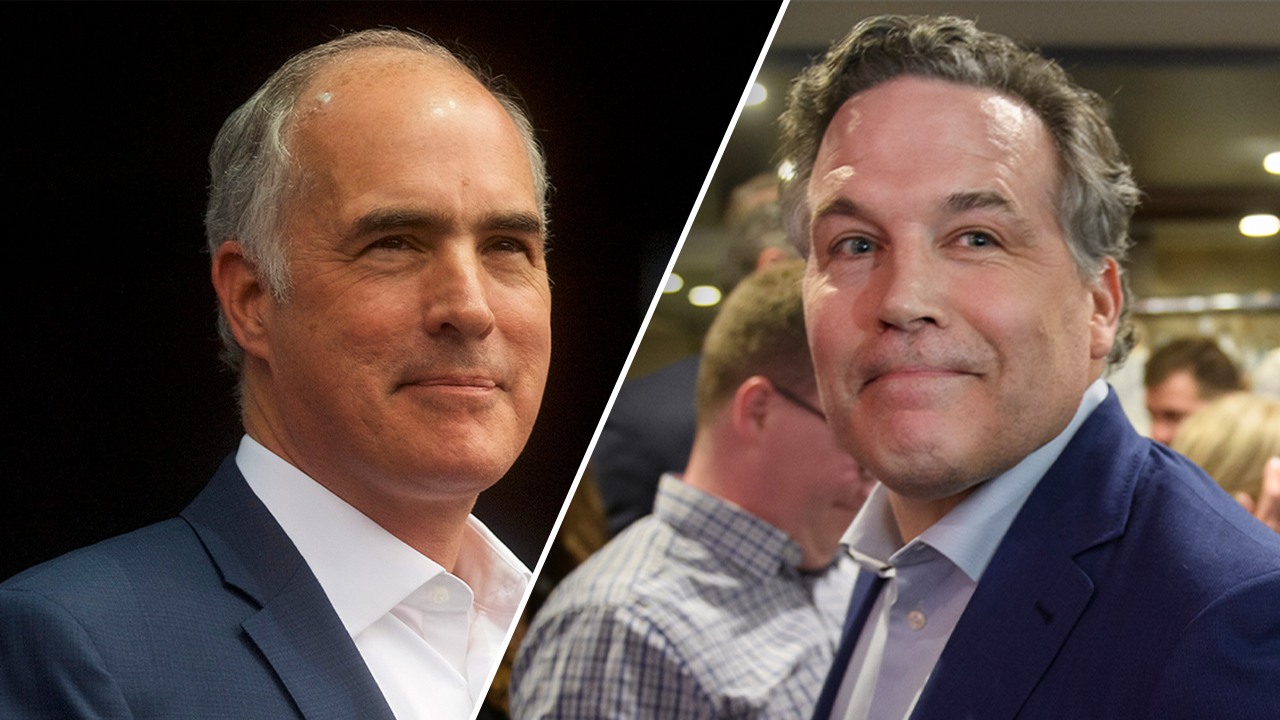
Republican Pennsylvania Senate candidate Dave McCormick was declared victorious in his high-stakes election against longtime Democrat Sen. Bob Casey on Tuesday.
Casey’s campaign released a statement Thursday afternoon saying he would not concede until all votes are counted.
“As the Pennsylvania Secretary of State said this afternoon, there are tens of thousands of ballots across the Commonwealth still to count, which includes provisional ballots, military and overseas ballots, and mail ballots,” Maddy McDaniel, a spokesperson for Casey’s campaign, said in a statement. “This race is within half a point and cannot be called while the votes of thousands of Pennsylvanians are still being counted. We will make sure every Pennsylvanian’s voice is heard.”
As of Thursday afternoon, The Associated Press was reporting McCormick with 3,340,649, or 49.0% of the vote, and Casey with 3,308,961, or 48.5% of the vote.
Casey has served in the Senate since 2008 and ultimately became a stalwart within the Democratic Party. For example, he voted on legislation President Biden supported 98.5% of the time, according to FiveThirtyEight data.
‘LIES THROUGHOUT’: TRUMP-BACKED CHALLENGER, LONGTIME DEM SENATOR FACE OFF IN HEATED BATTLEGROUND DEBATE
Sen. Bob Casey, D-Pa., left, and Republican challenger Dave McCormick. (Getty Images)
The Casey name also has deep roots in the state, with Bob Casey Sr., the senator’s father, serving as the Keystone State’s governor from 1987 to 1995 after years of serving in various other elected roles.
The longtime senator, however, faced what was described as his most difficult re-election effort to date, squaring up against Republican businessman Dave McCormick.
McCormick is an Army combat veteran and former CEO of hedge fund Bridgewater Associates who served as the undersecretary of commerce for industry and security as well as undersecretary of the treasury for international affairs in former President George W. Bush’s administration.
Political eyes have been locked on Pennsylvania this election cycle after it yet again emerged as a key battleground state for the presidential race. Trump narrowly won the state in his successful 2016 election against former Secretary of State Hillary Clinton, while President Biden declared victory in the Keystone State in the 2020 election.
MCCORMICK SEIZES ON PENNSYLVANIA SENATE RACE GAP, LAYING BORDER BLAME ON CASEY
The race was rated as “leans Democrat” by both the Fox News Power Rankings and the Cook Political Report, with Casey himself acknowledging this year that it would be a “close, tough race.”
Former President Obama is flanked by Sen. Bob Casey, D-Pa., left, and then-Pennsylvania Gov. Tom Wolf at a campaign rally in Philadelphia on Sept. 21, 2018. (Getty Images/Mark Makela)
Biden campaigned for Casey in their shared home state, with the president lauding the senator as “a man that kids can look up to.” On the other side of the aisle, McCormick earned Trump’s endorsement.
“He’s a good man. He wants to run a good ship,” Trump said during a rally in April. “He’s a smart guy. He was a very successful guy. He’s given up a lot to do this.”
PHILLY VOTERS SOUND OFF ON ECONOMY: ‘EVERYBODY IS STRUGGLING RIGHT NOW’
The two have sparred over issues such as immigration, abortion, spiraling inflation and law enforcement in their campaigns and during their debates.
GOP Senate candidate Dave McCormick is interviewed while touring the Lackawanna College School of Petroleum and Natural Gas in Tunkhannock, Pennsylvania, on May 10, 2022. (Michael M. Santiago/Getty Images)
BIDEN WILL ‘ABSOLUTELY’ HURT LONGTIME DEM SENATOR’S CHANCES OF RETAINING BATTLEGROUND STATE SEAT: MCCORMICK
Casey campaigned on a platform of protecting access to abortion, lowering “greedflation” and preserving Pennsylvania’s “energy legacy” while also working “to protect our environment” and bolstering infrastructure in rural areas.
McCormick campaigned on reeling in inflation under the Biden-Harris administration, securing the border, curbing crime, defending the Second Amendment and expanding the Keystone State’s energy sector.
The high-stakes election put both candidates under the national spotlight, including earlier this year when police leaders in the state slammed Casey for aligning himself with a pro-defund the police group as he geared up for the election. He was also dinged by McCormick and other conservatives for rhetoric blaming spiraling inflation on corporations’ alleged greed, which he calls “greedflation.”
McCormick came under fire from Casey and Democrats for splitting his time between Pennsylvania and Connecticut, where his children attend school, painting him as a Keystone State outsider.
Get the latest updates from the 2024 campaign trail, exclusive interviews and more at our Fox News Digital election hub.
Fox News Digital’s Bradford Betz contributed to this report.
Read the full article from Here

Continue Reading

“It’s been 53 years. I’ve been waiting that long.” “It’s been a very long time, a long time coming. And I’m so excited that my Knicks finally brought a championship home.” “Let’s go Knicks.” “I had to wake up at six o’clock.” “Knicks in five.” “Let’s go, Knicks.” “Let’s go, Knicks!” “We just moved to D.C. a few years ago, but we’re so happy to be back in New York, celebrating. Once we won we were like — we’re absolutely coming home. So, we had to bring Chester with us. I mean, he’s the biggest puppy Knicks fan there is. Chester, can you say Knicks in 5? Knicks in five.” “I got hurt a couple weeks ago, but this is the first time they’ve been to the finals since I was a year old. And so to be able to be here, this is a once-in-a-lifetime thing.” “My man’s out here with a boot and a Josh Hart jersey. My man’s got heart.” “It feels so overwhelming but overwhelming in a good way, where, like, I want to be — I want to, like, shoot some balls. I want to, like, just vibe with everyone because everyone’s here for one purpose, and that’s celebrating the Knicks.” “This has been like a uniting situation for New Yorkers, and I just can’t wait to feel the love from everybody.” “I think it’s a great equalizer, right? It brings everyone together. It doesn’t matter if you make $900,000 a year, if you make $50,000 a year. You’re united because of the Knicks.” “So often when this city comes together, it is because we are forced to by a moment of tragedy or adversity. What a gift it is to be brought together by pure, unfiltered joy.” “Most importantly, thank you to the fans. I’m not going to lie though, y’all all are some pretty hard critics, but we appreciate it. At least I do, appreciate it a lot.”

Concern numero uno is obvious. Giannis is one of the handful of players capable of altering the championship picture by himself. Pairing him with Jayson Tatum would create an impressive combination of size, athleticism, versatility, and star power. The question is whether Brad Stevens and the Celtics can actually pull it off without creating a new set of problems for themselves.
Boston’s path to Giannis is narrower than it first appears. The Celtics would almost certainly need to move Jaylen Brown, either directly to Milwaukee or through a third team. Reports indicate Brown has little interest in joining the Bucks (in paraphrase: “Milwaukee?! Yuck!”), which complicates matters further. We start moving from a blockbuster trade to a three-team puzzle involving contracts, draft compensation, and competing agendas.
Even if Boston finds a way through that maze, there’s no guarantee the resulting team will succeed.
Giannis may be a better asset than Brown, but championships are not won by comparing players one-for-one. They’re won by building complete teams (case in point: YOUR WORLD CHAMPION NEW YORK KNICKERBOCKERS ).
Brown averaged more than 28 points per game last season while defending multiple positions. He can create his own offense, punish smaller defenders, and absorb primary scoring responsibilities when Tatum is unavailable (as Tatum was for most of last season, recovering from a torn Achilles). Replacing him with Giannis raises Boston’s ceiling, perhaps, but also changes the structure of the roster.
The Celtics have spent years building an ecosystem around two star wings. Remove one and the supporting cast suddenly becomes more important, which means Stevens would have many more decisions to make before the start of training camp.
What catches me up is, if the Bucks believed that Giannis has more great years ahead of him, would they so quickly offload him to a conference rival? Might he actually be a distressed asset?
Giannis will turn 32 this season. He has generally been durable over his career but has dealt with increasing lower-body issues (especially calves and knees) in recent years, leading to more missed time. To wit:
• 2022–23: 63 GP / 19 missed
• 2023–24: 73 GP / 9 missed
• 2024–25: 67 GP / 15 missed
• 2025–26: 36 GP / 46 missed
Wouldn’t that just be the worst if the Celts parted with Brown to get him, and then Giannis missed extended time due to injury? Like, the absolute worst? (Insert diabolical laughter.)
A healthy Tatum-Giannis pairing would present unique challenges for New York. The Knicks would need to defend relentless downhill pressure while also containing one of the league’s best bucket creators. But, given their depth, New York may be better equipped than most teams to handle it.
So if the Celtics’ pursuit of Giannis causes an initial flutter of worry, you can let that just drift on by. The scenario only noses toward Red Alert if Boston nabs him while somehow also acquiring a guard who makes up for what they’d lose with Brown’s departure.
But wait! This just in: Chris Haynes has pushed back on the idea that a Giannis Antetokounmpo-to-Boston deal is close. He writes that Boston does not appear to be a promising destination and suggested the situation could extend into July. Additionally, Marc Stein reported that the Celtics are frustrated by speculation involving Jaylen Brown, while Brian Windhorst said Brown has not been formally offered in a trade. So, to quote the great William Goldman (also a Knicks fan), “Nobody knows anything.”
It’s worth noting that the Miami Heat are also reportedly in the mix. We’ve heard that the lack of income tax is alluring to the Greek Freak. Plus Florida offers sunny, warm weather, which is not a defining feature of Wisconsin. In the end, though, joining Boston would allow Giannis to keep all his favorite green-themed items in his wardrobe, and shouldn’t looking good be a priority, too?
Pittsburg, PA
SportsNet Pittsburgh parts ways with Penguins rinkside reporter Hailey Hunter after three seasons

Penguins rinkside reporter Hailey Hunter is out at SportsNet Pittsburgh after three seasons.
The network announced the decision on Wednesday evening.
“We are grateful for all of Hailey’s contributions during her time at SportsNet Pittsburgh. We wish her the very best in her future endeavors,” reads a statement from SportsNet Pittsburgh. “We will soon begin a nationwide search for a rinkside reporter for our Penguins coverage.”
The daughter of former NHL player Tim Hrynewich (who played for Pittsburgh between 1982 and 1984), Hunter joined the network during the 2023-2024 NHL season.
Per TribLive’s Rob Owen, Hunter said she wasn’t given a concrete reason for the decision.
“Unfortunately, I was told the Penguins have decided that they simply wanted to move in a different direction with the role,” she wrote to Owen. “I really wasn’t given any details, but I understand that’s the business we are in.”
Hunter added that she “absolutely loved my time with SportsNet Pittsburgh. The network truly felt like family and everyone there will always be great friends of mine. I’ll be having a get-together with many of the people I worked with next week, from cameramen to producers to executives from our network, the Penguins org, and the Pirates org. Sounds like about 60 people are coming, which is so kind, but also speaks to how close friends I became with everyone. We are all pretty shocked, but everyone’s kindness and support has truly meant the world to me.”
Previous to her time with SportsNet Pittsburgh, Hunter worked for Golf Channel and PGA Tour Entertainment as well as a team reporter and host for the New York Islanders during the 2021-22 season.
According to social media posts, Hunter and fiancé Gage Posey got married on May 16.
-
 Entertainment1 minute ago
Review: ‘Sugar,’ with Colin Farrell as an alien private eye, gets a new and improved second season
-
 Politics11 minutes ago
Political watchdog fines Newsom for failing to report $5.5M in solicited donations on time
-
 Sports23 minutes ago
Goalkeeper Raúl Rangel’s elite play and South Korea’s mistake help Mexico advance
-

 World31 minutes ago
US-Iran talks postponed as Israel attacks Lebanon
-
 News56 minutes ago
Luigi Mangione’s lawyers withdraw plans for psychiatric defense
-

 New York2 hours ago
Video: Knicks Fans Celebrate With Ticker-Tape Parade
-

 Los Angeles, Ca2 hours ago
Armed, dangerous CHP pursuit suspect tied to double homicide in Pomona
-

 Detroit, MI3 hours ago
First responders honored after rescuing 12 people from capsized sailboats near Belle Isle

