West
Winery, brewery, bagel shop team up to call out Berkeley's permissiveness of homeless encampments

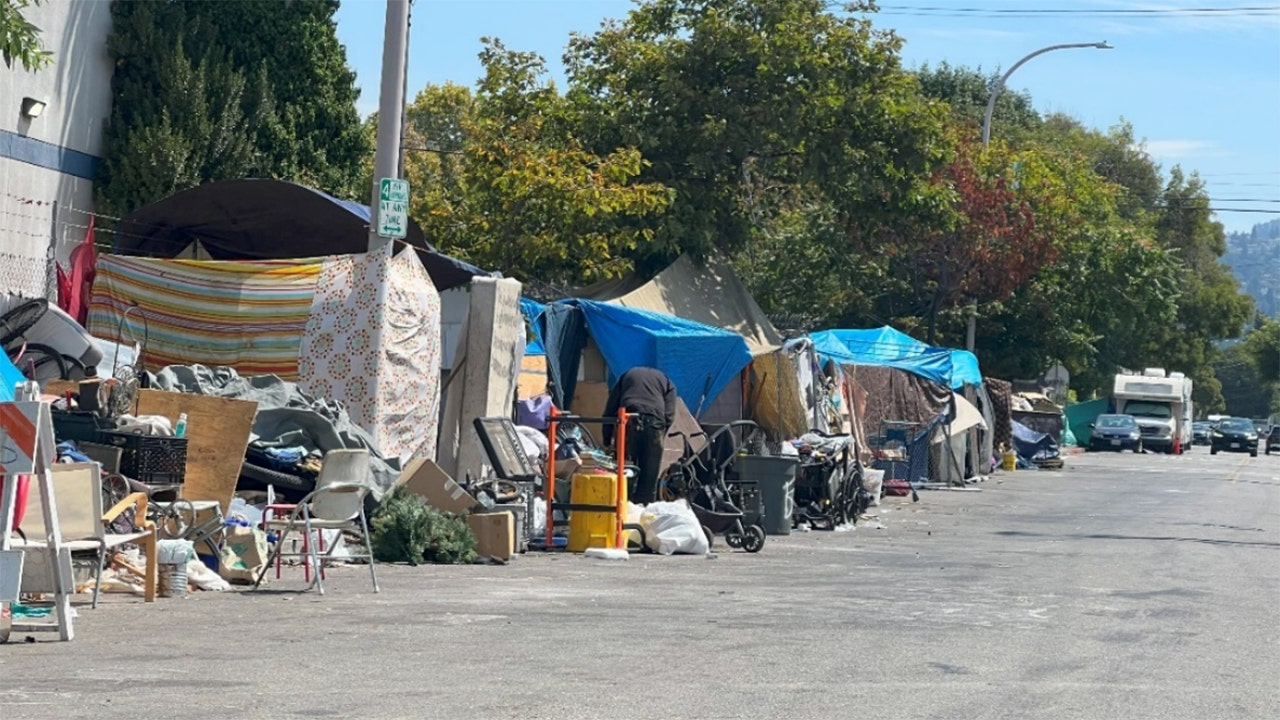
Several businesses in Berkeley, California, including a winery and a brewery, are suing the City of Berkeley for its failure to remove homeless encampments near them, which has hurt their profits.
The lawsuit was filed in Alameda County this week by eight businesses, including Covenant Winery, Emily Winston of Boichik Bagels and Fieldwork Brewing against the City of Berkeley.
The plaintiffs allege the case is about the City of Berkeley being required to follow the same nuisance laws private landowners must follow, while also owing an obligation to its citizens to maintain its streets and other public rights of way free from obstructions.
Over the past few years, the businesses claim, the city has allowed homeless encampments to remain on Harrison Street between Fifth, Sixth, Seventh, Eighth and Ninth Streets; along Codornices Creek; and in the Lower Dwight neighborhood.
NEWSOM CLEANS UP HOMELESS CALIFORNIA ENCAMPMENTS AFTER HE ALLOCATED BILLIONS OF DOLLARS WHILE CRISIS GREW
The City of Berkeley, California, is being sued by several businesses for failing to remove homeless encampments. (Superior Court of the State Of California County of Alameda)
The plaintiffs say in the lawsuit they believe the city allowed the encampments when the U.S. Court of Appeals for the Ninth Circuit “erroneously” ruled in two cases, saying a city may not criminalize public camping if there is no alternative space available for the campers to relocate.
While the decisions did not allow or require the city to permit encampments in a way in which it created a public nuisance, the city permitted and invited encampments in Harrison and Lower Dwight, knowing they would be a public nuisance, the plaintiffs allege.
The city also allowed encampments to remain in place despite shelter space being available.
GOV NEWSOM ORDERS HOMELESS ENCAMPMENTS TORN DOWN ACROSS CALIFORNIA: ‘NO MORE EXCUSES’
But in 2024, the U.S. Supreme Court reversed the Ninth Circuit’s decisions and said municipalities are permitted to remove public encampments whether sufficient alternative space is available or not.
The businesses said in the lawsuit they believe the city refuses to act, in part, because it fears litigation by advocates of those living in RVs and those who are homeless.
By filing the lawsuit, the businesses are asking the court to step in and require the city to follow the law and remove the encampments so the neighborhoods will be free of public and private nuisance conditions.
MASSIVE CALIFORNIA RESIDENTIAL TOWER TO OFFER HOMELESS PRIVATE ROOMS, GYM, CAFE AND MORE AMENITIES
The City of Berkeley, California, is being sued by several businesses for failing to remove homeless encampments. (Superior Court of the State Of California County of Alameda)
Fox News Digital has reached out to the city manager and some of the businesses who filed the lawsuit for comment.
The businesses are represented by Gavrilov & Brooks of Sacramento and Arizona-based Tully Bailey LLP. The latter won a case in 2023 that required the city of Phoenix to clear a homeless camp within the city limits.
Ilan Wurman, an attorney from Tully Bailey LLP who is on the Berkeley case, told Fox News Digital the Supreme Court’s decision earlier this year that held cities have the authority to remove homeless encampments, does not compel them to do so.
“It has become clear that Berkeley, even though it has shelter to offer, and its offers are routinely refused, does not plan to do anything about the encampments,” Wurman said. “Only a public nuisance lawsuit can force the city to do the right thing and clean up the city. This legal theory was deployed successfully in Phoenix, and we are optimistic it will work in Berkeley, too.”
FOX 2 in San Francisco spoke with Winston, who said she has tried to work with the city over the years to control the encampment near her business.
“It’s tough. It’s filthy. There’s trash everywhere. The street is frightening to drive down for customers. It’s not safe for our customers or our staff,” Winston said.
She also told the station she wants the unhoused residents to receive shelter and treatment they need but also called the city out for failing to improve conditions, forcing her to pursue legal action.
HOMELESS PERSON ALLEGEDLY ABDUCTS 4-YEAR-OLD AT CALIFORNIA RESTAURANT AMID UPTICK OF CRIME
Gov. Gavin Newsom along with a Caltrans cleanup crew at an encampment site near Paxton Street and Remick Avenue in Los Angeles as the state’s Clean California initiative continues Aug. 8, 2024, in Los Angeles. (Jason Armond/Los Angeles Times via Getty Images)
“I was not eager to do this. This was certainly not my idea of a good time. I wish the city would just have cleaned it up anyway,” she said.
Homeless encampments are a growing problem across California.
Gov. Gavin Newsom took to the streets of California in August to clean up trash left behind by homeless encampments, threatening municipalities that if they do not clean up encampments, they will lose state funding next year.
“I want to see results,” Newsom said at the time. “I don’t want to read about them. I don’t want to see the data. I want to see it.”
Homelessness has skyrocketed in the Golden State under Newsom’s leadership. According to the 2024 point-in-time count, which provides a snapshot of homelessness on a given night, the number of homeless individuals in California increased to approximately 172,000. This represented an increase from the estimated 131,000 homeless individuals counted in 2018, the year Newsom took office.
OAKLAND HOMELESS WOMAN STEALS CITY COUNCIL CANDIDATE’S FUNDRAISING MONEY: ‘I WAS LEFT TO FEND FOR MYSELF’
The City of Berkeley, California, is being sued by several businesses for failing to remove homeless encampments. (Superior Court of the State Of California County of Alameda)
Earlier this year, Newsom’s administration blamed counties and cities after a state audit report found his own homelessness task force failed to track how billions of dollars have been spent trying to tackle the crisis in the last five years.
At the time, a senior spokesperson for the California Interagency Council on Homelessness (CICH), which coordinates homeless programs across the state, told Fox News Digital the audit’s findings “highlight the significant progress made in recent years to address homelessness at the state level, including the completion of a statewide assessment of homelessness programs.”
Over the past five years, the CICH didn’t consistently track whether the money actually improved the situation, the audit concluded.
The spokesperson added local governments “are primarily responsible for implementing these programs and collecting data on outcomes that the state can use to evaluate program effectiveness.”
Since 2016, California has spent over $25 billion on homelessness. This includes state, local and federal funding allocated toward boosting the state’s “housing first” ideology through various programs, which prioritize placing people in housing first before addressing mental illness or substance abuse problems.
Fox News’ Jamie Joseph contributed to this report.
Read the full article from Here


PROVO — The preliminary hearing for Tyler Robinson is expected to wrap up Friday morning in Provo. But it will still be several weeks before a decision is made on whether there is enough probable cause to bind him over for trial.
Robinson, 23, is charged with 10 crimes, the most serious being aggravated murder, in the death of conservative political activist Charlie Kirk, who was shot and killed on the campus of Utah Valley University on Sept. 10, 2025. A preliminary hearing is held to determine whether there is sufficient probable cause to go to trial on the charges levied against a defendant.
The Utah County Attorney’s Office finished calling their witnesses to testify on Thursday. Robinson’s defense team, who have already called two forensic experts from the FBI and ATF to testify, are expected to call one more on Friday before resting. Robinson has been attempting to cast doubt on the reliability of DNA testing, arguing that test results are subjective.
Prosecutors have objected several times to the line of questioning, arguing that it falls well outside the bounds of what is needed for a preliminary hearing. Even 4th District Judge Tony Graf warned defense attorney Michael Burt on Thursday during one line of questioning, “I feel we are exiting the orbit of probable cause.”
At the end of a preliminary hearing, both sides typically give closing arguments, and the judge decides if there is enough evidence for a defendant to proceed to trial. On Thursday, Graf granted a defense motion for each side to first submit briefs summarizing their arguments. The state will submit its brief by July 28, followed by the defense’s reply on Aug. 11 and the state’s rebuttal on Aug. 18. After that, another hearing will be held on Sept. 1 for both sides to present their cases in court.
Also on Thursday, portions of the video interview of Robinson’s roommate and boyfriend at the time of Kirk’s death, Lance Twiggs, were shown to the courtroom after much debate.
In addition, screenshots of the text messages exchanged between Twiggs and Robinson, a note Robinson left for Twiggs and messages on Discord that Robinson allegedly sent to his friend group prior to turning himself in, were all displayed in court.
For each piece of evidence introduced during the week-long hearing, Graf has had to decide:
- Whether to admit that evidence into the record;
- Whether that evidence should be shown to everyone in the courtroom;
- Whether that evidence can be filmed by the livestream camera broadcasting the hearing.
Robinson’s defense team remains adamant that broadcasting evidence to people outside the courtroom will jeopardize their client’s right to a fair trial by prejudging a future jury pool. Prosecutors want the evidence shown to everyone for the sake of transparency. Graf has compromised on several pieces of evidence by allowing them to be displayed to people in the courtroom but not on the livestream feed.
The extended debates over what evidence can be shown to the public and what is only viewed by attorneys and the judge have prompted Jeff Neiman, the attorney for Erika Kirk and the Kirk family, to address the courtroom several times, both in person and in a briefing filed Wednesday night, calling on the court to make all evidence public.
“For 10 months, the victim’s family has waited for this preliminary hearing. Erika Kirk, the widow of Charlie Kirk, and his grieving parents traveled to this courtroom for one reason: to be present at these proceedings and to bear witness to the evidence concerning the death of their husband and son. At certain points throughout the preliminary hearing, the Kirk family sat in the room while evidence was admitted but not presented for their viewing. They were present in body, yet denied the very thing their presence was meant to secure: their ability to meaningfully observe the preliminary hearing,” Neiman said. “The victim’s family’s position is simple. At a minimum, every exhibit entered into evidence during the preliminary hearing must be visible to every person lawfully present in the courtroom.”
Erika Kirk and Charlie Kirk’s parents have been in the courtroom all week for the preliminary hearing.
At Neiman’s request, Graf agreed that at the end of court on Friday, he will show to the courtroom only the enhanced UVU surveillance video allegedly showing Robinson’s movements across the roof of the Losee Center and when he drops off the roof and runs to a wooded area off Campus Drive. The video includes moments in which film editors zoom in on the alleged gunman and impose a red circle around him to make it easier to view. The video was originally submitted as evidence but was only shown to Graf and attorneys.
Friday’s hearing begins at 9 a.m. Watch it livestreamed here:


Over the course of the next few weeks, we will be taking an in-depth look at the Bengals’ 2026 opponents. The Bengals play in Washington on Monday Night Football in Week 11 against the Commanders.
2025
The Commanders went 5-12 last season, finishing third in the NFC East a year after making a run to the NFC Championship Game. QB Jayden Daniels played in just seven games due to injury after winning NFC Offensive Rookie of the Year in 2024. Veteran Marcus Mariota started eight games, going 2-6, while now-Bengal Josh Johnson logged two starts under center.
Washington’s offense averaged 20.9 points per game last season, ranking 22nd in the league. Without their second overall pick quarterback, the Commanders struggled to pass the ball, averaging 184.1 passing yards per game, good for 24th in the league. The team’s top receiver Terry McLaurin played in 10 games as he too struggled with injuries. As a result, former San Francisco 49er Deebo Samuel led Washington with 72 receptions for 727 yards and five touchdowns.
The Commanders were more effective on the ground, ranking fourth in yards per carry (4.7) and yards per game (134.7). Washington primarily featured two backs: rookie Jacory Croskey-Merritt and Chris Rodriguez. Croskey-Merritt paced the team in attempts (175), yards (805) and touchdowns (eight) while Rodriguez added 112 carries for 500 yards and six scores.
On the other side of the ball, the Commanders allowed 26.5 points per game, the sixth most in the NFL, and 384.3 yards per game, the most in the league. Washington allowed the third-most rushing yards per game (141.8) and fifth-most yards per carry (4.8). The defense allowed 242.5 yards per game through the air, the fifth most. The unit struggled to force turnovers as well, notching the second-fewest takeaways in the NFL with 10.
Offseason Changes
Head coach Dan Quinn had to replace both coordinators this offseason, as the team decided to mutually part ways with former offensive coordinator Kliff Kingsbury and let go of defensive coordinator Joe Whitt Jr. The Commanders hired two first-time coordinators in David Blough (OC) and Daronte Jones (DC).
Washington overhauled its defense this offseason, starting with the defensive line. The Commanders signed former Ravens and Chargers DE Odafe Oweh to a four-year deal, former Texans DT Tim Settle Jr. to a three-year deal and former Jaguars and Patriots DE K’Lavon Chaisson to a one-year deal. They also drafted DE Joshua Josephs from Tennessee in the third round of the 2026 NFL Draft.
The team added LB Leo Chenal from the Chiefs in free agency and spent the seventh overall pick in the draft on LB Sonny Styles Jr. from Ohio State. On the back end, Washington signed S Nick Cross and CB Amik Robertson.
On the offensive side of the ball, Washington let Rodriguez walk in free agency and signed former Browns RB Jerome Ford and former Buccaneers RB Rachaad White instead. It added depth to the receiver room with one-year deals for Dyami Brown and Van Jefferson and used a second-round pick on Clemson WR Antonio Williams. The Commanders also signed TE Chig Okonkwo to a three-year contract from the Titans.
Wyoming
Wyoming officials say Meta’s 715,000-square-foot data center is responsible for contaminating its water system with a rare bacterium | Fortune

Cheyenne, Wyoming, officials say Meta’s data center construction is responsible for the contamination of part of the town’s recycled water system.
The Board of Public Utilities (BOPU) traced the presence of a bacterium discovered in its wastewater treatment facility earlier this year to Goat Systems LLC, a Meta contractor for the tech company’s in-progress 715,000-square-foot data center campus, according to recent public notices from the BOPU.
The bacterium did not enter Cheyenne’s drinking water supply and was found in systems used for irrigation purposes only. Cupriavidus gilardii is a rare organism typically found naturally in water and soil. Infections from this bacterium are extremely rare, BOPU said, but can pose a threat to elders and immunocompromised individuals directly exposed to it.
It was discovered during routine testing in February, prompting BOPU to temporarily suspend the city’s reclaimed water irrigation program and terminate Meta’s discharge privileges.
The board also announced last week it would not accept industrial wastewater discharges associated with fill-and-flush operations—which circulates, then flushes purified water to eliminate construction debris and residue—nor closed-loop cooling systems popular in data centers that circulate coolants mixed with water.
The board classified the incident as “significant non-compliance with federal pretreatment regulations.”
“Over the past two months, BOPU staff have undertaken significant remediation efforts, including draining and disinfecting the entire reuse water system and Prairie View Pond to eliminate any remaining bacterial presence,” one notice said.
Cheyenne’s BOPU declined Fortune’s request for comment and said it will hold a press conference in the next week with additional details on the situation.
A Meta spokesperson told Fortune the company is supporting Fortis, its general contractor, in its efforts to resolve the problem, and that Fortis began testing its own water through a third-party environmental specialist, who found no traces of the bacterium.
“When the board shared that it found a substance in the city’s wastewater—not public drinking water—Fortis immediately stopped discharging industrial wastewater and began hauling it offsite,” a spokesperson said in a statement. “Meta is committed to being a good neighbor in Cheyenne, including through the protection of local water resources, and will continue encouraging collaboration between Fortis and the board until this situation is resolved.”
Pollutants from data center construction and operations are part of the mounting anxieties Americans have around the exploding growth of AI infrastructure around the country. A recent Gallup poll found about 70% of Americans somewhat or strongly oppose the construction of data centers in their local area. While half of respondents cited environmental concerns, such as excess water usage and deforestation, 16% of respondents cited pollutants, including air and water contamination, among reasons for their opposition.
Meta announced the construction of the Cheyenne data center in July 2024, saying it would be the company’s 21st data center in the U.S. and 25th globally. According to the company, Cheyenne provided access to infrastructure and energy and had a large talent pool from which to recruit.
Meta projected that the $800 million investment would sustain more than 1,000 construction jobs at the height of the build and support 100 jobs once completed. The campus is one of 27 data centers in Cheyenne and 31 in Wyoming. By comparison, Northern Virginia has the most data centers in the country, with about 550.
The tech company, for its part, previously said it would allocate resources toward the energy grid and water-cleanup efforts, including working with Black Hills Energy and the Laramie County Conservation District to restore Crow Creek, which recharges the state’s Ogallala Aquifer.
“Meta wants to be a positive contributor in communities like Cheyenne,” the company’s announcement said. “And that includes investing in the energy grid and supporting local water restoration projects.”
-

 Rhode Island27 seconds ago
Our Favorite Write-Ins From the 2026 Best of Rhode Island Readers’ Poll – Rhode Island Monthly
-

 South-Carolina7 minutes ago
South Carolina National Guard lifts suspensions for pilots in July Fourth flyover
-

 South Dakota10 minutes ago
South Dakota T. rex could bring $30 million or more at auction
-

 Tennessee15 minutes ago
Rescue teams pull kayakers and dog from Red River in Tennessee
-

 Texas22 minutes ago
Fetus found deceased along Lewisville Lake shoreline was discarded intentionally, police say
-

 Utah26 minutes ago
Tyler Robinson preliminary hearing expected to wrap up Friday – KSLNewsRadio
-
Washington30 minutes ago
Bengals 2026 Opponent Preview: Washington Commanders
-

 Vermont30 minutes ago
Beau Welling’s Stowe Country Club Revamp Signals New Vermont Golf Era


