Lifestyle
WNBA star Dearica Hamby sues the league and her former team for discrimination

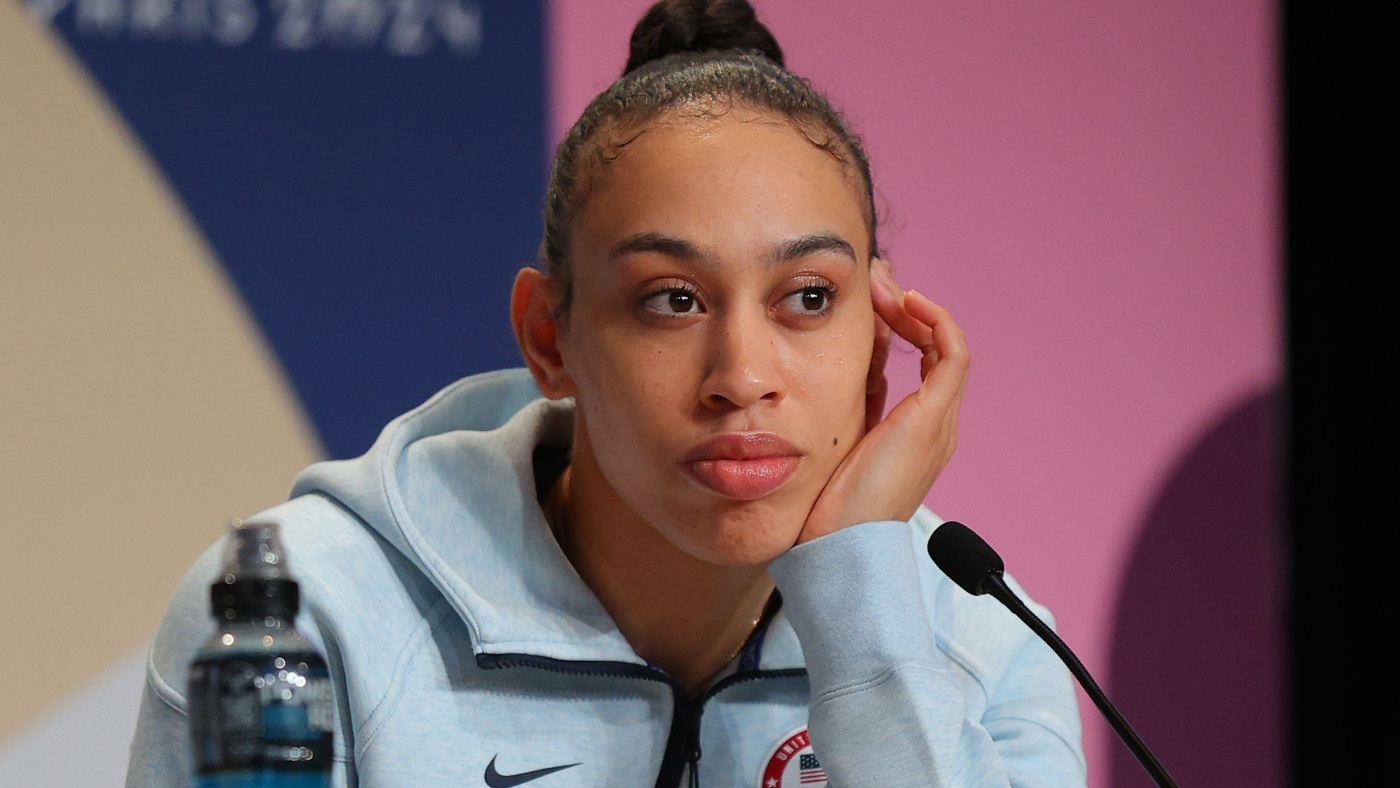
Dearica Hamby speaks during a Team USA 3×3 Basketball press conference in Paris in July. The U.S. women’s 3×3 basketball team won bronze at the Olympics last week.
Mike Lawrie/Getty Images
hide caption
toggle caption
Mike Lawrie/Getty Images
Fresh off an Olympic bronze medal, basketball star Dearica Hamby has filed a federal lawsuit against the WNBA and her former team, the Las Vegas Aces.
The three-time WNBA All-Star and two-time Sixth Women of the Year winner is accusing the league and her former team of discriminating and retaliating against her while she was pregnant, culminating in her trade to the Los Angeles Sparks in January 2023.
“Defendant’s decision to trade [Hamby] was motivated by [Hamby’s] announcement that she was pregnant after signing her contract extension,” reads the 18-page complaint, filed in U.S. district court in Nevada on Monday.
Hamby’s lawyers allege that being traded caused Hamby harm, including “lost promotional and/or endorsement opportunities, relocation to a more unfavorable tax environment, and the denial of a chance to participate for a back-to-back WNBA championship.”
They are asking for compensatory and punitive damages, “to be determined at trial.”
The Aces did not respond to a request for comment. Nor did the WNBA, but a spokesperson for the league has told multiple media outlets that officials are “reviewing the complaint.”
Aces coach Becky Hammon has denied Hamby’s allegations in the past, saying in May 2023 that the trade “came down to math and business.”
“We made the decision to move Hamby because we could get three bodies in for her one contract,” Hammon told reporters. “[Her pregnancy] was never an issue, and it was never the reason she was traded. It just wasn’t.”
The WNBA launched a formal investigation into Hamby’s discrimination claims in early 2023 — around the time that her second child was born — and concluded that the Aces had violated league rules “regarding impermissible player benefits.”
It consequently rescinded the Aces’ 2025 first-round draft pick, and also suspended Hammon for two games without pay “for violating league and team Respect in the Workplace policies.”
But this month’s lawsuit argues that the WNBA’s response didn’t go far enough to correct the violation of Hamby’s rights or provide her with any meaningful redress. Her lawyers say the WNBA “had the power to, but did not, rescind the trade.”
“The [WNBA] did not impose adequate punishment or consequences on the [Las Vegas Aces] for the discriminatory treatment experienced by [Hamby] nor for her unlawful trade to the Los Angeles Sparks such that it would deter any future similar conduct,” the complaint says.

Hamby gave birth to her son, Legend, in March 2023 and reported to training camp for the Sparks the following month. The lawsuit says she did not miss any required time with the team as a result of her pregnancy, and went on to play in all 40 of their regular season games. At the end of the season, the Aces won their second consecutive championship, without her.
Hamby filed a discrimination claim against the WNBA and the Aces with the Equal Employment Opportunity Commission in the fall of 2023, and the federal agency ruled in May 2024 that she had the right to sue.
Hamby’s attorneys — with the national firm HKM Employment Attorneys — said in a statement that the Aces had “exiled” Hamby for becoming pregnant and “the WNBA responded with a light tap on the wrist.”
“Every potential mother in the league is now on notice that childbirth could change their career prospects overnight,” they added. “That can’t be right in one of the most prosperous and dynamic women’s professional sports leagues in America.”
‘You’re trading me because I’m pregnant?’
Hamby has played in the WNBA since 2015, starting with the San Antonio Stars — who began operating as the Las Vegas Aces in 2018. She helped lead the Aces to their first-ever WNBA championship in the fall of 2022.
According to the lawsuit, Hamby signed a two-year contract extension with the team in the spring of 2022, which would have carried her through the 2024 playing season.
To seal the deal, the lawsuit says, the team offered Hamby additional “benefits and inducements” like an agreement to cover private school tuition costs for her daughter and allow her to occupy team-provided housing.
Less than a month after Hamby signed the contract extension, she discovered she was pregnant again. She told Hammon and other Aces staff during the summer, and publicly announced her pregnancy at their championship victory parade that fall.

Dearica Hamby poses with her daughter Amaya during a 2022 WNBA championship ring ceremony before the Aces’ game against the Los Angeles Sparks in May 2023.
Steve Marcus/Getty Images
hide caption
toggle caption
Steve Marcus/Getty Images
Hamby’s lawyers say that once her pregnancy was public, she “experienced notable changes in the way she was treated by Las Vegas Aces staff.”
She couldn’t get a clear answer on when her daughter’s tuition would be paid, and was informed that she had to vacate team-provided housing, according to the suit.
The lawsuit also recounts a January 2023 phone call between Hammon and Hamby in which the coach allegedly questioned her commitment to the team, falsely accused her of signing her contract extension while pregnant and suggested she wasn’t taking her off-season workouts seriously. The lawsuit says Hamby, then seven months pregnant, was “working out regularly as permitted by her medical doctors.”

Hammon allegedly told Hamby that no one expected her to get pregnant again, “implying that by signing the contract extension, Hamby implicitly agreed she would not get pregnant during the two-year extension period.”
Hamby’s lawyers say she twice asked, “You’re trading me because I’m pregnant?” Hammon allegedly responded, “What do you want me to do?”
According to the lawsuit, Hammon told Hamby the next day that her “time with the Aces is up,” and that she could “pick a place like Los Angeles or Atlanta.” Within a week, the team publicly announced that Hamby had been traded to the Los Angeles Sparks.
Hamby says she was punished after she spoke out
Hamby responded to the trade announcement with a public social media post expressing her gratitude and excitement, but also admitting that she was “heartbroken.”
“Being traded is a part of the business. Being lied to, bullied, manipulated and discriminated against is not,” she wrote, before outlining some of the back and forth over her pregnancy. “The unprofessional and unethical way that I have been treated has been traumatizing. To be treated this way by an organization, BY WOMEN who are mothers, who have claimed to ‘be in these shoes,’ who preach family, chemistry and women’s empowerment is disappointing and leaves me sick to my stomach.”
Shortly after, the executive director of the Women’s National Basketball Players Association emailed the WNBA’s general counsel on Hamby’s behalf, requesting they open an investigation, which they did.

Dearica Hamby of the Los Angeles Sparks attempts a shot during a May 2024 game in Indianapolis, Indiana.
Justin Casterline/Getty Images
hide caption
toggle caption
Justin Casterline/Getty Images
The lawsuit alleges that the Aces “engaged in a number of retaliatory acts” against Hamby after she went public with her complaints.
Some of the examples listed including telling players and staff to cease communication with Hamby, refusing to extend her an invitation to attend the White House ceremony celebrating their first championship win, and directing video personnel at a 2023 playoff game not to show Hamby’s daughter on screen despite the fact that she was “a fan favorite.”
The lawsuit says Hamby’s trade resulted in additional tax burdens, loss of sponsorship opportunities, reputational harm and other financial losses, in addition to emotional distress and anxiety.

Terri Carmichael Jackson, the executive director of the player’s union, reiterated in a statement this week that the 2020 collective bargaining agreement granted parents protections that ensured pregnancy wouldn’t mean the end of their career. Those include paying players their full salary while on maternity leave and providing an annual child care stipend of $5,000.
“Obviously, these protections did not change the nature of this business,” she added. “Any team can trade any player for any legitimate reason or no reason at all. But that reason can never be on the basis of race, gender, sexual orientation, parental status or pregnancy status.”


Since leaving office, former Vice President Mike Pence founded the policy and advocacy organization Advancing American Freedom.
Drew Angerer/Getty Images
hide caption
toggle caption
Drew Angerer/Getty Images

Since leaving office, former Vice President Mike Pence founded the policy and advocacy organization Advancing American Freedom.
Drew Angerer/Getty Images
Former Vice President Mike Pence played a key role in bringing President Trump to power in 2016. By putting his name on the Republican ticket, he helped reassure the Republican establishment and evangelical voters who were wary of Trump’s brash brand of populism.
Pence’s departure from Trump’s leadership of the Republican party began when Trump called on Pence to refuse to certify the results of the 2020 election — pressure Pence rejected.
“For four years, we had a close working relationship. It did not end well,” Pence wrote in his memoir So Help Me God, which was released in 2022.
In the years since leaving office, Pence has been advocating for an ideological restructure of the Republican party, and founded the policy and advocacy organization Advancing American Freedom. Pence builds on the theme of reimagining the Republican party in his new book What Conservatives Want, which provides a critique of the second Trump administration and what he terms the “populist right.”
In an interview with Morning Edition, Pence detailed to NPR’s Steve Inskeep his critique of the second Trump administration, shared his perspective on civil rights legislation and challenged Trump’s tariffs and other interventions in the economy.
Listen to the full interview by clicking on the blue play button above; and read highlights from the conversation below.
‘The populist right’ does not represent conservative beliefs
Pence believes that Trump has embraced “the populist right” over traditional conservatives in the Republican party.
The sale of economic American company U.S. Steel to Nippon Steel in Japan exemplifies this shift, Pence said.
In his first term, President Trump opposed the sale. But in his second term, he approved the sale and took a golden share — a class of shares in which a government can own a very small percentage of the company but has outsized voting rights.
Pence said that he was taken aback by Trump’s decision to take a golden share.
Free trade is essential to American conservatism
Pence takes umbrage with his former boss’ tariff-laden economic policy.
Pence said it violates conservatism’s bedrock belief in the power of free trade, and Trump has gone about granting exceptions to tariffs in an unfair way.
Granting waivers to large corporations from certain tariffs is “one of the lesser reported aspects of the tariff regime that’s been imposed by the administration,” Pence added.
Trump and Pence ran in 2020 on a mission to “drain the swamp,” rooting out government corruption and wasteful spending. However, Pence said Trump appears to have shifted from those goals.
“There’s maybe nothing more swampy than the battle over getting tariff waivers for big business,” Pence said.
Women’s rights on the right
There is a debate among the ultraconservative right about the role of women in civic life.
The concept of “household voting,” has become a familiar talking point for ultra-right-wing communities online. Supporters of “household voting” advocate that every American household should get one vote, the vote being that of the husband’s. This concept has been promoted by figures such as Abby Johnson, a prominent anti-abortion activist who spoke at the 2020 Republican National Convention. When asked about whether he supported household voting, Pence said he is not aligned
“It’s one person, one vote in this country. And people have bled and died for that principle throughout the years of our history,” Pence said.
He added that American families don’t need to be propped up by government programs to boost childbirth. “What American families need is an application of the kind of principles that will create higher wages, more opportunities, more jobs,” Pence said.
Should conservatives stand for civil rights?
Pence said he was an admirer of senator and one-time presidential candidate Barry Goldwater.
Notably, Goldwater voted against the Civil Rights Act of 1964.
“Should conservatives stand for civil rights?” asked Inskeep.
Pence responded that civil rights are important to conservatives, but that equality of opportunity is what legislation ought to enshrine, not equality of outcome.
Pence added that he stood by the Supreme Court’s decision to ban partisan gerrymandering on the basis of race, rendering ineffective a key provision of the Voting Rights Act of 1965.


Milly Alcock in Supergirl.
Warner Bros. Pictures
hide caption
toggle caption
Warner Bros. Pictures
Hollywood’s newest Supergirl is kind of a dirtbag — in the good way. Fearless and grumpy, Supergirl (Milly Alcock) sets out on a quest to support a new pal’s revenge journey and to make a point that should be clear by now: Never mess with a lady’s dog. Also featuring David Corenswet and Jason Momoa, is Supergirl a worthy follow up to Superman?
If you want more DC superhero action, check out these episodes:
‘Superman’ takes off and nails the landing
‘The Batman’ puts the emo in emote
Connect with Pop Culture Happy Hour:
Letterboxd / Facebook
Our weekly newsletter
Support Pop Culture Happy Hour+
-
Georgia6 minutes ago
Georgia Lottery Mega Millions, Cash 3 results for June 26, 2026
-

 Hawaii9 minutes ago
Police recover 19 gaming machines, $7K in Kakaako gambling bust
-

 Idaho14 minutes ago
The reactor race has begun
-

 Illinois21 minutes ago
New Illinois bill aims to overhaul public defense system | The Chicago Report
-

 Indiana24 minutes ago
Driver airlifted after NW Indiana police chase ends with crash into tree
-

 Iowa29 minutes ago
Vote: Class 1A Iowa High School Softball Midseason Player Of The Year
-

 Kansas36 minutes ago
Salina Stars Unite for Final High School Stage at Kansas Shrine Bowl
-

 Kentucky39 minutes ago
Beechwood’s Tyler Fryman commits to the Kentucky Wildcats

