Midwest
Missouri man free after judge overturns 1991 conviction, despite state pushback

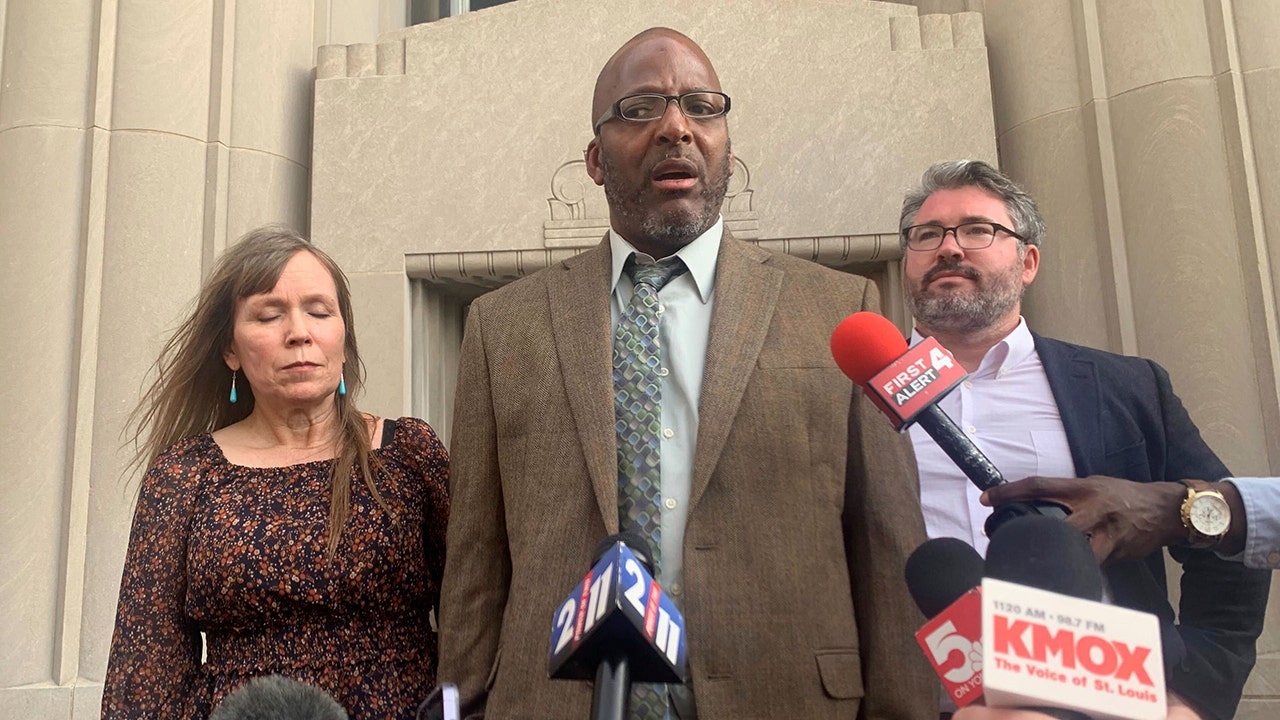
A Missouri man was freed from prison Tuesday after his murder conviction was overturned after 34 years behind bars, despite the state attorney general’s efforts to keep him there.
“I never gave up because my family never gave up,” Christopher Dunn said from the steps of the downtown St. Louis courthouse. “It’s easy to give up in prison when you lose hope. But when the system throws you away, you have to ask yourself if you wanted to just settle for it or fight for it.”
MISSOURI HALTS RELEASE OF MAN WITH OVERTURNED MURDER CONVICTION AS HE WAS ABOUT TO GO FREE
Dunn, 52, reunited with his wife, Kira Dunn, as he was officially released from the St. Louis city jail Tuesday night. As his release drew imminent, he was driven by van from the state prison in Licking, Missouri, to St. Louis, about 140 miles away.
A St. Louis circuit judge overturned Dunn’s murder conviction on July 22 and ordered his immediate release. But Dunn remained imprisoned amid a chaotic process that began when Missouri Attorney General Andrew Bailey appealed to try and keep Dunn locked up.
Christopher Dunn stands free after his murder conviction was overturned after 34 years behind bars, on the steps of a courthouse in downtown St. Louis, Tuesday, July 30, 2024. (Laurie Skrivan/St. Louis Post-Dispatch via AP)
When asked about the delay since the judge’s ruling, Dunn said, “It was testing. To hear the decision by the judge and then be prepared to leave on Wednesday, only to be brought back to prison. It was torture.”
Dunn’s release marks the second time in recent weeks that a person was freed from prison despite Bailey’s appeals to keep them in custody after a murder conviction was overturned.
Sandra Hemme was freed July 19 from a western Missouri prison after serving 43 years for a murder that a judge deemed there was evidence of her “actual innocence.” Bailey’s office also opposed Hemme’s release while an appellate court reviewed the case. She walked out of the prison only after a judge threatened Bailey with contempt if she wasn’t freed.
Political scientists and some attorneys have said Bailey was taking the tough stance to shore up votes in advance of a contested Republican primary. He faces a challenge from Will Scharf, an attorney for former President Donald Trump, in the Aug. 6 primary.
At one point last week, Dunn was minutes away from getting out of prison after the circuit judge, Jason Sengheiser, threatened a warden with contempt if he wasn’t released. But then the Missouri Supreme Court agreed to consider the case, temporarily halting his freedom.
Then on Tuesday, the state’s highest court issued a ruling stating that the St. Louis circuit attorney needed to confirm it had no plans to retry Dunn before he could be freed. Circuit Attorney Gabe Gore immediately filed a memorandum stating he would not seek a new trial, setting in motion the process toward Dunn’s freedom.
A statement from the Midwest Innocence Project said Dunn “is coming home.”
“We are thrilled that Chris will finally be reunited with his family after 34 years behind bars for a crime he did not commit,” the statement read. “We look forward to supporting Chris as he rebuilds his life.”
Earlier Tuesday, leaders of the Missouri NAACP and other organizations said that politics and racism were behind Bailey’s effort to keep Dunn behind bars. State NAACP President Nimrod Chapel Jr. said at a news conference that Bailey “superseded his jurisdiction and authority” in appealing Sengheiser’s ruling.
“What’s happening now is another form of lynching,” said another speaker, Zaki Baruti of the Universal African People’s Organization.
Bailey’s office, in an earlier statement, said the effort to keep Dunn in prison was warranted.
“Throughout the appeals process, multiple courts have affirmed Christopher Dunn’s murder conviction,” the statement read. “We will always fight for the rule of law and to obtain justice for victims.”
Dunn was convicted of first-degree murder in the 1990 shooting of 15-year-old Ricco Rogers. St. Louis Circuit Attorney Gabe Gore filed a motion in February seeking to vacate the guilty verdict. A hearing was in May.
Sengheiser wrote in his ruling that Gore “made a clear and convincing showing of ‘actual innocence’ that undermines the basis for Dunn’s convictions because in light of new evidence, no juror, acting reasonably, would have voted to find Dunn guilty of these crimes beyond a reasonable doubt.”
The Missouri Attorney General’s Office opposed the effort to vacate Dunn’s conviction. Lawyers for the state said at the May hearing that initial testimony from two boys at the scene who identified Dunn as the shooter was correct, even though they later recanted as adults.
Rogers was shot May 18, 1990, when a gunman opened fire while he was with a group of other teenage boys outside a home. DeMorris Stepp, 14, and Michael Davis Jr., 12, both initially identified Dunn as the shooter.
In a recorded interview played at the hearing, Davis said he lied because he thought Dunn was affiliated with a rival gang.
Stepp’s story has changed a few times over the years, Gore said at the hearing. Most recently he has said he did not see Dunn as the shooter. Gore said another judge previously found Stepp to be a “completely unreliable witness” and urged Sengheiser to discount him altogether.
Dunn has said he was at his mother’s home at the time of the shooting. Childhood friend Nicole Bailey testified that she spoke with him by phone that night and he was on a phone at his mother’s house.
Tristin Estep, the assistant attorney general, said that alibi could not be trusted and that Dunn’s story has shifted multiple times over the years. Dunn did not testify at the hearing.
A Missouri law adopted in 2021 lets prosecutors request hearings when they see evidence of a wrongful conviction. While Bailey’s office is not required to oppose such efforts, he also opposed another effort in St. Louis that resulted in Lamar Johnson being freed last year after serving 28 years for a murder case in which a judge ruled he was wrongfully convicted.
The 2021 law has resulted in the release of two men who each spent decades in prison. In addition to Johnson, Kevin Strickland was freed in 2021 after more than 40 years for three killings in Kansas City after a judge ruled he was wrongfully convicted in 1979.
Another hearing is approaching for Marcellus Williams, who narrowly escaped lethal injection and is now facing another execution date.
St. Louis County’s prosecutor believes DNA evidence shows that Williams didn’t commit the crime that landed him on death row. DNA of someone else — but not Williams — was found on the knife used in the 1998 killing, experts said.
A hearing on Williams’ innocence claim begins Aug. 21. His execution is scheduled for Sept. 24.
Bailey’s office is opposing the challenge to Williams’ conviction, too.
Read the full article from Here



Here’s what the huge Brewers Bob Uecker mural in Milwaukee looks like
See the completed 100-foot tall mural of Milwaukee Brewers play-by-play announcer Bob Uecker covers the Wintrust Financial Center in downtown Milwaukee.
Steve Czaban, a popular radio fixture on Milwaukee sports-talk airwaves, is back in the market with the announcement from the Wisconsin Sports Radio Network that he’ll host an hour-long morning show with Josh Albrecht soon.
The show will run from 8 a.m. to 9 a.m. on 105.7 FM and 1250-AM “The Fan” in Milwaukee. The network, established last October, also features stations in Green Bay/Appleton (99.7 FM, 101.9 FM), Wausau (93.9 FM), Madison (94.9 FM) and Duluth/Superior (710 AM).
Czaban, whose role as host of a morning show on 97.3 The Game was eliminated with iHeartRadio’s decision to end that station’s sports-talk format, hasn’t been on the air in Milwaukee since October.
His show somewhat takes the place of Trevor Thomas’s “Inside Wisconsin Sports,” a licensed property that will continue to broadcast within its usual 6 to 9 a.m. slot from its Green Bay home despite ending its partnership with the Wisconsin Sports Network, seemingly amicably. Thomas has been hosting with Albrecht, and their final show together was scheduled for June 30.
Thomas wrote on social media that he notified Audacy Milwaukee in March that he’d like to end the partnership, delaying his announcement until WSSP had a replacement lined up. Thomas said his show will still be heard on WNFL 99.7 FM in Green Bay and on YouTube.
“Changes are made in radio with little to no explanation because employees sign paperwork that, if they get let go, muzzles them in order to receive their severance pay. Probably not uncommon in other businesses as well,” Thomas wrote on X, responding to one commenter who noted it’s rare for changes in radio to receive full transparency.
“In this case, we created a brand, we own the trademark, our brand was hired to host a morning show, and I’m choosing to end the relationship with Milwaukee because it just wasn’t a fit. And it’s all good. I love those guys. Our show goes on our YouTube page, 99.7 WNFL, and other ‘spots’ to be announced sometime soon.”
Czaban has maintained a strong radio presence in Milwaukee despite unique circumstances; he has remained based in Washington, D.C. He had been a regular contributor to another wildly popular Milwaukee morning show, the “Bob and Brian” show on 102.9 FM, making appearances for two decades. At the time, Czaban also hosted an afternoon drive show at an ESPN affiliate in Washington, and he’s done nationally syndicated work for multiple high-profile outlets.
He joined The Game in 2019 and hosted a show with former University of Wisconsin basketball star Brian Butch.
Since “The Fan” itself ended local sports programming in 2022, it has resuscitated its presence in Milwaukee with shows featuring former Packers John Kuhn and Mason Crosby among its regular offerings, plus a drive-time show “Wisconsin Sports Daily” with longtime station voice Steve “Sparky” Fifer.
Minneapolis, MN
Minneapolis City Council abandons tax hike near George Floyd Square, revises development plan

After community pushback, the Minneapolis City Council unanimously decided to cover about $630,000 in costs that property owners were originally required to pay to support the development of People’s Way, a former gas station turned memorial in George Floyd Square. Council members also voted down a contract with Minnesota Agape Movement, which submitted a plan for the development and was selected by Mayor Jacob Frey in May.
Edwin Reed had to close his business in George Floyd Square due to drops in revenue in July of last year. Reed said he was surprised to hear about the special assessment handed out.
Reed said the fact that the cost was to be offloaded to locals upset him. He believes the project should not be the people’s responsibility, but the city’s.
“We didn’t start it, they did,” Reed said. “To make us pay for it is just another slap in the face to me, my business was decimated up there.”
Hennepin County Commissioner Angela Conley lives near George Floyd Square. She said the city council’s original decision was unfair, and she’s glad the council took steps to reconsider.
“I think it’s great that the city reevaluated the assessments that would have been placed on residents and businesses,” Conley said. “When we set a levy that collects property taxes, it’s to do things like take care of the roads that we drive on.”
Self-proclaimed “Tourist Interrupter” of George Floyd Square and Minneapolis resident Marquise Bowie said the neighborhood has gone without city investment for far too long.
Bowie is a founder of the Agape Movement, a 40-year-old grassroots community safety organization based in South Minneapolis. Since Floyd’s death, he and others in the organization have tried to support the community in any way they can, a commitment that Bowie said he hasn’t seen from city officials.
“It’s been six years. Nobody’s really investing in our neighborhood without any fires. We’ve seen fires burn down buildings to the gravel that are built back up,” Bowie said. “We don’t have nothing permanent that lets people know anymore about George Floyd or about the community at large.”
Following the city’s purchase of Peoples’ Way in 2023, the Minneapolis City Council received submissions from four teams that pitched their development ideas for the People’s Way. The Agape Movement was chosen by Frey earlier this year, but the city council voted against the decision, opting to reconsider other applicants.
South Minneapolis resident Dee Thomas said restrooms are a need at George Floyd Square.
“They want people to come through here and do tours here, but there’s no place to use the bathroom,” Thomas said. “Where can the people that are here in the community day by day, watching over the square and keeping the people safe, get to use the restroom and wash our hands?”
South Minneapolis resident Roxy Drake sat alongside Thomas on a metal chair at People’s Way. She said she wants to see a recreational center built. Community members may soon have the development they’ve been hoping for, but struggles to agree on a developer bring further uncertainty to the project.
Conley said, given the survey distributed to community members, Rise and Remember was the more favored option.
“What you saw the city council do was deny the mayor’s recommendation and move forward with the recommendation of the people who were surveyed and who said Rise and Remember best represents what we want to see at the site,” Conley said. “I think the council was really honoring the voices of residents.”
While it may appear that for one developer to win the bid, another one must lose, Conley said there is plenty to go around with the 38th Street THRIVE Plan, a plan created by community members and the city of Minneapolis to drive engagement on 38th Street between Nicollet Avenue and Bloomington.
“We should be listening to the residents, and I think we need to really fund the 38th Street THRIVE Plan so that other development can happen,” Conley said. “One of them could be what Agape has presented. Why not both?”
The timeline for construction of the square remains the same, with the project set to be done in late 2027, though development action remains unclear. However, Minneapolis City Council members Soren Stevenson and Jason Chavez have made continuing efforts with the project, frequently meeting with Frey about what is best for People’s Way.
Though Stevenson declined an interview with the Minnesota Daily, a member of his team said the next steps are still undecided and will be publicly announced when ready.
Bowie said he wants the council to move forward with Agape Movement’s plans for the square.
“We’ve been here, we were open to working with whoever to try to build a better community,” Bowie said. “We don’t want to stay in activism mode forever and kick the can down the road. We want to start building.”

INDIANAPOLIS (WISH) — Fever head coach Stephanie White said Fever star guard Caitlin Clark will not practice on Tuesday, adding that Clark will be doing an individual workout.
Clark (back) did not play in the Fever’s game on Saturday against the Los Angeles Sparks.
“We want her to be healthy, physically, mentally and emotionally, all the things,” White said on Friday ahead of the game against the Sparks. “I think it’s important to remember, again, when you’ve gone through injury and the traumatic aspect of injury, especially that she had last year, it’s ups and downs, physically, mentally, emotionally, and making sure that she’s 100% ready to go is the most important thing. Her taking care of that is priority for us.”
Clark left the Fever’s game against the Phoenix Mercury on Wednesday in the third quarter and did not return.
Clark has missed two games this season, both due to a back injury. The first game she missed was on May 20 against the Portland Fire.
Clark is averaging 21.2 points, 4.0 rebounds, and and 8.2 assists per game this season.
The Fever have a long break before their next game, when they travel to Las Vegas to play the Aces on Sunday. Tipoff is scheduled for 7 p.m.
-

 Milwaukee, WI2 minutes ago
Steve Czaban returns with new home in Milwaukee sports-talk radio
-

 Atlanta, GA7 minutes ago
Golestan brings a taste of Persian home cooking to Peachtree Corners – Atlanta Magazine
-

 Minneapolis, MN14 minutes ago
Minneapolis City Council abandons tax hike near George Floyd Square, revises development plan
-

 Indianapolis, IN17 minutes ago
Caitlin Clark not practicing Tuesday, to do individual workout
-

 Pittsburg, PA22 minutes ago
Pittsburgh area’s low jobless rate beats state, U.S. rates
-

 Augusta, GA29 minutes ago
Salvation Army of Augusta collects heat relief supplies
-

 Washington, D.C32 minutes ago
Washington Spirit Announces Midseason Roster Update
-
 Cleveland, OH37 minutes ago
No idling: Why it’s against the law in Cleveland

