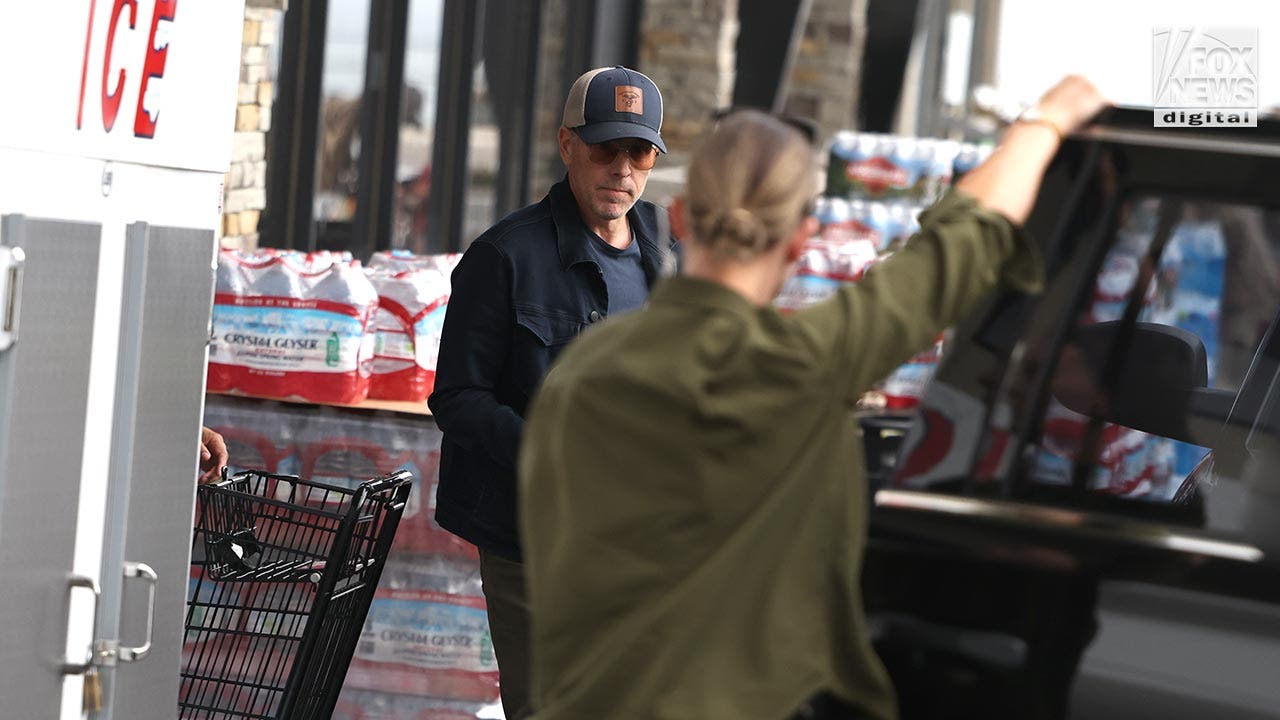
Fox News Digital exclusive photos show Hunter Biden out and about in Los Angeles while his father, President Joe Biden, remained hunkered down on the other side of the country, battling to save his legacy.
The younger Biden, who has reportedly been closely advising his father as a chorus of key Democrats have called on him to end his re-election bid, was seen shopping Friday and leaving the home of “Sugar Bro” Kevin Morris, the entertainment lawyer who funded his defense in a recent criminal trial.
President Biden has reportedly relied heavily on his troubled Yale Law School graduate son and his wife, first lady Jill Biden, as he has tried to fend off claims he is not mentally fit to serve another four years as president. The calls reached a crescendo following his disastrous performance in his June 27 debate against former President Donald Trump, the Republican nominee.
The president is spending the weekend at his vacation house in Rehoboth Beach, Delaware.
Hunter Biden started sitting in on meetings between his father and close staff at the White House just a week after the debate, with one White House source telling NBC at the time that the sudden presence caused confusion and prompted many to ask, “What the hell is happening?”
Advertisement
Biden appeared to rely on his son not only in those meetings, but on phone calls as well, sources had reported.
JD VANCE, OTHERS SAY BIDEN SHOULD RESIGN PRESIDENCY IF HE DROPS OUT OF THE RACE
Hunter Biden exits a supermarket as Secret Service detail holds the door open for him in Los Angeles, California, Friday, July 19, 2024. Hunter Biden remains in Los Angeles as his father, President Joe Biden, is in Delaware amid growing calls for him to drop out of the 2024 election race.(Toby Canham for Fox News Digital)
Hunter Biden was also reported to be one of the biggest advocates for his father staying in the race during a gathering at Camp David in the aftermath of the president’s poor debate performance, with some critics arguing that the president using his son as a top adviser has become a conflict of interest.
Rep. Greg Steube, R-Fla., responded to Hunter Biden’s involvement in these top-level meetings by labeling him “a walking national security threat.”
Advertisement
BIDEN’S CAMPAIGN ISSUES A RESPONSE AFTER TRUMP’S RNC SPEECH
Hunter Biden exits the home of Kevin Morris as Secret Service detail holds the car door open in Los Angeles, California, Friday, July 19, 2024. Hunter Biden remains in Los Angeles as his father, President Joe Biden, is in Delaware amid growing calls for him to drop out of the 2024 election race.(Toby Canham for Fox News Digital)
Some have alleged that Hunter Biden is seeking to have his father pardon him for two cases brought against him in Delaware and California. He was found guilty last month in the Delaware gun case and is awaiting sentencing. His trial on federal tax charges in California is scheduled to begin in September.
DEMOCRATS PLOT COUP TO ‘SAVE DEMOCRACY,’ BUT WHAT HAPPENS IF THEY FAIL?
Secret Service detail waiting outside the Los Angeles home of Kevin Morris as Hunter Biden visits on Friday, July 19, 2024. Hunter Biden remains in Los Angeles as his father, President Joe Biden, is in Delaware amid growing calls for him to drop out of the 2024 election race.(Toby Canham for Fox News Digital)
Advertisement
His lawyers are requesting that both federal cases be thrown out, arguing that Special Counsel David Weiss had been illegally appointed. Hunter Biden was convicted last month on three felony charges related to a handgun purchase in 2018, and a case in California about alleged federal tax crimes is ongoing.
“It’s just a pure and simple massive interest in his dad staying president so he can pardon not only Hunter, but Joe and the rest of the family for the crimes they committed, and probably Merrick Garland, too, for his role in the cover-up,” Mike Howell, the executive director of the Oversight Project at the Heritage Foundation, told Fox News Digital earlier this month.
Hunter Biden was found guilty on all charges in the Delaware gun case, including counts of making a false statement in the purchase of a gun, making a false statement related to information required to be kept by a federally licensed gun dealer, and possession of a gun by a person who is an unlawful user of, or addicted to, a controlled substance.
Fox News Digital’s Michael Lee and Adam Shaw contributed to this report.
Advertisement
Peter Aitken is a Fox News Digital reporter with a focus on national and global news.
SPARKS, Nev. (KOLO) – From Friday, July 17, at 10 a.m. through 6 a.m. Monday, July 20, Southbound Pyramid Way will be closed from Oddie Boulevard to C Street in Sparks for repaving and reconstruction work, according to a Wednesday, July 15, Nevada Department of Transportation news release.
• Southbound vehicles will be detoured via McCarran Boulevard
• Business access will remain available via side streets and marked with signs
• Westbound and eastbound Prater Way will remain open during the closures
Advertisement
• Drivers are asked to leave extra time to detour around the closures
The $14 million improvement project will improve Pyramid Way for bout 28,000 drivers who use it daily, the release said.
In 2010, the road was fully repaved, with minor resurfacing in some areas more recently.
This story was co-published and supported by the journalism nonprofit the Economic Hardship Reporting Project.
“Farmwork in New Mexico, legal work authorization card required.”
It was fall 2020, three years after Mark and Mary (not their real names) first moved to the United States from eastern China. Laid off from their jobs a few months earlier, they were desperate for income, living in a cramped Monterey Park, California, apartment that they shared with four others.
Advertisement
For over two decades in China, alongside their day jobs, they had cultivated peanuts, rice and sweet potatoes on two acres in an undeveloped agricultural part of the country. The crops helped keep their six children fed. But as their own parents aged and their children got older, they wanted a steadier future.
The ad, on a popular job postings site for Chinese-speaking migrant workers, didn’t specify what kind of farmwork they’d be doing, but the line about paperwork made it sound legitimate. They called the number listed in the ad, and the details sounded promising: $200 a day for eight to 10 hours of “flowering trimming,” with food and accommodation provided. A few days later, they received a text message showing the location: Farmington, a sleepy oil-and-gas town of 46,000 on the edge of the Navajo Nation. It is the largest city in the Four Corners, the area where New Mexico, Colorado, Utah and Arizona meet, and it is one of New Mexico’s major towns.
In the first week of October, the couple began the 740-mile, nearly 12-hour drive east. As they neared Farmington, they watched the sun bear down on Ship Rock, an escarpment rising 1,400 feet above the rugged high desert, visible for 50 miles in almost every direction. Beneath the watchful gaze of the winged, cathedral-like pinnacle, the San Juan River trickled through a dry, khaki-colored valley past stony mesas and rolling hills.
When the couple arrived at their destination, a pink, two-story motel, Mary told me that a middle-aged Chinese-speaking man took their car keys and confiscated their phones. Mary and her husband were put into separate rooms. Some had been converted into a makeshift processing facility, with the mattresses stashed in the bathroom and the dresser drawers emptied out. The doors were kept locked or guarded, according to legal documents, and Mark, Mary and the other workers were told to sit on an upside-down bucket beside heavy-duty black trash bags stuffed with lime-green marijuana plants.
Mary remembered the plant’s distinctive odor. The work left her nose swollen “like an elephant” and she spiked a 100-degree fever. Mary’s assignment was to cut the leaves from the plants’ buds with scissors from 7 a.m. or earlier, until 10 at night, working almost nonstop, according to legal documents. She was denied medication, and when she tried to stop work, she was forced to continue, a civil case she and others filed later stated.
Advertisement
Mark and Mary had unwittingly walked into the shadowy fringes of New Mexico’s brand-new legal weed industry — and the early days of a network that sought to use Chinese immigrants as labor on the farms that supplied the growing demand for the drug.
New Mexico, which legalized the adult use of weed in 2021, began its first licensed sales in 2022, and currently sells at least $35 million every month. Colorado and other states in the region have also legalized the plant’s use over the past decade and a half. At the same time, cannabis entrepreneurs started to see the potential for an unexpected workforce: Chinese immigrants. With youth unemployment hovering around 15% in China amid the post-pandemic economic downturn, over 60,000 Chinese migrants crossed the Mexican border into the U.S. from 2021 to 2024.
When law enforcement tried to rein in illegal weed operations like this one, the workers became the focus of their efforts. Despite the efforts of social support groups, the trafficked immigrant workers ended up bearing the brunt of the punishment for the very system that exploited them.
LATE ON THE AFTERNOON of Oct. 8, 2020, a local passerby noticed that a man was moving marijuana plants from a vehicle into a room at the motel. A strong smell of weed was emanating from cars in the parking lot with California license plates. Shortly after that passerby dialed 911, police arrived at the motel room and knocked on the doors.
Advertisement
The workers opened the doors. “At first, I felt like I was finally rescued,” Mary said. But that quickly changed: The officers escorted the 16 workers out of the rooms, instructed and gestured for them to sit or kneel on the ground, according to police dashcam video included in court filings against Mary. Some held their hands behind their heads, and as they waited over two hours to be transferred to the San Juan County Adult Detention Center, a policeman who spoke some Mandarin Chinese arrived and asked if the group knew what they were cutting. Everyone shook their heads.
After approximately five days of detention, Mary and the workers were advised that they couldn’t leave San Juan County pending trial, according to charging documents. She stared at the legal papers and tried to make sense of letters she did not understand.
A few days earlier, I’d been in Farmington, running down rumors about illegal marijuana grows involving hundreds of Chinese Americans and Chinese immigrants on the Navajo Nation in northwestern New Mexico. I collected notes on ads for investment opportunities and jobs, describing a marijuana operation on tribal land as “undoubtedly a golden opportunity.” I ran into Chinese-speaking workers in mobile home parks and half-empty strip malls in and around Farmington. Outside a motel, I stopped to talk to a Chinese-speaking man about to light a cigarette — one of Mary’s co-workers, it turned out. We stayed in touch, and after he was arrested alongside Mary, he shared his charging documents with me, clearly confused.
In the wake of the bust at the Farmington motel, law enforcement intended to shut down the entire operation. More than 1,000 Chinese Americans and Chinese immigrants were employed by the sprawling enterprise at its peak, Navajo Nation police told me.
Given the high-profile nature of the bust, local law enforcement took the stance that anyone, at any level, involved in illegal cannabis growing was culpable. “You can’t say you don’t know what’s going on,” one of San Juan’s top police officers told me at the time. “We will charge them. And we will prosecute them.”
Advertisement
“At first, I felt like I was finally rescued.”
This is not a new — or uncommon — approach. Since 1979, the U.S. Drug Enforcement Agency (DEA) has offered grants to fund cannabis eradication. Success is often measured by tracking seizures and destruction, with state and local agencies presenting the number of weapons seized and the amount of product destroyed. That leads law enforcement to focus on the physical operation rather than its finances and leadership. It’s easier to find the workers, laboring in the fields and hoop houses, than it is to catch the financial backers and often-digital systems used to bring in laborers under false pretenses. The legalization and decriminalization of cannabis has also reduced interest in prosecuting those behind the business.
This means that the harshest consequences often fall on those who were least responsible. In early November 2020, a few weeks after local law enforcement targeted the Farmington motel, federal officers from the Federal Bureau of Investigation and the DEA raided Diné politician and entrepreneur Dineh Benally’s farms on the Navajo Nation. They found dozens of Chinese workers, who were underdressed for the cold weather and half-asleep among the plants inside the heated hoop houses. The workers were searched and bused to a nearby high school, where the gym and classrooms were arranged for interrogation.
None of the farm’s operators or backers were arrested at the time, however. By the time law enforcement arrived, they were long gone. The charges against the 16 workers who were picked up at the motel weren’t dropped until late November, over two weeks after the bust. Yet they were clearly not the ones running the business, and at least some of them had no idea the work they engaged in was illegal.
Although law enforcement hadn’t arrested the operation’s leadership, I wanted to know just how dozens of Chinese-speaking workers had ended up in this remote part of New Mexico, a state with few Chinese communities.
Advertisement
SOME OF THE WORKERS I spoke with mentioned a “Mr. Lin.” I tracked the phone number on the Chinese-language investment ads — as well as various speeding citations and calls to local and tribal police — to Irving Rea-Yui Lin, a Taiwanese American entrepreneur based in Monterey Park, California. He agreed to meet me at the lobby of a two-star motel on the eastern end of Farmington. Solid and slightly hunched at 5 feet 7, Lin, then almost 70, resembled any nonchalant grandpa you might run into at a park in China.
Around 2018, he told me, he began exploring investment opportunities in cannabis and met Benally. In early 2020, Lin brought Benally to L.A.’s suburban Chinatown and served as translator as Benally discussed cannabis investment in the Navajo Nation.
“(Benally) said they were a sovereign nation with their own regulations and licenses, which was similar to China’s ‘one country, two systems’ arrangement in Hong Kong,” Lin recalled. Around 100 people showed up at the meeting room. “The pandemic made it a golden opportunity.”
“We started doing whatever we could,” Lin recalled. Cannabis is strictly illegal in almost all of East and Southeast Asia. And in the U.S., Asian Americans are more likely to believe that marijuana legalization makes communities less safe and to show less support for it than other ethnic groups.
In spite of that, Benally and Lin’s strategy seemed to work. Some people invested tens of thousands of dollars — their life savings — after Benally promised that it was legitimate. Posts showed up on WeChat groups and in classified ads in Chinese-language newspapers through job agencies, offering job opportunities in “New Mexico flower trimming,” “weeding on Indian Reservations” and “building greenhouses and pipework on the Navajo Nation,” according to court filings.
Advertisement
“And if they’re stuck in New Mexico, they’re stuck on a whole other planet.”
Lin made it clear in repeated interviews with me that he was well aware of the nature of the plants involved — he knew it was marijuana — but that he saw it as part of a long tradition of surviving by using loopholes in the legal system. “Just like how I made money in New York 40 years ago: always going through Pian Men,” he said, using a common Chinese phrase that literally means “side gates”—unofficial, higher‑risk ways of earning money by working off the books, hustling in cash‑only side gigs or trading in gray‑market goods when you can’t get a regular job.
“The tendency to find side gates is a natural one,” Lin added. For first-generation immigrants, “many methods were unconventional, and jobs and gigs were also intrinsically unconventional. Over time, no matter what, it was all side gates. It becomes a habit.”
Lin himself survived on these side gates: After graduating from college in Taiwan, he became a seaman on the Pacific route from Taiwan to San Francisco, where he first dreamed of immigrating while gazing at Oakland’s bustling harbor. In his sailor’s cabin, he studied English and read computer science textbooks between his onboard duties. He developed a plan: “Come to the United States, take the TOEFL (Test of English as a Foreign Language), study computer science, and get a job at IBM,” Lin said. But he needed money to cover his tuition and expenses at a computer science master’s program in New Jersey, and so he was drawn in by ads shared by job agencies in Manhattan’s Chinatown. There, he found his first job as a warehouse manager, earning $220 a week, or over $10,000 a year.
After graduating, he dabbled in other businesses, including information technology, nickel mines, gold mines and real estate. He was once the leader of a coalition of Chinese IT entrepreneurs, he told me. Chinese people on the East Coast called him “President Lin,” he said. But his reputation was tarnished by at least one copyright lawsuit against his company in the late 1990s, and his other ventures were short-lived successes, forcing him to roam the fringes of American society and reestablish himself in L.A.’s suburban Chinatown.
Advertisement
The workers at Benally’s operation, he said, were doing much the same. Cannabis cultivation operates nationwide: It’s seasonal, labor-intensive and easy to staff informally through brokers. New Mexico is not the only place it has surfaced; in recent years, raids in California, Oklahoma, Massachusetts and Maine have uncovered similar recruitment and trafficking allegations.
Lin shuttled more than 100 workers from Los Angeles to New Mexico, sometimes for a fee, he said, and offered services to transport up to twenty thousand marijuana seedlings in his 12-seat van. He profited from the business, he admitted. Meanwhile, workers and investors lacked the inside information he had.
New Mexico has a long history of trafficked workers, but the systems set up to help the victims, who often spoke Spanish, struggled to support those affected by Lin and Benally’s operation. Lynn Sanchez, director of the human trafficking outreach department at The Life Link, a Santa Fe-based nonprofit that connects crime victims with legal, economic and housing support, first met Mary and other Chinese workers shortly after the raid on the Navajo Nation. She and a few social service providers waited at the high school where the workers were bused. They brought Spanish- and English-language pamphlets, since law enforcement had told her about providing services to “displaced farmworkers.”
She was surprised to learn that all the workers were Chinese. With a FBI agent translating, Sanchez tried to explain what Life Link could offer. But initially only eight of the nearly 60 Chinese workers Sanchez spoke with that day accepted Life Link’s prepaid debit cards, clothing, food and other essentials. The agent, she recalled, shook her head and snapped: “They don’t want help; they just want another job.”
Advertisement
A public defender later called her. The public defender, Nicole Hall, had seen a stack of case files about the 16 workers picked up at the Farmington motel, with misspelled Chinese names. “Something was wrong,” Hall later told a reporter. “And none of these people should be going to jail.”
Sanchez followed up with Mary and the other 15 workers at the two hotel rooms in Farmington they shared. “I don’t know what they were eating or how they were surviving, but it looked like they’ve been through an awful lot,” Sanchez told me.
The migrant workers found the place they’d ended up disorienting. Outside, the San Juan River Valley looked tranquil in the shifting pink-orange light of a sunny late afternoon.
“You don’t see the world the same way when you’ve been psychologically overwhelmed like that, to be their age, to be taken at gunpoint to jail, and then to be told you have to stay here, in this climate that was really very anti-Asian,” Sanchez said. “And if they’re stuck in New Mexico, they’re stuck on a whole other planet.”
The workers’ mugshots had been published by local outlets and republished in China; the anti-Asian hatred that spread during the early days of the COVID-19 pandemic further made them a target. While waiting for their hearings, many stayed inside, afraid to be seen, afraid to ask for help.
Advertisement
After the charges were dropped in late November 2020, many of the workers used state funds for crime victims to return to Monterey Park. They found a cold welcome: Few employers would hire them once news of their suspected involvement in the black-market marijuana industry got out in Chinatowns in the U.S. and in China. At least three workers said that they’d received random phone calls that warned them not to seek help or cooperate with law enforcement. “There was a sense that someone was following us,” Mary told me.
Some of them were desperate to take any opportunity that came their way. Hoping to save money and buy medication for his daughter in China, who suffered from a serious heart condition, a man in his 50s immediately took on a job transporting marijuana plants, according to Sanchez and Lin. In late 2021, he was pulled over while driving a truckload and was arrested in Oklahoma. He then spent around a year and a half in immigration detention centers in Colorado and Texas. During that time, his daughter died.
The other workers were due to receive checks that covered their lost wages in New Mexico. Sanchez decided to deliver them in person instead of mailing them. She repeatedly visited Monterey Park, a low‑rise, predominantly Asian suburb where Chinese restaurants, storefront churches and employment agencies share the same strip malls. She walked along streets where employment agency windows were filled with ads for working-class jobs. Workers were lined up at the door, sometimes out into the street.
Sanchez realized that Mark and Mary’s experience wasn’t an isolated one. According to one estimate, around 2.5 million Chinese migrant workers had immigrated in recent decades, many passing through Monterey Park, driven by political suppression and economic distress. “Monterey Park was packed with a dense mass of Chinese men looking for work,” one of the other Life Link employees told me. “And some would end up in New Mexico.”
Advertisement
Sanchez soon learned that Mary no longer felt safe in Monterey Park. She offered Mary and other workers the chance to relocate to New Mexico. Mary and her husband were among the first to say yes. Life Link helped them apply for affordable housing, rent assistance and health care. Sanchez connected Mary and the others with legal partners, including the New Mexico Immigration Law Center and the Human Trafficking Legal Center of Washington, D.C., to apply for T-visas, which are reserved for trafficking victims and have an annual rejection rate as high as 40%.
Sanchez also hired her organization’s first Chinese-speaking employee: Yuxi Qin, whose father was one of the workers arrested in Farmington. He accepted Life Link’s assistance and moved to New Mexico, and after she saw his relocation and recovery, she began to help Sanchez with the growing number of Chinese-speaking clients.
“The illicit cannabis industry brought migrant workers from China, a place that we’d never expected to see in New Mexico,” Sanchez said. She acknowledged that it had been a learning experience; next time, she hoped, nobody would fall through the cracks. “There is much more to do.”
At the same time, some law enforcement agencies wanted to focus on the people behind the illicit cannabis trade. Like Sanchez, Kevin McInerney, a commander at California’s Department of Cannabis Control and one of Sanchez’s West Coast partners, had spent time strolling around Monterey Park. Following the lead of a Chinese-speaking anti-trafficking investigator with the U.S. Department of Labor, McInerney would sit at an unpretentious joint that served classic Northern Chinese dishes or stop by the employment agencies to read the job postings taped to the doors and talk to laborers waiting on the street for rides to worksites or to the airport for out-of-state work.
Advertisement
“The workers seemed more like victims of the system than criminals.”
“They were picked up during the days, dropped off, and then ended up in the day-rental converted apartments, where multiple people slept in the same room, with their belongings in a separate place,” McInerney said. The workers seemed more like victims of the system than criminals. He began to have second thoughts about local news clips showing police officers busting into residential shacks and handcuffing workers at marijuana farms. The visuals fit into the conventional logic of dealing with drug crimes, but left him with a lot of questions.
In 2022, California’s Department of Cannabis Control started an anti-trafficking and worker exploitation effort, he said, to “investigate the recruitment pipeline funneling migrant workers into cannabis” and “shift the culture of law enforcement.”
“That’s been a struggle, not just here,” he said, due to the lack of resources for the time-consuming work of investigating the people behind the recruitment, transportation, housing and coercion.
The kind of thing that Lin and others allegedly engaged in is particularly hard to tackle. Labor advocates and investigators have come to realize it is a type of “affinity exploitation.” Operators recruit newcomers through the same language and social circles that immigrants rely on to survive, turning those same trusted networks of trust into a funnel for fraud, coercion and sometimes forced labor. And once they’re involved, the people themselves become a part of the supply chain. Without stability, legal experts explained, people can be exploited by every aspect of their basic needs.
“Cannabis entered and operated within this existing infrastructure,” said Erika Moritsugu, former deputy assistant to President Joe Biden and the Asian American and Native Hawaiian and Pacific Islander senior liaison at the White House, in an email. The New Mexico case caught her eye after she learned about it through “community partners on the ground” and “field colleagues in government.” She met with eight of the Chinese workers over a video chat in 2021.
Advertisement
But law enforcement’s growing awareness of the role — and the power — of the illicit operations’ backers lagged behind the fast-moving business. Lin emerged from the Navajo Nation bust relatively unscathed, except for, he said, the visit a law enforcement officer made to his hotel in Farmington. And he quickly returned to corralling new investors for new projects that his partners were starting in Oklahoma.
The winter following the bust, I watched him pitch a group of 20 or so at a Chinese community center in Los Angeles County. The attendees sat at a safe social distance from one another, wearing masks or plastic face shields. The flyer they held promised “Legally licensed, completely transparent! The COVID-19 Pandemic has brought a turning point to the industry! A senior expert explains!”
As he took the stage, Lin urged people to join him in investing in cannabis in Oklahoma and promised them a fortune.
“The return on investment is higher than 1,000%. Finance one greenhouse, and you’ll walk away with $300,000.” Lin wandered around in the room with a mic in his hand, gesturing like a stand-up comedian. Once investors put in the funds, he said, “our professional team will take care of the rest.”
Advertisement
Lin said that much of the demand for marijuana grown in Oklahoma came from out-of-state buyers because it was so costly to enter the state-sanctioned cannabis industry. “Running a dispensary is very expensive, and we reduce their cost,” he added.
Transporting marijuana products across state lines is a federal felony offense, but Lin didn’t make that clear to his potential investors at the seminar or the workers he and his partners hired from job agencies.
Lin obtained a permit for a marijuana farm in Waterflow, an unincorporated community between Farmington and Shiprock, that was issued by New Mexico’s Cannabis Control Division in December 2023. (The license for NNK Equity LLC was revoked in August 2024, after a compliance check determined that the grow had exceeded its allotted plant count.) He also reconnected with Benally, with whom he claimed to have cut ties after the Farmington hotel bust. He told me that he had helped to bring workers to Estancia, New Mexico, 45 minutes southeast of Albuquerque, for a year. Benally had established cannabis grows there.
The operation in Estancia proved to be a turning point for how law enforcement officers in New Mexico dealt with the workers they found. David (not his real name), a sturdy 20-something-year-old cattle rancher from the dry grasslands of northwestern China, was one of those who ended up working in Estancia. His spouse lived in the U.S., and in 2023, he sold his cattle, left China and entered the U.S., walking across the Mexican border to reunite with his spouse. Drawn by the hope of earning at least $4,500 a month, he booked a flight from New York, where he was living, to Albuquerque. There, he and another young Chinese man were picked up by a car bound for Estancia.
“Finance one greenhouse, and you’ll walk away with $300,000.”
“I was in what seemed like a complete wasteland,” David told me. “Without a single light bulb in sight. And you wouldn’t even know if you were being sold to anyone.”
Advertisement
David said the farm had around 60 employees, all Chinese-speaking, in an isolated environment: one locked gate, dogs as guards. Workers worked long hours, and he wanted to quit on the second day, but his request was denied. And without a car, leaving felt impossible.
On the morning of the third day, as he ate breakfast and prepared to work, at least 100 officers arrived at the gate, David remembered. Two armored vehicles entered. A truck with a large antenna came in, he said, and a trailer with porta-potties followed. Three helicopters circled overhead. This time, law enforcement was ready: Through loudspeakers, David recalled, officers made announcements in Mandarin Chinese, saying they were from the New Mexico attorney general’s office.
“Don’t panic, we’re here to search,” one of the loudspeakers blasted. Workers emerged from hoop houses, crouching and covering their heads. Officers checked their documentation. A bus arrived for anyone who wanted to leave. Most decided to keep working until payday, but six workers boarded it, including David.
Law enforcement connected them to Lynn Sanchez and Life Link. David was initially skeptical of Sanchez and her organization. But Mary told him, “Lynn is kind-hearted and genuinely here to help you,” David recalled.
On Sept. 27, 2023, Mark, Mary and 13 other Chinese migrant workers who were arrested in Farmington filed a civil lawsuit against Lin, Benally and others they alleged had trafficked them. McInerney told me the workers’ progress — finding stable housing, legal support, a clearer path to immigration relief — offered a model: Treat trafficked workers as victims first, and use that stability to build cases that target networks rather than individual laborers.
Advertisement
When I asked Irving Lin for comment on the civil lawsuit, he claimed that he “has a clean background” and merely served as an interpreter for immigrant workers. He felt betrayed by his own people and claimed, inaccurately, that the workers were able to get green cards. “Again, it’s all through side gates,” he said.
His obstinance reminded me of a conversation we had just before Lunar New Year in 2021. He recalled that after he started dabbling in the marijuana industry in 2018, his wife often told him: “I’m sure you’ll be arrested one day.” One of his daughters would say, “Daddy’s crazy.” “But Daddy is creating something,” Lin would snap back.
“Marijuana would devalue if we don’t move fast, given the wave of legalization in many states,” Lin said. “I’m no longer young. Time is limited. And I might not be able to do this in another three or five years.”
He faced new pressures as the legal system turned its focus to him and the other business operators. In 2024, Benally’s cannabis license in Estancia and Lin’s in Waterflow were revoked, and Lin was arrested in late 2024. On Jan. 23, 2025, after more than five years of federal investigations, the FBI arrested Dineh Benally, and the two men were detained without bail as they face federal charges. Benally pleaded guilty to 15 felonies tied to his operations on the Navajo Nation and elsewhere in New Mexico, including “unlawfully employing illegal aliens” and “conspiracy to harbor illegal aliens.” He faced a mandatory minimum of 15 years and could be sentenced to life. Benally did not return a request for comment.
Lin was charged with three counts of drug conspiracy, manufacturing marijuana and possession with intent to distribute. After he was booked into a county correctional center, according to New Mexico court documents, he was diagnosed with pancreatic cancer. While being transferred between jails and medical care, he continued to assert his innocence and requested English-Chinese interpretation in court. In December 2025, Lin passed away in custody. The official cause of death was heart failure; a representative of his estate filed a wrongful death case in state court. Lin’s family and lawyer did not return requests for comment.
Advertisement
Law enforcement’s efforts to prevent future operators from repeating Lin’s activities face new challenges. In March 2024, Los Angeles County proposed creating a workers’ resource center — a hub for accessing physical and mental health services, transportation and housing navigation, immigration and employment-rights training, wage-theft clinics and other support in Chinese — in Monterey Park. The plan required at most about $2 million per year, a fraction of McInerney’s total budget. Due to a lack of funding, the plan is on hold.
Some of the people trafficked to work on Lin and Benally’s farms will bear the consequences forever, such as the worker who lost his daughter. He still travels between California and New Mexico looking for work. Others, though, have begun to find their footing. Almost all the other workers who had filed suit obtained T-visas. And Mark and Mary have built a quiet life in Santa Fe, in an apartment across the street from the visual art exhibition Meow Wolf. Early in the morning, before the tourists, college students and young professionals trickle in, the couple plays badminton in Meow Wolf’s parking lot. They checked out the exhibition once but weren’t impressed by its colorful mosaics and other dazzling features. They left immediately; they preferred nature, they said, and would drive up to the Santa Fe Mountains, where the high desert opens into a sea of aspens and ponderosa pines. They dream of opening a dumpling restaurant, or perhaps a health center based on traditional Chinese medicine.
“People like them used to feel like they were fish, always swimming aimlessly to find gigs in job agencies and floating around the United States,” Qin said. “They have become trees, started to take root, and are flourishing in New Mexico.”
Susie Ang is an illustrator based in Singapore.
Advertisement
We welcome reader letters. Email High Country News at editor@hcn.org or submit a letter to the editor. See our letters to the editor policy.
This article appeared in the July 2026 print edition of the magazine with the headline “The weed’s industry’s trafficked workforce.”
This <a target=”_blank” href=”https://www.hcn.org/issues/58-7/the-chinese-immigrants-trafficked-on-new-mexicos-weed-farms/”>article</a> first appeared on <a target=”_blank” href=”https://www.hcn.org”>High Country News</a> and is republished here under a <a target=”_blank” href=”https://creativecommons.org/licenses/by-nc-nd/4.0/”>Creative Commons Attribution-NonCommercial-NoDerivatives 4.0 International License</a>.<img src=”https://i0.wp.com/www.hcn.org/wp-content/uploads/2023/05/cropped-HCN_Logo-Monogram_White_Sq-2.png?resize=150%2C150&quality=100&ssl=1″ style=”width:1em;height:1em;margin-left:10px;”>




 Michigan5 seconds ago
 Massachusetts6 minutes ago
 Minnesota12 minutes ago
 Mississippi18 minutes ago
 Missouri24 minutes ago
 Montana30 minutes ago
 Nebraska36 minutes ago
 Nevada42 minutes ago
