Connect with us

Northeast

Local officials attack New York City plan to house migrants in Staten Island church: 'Hurting this community'

Published

on

Local officials attack New York City plan to house migrants in Staten Island church: 'Hurting this community'

Staten Island officials had harsh words for New York City’s latest plan to open a migrant shelter in a local church.

Staten Island Borough President Vito Fossella, alongside Councilwoman Kamillah Hanks and Councilman David Carr, held a last-minute press conference on Monday attacking a proposal to place 15 cots in the Faith United Methodist Church for single adult men. 

“Out of the blue, in the dark of the night, we were just told last week that ‘guess what, despite all your best efforts, we’re going to open up a migrant shelter…which is wrong. We come here united,” Fossella, a Republican, said, according to the New York Post.

The bipartisan group of community leaders agreed that opening a migrant shelter would be “hurting this community and the people.”

FURIOUS STATEN ISLAND RESIDENT VOWS COMMUNITY WILL STOP MIGRANT SHELTER IN ITS TRACKS: ‘THIS IS GROUND ZERO’

Advertisement

Staten Island Borough president Vito Fossella said that the city only gave him a few days’ notice before insisting that a local church would open a migrant shelter. (Photo by Helen H. Richardson/MediaNews Group/The Denver Post via Getty Images)

“Some people in this community wake up every day trying to figure out, ‘How do we make Portland Richmond better? How do we make the North Shore better?’” Fossella said.

He added, “And then along comes the agencies, [which] say, ‘Guess what? Here’s a way we can make it better: We’re gonna’ dump a migrant shelter right in the middle of your neighborhood.’”

“How is that any degree of common sense? It’s not,” he said. “We have to stand and fight back.”

Hanks, a Democratic councilwoman, agreed with Fossella and criticized the city for giving them such short notice, the New York Post reported.

Advertisement

“The residents of this district are tired — they’re tired of constantly waking up one day to find that an institution they trusted has made the decision that they feel will have a negative impact on their community and their safety,” Hanks continued.

She added, “We deserve a reasonable expectation that communities will be provided with adequate notice and will not intentionally keep us in the dark while decisions are made.”

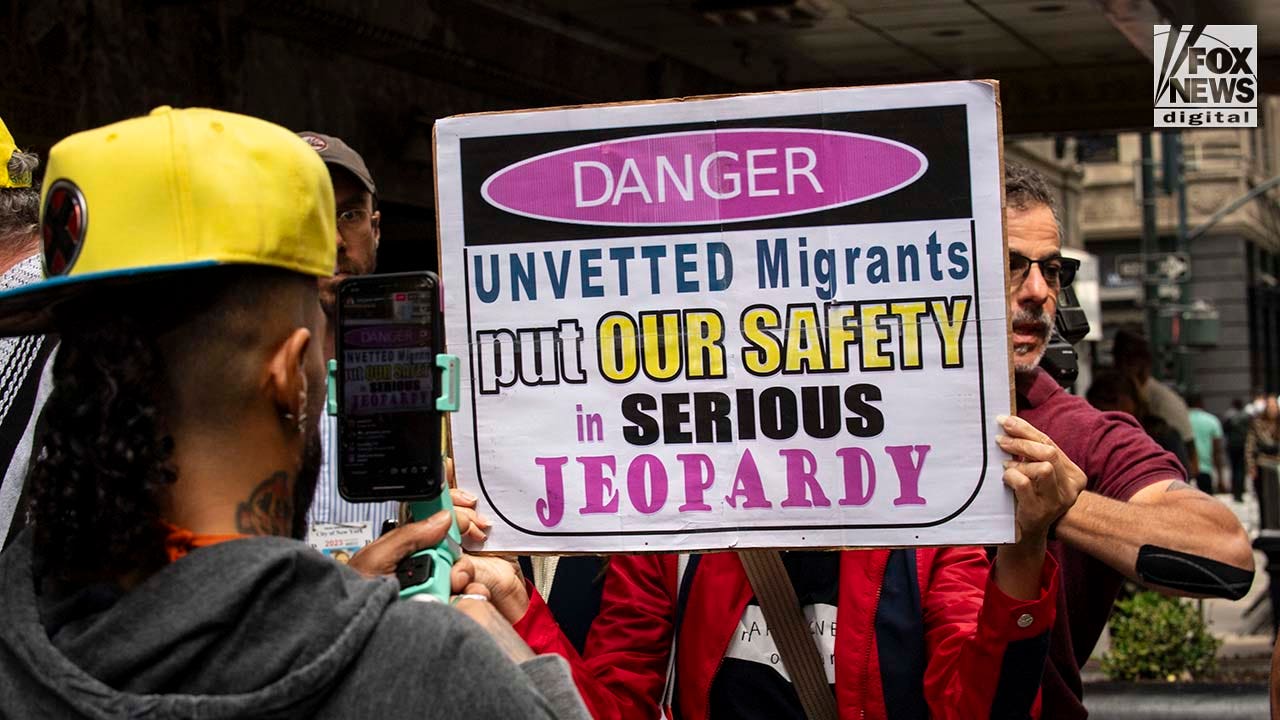
Staten Island residents and local leaders have attacked New York City’s attempts to shelter migrants in their neighborhoods. (Julia Bonavita/Fox News Digital)

Carr, a Republican, noted that it was unlikely the church could even be equipped to be converted into a shelter, insisting that Staten Island is not under any obligation to provide shelter for migrants.

“We should be talking about closing shelters, winding them down, not opening up new ones like the one that they intend to put behind us,” he said, indicating the church behind them.

Advertisement

“I’m not just against migrant shelters in my backyard,” Carr continued. “I’m against migrant shelters in everyone’s backyard.”

NYC RESIDENTS PROTEST ON STATEN ISLAND AS MIGRANT CRISIS WORSENS, CLAIM THEY ARE ‘NOT BEING VETTED’: REPORT

Speaking with Fox News Digital, Fossella said that Staten Island has frequently pushed back against some of New York City’s efforts to open more migrant shelters in their borough. For example, in September, a Staten Island judge ruled that a school being used to house migrants had to be vacated.

“From day one, we’ve been pretty clear that we feel that this policy is unsustainable. And clearly, it’s been unsustainable,” he said.

Fossella attacked New York City’s “right to shelter” mindset when it comes to welcoming migrants.

Advertisement

He further attacked the way New York City has been handling the migrant crisis over the past few years.

“Every day, people from all over the world come, and they roll the dice and once they cross the border, they are sent to wherever they want to go. And the unfortunate situation in New York City is the belief that’s wrong, that there’s this so-called ‘right to shelter’ that the city has an obligation to accommodate them, to put them up in hotels, to feed them, to give them mopeds, to give them iPhones. It’s wrong. It’s just not true,” Fossella said.

As of Monday night, Fossella stated that he had not yet heard back from the city.

Fox News Digital reached out to the New York City mayor’s office for a comment.

Advertisement

Read the full article from Here

Continue Reading
Click to comment

Leave a Reply

Your email address will not be published. Required fields are marked *

This site uses Akismet to reduce spam. Learn how your comment data is processed.

Vermont

9 Great Road Trips to Take in Vermont

Published

on

9 Great Road Trips to Take in Vermont


Vermont is packed with scenic roadways that cross the state’s small villages, ski resorts, mountain ranges, and the islands of Lake Champlain. Along the way, these drives connect historic landmarks such as the Arlington Covered Bridge and access to state parks, battlefields, and working farms. The routes also tie together the region’s cultural threads, from Revolutionary War sites near the Green Mountain National Forest to Robert Frost’s former home in Shaftsbury. These nine road trips capture both the landscape and heritage of Vermont.

Molly Stark Scenic Byway

Aerial view of Brattleboro, Vermont.

The Molly Stark Scenic Byway follows Route 9 for about 48 miles. Running east to west from Brattleboro to Bennington, this southern Vermont route is known for views of small towns, covered bridges, and mountain lakes. It passes through portions of the Green Mountain National Forest. The byway is named after Revolutionary War General John Stark’s wife, and the route generally follows the corridor associated with his 1777 march to the Battle of Bennington.

In Brattleboro, the Creamery Covered Bridge was originally built in 1879 and later reconstructed. It is closed to vehicle traffic but open to pedestrians. The Brattleboro Museum & Art Center holds exhibitions by regional and international artists. Molly Stark State Park in Wilmington includes a short hike up Mount Olga.

Lake Champlain Byway

Aerial view of Burlington, Vermont.

The Lake Champlain Byway stretches for about 184 miles in the northwest part of the state. It follows a network of routes including US 2, US 7, and several connecting state highways. Running north to south, the byway begins in Alburgh near the Canadian border, continues through Burlington and Vergennes, and ends in Orwell.

Following the shoreline of Lake Champlain, this drive runs near Alburgh Dunes State Park and Grand Isle State Park on an island in the middle of the lake. Vergennes Falls Park, on Otter Creek, has a boat launch and a scenic waterfall right in town.

Advertisement

Vermont Route 100

Gold Brook Covered Bridge in Stowe, Vermont.

Sometimes called the “Skier’s Highway” for its proximity to the state’s top ski resorts, Vermont Route 100 runs about 216 miles. It starts in the north near Newport and heads south to Stamford at the Massachusetts border, running north-south through much of central Vermont alongside the Green Mountain National Forest.

In Stowe, Stowe Mountain Resort and Smugglers’ Notch State Park offer outdoor recreation. Stowe is also home to the Gold Brook Covered Bridge, built around 1844 and still spanning Gold Brook. Next on the route in Plymouth, Coolidge State Park has rustic campsites and picnic areas near President Coolidge’s birthplace. Ludlow is another stop for skiers at Okemo Mountain Resort. In Weston, the Vermont Country Store sells gifts, apparel, and traditional New England goods such as maple syrup.

Green Mountain Byway

A scenic byway through rural Vermont.

At 71 miles long, the Green Mountain Byway follows the peaks and passes of the northern Green Mountains. It sits in the north-central part of the state and takes in views of forests and Vermont’s highest peak at Mount Mansfield. Following a combination of Routes 100, 100C, 108, 15, and 15A, the byway passes through towns such as Stowe and Hyde Park.

The Green River Reservoir State Park in Hyde Park covers about 5,500 acres and is well suited for paddling and swimming. Farther along, drivers can stretch their legs at Little River State Park or take a tour of the ice cream production line at the Ben & Jerry’s Factory in Waterbury.

Smugglers’ Notch

Curving road at Smugglers' Notch State Park, Vermont.
Curving road at Smugglers’ Notch State Park, Vermont.

Smugglers’ Notch, an approximately 3.5-mile stretch, sits within the larger Green Mountain Byway. It follows Route 108, a winding mountain road with rocky terrain and hairpin turns between Stowe Mountain Resort and Smugglers’ Notch Resort. The route was historically used for smuggling goods, particularly during the early 19th century Embargo period and later during Prohibition. This section of Route 108 is closed from late fall to mid-May due to unsafe road conditions.

Although short and seasonal, this stretch is good for fall leaf viewing and for warm-weather visits to the resorts. Both Stowe and Smugglers’ Notch offer spring and summer activities including hiking, climbing, and disc golf. Smugglers’ Notch State Park is part of the more than 44,000-acre Mount Mansfield State Forest, making it a useful pull-off for picnics and nature watching.

Stone Valley Scenic Byway

Aerial view of Manchester, Vermont.

Located on Route 30, on the southwestern side of the state, the Stone Valley Scenic Byway connects Poultney and Manchester and runs about 30 miles. It winds through Poultney, Wells, Pawlet, Rupert, and Dorset while passing historic landmarks and mountain peaks.

In Hubbardton, the Hubbardton Battlefield State Historic Site marks a 1777 Revolutionary War battle. Poultney’s Lake Saint Catherine State Park covers 117 acres and is set up for camping and swimming. In Manchester, the American Museum of Fly Fishing preserves the history of the sport through art, rod design, and antique gear.

Connecticut River National Byway

Connecticut River Byway from Mount Sugarloaf.
Connecticut River Byway from Mount Sugarloaf. Image credit: Wikimedia Commons.

The Connecticut River Byway runs about 500 miles in total across Massachusetts, New Hampshire, and Vermont. The Vermont portion follows Route 5 alongside Interstate 91 for roughly 250 miles along the Connecticut River. The route parallels the New Hampshire border and offers occasional views toward the White Mountains to the east and Vermont’s own hills to the west. This drive goes through St. Johnsbury, Windsor, and Bellows Falls before ending near the Massachusetts border.

In St. Johnsbury, the Fairbanks Museum and Planetarium holds a broad natural history collection. A section of the Appalachian Trail passes near Norwich, with trailheads accessible from the byway. In Weathersfield, Wilgus State Park sits right along the Connecticut River with camping, canoe access, and short woodland trails.

Advertisement

Crossroads of Vermont Byway

Hot air balloon inflating in Quechee, Vermont.

The Crossroads of Vermont Byway runs about 50 miles on Route 4. It starts in the center of the state and heads east from Rutland to Quechee near the New Hampshire border, passing through Killington, which has access to a section of the Appalachian Trail, and Woodstock.

In Killington, Gifford Woods State Park is a small 114-acre property near the base of the Killington and Pico peaks. Next on the route is Billings Farm & Museum, a working dairy farm and agricultural exhibit in Woodstock. The Simon Pearce restaurant and glassblowing flagship and the Vermont Institute of Natural Science are both in Quechee.

The Shires of Vermont Byway

Farm with red barn in Arlington, Vermont.

The Shires of Vermont Byway, historic Route 7A, spans about 33 miles between the Taconic and Green Mountains, close to the Batten Kill River. The roadway is named for the “shires,” or county seats. Bennington County has two of them, Manchester in the north and Bennington in the south. The route runs through Arlington and Shaftsbury in the southwestern part of the state.

In Arlington, the West Arlington Covered Bridge, built in 1852 and crossing the Batten Kill River, is one of Vermont’s older covered bridges. The Robert Frost Stone House Museum in Shaftsbury holds a collection of the poet’s works in the 18th-century stone house where he wrote many of his best-known poems. His gravesite is nearby in Old Bennington, at the First Congregational Church. The Bennington Battle Monument, completed in 1891, commemorates the Revolutionary War’s Battle of Bennington.

Exploring Vermont by Road

Vermont’s scenic drives cover both long cross-state journeys and shorter excursions. Some routes run through the Green Mountains and along Lake Champlain; others take in food-and-craft stops like the Ben & Jerry’s Factory or the Vermont Country Store. Many of these routes are located within driving distance of one another, and most are popular during fall foliage season.


Source link

Advertisement
Continue Reading

New York

Democrats Weigh Whether a Lawmaker’s Ethnicity Counts More Than Ideology

Published

on

Democrats Weigh Whether a Lawmaker’s Ethnicity Counts More Than Ideology

Outside a Sikh temple in the Little Punjab section of Queens, hundreds of people lined up around the block, waiting to receive plates of hot chickpea curry and deep-fried bhatura bread. It was the third Sunday in April, and the temple had prepared thousands of meals to celebrate the Indian harvest festival Vaisakhi.

Inside, the local assemblywoman, Jenifer Rajkumar, who had traded her signature red dress for one in harvest yellow, was working the crowd.

“Who here likes to have a Punjabi representative in office?” she asked the congregants, referring to herself. About half of them raised their hands.

Ms. Rajkumar registered faint disapproval. Everyone should raise their hands, she said, because “as a community, we have never been more powerful.”

She had a point. Last November, many of the people in the room had helped elect Zohran Mamdani as the first South Asian American to become the mayor of New York City. But as Ms. Rajkumar seeks another term in office, her race may test whether this community’s support of Mr. Mamdani was rooted more in identity or ideology.

Advertisement

Her Democratic primary opponent, David Orkin, is a democratic socialist who is also courting the mayor’s supporters, and earlier that afternoon, he had also visited the temple. He was accompanied by an entourage of progressive South Asian volunteers who helped to ingratiate him with the local community.

Ms. Rajkumar, who had brought her mother along, gave an impassioned speech; Mr. Orkin helped make the festival’s bread.

The June primary contest has grown fractious, with each candidate accusing the other of election fraud and Mr. Orkin recently suing to kick Ms. Rajkumar off the ballot. The primary may also be a measure of the Democratic Socialists of America’s growing momentum in New York.

Mr. Orkin is the first Democrat to primary Ms. Rajkumar, the incumbent, since she won her seat in 2020, when she and Mr. Mamdani made history as the first South Asian Americans elected to the State Assembly.

But this year, the same progressive South Asian and Indo-Caribbean networks that helped elect Mr. Mamdani as mayor are trying to rally an energized South Asian electorate around Mr. Orkin, potentially dividing voters in Queens who might otherwise gravitate toward backing Ms. Rajkumar.

Advertisement

Mr. Orkin, an anti-Zionist Jew, has now become a familiar figure at South Asian temples and community events in Queens, being squired about by members of DRUM Beats, the political arm of Desis Rising Up & Moving, and the newly formed Hindus for Human Rights Action.

“During Ramadan I probably went to like eight iftars,” Mr. Orkin said. “Every Friday, I’m going to masjid and doing jummah prayer, and then I think we’re gonna get into a practice of, every Sunday, going to a gurudwara.”

Andrew Singh, an Indo-Caribbean DRUM Beats organizer who lives around the block from Ms. Rajkumar’s office, spends much of his free time phone-banking for Mr. Orkin and introducing him to congregants at local temples, so as to “not let the identity politics get in the way,” he said.

Ms. Rajkumar is running on more than her identity. She came to office after serving as the state’s first director of immigration affairs under Gov. Andrew M. Cuomo, where she created a $31 million fund to provide legal services for immigrants.

As a second-term lawmaker, she successfully championed legislation in 2023 that made Diwali — a festival observed by Hindus, Sikhs, Jains and Buddhists — a public school holiday in New York, an achievement noted by many people interviewed for this article.

Advertisement

More recently, Ms. Rajkumar gained broader attention for her frequent and often perplexing appearances at news conferences and events held by Eric Adams, Mr. Mamdani’s predecessor as mayor. She also unsuccessfully ran for public advocate last year, losing to the incumbent, Jumaane Williams, by more than 50 percentage points in the Democratic primary.

Ms. Rajkumar has always said that her Indian parents’ rags-to-riches journey was what inspired her to work in government. Her family was one of millions that had been dispossessed during the 1947 Partition of India, and her parents, both doctors, “came to America with $300 and a suitcase.”

Her back story, as well as her work in the Legislature, has earned the respect and continued support from members of the Bangladeshi American Society, including many who also backed Mr. Mamdani’s mayoral candidacy.

“The vote that we did with Mamdani is totally different,” explained Mohammad Ali, the head of the Bangladeshi American Society. He and a dozen other local leaders who have supported Ms. Rajkumar said that they voted for Mr. Mamdani not because of his socialist platform, but, at least in part, because they felt they knew him.

Mr. Ali characterized Ms. Rajkumar as “a true friend to our community.”

Advertisement

But her track record has failed to impress DRUM Beats, whose leaders say she has not meaningfully delivered for her working-class constituents.

“Vast parts of the community know that she is just like every other politician,” said Simran Thind, a Punjabi organizer who recently took Mr. Okrin to two Sikh temples during Vaisakhi. “She shows up, she says a few words in our language and she leaves.”

The organization’s executive director, Fahd Ahmed, said that, early on, it had been willing to try to work with Ms. Rajkumar. Then the assemblywoman formed a close alliance with Mr. Adams, and any hope that they could reconcile their differences evaporated.

“It just reinforced what we were already assessing her to be: pro-police, pro-real estate, pro-corporation, highly focused on personal relationships,” Mr. Ahmed said.

Ms. Rajkumar defended her relationship with Mr. Adams, saying that she “got to be involved in every single issue in this city,” adding, “everyone saw me everywhere.”

Advertisement

It was also a practical calculation, she said, allowing her to “deliver for my constituents in ways they had never been delivered for before,” like making Diwali a school holiday. She compared her appearances with Mr. Adams to Mr. Mamdani’s visits to the Trump White House.

Some left-leaning groups remain dubious.

In March, Mr. Orkin, 34, met with progressive organizers at Saar Indian restaurant in Midtown Manhattan, where he chatted over masala coated canapés and happily accepted the endorsement of Hindus for Human Rights Action.

The posters decorating the walls of the restaurant championed “A Free Palestine,” but the Hindu group, which has modeled itself after Jewish Voice for Peace Action, aims to fight right-wing Hindu nationalism in the Indian diaspora.

The group’s political director, Ria Chakrabarty, explained that its decision to endorse Mr. Orkin was motivated by its distrust of Ms. Rajkumar. Since 2020, Ms. Rajkumar has been accused — including by Mr. Mamdani — of welcoming right-wing Hindu nationalist ideology into her orbit, by accepting campaign donations from people and groups supportive of India’s Prime Minister Narendra Modi. (Ms. Rajkumar and the Coalition of Hindus of North America have characterized those accusations as discriminatory for singling out the Hindu donors of a Hindu politician.)

Advertisement

“Five years ago, she might not have been as unpalatable,” Ms. Chakrabarty said. “But this is, for us, a moment of real clarity.”

When Mr. Orkin addressed the gathering that night at Saar, he acknowledged the seeming incongruity of his own presence.

“Probably to some of you I am just a random white guy,” he said. But as a longstanding member of Jewish Voice for Peace, he said he was also someone who could understand the perspective of the progressive Hindus and noted the importance of “speaking out against Hindu nationalism and its very obvious connections to Zionism.”

A resident of Ridgewood, in the district’s more liberal northern enclave, Mr. Orkin spent the last three years working as a staff attorney at the immigrant-advocacy nonprofit Make the Road New York. He is openly gay, Jewish, Mexican on his mother’s side, and speaks fluent Spanish. He got the idea to run for office last July, after campaigning for Mr. Mamdani, and his background was appealing enough to DRUM Beats that the group endorsed him on Day 1 of his campaign.

Amit Pratap Shah, a leader of the Ridgewood Nepalese Society, said that “at a very grass-roots level, when it comes to support, we have to first look at who can be the best candidate for our community.” He said that he voted for Mr. Mamdani and supported Ms. Rajkumar, but added that his Nepali cultural center welcomes diverse voices and “it’s up to our community members to decide what they want to support.”

Advertisement

At the moment, Mr. Shah said, he thought that Ms. Rajkumar was the favorite because “people know her.” Then he reconsidered. Mr. Orkin, he allowed, “also visited our community center.”

Continue Reading

Boston, MA

Buffalo visits Boston with 2-1 series lead

Published

on

Buffalo visits Boston with 2-1 series lead


Buffalo Sabres (50-23-9, in the Atlantic Division) vs. Boston Bruins (45-27-10, in the Atlantic Division)

Boston; Sunday, 2 p.m. EDT

LINE: Bruins -115, Sabres -105; over/under is 6

NHL PLAYOFFS FIRST ROUND: Sabres lead series 2-1

Advertisement

BOTTOM LINE: The Buffalo Sabres visit the Boston Bruins in the first round of the NHL Playoffs with a 2-1 lead in the series. The teams meet Thursday for the eighth time this season. The Sabres won 3-1 in the last meeting.

Boston has a 45-27-10 record overall and a 12-14-3 record in Atlantic Division games. The Bruins rank second in league play serving 11.9 penalty minutes per game.

Buffalo has a 50-23-9 record overall and an 18-7-4 record in Atlantic Division play. The Sabres have a 46-4-8 record when scoring three or more goals.

TOP PERFORMERS: Morgan Geekie has 39 goals and 29 assists for the Bruins. Mark Kastelic has three goals and one assist over the last 10 games.

Rasmus Dahlin has 19 goals and 55 assists for the Sabres. Alex Tuch has scored six goals and added four assists over the last 10 games.

Advertisement

LAST 10 GAMES: Bruins: 3-5-2, averaging 2.4 goals, 4.5 assists, 4.4 penalties and 10.7 penalty minutes while giving up 2.3 goals per game.

Sabres: 6-3-1, averaging 3.4 goals, 5.7 assists, 5.3 penalties and 14.4 penalty minutes while giving up 2.5 goals per game.

INJURIES: Bruins: None listed.

Sabres: Jiri Kulich: out for season (ear), Sam Carrick: out (arm), Josh Norris: day to day (undisclosed), Justin Danforth: out for season (kneecap).

___

Advertisement

The Associated Press created this story using technology provided by Data Skrive and data from Sportradar.


Source link

Continue Reading
Advertisement

Trending

